Spreadsheets can work for small payrolls, but they become harder to manage when salary calculations, leave deductions, advances, tax, PF, CIT, SSF, payslips, and reports all need to stay accurate. A single missed update can affect an employee's salary, deductions, or payroll records. Understanding how each payroll deduction in Nepal is calculated and applied can help HR teams identify where manual processes are most likely to break down.
Payroll software helps HR teams automate salary calculations, manage employee deductions, generate payslips, and keep payroll records organized. For businesses in Nepal, however, the right payroll software should also support local tax and payroll requirements rather than simply handling basic salary calculations.
This guide compares the top 5 payroll software options for HR teams in Nepal, focusing on payroll features, Nepal-specific requirements, ease of use, and pricing where publicly available.
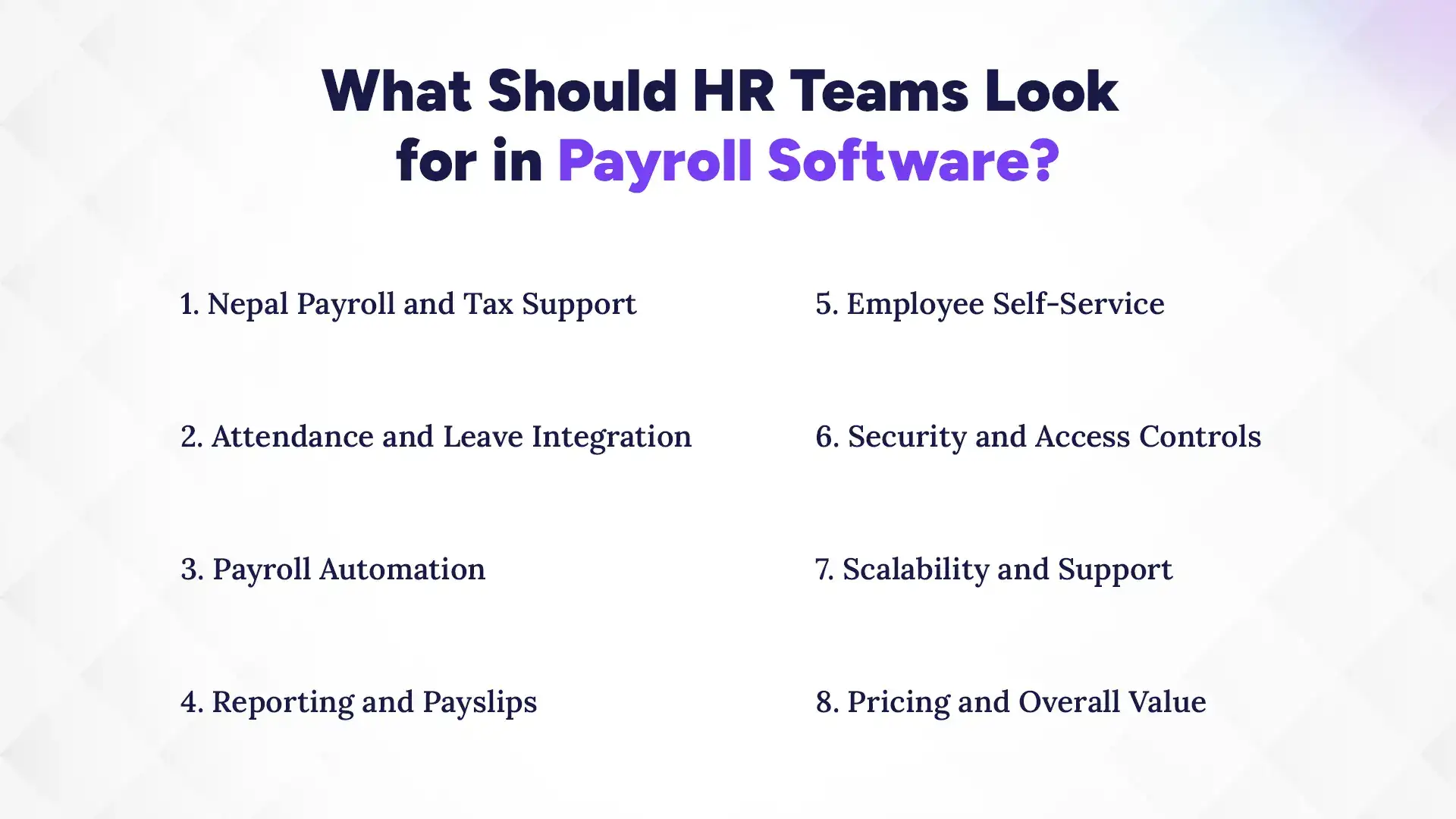
What Should HR Teams Look for in Payroll Software?
HR teams should evaluate payroll software based on Nepal-specific tax and payroll support, salary and deduction calculations, attendance and leave integration, reporting, and employee self-service, security, usability, support, scalability, and overall cost. Before comparing payroll software, it helps to establish the criteria that matter most for HR teams in Nepal. The best option is not simply the one with the most features; it should fit your payroll process, handle local requirements accurately, reduce manual work, and remain practical as your organization grows.
1. Nepal Payroll and Tax Support
The software should support Nepal's payroll requirements, including income tax calculations, PF, CIT, SSF, deductions, and applicable reporting. This is especially important when tax rates or payroll rules change between fiscal years.
2. Attendance and Leave Integration
Payroll should connect with attendance and leave data where possible. This can reduce manual calculations for working days, overtime, leave deductions, and other salary adjustments. When payroll connects directly to a leave management software, HR teams don't have to manually transfer leave balances or absence data before each pay run.
3. Payroll Automation
Look for software that automates recurring payroll tasks such as salary calculations, deductions, tax calculations, and payroll processing. Automation can reduce repetitive data entry and help minimize calculation errors.
4. Reporting and Payslips
Look for software that automates recurring payroll tasks such as salary calculations, deductions, tax calculations, and payroll processing. Automation can reduce repetitive data entry and help minimize calculation errors. For businesses still running payroll manually, switching to automated payroll software can eliminate many of these repetitive tasks entirely.
5. Employee Self-Service
Employee self-service features can reduce routine HR queries by allowing employees to access payslips, leave information, attendance records, and relevant personal details directly.
6. Security and Access Controls
Payroll data contains sensitive employee and salary information, so security should be part of the evaluation. Look for role-based access, secure authentication, controlled data access, backups, and other appropriate security measures.
7. Scalability and Support
The software should continue to work effectively as your employee count, branches, and payroll complexity increase. Reliable vendor support, onboarding, training, and timely assistance are also important when payroll issues need to be resolved quickly.
8. Pricing and Overall Value
Compare the total cost rather than looking only at the advertised subscription price. Consider user or employee limits, implementation costs, additional modules, support, integrations, and other charges when assessing the overall value.
Insights
Did You Know?
Payroll software can automate salary calculations, tax deductions, SSF, and payslips, helping HR teams reduce repetitive manual work. Pace HRMS brings these payroll processes together in one platform.
What are the Top 5 Most Popular Payroll Software in Nepal?
The most renowned payroll software options in Nepal differ in their strengths, target users, and overall approach to payroll management. Pace HRMS is often well-praised for its 100% payroll accuracy, autoamted payslip generation, and configurable salary deductions. The table below gives a quick comparison of five options based on their best use case, key strengths, and general pricing approach before we look at each software in more detail.
Software
Best For
Key Strength
Pricing Approach
Pace HRMS
Integrated HR and payroll
Nepal-focused payroll with attendance, leave, and biometric integration
Custom, based on team size and modules
Pedal1
Growing SMEs and distributed teams
Automated payroll with biometric, geolocation, and cloud-based HR management
Published plans
HajirHR
Attendance-linked payroll
Mobile and biometric attendance with payroll integration
Published per-seat rates
RigoHR
Approval-controlled payroll
Maker-checker workflows, approvals, and audit trails
Published per-employee tiers
Nimble HRMS
Broader HR management
End-to-end HR management from recruitment to employee exit
Custom, quote-based
1. Pace HRMS
Pace HRMS is an integrated HRMS designed for businesses in Nepal that want to manage payroll alongside attendance, leave, employee records, and other HR processes. Instead of treating payroll as a separate function, Pace HRMS connects salary processing with the employee data HR teams already manage.
Pace HRMS supports employee salary and compensation management, automated payroll processing, attendance and leave integration, tax and statutory deductions, PF, CIT, SSF, overtime, allowances, bonuses, payslips, payroll reports, and employee self-service.
For Nepali businesses, its focus on local payroll requirements makes it relevant for teams managing tax, PF, CIT, SSF, payslips, and payroll reporting as part of their regular HR operations. Connecting these processes in one system can also reduce repetitive data entry and the need to maintain employee information across separate tools. Before you commit, ask for payroll report samples and eTDS support details during the demo.
2. Pedal1
Pedal1 is a cloud-based HR software that combines payroll, attendance, leave management, employee records, and employee self-service in one platform. It helps businesses reduce manual HR work and keep employee information organized.
Its features include payroll processing, biometric attendance, geolocation tracking, shift management, reimbursements, and digital payslips. This makes Pedal1 a practical option for businesses managing office, field, or remote employees.
HajirHR is a Nepal-focused HRMS that combines payroll with attendance, leave, employee management, and employee self-service. It also supports mobile and biometric attendance for different workforce environments.
Its payroll capabilities include salary management, attendance and leave, PF, CIT, SSF, and TDS-related functionality, payslips, reports, employee self-service, and mobile and biometric attendance. It's worth verifying PF, CIT, SSF, and eTDS handling directly during a demo, since HajirHR's strongest documented strength is attendance, and payroll compliance depth deserves a closer look.
4. RigoHR
RigoHR is an HRMS and payroll platform that combines salary management with attendance, leave, employee records, and other HR functions. Its approval workflows and audit trails make it particularly relevant for teams that require greater payroll oversight.
RigoHR supports payroll and salary management, tax and statutory deductions, attendance and leave integration, payroll reports, employee self-service, and approval controls such as maker-checker workflows and audit trails. For organizations where payroll accuracy directly affects financial reporting, having clear payroll visibility across HR and finance departments can make approval workflows more effective regardless of which system you choose.
5. Nimble HRMS
Nimble HRMS is a broader HR platform covering payroll, employee management, attendance, leave, recruitment, and performance management. It brings multiple HR processes together within one system.
Its payroll functionality includes salary processing, tax and statutory deductions, PF, CIT and SSF-related functionality, attendance, overtime, payroll reports, and employee self-service. Check how long implementation typically takes and whether a lighter plan exists, since its broader HR lifecycle scope may be more than you need if payroll is the only immediate priority. Teams that only need payroll right now but may want to expand later should understand the different types of HR software available before committing to a full-scope HRMS.
Which Payroll Software Should Your HR Team Choose?
There is no single payroll system that fits every HR team. The right choice depends on workforce size, payroll complexity, and how much setup support your team needs.
Pace HRMS is worth prioritizing if you want payroll unified with attendance, leave, and employee records in one locally supported system. NepalHRM fits best if transparent, published pricing and a free plan for smaller teams matter most. HajirHR is the stronger fit if attendance tracking and mobile or biometric access are your daily priority. RigoHR makes sense for teams that need approval controls and audit trails before payroll runs. Nimble HRMS suits businesses that want payroll bundled inside a broader HR lifecycle system and are comfortable with quote-based pricing.
For most HR teams, the deciding factor comes down to whether payroll needs to stand alone or connect closely with attendance, leave, and the rest of HR operations. The difference between using standalone payroll software versus a full HRMS often becomes apparent once the team starts managing attendance, leave, and employee records alongside salary processing.
Why Nepal Payroll Needs Local Support
Payroll in Nepal involves more than calculating monthly salaries. HR and finance teams also need to manage local contributions, tax rules, deductions, and reporting requirements as part of the payroll process.
PF (Provident Fund): Employee and employer contributions need to be calculated and recorded correctly.
CIT (Citizen Investment Trust): Employee contributions may be considered when calculating taxable income, subject to applicable rules.
SSF (Social Security Fund): SSF follows its own contribution structure and needs to be handled separately from PF and other deductions. Understanding how SSF contributions work in Nepal can help HR teams set up the correct withholding structure from the start.
Income tax slabs: Nepal uses progressive income tax slabs rather than a single flat rate. See our [salary tax slab guide] for the current structure.
eTDS reporting: Payroll teams need accurate TDS records for required Inland Revenue Department reporting.
For Nepali businesses, these requirements make local payroll support particularly important. A Nepal-focused payroll system can build these requirements into the regular salary workflow instead of leaving HR teams to manage them through separate calculations or manual processes.
Common Mistakes When Choosing Payroll Software
Choosing payroll software based only on features or price can create problems later. HR teams should avoid these common mistakes:
Choosing Based Only on Price: The cheapest option may not provide the payroll features, support, or compliance capabilities your team needs.
Assuming Every HRMS Handles Nepal Payroll the Same Way: Check how the software handles tax, PF, CIT, SSF, and eTDS requirements.
Ignoring Attendance and Leave Integration: Manual transfer of attendance and leave data can reduce the benefits of payroll automation.
Not Testing With Real Employee Data: Test realistic salary, deduction, attendance, and leave scenarios before choosing a system.
Overlooking Reporting Requirements: Make sure the software can generate the payroll and tax reports your HR and finance teams need.
Failing to Check Support and Implementation: Consider the vendor's onboarding, training, and ongoing support before making a decision.
Ready to Simplify Payroll?
Automate salary calculations, tax deductions, SSF, payslips, and payroll reports with Pace HRMS.
Choosing the right payroll software depends on more than the number of features or the lowest cost. HR teams in Nepal should look for a system that can handle local payroll requirements, connect with attendance and leave, reduce manual work, and support the business as it grows.
Among the options compared, Pace HRMS stands out as an integrated HR and payroll solution that brings salary processing, employee records, attendance, leave, and Nepal-specific payroll requirements together in one system. Explore Pace HRMS Software to see how it connects payroll with the rest of your HR operations, or request a demo to evaluate how it fits your team's needs.
FAQs
What is the best payroll software in Nepal?
+
Pace HRMS is a leading payroll software in Nepal for businesses that want payroll, attendance, leave, and employee records managed in one system.
How much does payroll software cost in Nepal?
+
Payroll software costs vary by vendor, employee count, and features. Some providers charge per employee, while others offer fixed or quote-based pricing.
Does payroll software support Nepal's tax and statutory deductions?
+
Most Nepal-focused payroll software supports deductions such as PF, CIT, SSF, and tax calculations, although the level of automation can vary by provider.
Can payroll software integrate attendance and leave?
+
Yes. Payroll software can connect attendance and leave records directly with salary calculations, reducing manual data entry and payroll errors.
Is payroll software suitable for multi-branch businesses?
+
Yes. Many payroll systems support multiple branches and allow businesses to manage employee and payroll data from a centralized platform.
Can employees access their payslips through payroll software?
+
Yes. Many payroll systems provide employee self-service access, allowing employees to view and download their payslips.
What should I ask a vendor before committing to payroll software?
+
Ask about Nepal-specific compliance features, payroll automation, report availability, implementation costs, customer support, and total pricing before making a decision.
Ready to get started?
Book a 30-minute consultation call, and let's talk about your goals.