Managing payroll in Nepal shouldn't feel like a high-stakes guessing game every month. For business owners and HR teams, manually calculating Tax Deducted at Source (TDS), tracking Social Security Fund (SSF) contributions, and staying compliant with the Labor Act 2017 can quickly turn into a spreadsheet nightmare. A single mathematical slip or a missed update from the Inland Revenue Department (IRD) can lead to unexpected legal penalties, payroll delays, and unhappy employees.
The secret to stress-free payroll lies in understanding how to turn complex local labor laws into a simple, step-by-step formula. In this practical guide, we will break down exactly how payroll deductions work in Nepal, how to calculate them accurately, and how to structure your system so you achieve flawless compliance and complete financial transparency on every single payslip.
What Are Payroll Deductions?
Payroll deductions are specific amounts taken out of an employee's total monthly earnings by their employer to pay for taxes, mandatory retirement funds, or voluntary benefits. These withheld amounts are processed directly from the source during each pay cycle to ensure all financial obligations are met before the worker is paid. This system transforms an individual's total earned salary into their actual liquid take-home pay.
Why Are Payroll Deductions Important?
Payroll deductions play a vital role in maintaining legal compliance and ensuring employees receive accurate salaries. They also help employers manage taxes, social security contributions, and other mandatory deductions efficiently.
Ensure legal compliance with Nepal's tax and labor regulations.
Prevent legal penalties by deducting and remitting taxes and contributions correctly.
Guarantee accurate employee pay by calculating deductions before salary is disbursed.
Support SSF and retirement benefits through regular Social Security contributions.
Reduce the risk of government audits by maintaining accurate payroll records.
Promote financial transparency with clear salary and deduction records.
Build employee trust through consistent and error-free payroll processing.
Simplify payroll management by automating mandatory salary deductions.
Insights
Did You Know?
Payroll deductions can vary based on an employee's salary, tax obligations, and applicable contributions. Pace HRMS helps automate payroll calculations and deductions to reduce manual work.
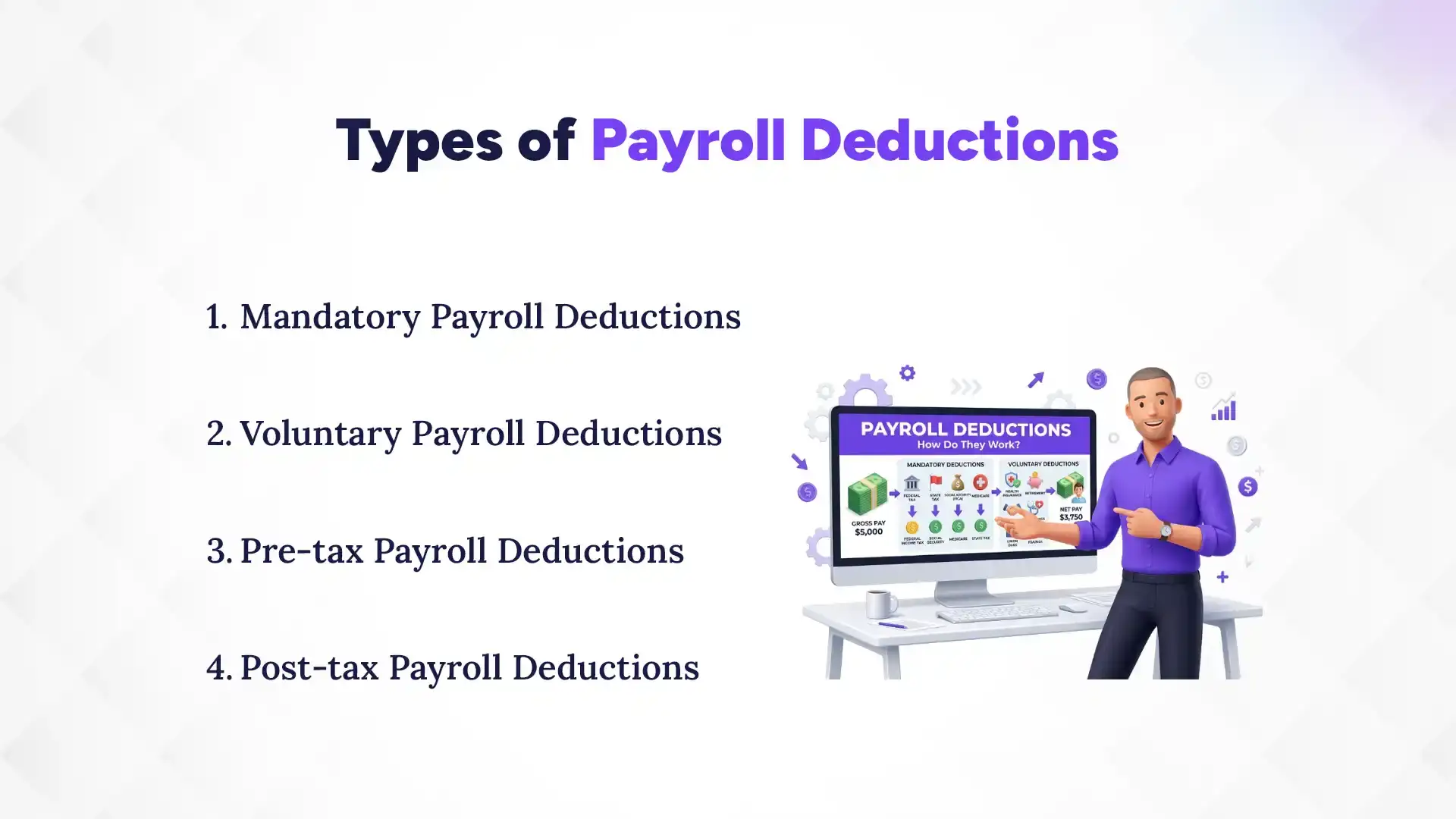
Types of Payroll Deductions
Payroll deductions are categorized into distinct types based on whether they are legally required, chosen voluntarily, or processed before or after taxes are calculated. Understanding these categories helps employers structure their payroll engine to apply withholdings in the correct chronological order. Properly classifying each item protects the business from tax compliance audits and ensures employees understand their pay slip details.
1. Mandatory Payroll Deductions
Government regulations dictate that employers must withhold specific legal contributions, like the 11% Social Security Fund (SSF) allocation, directly from an employee's basic salary. This compulsory withholding ensures your business complies with national labor laws and avoids expensive statutory penalties. Teams must track these updates monthly because missing a change can trigger automated fines from the Inland Revenue Department. I always recommend auditing these mandatory settings at the start of every fiscal year to verify accuracy.
2. Voluntary Payroll Deductions
Employees can choose to authorize extra fund withholdings, such as additional retirement deposits or group medical insurance top-ups, to improve their financial security. Employers only process these deductions after receiving a signed, written request from the staff member. This method allows workers to customize their corporate benefits package while leveraging company-negotiated group rates. You must maintain clear digital records of these consent forms to protect the organization during internal audits.
3. Pre-Tax Payroll Deductions
Pre-tax deductions are specific allocations taken out of gross earnings before the payroll system calculates an employee's monthly income tax liability. Processing items like the Citizen Investment Trust (CIT) at this stage lowers the worker's total taxable income base. This legal tax-shielding mechanism saves the employee money while promoting long-term savings habits. HR managers must cross-reference the maximum statutory caps to prevent taking out more than the allowed legal limits.
4. Post-Tax Payroll Deductions
Post-tax deductions are amounts subtracted from what remains after all income taxes have already been assessed and withheld from the monthly pay. Typical examples include recovering temporary festival advances, cell phone cost overages, or internal corporate loan installments. Because these deductions do not reduce tax obligations, you must process them at the very end of the calculation workflow. Tracking these balances separately ensures your core financial ledgers remain perfectly balanced before bank transfers occur.
Managing payroll inside Nepal requires processing specific local funds, savings vehicles, and tax structures dictated by national legislation.
Deduction Type
Governing Authority
Standard Employee Rate
Basis of Calculation
Income Tax (TDS)
Inland Revenue Department (IRD)
Progressive (1%–36%)
Total Taxable Annual Income
Social Security Fund (SSF)
Ministry of Labor, Employment & Social Security
11%
Basic Monthly Salary
Provident Fund (PF)
Employees' Provident Fund (Karmachari Sanchaya Kosh)
10% (For non-SSF old schemes)
Basic Monthly Salary
Citizen Investment Trust (CIT)
Citizen Investment Trust Board
Voluntary (Up to 1/3 of income or applicable limits)
Gross Monthly Salary Base
1. Income Tax (TDS)
Employers act as primary withholding agents for the state, calculating an employee's projected annual income tax liability and deducting one-twelfth of that amount each month. The calculation follows progressive tax slabs starting at a baseline 1% social security tax for initial income brackets, scaling up to 36% for top-tier earners. This deduction requires continuous tracking of marital status choices, medical tax credits, and changing remote area allowances to prevent year-end compliance mismatches.
2. Social Security Fund (SSF) Contributions
The Contribution-Based Social Security Act has made SSF registration completely mandatory across the formal private sector, completely reshaping how modern benefits are structured. The employee's individual share is fixed at exactly 11% of their basic salary, which the employer combines with a 20% corporate contribution to create a total 31% monthly deposit. This single combined withholding automatically distributes funds into specialized national accounts covering medical, accident, dependent family protection, and retirement pension schemes.
3. Citizen Investment Trust (CIT)
The Citizen Investment Trust operates as an incredibly popular voluntary savings vehicle designed to help Nepalese professionals build long-term wealth while optimizing their current tax burdens. Employees can legally route up to one-third of their total assessable income or a maximum cap of NPR 300,000 annually into this government-backed fund. This deduction must be processed before the monthly income tax calculations run, acting as an eligible reduction that drops the worker into a lower effective tax slab.
4. Provident Fund (PF)
For traditional organizations operating outside the modern integrated SSF platform, the standard Employees' Provident Fund (Karmachari Sanchaya Kosh) framework dictates a mandatory 10% employee salary deduction. The employing business matches this 10% contribution exactly, remitting the total 20% pool to the state treasury every single month. Tracking this legacy mechanism accurately is vital, as companies transitioning toward the SSF framework must carefully manage how old PF balances are frozen or integrated.
5. Loan Repayments
Many prominent corporate entities throughout Nepal provide institutional loans to their workers for major life milestones, including home construction, vehicle purchases, or family medical emergencies. The recurring monthly installments for these internal loans must be recovered smoothly via post-tax payroll deductions based on signed amortization schedules. Payroll administrators must balance these deductions carefully to ensure that the workers' take-home pay never drops below the survival minimums outlined in national labor regulations.
6. Insurance Premiums
Under current Nepalese labor laws, organizations must arrange active medical and accidental insurance policies for their workforce, with medical premiums frequently split 50:50 between the firm and the worker. The employee's half of the insurance premium is managed via a regular payroll deduction, which qualifies for a dedicated income tax exemption of up to NPR 40,000 annually. Ensuring that these deductions align with active insurance provider invoices protects employees from facing unexpected policy lapses.
7. Salary Advances
Issuing mid-month salary advances or early cash payouts during major national celebrations like Dashain and Tihar is a deeply ingrained cultural and professional practice across Nepal. These short-term financial advances are not classified as permanent income adjustments, meaning they must be systematically recovered during the subsequent primary payroll cycle. The exact advanced sum is subtracted as a flat, post-tax deduction, completely neutralizing the temporary internal corporate debt balance.
8. Other Employer-Specific Deductions
Enterprises often implement customized internal deduction schemes to cover specialized, localized costs, such as shared daily corporate transport, subsidized staff cafeteria meal plans, or uniform allocations. These specific deductions require unambiguous, signed consent clauses within individual employment contracts to protect the organization from unexpected regulatory disputes. Each custom category must be carefully mapped in the accounting ledger to ensure these internal collections do not inadvertently skew statutory tax reporting data.
Make Payroll Deductions Easier
Automate salary calculations, tax deductions, SSF, and payroll processing with Pace HRMS.
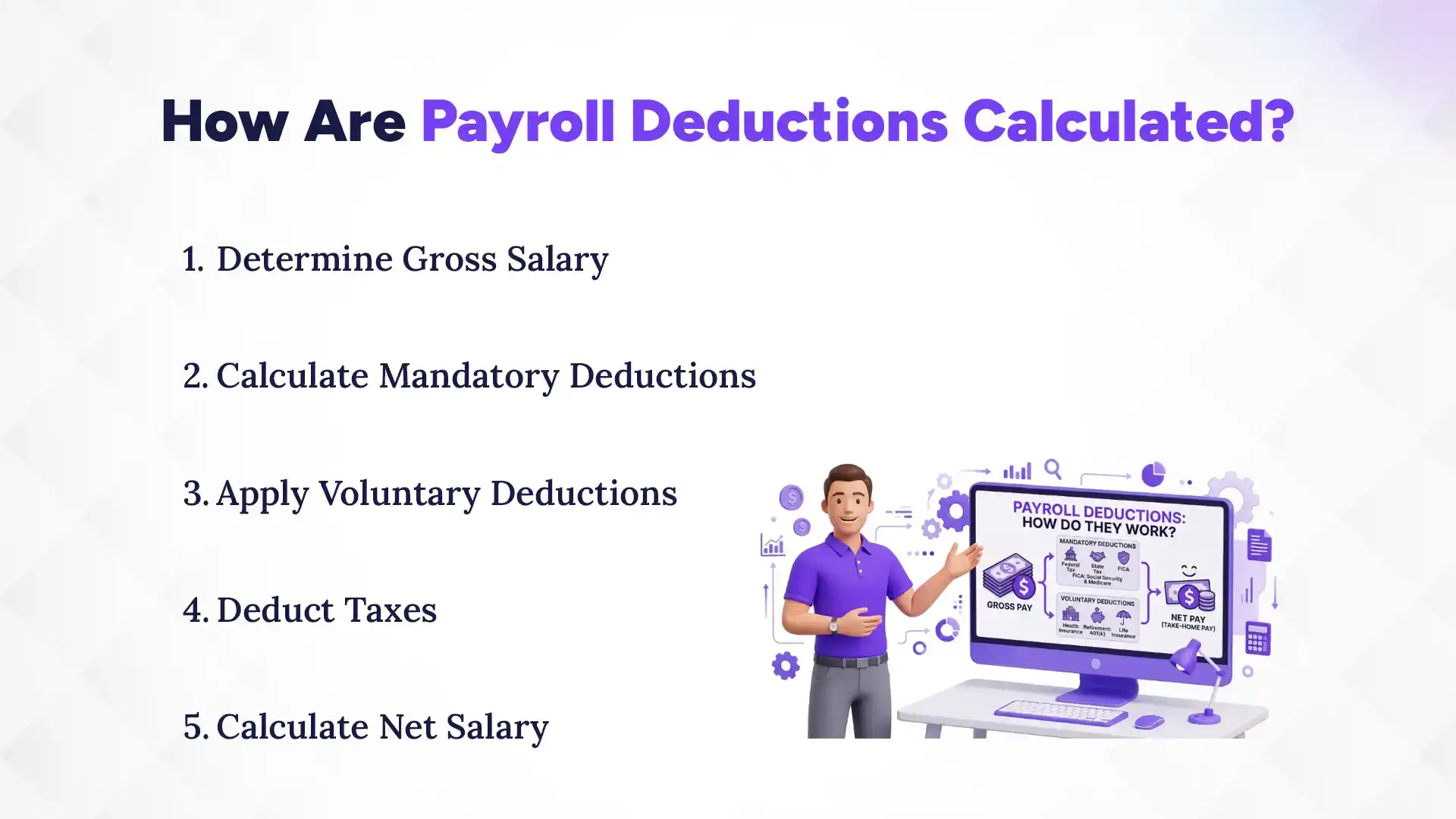
Payroll deductions are calculated by subtracting mandatory social funds and voluntary pre-tax contributions from an employee's gross salary, applying progressive income tax slabs to the remaining taxable balance, and then removing any final post-tax liabilities. This step-by-step subtraction workflow ensures that statutory retirement funds drop the employee's taxable income footprint before tax is assessed. The remaining balance after all legal, tax, and internal adjustments represents the exact net take-home pay.
1. Determine Gross Salary
Collate the basic monthly salary, all recurring allowances (such as housing, dearness, and fuel), transport stipends, and any overtime or performance bonuses earned. This combined calculation forms the absolute financial baseline for the entire payroll processing sequence.
2. Calculate Mandatory Deductions
Compute the mandatory 11% employee Social Security Fund (SSF) contribution based purely on the basic salary component, completely ignoring any non-basic allowances. Ensure this calculated value is set aside securely to serve as your primary pre-tax retirement deduction.
3. Apply Voluntary Deductions
Subtract approved voluntary pre-tax deductions, including employee-requested Citizen Investment Trust (CIT) transfers or certified corporate medical insurance premium shares. Verify that these combined voluntary figures strictly abide by the maximum statutory caps permitted by the Inland Revenue Department.
4. Deduct Taxes
Project the annual assessable income based on current monthly figures, apply the corresponding progressive Nepalese income tax slabs, and determine the exact monthly TDS requirement. Deduct this calculated income tax sum from the remaining pre-tax salary balance.
5. Calculate Net Salary
Subtract any remaining post-tax deductions, such as internal corporate loan repayments, advanced salary recoveries, or misconduct fines, from the post-tax balance. The final resulting figure represents the clean net salary to be transferred to the worker's bank account.
Legal Requirements for Payroll Deductions in Nepal
The entire payroll landscape in Nepal is governed by intersecting statutory laws, making an explicit understanding of these regulatory frameworks vital for any running business.
The Labor Act 2017 establishes absolute protection over worker wages, making it entirely illegal for an enterprise to execute arbitrary salary deductions without clear, documented legal justification. Deductions are strictly confined to authorized statutory funds, explicit court-issued garnishment orders, or specific instances where a worker has caused proven, quantifiable financial damage to corporate property. Furthermore, the act mandates that employers must pay salaries within seven days of the payroll cycle's conclusion, complete with an itemized, clear breakdown of all deductions.
The Income Tax Act 2058 imposes strict legal duties on employers acting as withholding agents, requiring them to calculate and submit accurate TDS amounts by the 25th day of the following Nepalese month. Simultaneously, modern Social Security Fund regulations mandate that the combined 31% SSF contribution must be uploaded and deposited via the online portal within 15 days of the month-end. Failing to meet these strict timelines triggers immediate automated interest penalties and leaves corporate directors personally liable to legal prosecution by the state.
How Payroll Software Simplifies Payroll Deductions
Payroll software simplifies payroll deductions by automatically calculating statutory social funds, adjusting for shifting tax brackets, and generating itemized digital payslips with a single click. By moving away from manual spreadsheets, the software eliminates human calculation errors while instantly matching the latest government compliance directives. This automation saves human resource teams hours of manual administrative labor each month while protecting the business from expensive filing penalties.
Conclusion
Managing payroll deductions in Nepal demands absolute precision, a deep understanding of evolving tax slabs, and strict adherence to intersecting labor laws. The era of tracking deductions across fragmented manual spreadsheets is quickly drawing to a close, as modern regulatory systems like the SSF and IRD digital portals demand flawless, instant reporting accuracy. Prioritizing clear automation, transparent communication, and ironclad legal compliance on every payslip protects your enterprise from costly penalties while fostering an organizational culture of deep professional trust.
Discover how Pace Infosys simplifies complex statutory compliance, automates local tax calculations, and secures your monthly workflows with our industry-leading payroll software solutions built explicitly for the Nepalese market
FAQs
What are payroll deductions?
+
Payroll deductions are specific monetary amounts withheld from an employee’s gross monthly earnings to fulfill statutory tax liabilities, retirement mandates, or voluntary benefit contributions. These calculated withholdings directly determine the final liquid take-home pay transferred to a worker's bank account.
What is the difference between gross salary and net salary?
+
Gross salary represents the total unadjusted compensation an employee earns in a month before any financial adjustments are made, including basic pay, allowances, and bonuses. Net salary is the final take-home pay remaining after every mandatory tax, social fund contribution, and voluntary deduction has been subtracted.
Which payroll deductions are mandatory in Nepal?
+
The mandatory deductions required by national law encompass progressive income tax (TDS) administered by the IRD and an 11% employee contribution to the Social Security Fund (SSF). Organizations operating outside the active SSF framework must alternatively deduct a mandatory 10% for the legacy Employees' Provident Fund (EPF).
How are payroll deductions calculated?
+
Deductions are calculated by taking the gross salary and first subtracting eligible pre-tax components like employee SSF shares or voluntary CIT deposits. The remaining balance is assessed against progressive national income tax slabs for TDS, followed by subtracting any post-tax loan or advance repayments.
Can employers make deductions without employee consent?
+
Employers can only execute deductions without explicit employee consent when fulfilling mandatory statutory obligations like TDS and SSF, or when complying with formal court-ordered garnishments. Any other custom deduction for corporate services, cafeteria plans, or transport requires an explicit signed agreement from the worker.
Are payroll deductions taxable?
+
Mandatory pre-tax deductions like SSF contributions and voluntary deposits to approved vehicles like the Citizen Investment Trust lower an employee's immediate taxable income footprint. Conversely, post-tax deductions like internal company loan repayments or advance salary recoveries are calculated after income taxes have already been assessed.
How does payroll software manage payroll deductions?
+
Payroll software manages deductions by completely automating the mathematical workflows using built-in, localized compliance rules that match current Nepalese tax legislation. The system updates automatically when government regulations shift, generates compliant digital reports, and prints itemized monthly payslips for the workforce.
Why are payroll deductions important for businesses?
+
Executing accurate payroll deductions shields a business from severe regulatory fines, operational suspensions, and complex legal audits initiated by government ministries. Additionally, maintaining clear, itemized deduction workflows prevents workplace wage disputes and builds long-term operational trust across the entire employee landscape.
Ready to get started?
Book a 30-minute consultation call, and let's talk about your goals.