
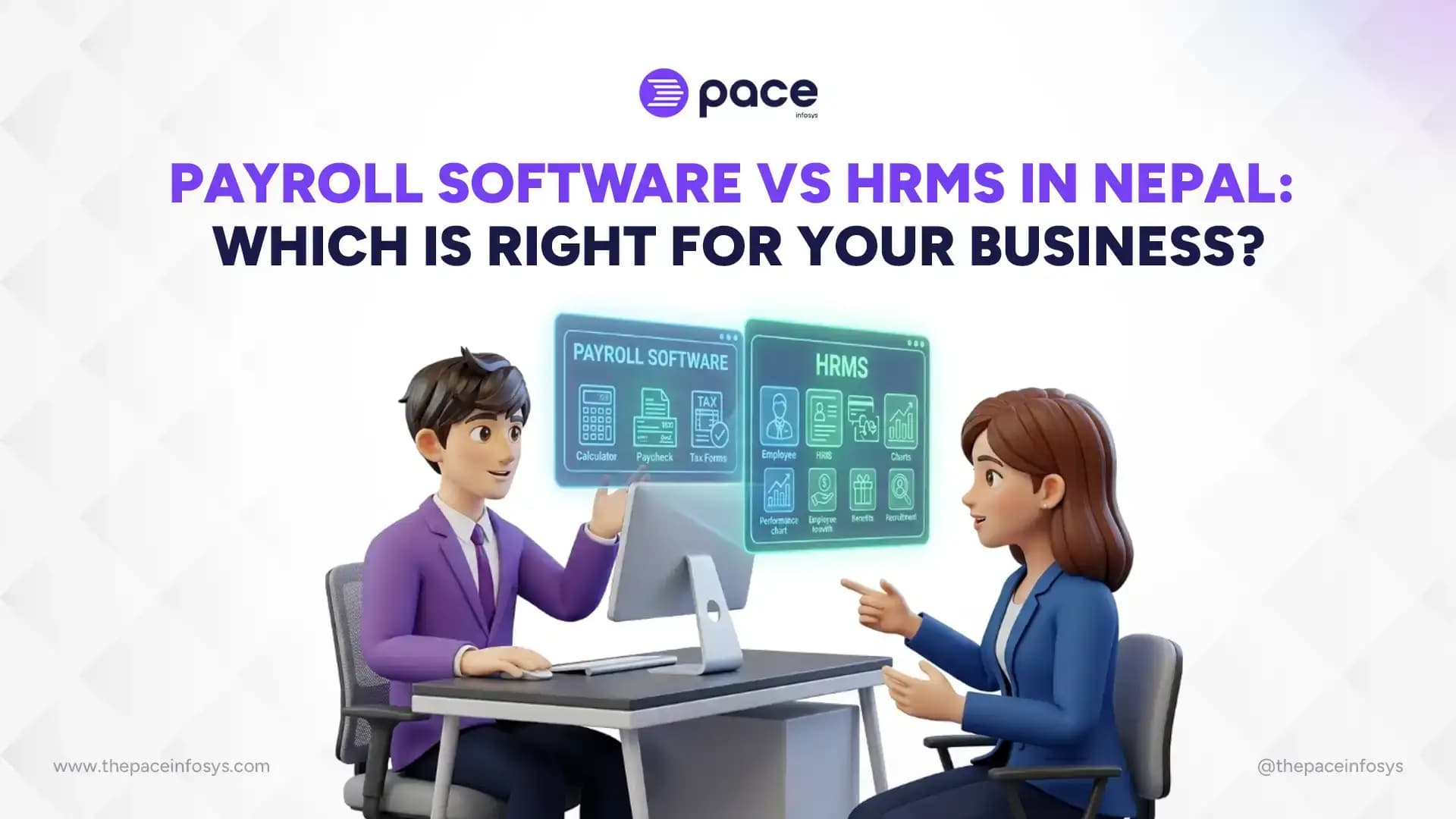

Payroll software calculates and disburses salaries, while HRMS covers the full employee lifecycle, including payroll, leave, attendance, and compliance, which means many Nepali businesses using only payroll software are missing a large part of what HR actually requires. The confusion between the two isn't just semantic; it shapes what a business can and can't track once headcount grows past a handful of employees.
This guide covers what actually separates payroll software from HRMS, why the two get confused so often, what each one handles that the other doesn't, what happens when a business relies on payroll software alone, what to weigh before choosing, and whether Nepali businesses genuinely need both, closing with which HRMS offers built-in payroll.
What Is the Difference Between Payroll Software and HRMS?
Payroll software focuses specifically on calculating and disbursing employee salaries, while HRMS covers the broader employee lifecycle, including payroll, leave, attendance, and compliance, in one system.
Payroll software exists to calculate wages, apply deductions, and issue payments accurately and on schedule, and little beyond that. Understanding the core purpose of payroll software makes clear why it's a narrow tool built to do one job well, not a general HR system.
HRMS, on the other hand, is built to manage the full employee relationship, from hiring through leave, attendance, performance, and compliance, with payroll as just one module inside a larger system. Recognizing what HR software actually does explains why it replaces several separate tools rather than just one.
Where the two actually overlap is narrower than most people assume: both systems calculate pay and generate payslips, which is exactly where the confusion between them usually starts. Identifying where the two overlap helps clarify that the real difference lies in everything HRMS covers beyond that shared payroll function.
Why Do Businesses in Nepal Confuse Payroll Software With HRMS?
Businesses in Nepal confuse payroll software with HRMS because vendors often use overlapping marketing language, payroll is frequently sold as a module within HRMS, and standalone payroll tools sometimes market themselves as complete HR solutions.
1. Overlapping Marketing Language
Many vendors use terms like "HR software" loosely, regardless of whether the product actually covers more than payroll. Cutting through overlapping marketing language is often the first step businesses need to take before learning how to choose HR software and comparing tools fairly.
2. Payroll as an HRMS Module
Because payroll is usually one module within a full HRMS, it's easy to assume the two are interchangeable rather than one being a subset of the other. Seeing payroll as an HRMS module, not the whole system, reframes the comparison correctly from the start.
3. Different Vendor Positioning
Some standalone payroll vendors position their product as a complete HR solution to appeal to a broader market, even when it doesn't cover leave, attendance, or compliance. Watching for this kind of vendor positioning helps businesses avoid selecting a tool that undersells what it's actually missing.
What Happens When Businesses Use Only Payroll Software?
When businesses use only payroll software, employee records stay fragmented across separate tools, leave and attendance tracking remains manual, compliance gaps appear outside of payroll, and workforce reporting stays limited.
1. Fragmented Employee Records
Without a central HR system, employee information ends up scattered across payroll software, spreadsheets, and paper files. Fixing fragmented employee records usually becomes the first motivation businesses have for eventually adopting a full HRMS.
2. Manual Leave and Attendance Tracking
Payroll software doesn't manage leave requests or attendance, so businesses are left tracking these manually, often through separate leave management software and spreadsheets that don't sync with payroll. This manual tracking becomes increasingly unmanageable as headcount grows.
3. Compliance Gaps Beyond Payroll
Payroll compliance only covers tax and statutory pay requirements, leaving broader labor law obligations around leave, documentation, and recordkeeping unaddressed. These compliance gaps beyond payroll often go unnoticed until an audit or dispute forces the issue, which is why understanding employee payroll deductions in Nepal and broader labor rules is critical.
4. Limited Workforce Reporting
Payroll software can report on pay and deductions, but it can't provide the broader workforce insights that come from combining leave, attendance, and performance data in one place. This limited workforce reporting makes strategic HR decisions harder to support with real data.
What Should You Look for Before Choosing Between the Two?
Before choosing between the two, businesses should look at their current and future workforce needs, how well systems would integrate if kept separate, and the budget difference between standalone tools and a combined platform.
1. Current and Future Business Needs
A small, stable team might only need payroll today, but a business planning to grow should weigh whether leave, attendance, and compliance needs will soon outpace what payroll software alone can handle. Assessing current and future business needs upfront avoids having to migrate systems again in a year or two.
2. Integration Between Systems
If a business keeps payroll and HR functions separate, it's worth checking whether those systems can integrate cleanly or whether data will need to be reconciled manually. Poor integration between systems often ends up recreating the same fragmentation a combined HRMS would have avoided.
3. Budget for Standalone vs. Combined Tools
A combined HRMS with payroll built in often costs less overall than maintaining two separate subscriptions and manually connecting them. Comparing the real budget for standalone vs. combined tools, including the hidden cost of manual reconciliation and factoring in how much HR software costs in Nepal, usually favors the combined option for growing teams.
When Do Nepali Businesses Need Both Payroll Software and HRMS?
Nepali businesses need both payroll software and HRMS running separately only in specific situations, such as mid-migration to a new system, an existing payroll contract that can't be broken yet, or a finance team that requires payroll to stay independent from HR for internal governance reasons.
1. During a Migration or Transition Period
Businesses moving from standalone payroll software to a full HRMS often run both in parallel for a payroll cycle or two, keeping the old system live as a safety net while the new one is validated. Running both during a migration or transition period is temporary by design, not a long-term setup.
2. When an Existing Payroll Contract Is Still Active
Some businesses are locked into a payroll vendor contract with time remaining, making it more practical to adopt HRMS for everything else now and fold payroll in once the contract ends. Working around an existing payroll contract that's still active is a common, purely commercial reason to keep the two separate temporarily.
3. When Finance Requires Payroll Independence for Governance
In some larger organizations, finance teams intentionally keep payroll on a separate, tightly controlled system for audit and governance reasons, even while HR runs a broader HRMS for everything else. Finance requiring payroll independence for governance is one of the few cases where running both isn't a stopgap but a deliberate long-term choice.
4. Outside These Cases, Combined HRMS Is Usually the Better Fit
Outside of migration periods, existing contracts, or specific governance requirements, there's little practical reason for most Nepali businesses to maintain two separate systems instead of one HRMS with built-in payroll. Recognizing that combined HRMS is usually the better fit keeps businesses from treating a temporary or edge-case setup as the default.
Which HRMS Offers Built-In Payroll for Nepali Businesses?
Pace HRMS offers the best built-in payroll for Nepali businesses, combining salary processing with leave, attendance, and compliance management in a single platform. It's designed to reflect how Nepali businesses actually manage employee lifecycles and payroll.
For businesses in Nepal looking to move from fragmented tools to something unified, Pace HRMS removes the need to choose by combining accurate, compliant payroll processing with leave, attendance, and employee record management in one place. It pulls together salary data, attendance logs, and compliance tracking into a single system instead of scattered spreadsheets. As one of the top 5 HR software options in Nepal, it's built to handle Nepal-specific tax and statutory requirements the same way a dedicated payroll tool would, without leaving HR functions to a separate system.
Conclusion
Payroll software and HRMS solve different problems, and most growing businesses in Nepal outgrow standalone payroll software once leave, attendance, and compliance needs expand beyond just paying people correctly. Rather than running two disconnected systems, an HRMS with built-in payroll gives businesses everything payroll software offers, plus the rest of what HR actually requires.
If your business is trying to decide between standalone payroll and a full HRMS, explore Pace HRMS's built-in payroll features with a demo or contact Pace Infosys to see how it fits your team.