Are you struggling to manage HR tasks manually as your team grows? Many businesses face challenges like tracking employee records, payroll errors, and compliance issues without a proper HR system. Manual processes can be time-consuming, prone to mistakes, and make decision-making harder.
In this blog, we will explain what HR software does and how it solves common HR problems. You’ll learn how HR software automates tasks, improves efficiency, ensures compliance, and supports employee management. By the end, you’ll understand the real benefits and why modern businesses are adopting HR technology.
What Does HR Software Do?
HR software is a digital solution designed to manage and streamline human resource tasks efficiently. It centralizes employee information, automates repetitive HR functions, and provides insights to improve workforce management. Essentially, it reduces the burden of manual HR work and ensures accuracy and compliance.
The core purpose of HR software is to help businesses handle payroll, attendance, leave management, performance tracking, and recruitment in a structured way. It allows HR teams to focus on strategic initiatives instead of administrative tasks. This improves productivity and ensures smoother operations as the organization grows.
How HR Software Replaces Manual HR Processes:
Automates payroll calculation and salary disbursement, eliminating errors from manual processing.
Tracks attendance, leave, and overtime digitally, reducing paperwork and manual tracking.
Stores employee records securely in a centralized database for easy access.
Simplifies recruitment workflows, from posting jobs to tracking applicants.
Generates reports and analytics for better decision-making without manual data compilation.
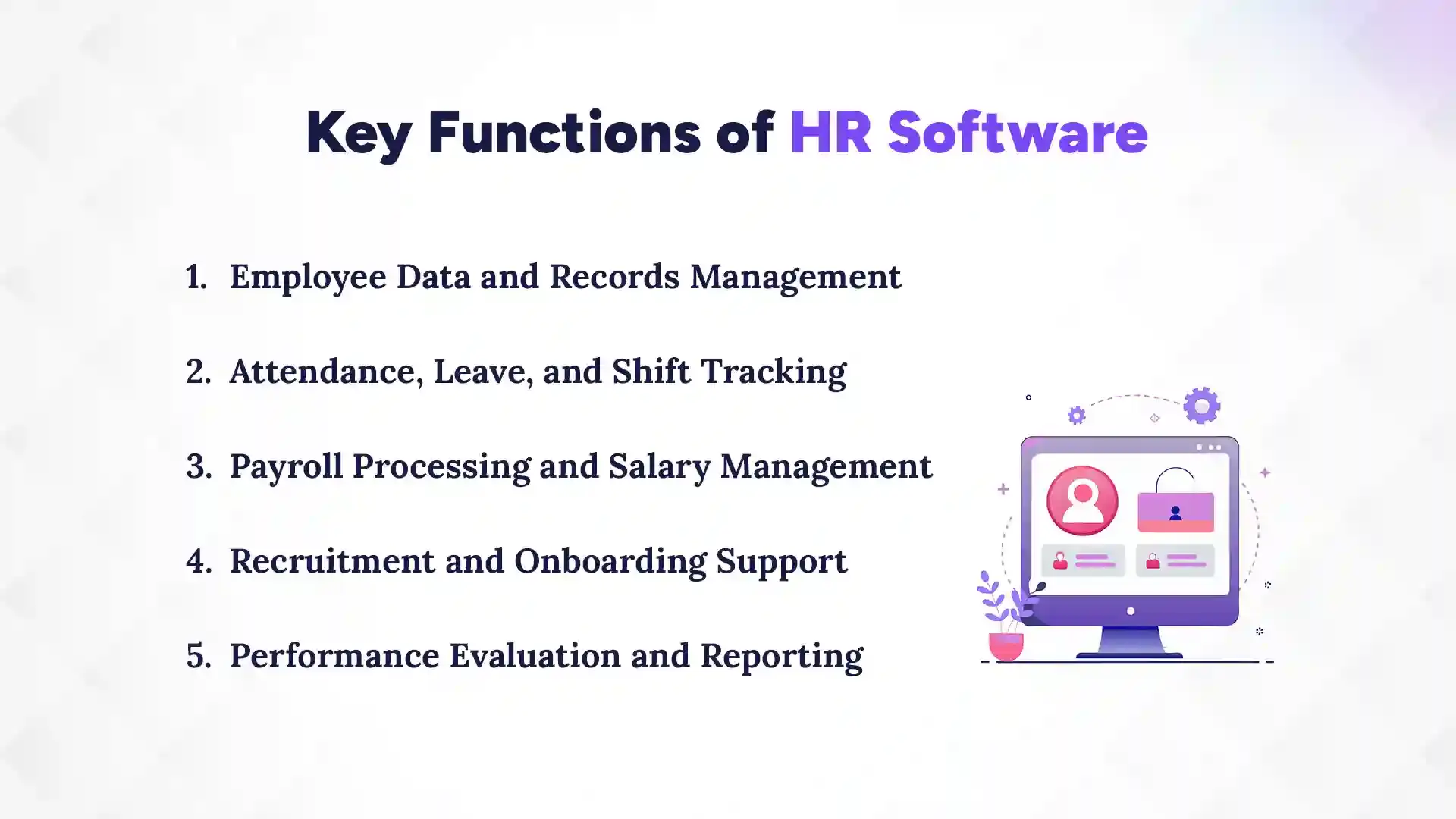
Key Functions of HR Software
HR software performs multiple critical functions that simplify HR management and improve efficiency. It helps businesses centralize employee data, automate repetitive tasks, and reduce errors. From payroll to performance evaluation, HR systems streamline processes that are traditionally time-consuming. These functions save HR teams valuable time and support better decision-making. Modern HR software integrates several HRMS features in one platform, making workforce management seamless.
1. Employee Data and Records Management
HR software centralizes all employee information in a secure digital database. It stores personal details, job history, qualifications, and contact information. Employees’ records are easily accessible for HR teams when needed. This reduces manual filing errors and improves data accuracy. Regular updates and secure storage ensure compliance with labor regulations.
2. Attendance, Leave, and Shift Tracking
The system tracks employee attendance, working hours, leave balances, and shift schedules automatically. It eliminates the need for manual registers and spreadsheets. HR managers can approve leave requests digitally and monitor absenteeism trends. Some systems integrate biometric or online check-in features. Accurate tracking ensures proper payroll and workforce planning.
3. Payroll Processing and Salary Management
HR software automates payroll calculation, tax deductions, and salary disbursement. This reduces human errors and saves time for HR teams. It ensures compliance with labor laws and statutory requirements. Payslips can be generated automatically and delivered to employees digitally. Payroll management becomes faster, transparent, and error-free.
4. Recruitment and Onboarding Support
Recruitment modules streamline job postings, applicant tracking, and candidate communication. HR software organizes applications, schedules interviews, and maintains candidate records. Onboarding workflows, such as document collection and orientation, are automated. This speeds up the hiring process and improves the new employee experience. Efficiency increases while reducing administrative burden.
5. Performance Evaluation and Reporting
HR software tracks employee performance metrics and generates evaluation reports automatically. Managers can set goals, monitor progress, and conduct appraisals digitally. Reporting tools help identify high performers and skill gaps. Data-driven insights support promotions, training, and succession planning. Accurate reporting also aids strategic HR decision-making.
How HR Software Helps HR Teams and Managers?
HR software benefits HR teams and managers by automating routine tasks, improving accuracy, and providing actionable insights. It reduces administrative burden, ensures compliance, and allows HR professionals to focus on strategic initiatives. Centralizing employee data and streamlining processes, it enhances efficiency and supports better decision-making across the organization. Overall, it transforms HR from a manual, time-consuming function into a more productive, data-driven department.
1. Operational Benefits
HR software streamlines daily HR operations, from managing employee records to handling approvals. Tasks that once required manual effort are now automated. This reduces errors and improves consistency across processes. Operational efficiency increases, allowing HR teams to focus on value-added activities. Automation also ensures standardized workflows across departments.
2. Reduces Repetitive Administrative Work
Manual HR tasks like attendance tracking, leave approvals, and payroll calculations are automated. Repetitive work consumes significant time and often leads to mistakes. HR software handles these tasks efficiently, freeing up HR staff to focus on strategic planning. Reduced administrative workload improves employee satisfaction and productivity.
3. Improves Accuracy and Compliance
HR software ensures accurate record-keeping and payroll calculations. It automatically applies statutory rules, tax deductions, and labor law compliance. Digital storage reduces errors and prevents data loss. Managers can trust the system for reliable information. Compliance reporting becomes easier and faster.
4. Saves Time for HR and Management Teams
Automation of routine tasks significantly reduces the time HR and managers spend on administrative work. Time savings allow HR to focus on recruitment, employee engagement, and strategy. Management can access real-time reports without manual calculations. This leads to faster decisions and smoother operations.
5. Supports Better Decision-Making with Data
HR software generates reports and analytics on performance, attendance, turnover, and more. Managers can identify trends, strengths, and gaps quickly. Data-driven insights support promotions, training, and workforce planning. Decisions are based on accurate and up-to-date information. Strategic planning becomes more effective and informed.
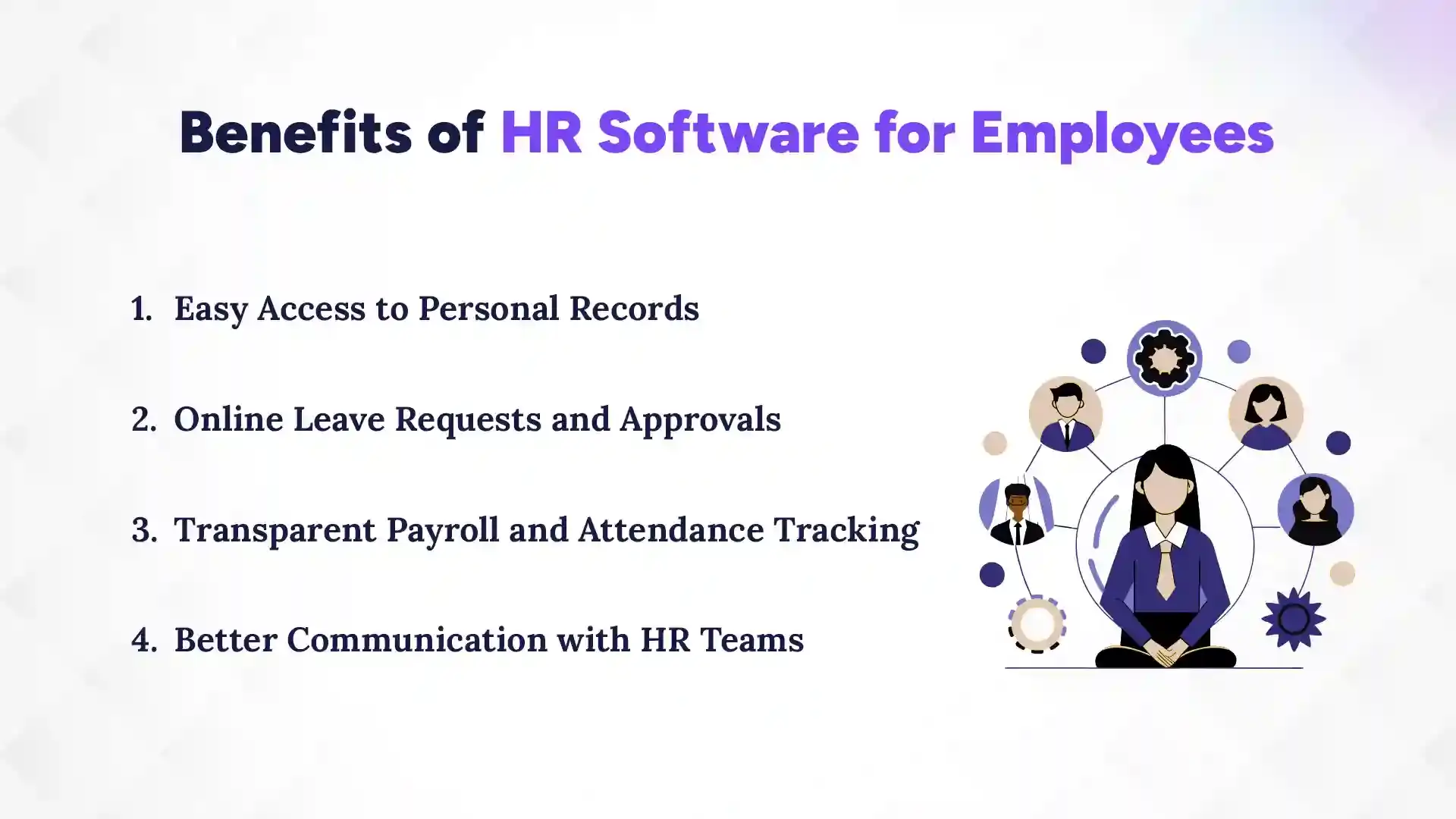
Benefits of HR Software for Employees
HR software not only helps HR teams but also makes employees’ work-life easier. It provides quick access to personal records, simplifies leave requests, ensures transparent payroll, and improves communication with HR. Employees can manage their tasks efficiently and stay informed about policies and updates. This leads to higher satisfaction and engagement at work.
1. Easy Access to Personal Records
Employees can view their personal and employment information anytime through the HR software. This includes contact details, job history, and benefits. They no longer need to request information from HR manually. Easy access empowers employees to manage their records and stay updated. It also reduces administrative queries and waiting time. Additionally, employees can update certain information themselves, keeping records accurate and current. This feature ensures transparency and builds trust between employees and HR.
2. Online Leave Requests and Approvals
HR software allows employees to submit leave requests digitally. Managers can review and approve them quickly through the system. Leave balances are updated automatically, reducing confusion. Notifications ensure employees know the status of their requests. This process is faster, transparent, and eliminates paperwork. It also allows employees to plan vacations or personal time with better visibility of team schedules. Automated leave tracking prevents errors and ensures fair leave management across the team.
3. Transparent Payroll and Attendance Tracking
Employees can check salary details, deductions, and attendance records online. An automated payroll system ensures accuracy and reduces disputes. Attendance tracking shows hours worked, overtime, and leave usage. Transparency builds trust and ensures employees feel fairly treated. It also allows employees to plan and manage their schedules effectively. Employees can download payslips or attendance reports whenever needed for personal or official purposes. This level of transparency minimizes payroll-related queries and improves overall satisfaction.
4. Better Communication with HR Teams
HR software provides a direct channel for employees to communicate with HR. Queries about policies, benefits, or approvals are addressed quickly. Notifications, alerts, and messaging features keep employees informed. This reduces delays and confusion in internal communication. Employees feel more supported and connected to HR. It also creates a documented communication trail for accountability and future reference. Enhanced communication improves engagement and ensures employees feel heard and valued.
HR Software for Small vs Large Businesses
HR software needs vary depending on business size. Small businesses often require simple, cost-effective solutions to manage basic HR tasks. Large organizations need scalable systems with advanced features to handle complex operations across departments and locations. Choosing the right HRMS solution ensures efficiency and growth for any business size.
Aspect
Small Businesses
Large Businesses
HR Needs
Manage basic employee records, attendance, payroll, and leave tracking.
Handle complex HR processes, multi-department management, global compliance, and high employee volume.
Software Complexity
Simple, easy-to-use, affordable systems with essential features.
Advanced, feature-rich platforms with automation, analytics, and integration capabilities.
Scalability
Limited scalability, suitable for small teams (10–100 employees).
Highly scalable, supports hundreds to thousands of employees as the company grows.
Recruitment & Onboarding
Basic applicant tracking and onboarding workflow.
Full-featured recruitment management, automated workflows, and onboarding for multiple locations.
Standalone system or basic integrations with payroll and banking.
Integrates with ERP, finance, payroll, and other enterprise tools for seamless operations.
Cost
Affordable, subscription-based, or one-time payment.
Higher investment, often subscription or license-based, justified by advanced functionality and scalability.
Cloud-Based HR Software vs Manual HR Management
Cloud-based HR software transforms HR operations by providing automation, real-time access, and data-driven insights. Unlike manual HR management, it reduces errors, saves time, and supports strategic decision-making. Organizations benefit from better efficiency, transparency, and flexibility with cloud solutions.
Aspect
Manual HR Management
Cloud-Based HR Software
Decision-Making Support
Limited insights; decisions are based on incomplete or outdated data.
Provides real-time analytics and reports for informed, data-driven decisions.
Time Efficiency
Time-consuming processes like payroll, attendance, and leave tracking take hours or days.
Automates repetitive tasks, saving significant time for HR teams.
Error Rate
High likelihood of human errors in payroll, attendance, and record-keeping.
Automated calculations and record management reduce errors drastically.
Data Access
Records are stored in physical files; access is slow and location-dependent.
Difficult to scale; more employees increase the manual workload exponentially.
Easily scalable to support small teams or large organizations without extra effort.
Compliance & Reporting
Hard to track regulations and generate reports manually; prone to compliance risks.
Built-in compliance checks and automated reporting ensure adherence to labor laws.
Cost
Low upfront software costs but high long-term time and administrative costs.
Subscription or license-based; reduces labor costs and improves ROI through automation.
Which Is the Best HR Software in Nepal?
The Pace HR software is the best HR software in Nepal because it combines user-friendly features with local compliance support, making it ideal for Nepali businesses of all sizes. It covers core HR functions like payroll, attendance, leave management, recruitment, and performance tracking while ensuring that statutory regulations and tax laws in Nepal are properly followed. Businesses can rely on it for accurate reporting, timely payroll processing, and secure data management.
In addition, Pace HR software offers scalable solutions suitable for both small teams and large organizations. Its pricing is competitive, support is locally available, and the platform is customizable to meet business-specific requirements. Rather than relying on a single feature, Nepali companies benefit from a combination of compliance, automation, and ease of use, which makes Pace HR software a trusted choice in the local market.
Is HR Software Necessary for Businesses in Nepal?
Yes, HR software is necessary for businesses in Nepal because it addresses key challenges faced by companies, such as manual record-keeping, payroll errors, and inefficient leave and attendance tracking. As Nepali businesses grow, managing employees manually becomes time-consuming and prone to mistakes. HR software automates these processes, saving time, reducing errors, and ensuring compliance with local labor laws and statutory requirements.
Additionally, HR software supports better workforce management, performance tracking, and reporting. Many Nepali companies are adopting digital HR systems to improve efficiency, employee satisfaction, and strategic decision-making. With competitive business environments and increasing regulatory requirements, HR software is no longer a luxury but a critical tool for sustainable growth and smooth HR operations in Nepal.
Conclusion
HR software is a powerful tool that streamlines HR tasks, including payroll, attendance, leave management, recruitment, and performance tracking. It reduces manual work, improves accuracy, ensures compliance, and provides valuable data insights for better decision-making. Both HR teams and employees benefit from easier access to records, faster processes, and improved communication.
Choosing the right HR software is essential for businesses to maximize efficiency, scalability, and employee satisfaction. Tools like Pace HR software cater to local compliance and organizational needs, making implementation smoother. For Nepali businesses looking to grow sustainably, adopting HR software is a strategic investment that saves time, reduces errors, and supports long-term workforce management and business success.
FAQs
What does HR software do in a company?
+
HR software automates HR tasks like payroll, attendance, leave management, recruitment, and performance tracking, reducing manual work and improving efficiency.
Which is the best HR software in Nepal?
+
The Pace HR software is considered the best HR software in Nepal because it combines local compliance, scalability, automation, and user-friendly features for Nepali businesses.
Is HR software necessary for small businesses in Nepal?
+
Yes, HR software is necessary for small businesses as it streamlines HR operations, saves time, reduces errors, and ensures compliance even with limited staff.
What features should HR software have?
+
Essential features include employee data management, payroll, attendance tracking, leave management, recruitment, onboarding, performance evaluation, and reporting with analytics.
Can HR software handle payroll and attendance?
+
Yes, HR software automates payroll calculations, tax deductions, salary disbursement, and tracks attendance, leave, and shift schedules accurately.
Is cloud-based HR software safe to use?
+
Yes, cloud-based HR software uses encryption and secure servers to protect employee data, while allowing remote access and regular backups.
How much does HR software cost in Nepal?
+
Costs vary depending on features and business size; small business plans are affordable monthly subscriptions, while enterprise solutions for large organizations are higher.
What is the difference between HR software and HRMS?
+
HR software focuses on core HR tasks, while HRMS (Human Resource Management System) is more comprehensive, including payroll, analytics, performance, and strategic workforce planning.
Ready to get started?
Book a 30-minute consultation call, and let's talk about your goals.