Finding the perfect HR software for your business can feel like navigating a maze of spreadsheets, attendance logs, and endless emails, and let’s be honest, nobody wants to play HR detective all day. From payroll nightmares to onboarding chaos, the right tool can turn mountains of paperwork into a smooth flight over the HR landscape. With the right HR software, you can save hours, reduce errors, and actually enjoy managing your team. Yes, HR can be that satisfying!
In this blog, we’ll explore the Top 5 HR Software in Nepal, breaking down features, pricing, and local support to help you make an informed choice. You’ll get a detailed comparison table, see why Pace HR leads the pack, and learn which software fits your business size, compliance needs, and budget, essentially turning HR from a headache into a streamlined, efficient powerhouse. By the end, you’ll know exactly which HR tool can make your office run like a well-oiled machine.
What Is HR Software?
HR software, also called HRMS (Human Resource Management System), is a digital toolkit that helps businesses manage employee data, payroll, recruitment, performance, attendance, and training, all in one place. Think of it as the Swiss Army knife for HR teams: compact, versatile, and capable of handling almost any HR challenge without breaking a sweat. For modern businesses, HR software is no longer a luxury; it’s the backbone that keeps operations smooth, ensures compliance, and frees HR professionals from drowning in paperwork.
Here’s why investing in HR software can transform the way your business operates:
Streamlined Employee Management: All employee records, contracts, and personal information are organized in one secure hub.
Accurate Payroll & Compensation: Automates salary, bonuses, taxes, and deductions, reducing costly errors.
Efficient Recruitment & Onboarding: Tracks applicants, schedules interviews, and makes onboarding smoother than coffee on a Monday morning.
Attendance & Leave Tracking: Integrates biometric, mobile, and geofencing attendance, eliminating the chaos of manual logs.
Performance & Training Management: Monitors goals, appraisals, and skill growth, keeping your team sharp and motivated.
Compliance & Reporting: Ensures labor law compliance, generates reports, and avoids HR nightmares with regulators.
Employee Self-Service Portal: Let's staff update info, check payslips, and apply for leave, freeing HR to focus on strategy rather than chasing forms.
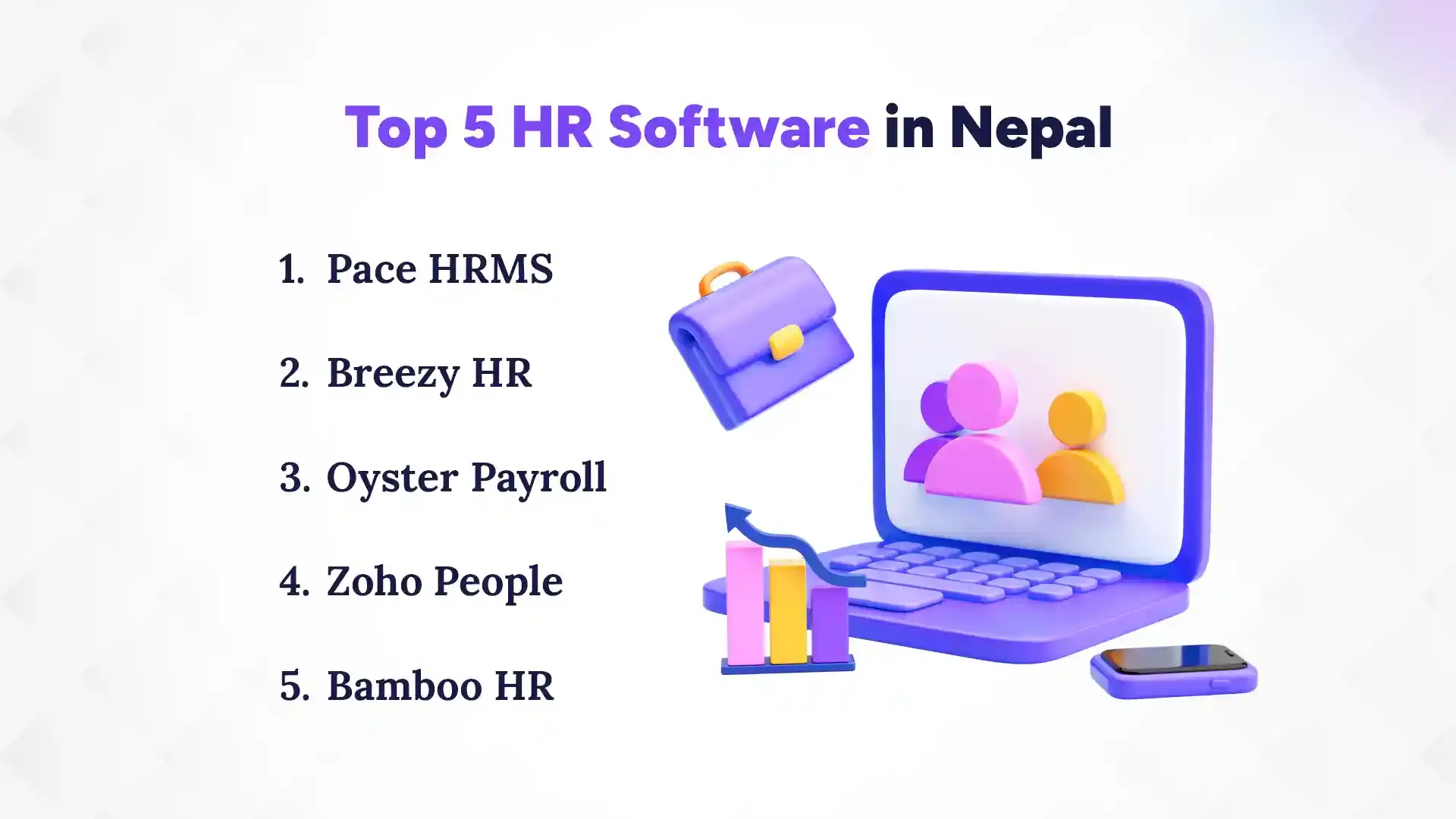
Top 5 HR Software in Nepal
When Nepali businesses begin searching for the Top 5 HR Software in Nepal, they’re really asking: which tools make HR faster, simpler, and more reliable without breaking the bank? While many global HR solutions exist, only a handful truly serve local needs, and some (like Pace HR Software) are tailored specifically for Nepal’s business landscape. In this section, we’ll walk through five popular HRMS options that companies often consider, spotlighting their features, strengths, and limitations so you can make a smart, practical choice.
1. Pace HRMS
Pace HRMS is a globally designed HRMS that centralizes all HR operations, payroll, attendance, recruitment, performance, and training in a single platform. Cloud-based and mobile-friendly, it is ideal for small startups, mid-sized companies, and multinational corporations alike. With mobile geofencing, biometric attendance, automated onboarding, and a self-service employee portal, it reduces errors and administrative bottlenecks. Compliance features cover multiple countries, ensuring international HR operations run smoothly. The interface is intuitive, letting HR teams focus on strategy instead of paperwork. Pace HRMS also scales with your business and integrates seamlessly with other tools, making HR management efficient, accurate, and stress-free. Think of it as the control tower for your HR processes, keeping everything on course.
Key Features:
Payroll automation for salaries, taxes, and bonuses globally
Attendance & leave tracking via mobile, biometric, and geofencing
Recruitment & ATS with job postings and onboarding automation
Performance management with goal tracking and appraisals
Training and learning modules for skill development
Employee self-service portal for leave, payslips, and personal info
Pros:
All-in-one HRMS for global and local operations
Cloud-based and mobile-friendly for remote access
Scalable for companies of any size
Built-in global compliance for payroll and labor laws
Advanced attendance tracking with geofencing & biometrics
Initial setup may require support for global configuration
Some features need training for full utilization
Not ideal for businesses needing only basic payroll
2. Breezy HR
Breezy HR is a recruitment-focused HR software designed to streamline hiring processes. From candidate sourcing and interview scheduling to pipeline management and onboarding, it makes recruitment faster and more organized. While it doesn’t cover payroll, attendance, or performance management, Breezy HR excels in helping HR teams reduce bottlenecks, improve candidate experience, and save time. Its visual interface is intuitive and easy to use, so teams spend less time clicking around and more time making strategic hiring decisions. For businesses prioritizing recruitment, Breezy HR acts like a tireless recruitment assistant, keeping the hiring process smooth and efficient.
Key Features:
Applicant tracking system (ATS) with visual pipelines
Candidate sourcing across multiple channels
Interview scheduling with automated calendar integration
Team collaboration tools for feedback and scoring
Recruitment analytics for time-to-hire and candidate sources
Customizable workflows for different job roles
Pros:
Excellent for recruitment-focused HR teams
Intuitive, easy-to-use interface
Reduces hiring time and candidate miscommunication
Visual pipeline improves clarity of applicant status
Quick implementation and adoption
Flexible workflows for different hiring processes
Cons:
Limited payroll, attendance, and performance features
Not tailored for Nepali labor compliance
Requires third-party tools for full HRMS capabilities
Reporting is limited to recruitment metrics
Minimal employee self-service options
Less suitable for companies seeking end-to-end HR management
3. Oyster Payroll
Oyster Payroll is a global payroll platform built for businesses with international teams and remote employees. It automates salary processing, taxes, statutory deductions, and contractor payments across multiple countries. While it focuses primarily on payroll, its accurate reporting, compliance dashboards, and payment scheduling make it indispensable for remote-first companies. Oyster Payroll reduces payroll errors, ensures timely payments, and simplifies compliance reporting. Although it doesn’t offer full HRMS functionalities like recruitment or training, it acts as a precision engine for global payroll management. Think of it as the backbone keeping distributed teams paid and compliant without the manual headaches.
Key Features:
Global payroll automation for multi-country teams
Tax calculation and statutory compliance for supported regions
Contractor and remote employee payment management
Payroll reporting dashboards for HR and finance
Employee payment scheduling with automated reminders
Compliance alerts for statutory obligations
Pros:
Excellent for global payroll and compliance
Reliable contractor and remote employee management
Accurate reporting dashboards for audits
Reduces manual payroll errors significantly
Supports multiple currencies and tax jurisdictions
Timely salary processing for all employees
Cons:
Minimal HR features beyond payroll
Nepal-specific compliance may need manual adjustments
Higher cost for small businesses
No recruitment, onboarding, or training modules
Limited mobile self-service for employees
Not suitable for companies wanting full HRMS coverage
4. Zoho People
Zoho People is a cloud-based HR software that provides essential HR functions for growing businesses. It manages attendance, leave, performance, and basic recruitment while integrating seamlessly with other Zoho apps like CRM, Projects, and Desk. Its mobile-friendly interface allows HR teams and employees to access data anywhere. Payroll is not included by default, but Zoho People’s modular structure allows businesses to add functionalities as needed. It is scalable, flexible, and particularly suitable for companies already invested in the Zoho ecosystem. Think of it as a reliable, versatile HR tool that keeps core HR tasks organized and accessible.
Key Features:
Centralized employee database with detailed records
Attendance and leave management with approvals
Performance appraisals and goal tracking
Basic recruitment and applicant tracking
Integration with Zoho suite (CRM, Projects, Desk)
Mobile app access for employees and managers
Pros:
Affordable and modular pricing
Flexible and mobile-friendly interface
Scalable as the business grows
Easy integration with other Zoho apps
Good for core HR management
Quick adoption with minimal training
Cons:
Payroll functionality is not native
Needs customization for Nepali labor compliance
Advanced HR analytics require add-ons
Limited global compliance features
Minimal onboarding automation
Not ideal for full HRMS needs
5. BambooHR
BambooHR is an intuitive HR software focusing on employee records, performance, and engagement. It simplifies HR workflows, reporting, and performance management, making it ideal for small to medium businesses. Payroll and attendance tracking require third-party integrations. BambooHR’s interface is sleek, mobile-friendly, and designed to reduce administrative burden while enhancing employee experience. It is particularly strong in performance management, document storage, and engagement tracking. Think of it as a friendly HR assistant that organizes employee data, monitors progress, and keeps HR teams in control without stress.
Key Features:
Employee records and centralized workflows
Time and attendance tracking (with optional integrations)
Performance management with goal setting and appraisals
Reporting and analytics dashboards
Document storage and approval workflows
Employee engagement tools like surveys and feedback
Pros:
Highly intuitive and easy to use
Strong performance and engagement management
Good reporting and workflow automation
Mobile-friendly interface
Efficient document management
Quick adoption with minimal learning curve
Cons:
Payroll and attendance require third-party integration
Lacks mobile geofencing attendance
Higher cost for full-feature access
Limited recruitment and onboarding modules
Not ideal for global payroll or compliance
Some advanced analytics require add-ons
Ready to Choose the Right HR Software??
Compare features, automate HR operations, and find a smarter HRMS solution tailored to your business.
Pace HR Software stands out because it combines global usability, robust features, and seamless automation in one platform, making HR simpler, faster, and more accurate. Understanding how to choose HR software becomes easier when platforms like Pace show how payroll, attendance, recruitment, performance, training, and employee self-service can work together efficiently. It remains scalable for companies of all sizes. Think of it as a Swiss army knife for HR, versatile, precise, and reliable, helping HR teams focus on strategy instead of tedious manual tasks.
Comparison Basis
Pace HRMS
Other HRMS
Global & Local Compliance
Built-in global compliance with multi-country payroll; adaptable to Nepali labor laws
Limited compliance support; often requires manual adjustments for Nepal
Payroll Management
Fully automated payroll with taxes, bonuses, deductions, and multi-country support
Basic payroll may require separate modules or integrations
Attendance Tracking
Mobile attendance, biometric, geofencing, and bulk uploads
Often limited to manual or basic attendance, mobile geofence is rare
Recruitment & ATS
Complete applicant tracking, onboarding automation, interview scheduling, and candidate pipelines
Limited recruitment capabilities; ATS may be basic or separate
Performance Management
Goal tracking, appraisals, continuous feedback, and reporting dashboards
Basic performance tracking, limited reporting, and analytics
Training & Learning Management
Assign courses, track completion, integrate with performance; automated workflows
Often missing, requiresa separate LMS or manual tracking
Employee Self-Service
Employees access payslips, leave requests, attendance, and personal info on mobile/web
Limited self-service; mostly web-only or partially functional
Scalability & Integration
Scales from SMEs to multinational corporations; integrates with other tools seamlessly
May not scale well; integrations are limited or manual
24/7 global support with setup guidance and updates
Support is limited to business hours or region-specific
How to Choose the Right HR Software for Your Company?
To choose an HR software for your business, you need more than flashy features; it’s about finding a tool that fits your business like a well-tailored suit. The right HRMS should simplify payroll, attendance, recruitment, performance tracking, and employee engagement while supporting local labor laws. Consider factors like company size, scalability, mobile access, and support services. Picking the wrong system can feel like buying a sports car for a dirt road; it looks fancy, but it won’t deliver where you need it most. Here’s a practical guide to help you select the perfect HR software.
1. Business Size & Feature Requirements
Your company size often dictates the HRMS you need. Small businesses may only need core modules like payroll and attendance, while medium to large enterprises require advanced features such as recruitment tracking, performance management, and learning modules. Think of it like choosing shoes, small steps need comfort and simplicity, while long marathons require robust support and durability. Always align the software’s capabilities with your current needs and future growth plans.
2. Payroll & Attendance Management
Payroll and attendance are the backbone of HR operations. Look for automated payroll calculation, tax compliance, overtime management, and accurate attendance tracking, including mobile and geofencing options. A system that handles this efficiently reduces errors and saves HR teams hours of tedious work. Imagine it as the engine of your HR vehicle, without a smooth-running engine, even the fanciest features won’t perform well.
3. Recruitment & Applicant Tracking
Recruitment can make or break your team’s quality. Choose HR software with a robust Applicant Tracking System (ATS), candidate pipelines, interview scheduling, and onboarding automation. Integration with your employee database ensures seamless transitions from candidate to employee. A strong recruitment module is like having a magnet that attracts top talent while keeping your hiring process organized and painless.
4. Mobile Access & Self‑Service Portals
Modern HR software should empower employees with self-service portals accessible via mobile or web. Features like leave applications, attendance logging, payslip downloads, and personal data updates save HR teams from constant queries. Mobile access also ensures managers can approve requests or check reports on the go. Think of it as giving your employees the keys to their HR cockpit; they take control, and HR navigates smoothly behind the scenes.
5. Support & Local Compliance Assistance
Finally, reliable customer support and local compliance assistance are essential. HR software should guide you through setup, updates, troubleshooting, and compliance with Nepali labor laws. Without proper support, even the best software can feel like a puzzle missing half the pieces. Ensure your HRMS provider offers timely help and resources, so you can focus on people rather than paperwork.
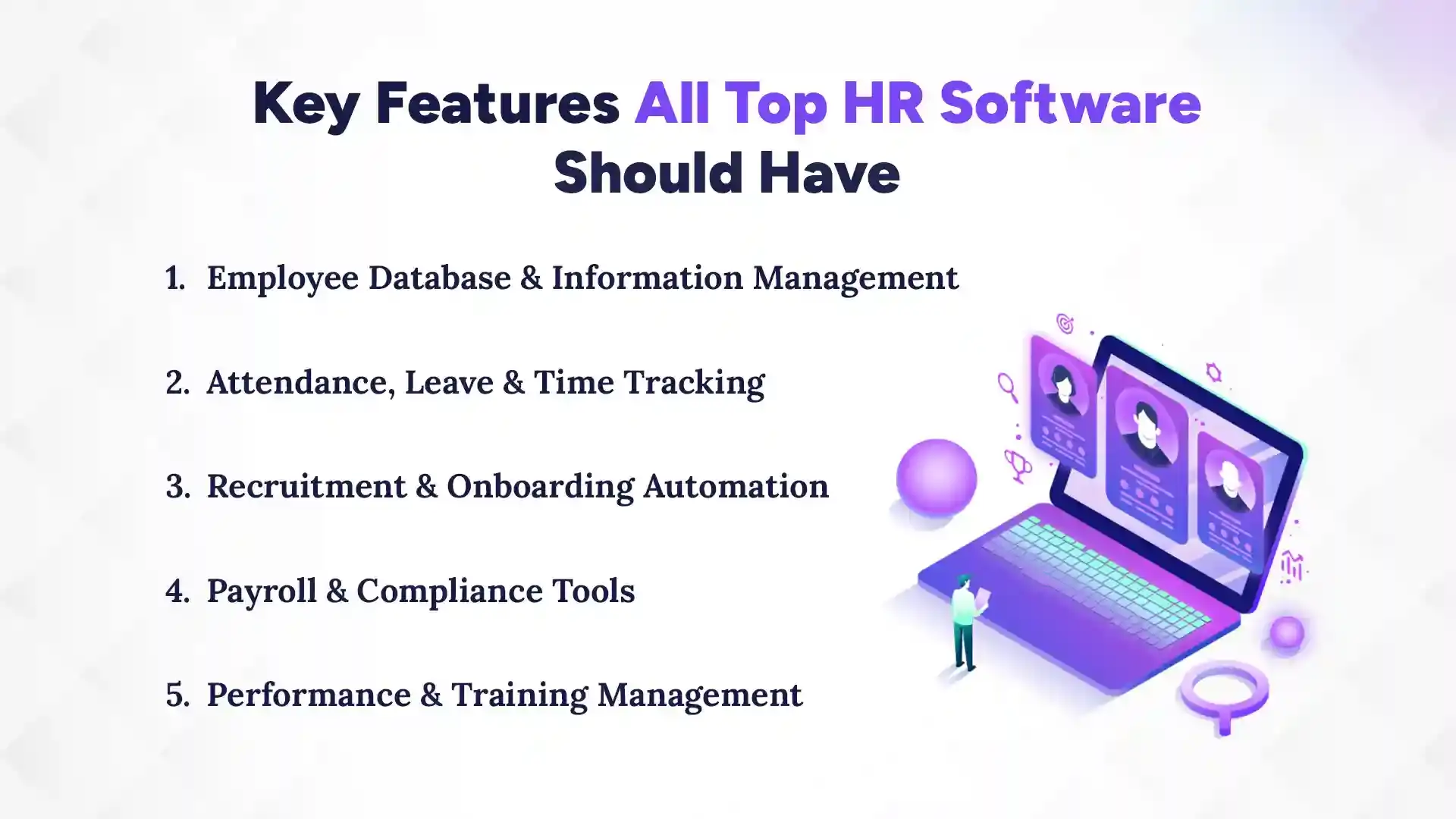
Key Features All Top HR Software Should Have
Not all HR software is created equal, but the best systems share a core set of features of HR software that make HR operations smooth, accurate, and less stressful. From managing employee data to automating payroll and performance, these capabilities turn what used to be a mountain of paperwork into a streamlined workflow. Think of these features as the toolkit every HR professional wishes they had, each tool making their job faster, easier, and more effective.
1. Employee Database & Information Management
A central employee database is the heart of any HR software. It stores personal details, job history, contracts, and qualifications in an organized, secure system. Advanced HRMS also integrate attendance, leave balances, and reporting tools directly into this database. Imagine it as a digital filing cabinet that never misplaces a file, where every HR decision draws instantly on accurate data.
2. Attendance, Leave & Time Tracking
Tracking attendance, leave requests, and work hours is no longer a manual headache. Modern HR software, through an advanced attendance management system, offers mobile check-ins, geofencing, biometric integration, and approval workflows. Employees can submit requests, while managers track attendance patterns and generate reports in seconds. It’s like having a digital timekeeper who never misses a beat.
3. Recruitment & Onboarding Automation
The hiring process can be messy without proper tools. Top HR software includes applicant tracking, interview scheduling, and automated onboarding workflows. Once a candidate is hired, their data flows seamlessly into the employee database, minimizing errors. Think of it as a well-oiled conveyor belt turning top talent into productive employees without losing momentum.
4. Payroll & Compliance Tools
Payroll isn’t just salary calculation, it’s taxes, bonuses, deductions, and statutory compliance all rolled into one. Advanced HRMS automates these tasks, integrates attendance data, and generates payslips instantly. Compliance with local and global labor laws is built in, reducing the risk of fines or errors. It’s like having a trusted accountant and lawyer rolled into one digital assistant.
5. Performance & Training Management
Tracking performance and managing learning programs is critical for employee growth. HR software helps set goals, monitor KPIs, run appraisals, and assign training modules. Integration ensures that progress and achievements are reflected across the system, creating a continuous feedback loop. Imagine it as a personal coach guiding employees to reach their full potential while keeping HR informed.
Conclusion
Choosing the right HR software in Nepal can feel like navigating a maze, but with the right tools, it becomes more like cruising on a well-paved highway. From payroll and attendance to recruitment, performance, and training, an all-in-one platform ensures your HR operations run smoothly, errors are minimized, and teams stay productive. Modern HRMS like Pace HR combine global standards with local adaptability, giving businesses a competitive edge while simplifying everyday processes.
At the end of the day, the best HR software is the one that fits your company’s size, culture, and growth plans. By evaluating features, mobile access, compliance support, and scalability, you can find a system that empowers both HR teams and employees, turning complex processes into organized, efficient workflows that feel effortless, something solutions from The Pace Infosys aim to deliver.
FAQs
What is the best HR software for Nepali businesses?
+
The best HR software is Pace HRMS, offering global compliance, payroll, attendance, recruitment, and performance management in a single, scalable platform.
Can small businesses in Nepal use Pace HR effectively?
+
Yes, Pace HR scales for SMEs, providing core HR functions like payroll, attendance, recruitment, and self-service tools without overwhelming resources.
Does Pace HR support mobile attendance tracking?
+
Absolutely, Pace HR includes mobile check-ins, geofencing, and biometric integration, making attendance tracking accurate and convenient for employees on the go.
How does HR software help with payroll in Nepal?
+
HR software automates payroll, calculates taxes, bonuses, and deductions, ensures compliance with local laws, and generates payslips instantly, reducing errors and manual work.
Can HR software manage recruitment and onboarding?
+
Yes, top HRMS like Pace HR streamline recruitment with applicant tracking, interview scheduling, and automated onboarding, reducing administrative effort and improving candidate experience.
Is global HR software suitable for Nepali companies?
+
Yes, globally designed HR software like Pace HR adapts to local compliance while offering advanced features for payroll, performance, attendance, and training management.
Do employees get self-service access in HR software?
+
They do; self-service portals let employees apply for leave, check attendance, access payslips, and update personal info, reducing HR back-and-forth.
How do I choose the right HR software for my business?
+
Choose HR software based on company size, required features, payroll and attendance needs, mobile access, recruitment automation, and support for local compliance.
Ready to get started?
Book a 30-minute consultation call, and let's talk about your goals.