Managing people should help your business grow, not slow it down. Yet many growing companies in Nepal still struggle with scattered employee records, manual attendance tracking, payroll errors, and compliance headaches that eat up time and money. As teams expand, these HR challenges multiply, leading to inefficiency, frustrated employees, and costly mistakes.
This is where choosing the right HR software becomes critical. With so many tools available, selecting the wrong system can create more problems than it solves, while the right one can transform how your HR team operates.
This guide is designed to help Nepali employers and HR teams understand HR software clearly, avoid common pitfalls, and confidently choose a solution that saves time, reduces costs, and supports long-term business growth. Let's dive into learning what is and how to choose the best HR software for businesses in Nepal!
What is HR Software and How Does It Work?
HR software is a digital system designed to manage, automate, and simplify day-to-day human resource activities. Instead of relying on spreadsheets, paper files, and manual calculations, HR software brings all employee-related data and processes into one centralized platform. This allows HR teams and business owners to manage people more efficiently, accurately, and securely.
At its core, HR software works by storing employee information in a secure database and automating routine HR tasks. Once employee data is entered, the system connects different HR functions such as attendance, payroll, leave, and performance, ensuring that updates in one area are reflected across the system. Most modern HR software is cloud-based, meaning it can be accessed anytime through the internet without installing complex systems.
Core functions of HR software include:
Employee database and digital records management
Attendance and shift tracking
Payroll processing and salary calculations
Leave and holiday management
Performance evaluation and goal tracking
Recruitment, onboarding, and employee lifecycle management
HR reporting and compliance documentation
The difference between manual HR management and HR software is significant. Manual HR processes are time-consuming, prone to human error, and difficult to scale as a company grows. HR software, on the other hand, automates repetitive tasks, reduces errors, improves transparency, and provides real-time insights. For growing businesses, especially in Nepal, HR software helps ensure compliance, improves productivity, and allows HR teams to focus on strategic people management rather than paperwork.
Why Choosing the Right HR Software Matters?
Choosing the right HR software directly impacts how efficiently you manage employees, control costs, and scale your business without operational chaos.
As businesses in Nepal grow, HR operations become more complex. Employee data increases, payroll rules change, compliance requirements tighten, and expectations from employees rise. The right HR software acts as a foundation that keeps all these moving parts organized and accurate, while the wrong choice can lead to inefficiencies, frustrated teams, and unnecessary expenses.
The biggest impact of choosing the right HR software is on employee management and productivity. When attendance, leave, payroll, and performance data are automated and centralized, HR teams spend less time on manual work and more time supporting employees. Managers gain visibility into workforce data, and employees experience faster approvals and fewer errors.
Key benefits of choosing the right HR software include:
Improved accuracy in payroll, attendance, and employee records
Better compliance with labor regulations and internal policies
Stronger data security and controlled access to sensitive HR information
Reduced administrative workload and HR operational costs
Scalability to support team growth without changing systems
Better reporting and insights for informed decision-making
From a cost perspective, the right HR software reduces long-term expenses by minimizing payroll errors, reducing paperwork, and eliminating the need for multiple disconnected tools. Most importantly, it allows businesses to grow confidently, knowing their HR processes can scale smoothly alongside their workforce.
Key Features to Look for When Choosing HR Software
Choosing HR software is not just about buying a tool. It is about making daily HR work easier and smoother. The right features help HR teams save time and avoid mistakes. They also help employees trust the system and use it comfortably. Following are the core features a good HRMS possess:
1. Employee Database and Records Management
This feature stores all employee information in one place. It includes personal details, job roles, documents, and work history. Instead of searching through files or spreadsheets, HR can find everything in seconds. Data can be updated easily when roles or salaries change. Access can be controlled so that only the right people see sensitive data. This keeps employee information safe and organized. It also reduces the risk of data loss.
2. Payroll and Attendance Tracking
Payroll and attendance are two of the most important HR tasks. This feature tracks working hours, late entries, and absences automatically. It links attendance data directly with payroll calculations. This reduces salary mistakes and payment delays. HR does not need to calculate salaries manually every month. Employees can trust that they are paid correctly. It also saves a lot of time for HR teams.
3. Leave and Performance Management
Leave management allows employees to apply for leave online. Managers can approve or reject leave in just a few clicks. Leave balances are updated automatically. Performance management helps track goals and reviews. It gives managers a clear view of employee progress. Regular feedback becomes easier to manage. This helps employees improve and stay motivated.
4. Recruitment and Onboarding Tools
Recruitment tools help manage job openings and applications. HR can track candidates from application to hiring. Once hired, onboarding tools guide new employees step by step. Important documents can be shared digitally. New employees understand policies faster. This creates a smooth first experience. It also reduces manual work for HR.
5. Reporting and Analytics
Reporting tools turn HR data into simple reports. HR can see attendance trends, payroll costs, and employee growth. Reports help management make better decisions. Data is shown in a clear and easy format. There is no need for manual calculations. This saves time and reduces errors. It helps businesses plan better for the future.
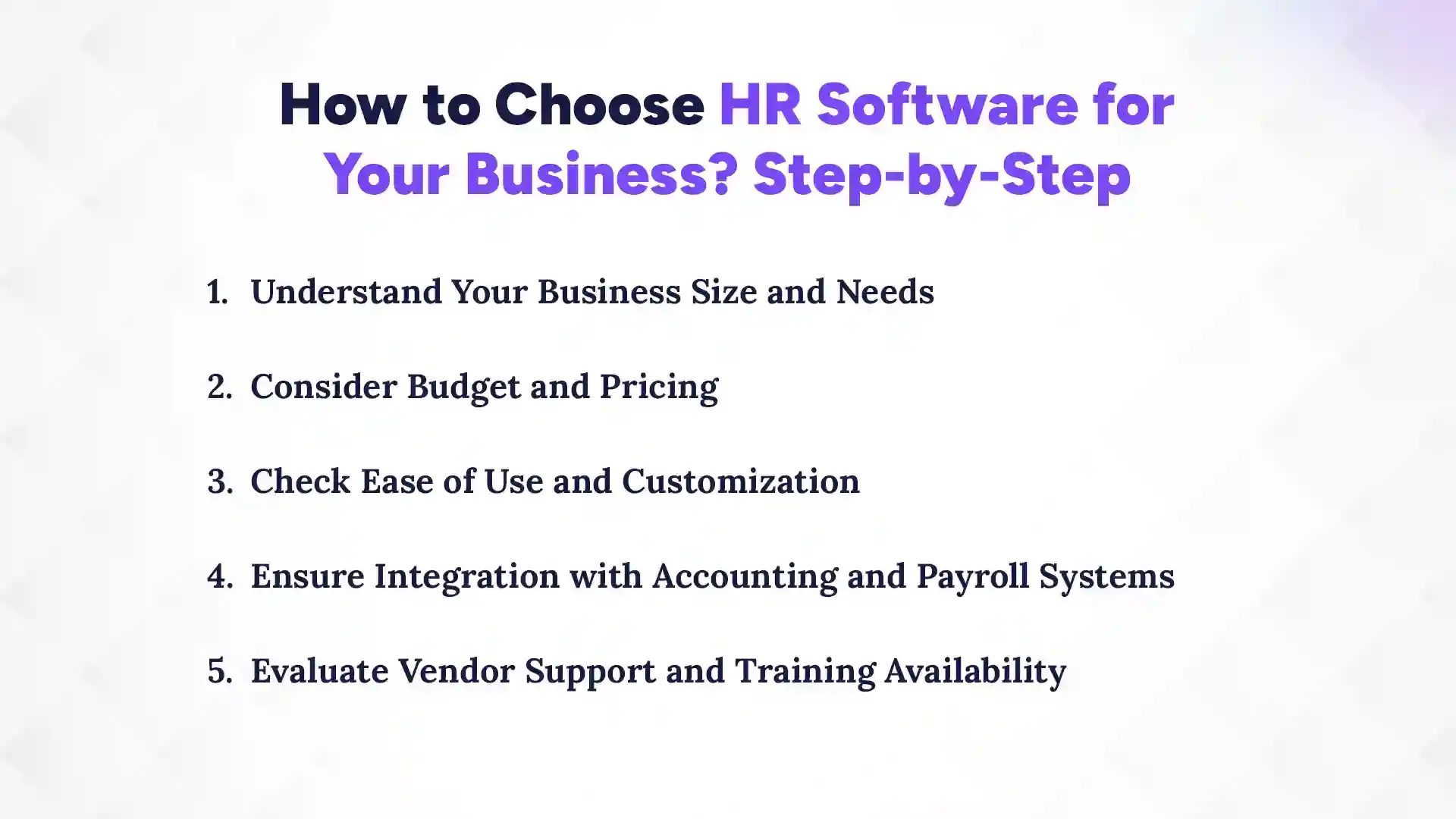
How to Choose HR Software for Your Business? Step-by-Step
To choose the right HR software, understand your needs, your budget, and how the system will support your business as it grows. When you follow a clear step-by-step process, you avoid confusion and costly mistakes. This approach helps you select software that truly fits your team instead of forcing your team to fit the software.
1. Understand your Business Size and Needs
Start by looking at how big your company is today. A small team needs simple features, while a growing business needs more control and structure. List your daily HR tasks, such as attendance, payroll, and leave. Think about future growth and new hires. Avoid buying features you will never use. Evaluate how the new HR software benefits your business. At the same time, do not choose software that you will outgrow quickly. The goal is to match the software with your real needs.
2. Consider Budget and Pricing
Set a clear budget before comparing options. Check whether pricing is monthly or yearly. Understand what features are included and what costs extra. Cheap software may lack important features or support. Expensive software may offer more than you need. Choose a plan that gives value, not just a low price. Always ask about hidden fees.
3. Check Ease of Use and Customization
HR software should be easy to use for both HR staff and employees. A complex system creates confusion and resistance. Look for a clean and simple dashboard. Customization helps match the software to your company's rules. You should be able to set work hours, leave types, and approval flows easily. Less training time means faster adoption. This saves time for everyone.
4. Ensure Integration with Accounting and Payroll Systems
Your HR software should work smoothly with payroll and accounting tools. Integration of payroll system reduces manual data entry. Attendance and salary data should sync automatically. This helps avoid payroll errors. It also saves time every month. Ask the vendor how integration works. Smooth data flow is very important for accuracy.
5. Evaluate Vendor Support and Training Availability
Good support is just as important as good features. Check if the vendor offers local support in Nepal. Ask about training for HR teams and employees. Quick support helps solve issues faster. Look for help guides or live support options. Poor support can cause long delays. Reliable support ensures long-term success.
Which is the Best HR Software in Nepal?
The best HR software in Nepal is Pace HR Software because it is built for local businesses, local rules, and real HR needs. Many HR tools are available in the market, but not all of them work well for Nepali companies. The best HR software is one that understands local payroll rules, work culture, and business challenges. It should be easy to use, affordable, and supported by a local team. This is where Pace HR Software stands out for businesses in Nepal.
Pace HR Software is designed as a cloud-based SaaS platform that helps companies manage HR tasks smoothly from one system. It supports businesses of all sizes, from small teams to growing enterprises. The system focuses on simplicity, accuracy, and scalability so companies can grow without changing software.
Why Pace HR Software is the best choice for Nepali businesses:
Built to support Nepali payroll rules and local compliance needs
Easy-to-use interface for HR teams and employees
Complete features, including attendance, payroll, leave, and performance
Cloud-based access for remote and office teams
Affordable pricing suitable for Nepali businesses
Local support team that understands business challenges in Nepal
What truly defines the best HR software in Nepal is local understanding. Pace HR Software offers timely support, local training, and flexible pricing plans. It reduces manual work, improves accuracy, and saves time for HR teams. For businesses looking for a reliable and future-ready HR solution, Pace HR Software delivers both value and confidence.
Cloud-Based vs On-Premise HR Software
Choosing between cloud-based and on-premise HR software depends on how your business works and what level of control you need. Both options help manage HR tasks, but they work very differently. Understanding these differences makes decision-making easier.
Feature
Cloud-Based HR Software
On-Premise HR Software
Setup
No complex setup, ready to use online
Requires installation on company servers
Access
Can be accessed from anywhere with internet
Accessible only from the office or the local network
Cost
Monthly or yearly subscription, lower upfront cost
High upfront cost for servers and licenses
Maintenance
Managed by the software provider
Managed by your internal IT team
Updates
Automatic updates and new features
Manual updates required
Data Security
Secure cloud servers with backups
Depends on the in-house security setup
Scalability
Easy to scale as the team grows
Difficult and costly to scale
Best For
Startups and growing businesses
Large companies with strong IT teams
For most growing businesses in Nepal, cloud-based HR software is simpler, more flexible, and cost-effective.
Common Mistakes to Avoid When Selecting HR Software
Many businesses rush when choosing HR software. This often leads to wrong decisions and regret later. A small mistake at the start can cause big problems in daily HR work. Knowing these mistakes helps you choose better and smarter.
1. Choosing Software Based Only on Price
Many companies pick the cheapest option to save money. Low price often means limited features and weak support. Cheap software may not handle payroll or attendance properly. Over time, errors can cost more than the software itself. HR teams may struggle with daily tasks. Employees may lose trust in the system. Always look at value, not just price.
2. Ignoring Scalability and Future Needs
Some businesses choose software only for current needs. As the team grows, the software cannot keep up. This leads to switching systems again. Data migration becomes stressful and risky. Future hiring and expansion should be considered early. The right software should grow with your business. Planning ahead saves time and money.
3. Not Testing Demos or Trials
Skipping demos is a common mistake. A demo shows how the software really works. What looks good on a website may feel confusing in real use. HR staff and managers should try the system. This helps spot problems early. Trials build confidence before buying. Always test before deciding.
4. Ignoring Support and Training
Good software still needs good support. Many businesses ignore this point. Without training, staff may use the system incorrectly. Slow support can delay payroll and approvals. Local support is very helpful. Quick help saves stress. Support quality matters as much as features.
Who Should Use HR Software in Nepal?
HR software should be used by any business in Nepal that wants to manage employees better, faster, and with fewer errors. As teams grow and HR tasks increase, manual work becomes hard to control. HR software helps businesses stay organized, accurate, and ready for growth.
1. Small and Medium Businesses
Small and medium businesses often start with manual HR work. At first, this may feel manageable. But attendance, payroll, and leave tracking soon become confusing. HR software helps keep everything in one place. It reduces mistakes in salary and leave balance. Owners and managers save time on daily HR tasks. Employees also get clear records. This builds trust and structure.
2. Growing Startups
Startups grow fast and change often. Manual HR systems cannot keep up with fast hiring. HR software helps manage new employees easily. Onboarding becomes smooth and simple. Policies and records stay organized. Startups can focus on growth instead of paperwork. Cloud access also supports remote teams. This makes HR work flexible.
3. Large Enterprises and HR Departments
Large companies handle large amounts of employee data. Manual systems are risky and slow. HR software helps manage complex payroll and attendance rules. It supports performance reviews and reporting. HR teams can track data easily. Compliance becomes easier to manage. Large teams need structured systems. HR software provides that control and clarity.
Conclusion
Choosing the right HR software is not just a technology decision; it is a business decision that shapes how your company manages people, time, and growth. For businesses in Nepal, the right HR system brings order to daily operations, reduces errors, and builds trust between employees and management. Instead of struggling with manual work and scattered data, companies can focus on productivity and long-term goals.
The best HR software adapts to your business size, supports local needs, and grows with you. When HR processes run smoothly, teams work better, and decisions become clearer. By investing wisely in the right HR software, Nepali businesses can create a stronger, more organized, and future-ready workplace.
FAQs
How do I choose the right HR software?
+
To choose the right HR software, start by understanding your business size and daily HR needs. Choose software that is easy to use, fits your budget, and can grow with your team.
What is the best HR software in Nepal?
+
The best HR software in Nepal is Pace HR Software. It supports local payroll rules, is simple to use, and offers local support.
Is HR software necessary for small businesses in Nepal?
+
Yes, HR software helps small businesses manage attendance, payroll, and leave easily. It reduces errors and saves time even for small teams.
How much does HR software cost in Nepal?
+
HR software usually comes with monthly or yearly pricing. The cost depends on features, the number of employees, and the support level.
What features should HR software have?
+
Basic features include employee records, attendance, payroll, and leave management. Reporting and performance tracking are also useful.
Can HR software integrate with payroll systems?
+
Yes, most modern HR software can integrate with payroll systems. This helps automate salary calculations and reduce errors.
Is cloud-based HR software safe to use in Nepal?
+
Yes, cloud-based HR software is safe when it uses secure servers and data protection. It also provides regular backups and controlled access.
How long does HR software implementation take?
+
Implementation usually takes a few days to a few weeks. The time depends on company size and data setup.
Ready to get started?
Book a 30-minute consultation call, and let's talk about your goals.