Many Nepalese business and working professionals see SSF as just another tax or a complicated paperwork hurdle. But in reality, the Social Security Fund (SSF) is much more than that; it is a powerful safety net designed to protect both the company and the people who make it run.
In a country where medical bills can drain your savings overnight, the Social Security Fund (SSF) is the government’s way of making sure you’re never left stranded. Whether it’s a sudden hospital visit, a happy addition to the family, or planning for a peaceful retirement, SSF has your back.
However, we all know that figuring out the registration and contribution rules can feel like a major headache. That’s why we’ve put together this simple guide to help you understand exactly how it works and why it is a total game-changer for your professional future.
What is Social Security Fund (SSF) in Nepal?
In technical terms, the Social Security Fund (SSF) is a contribution-based welfare system. You can think of it as a shared fund where both the employee and the employer make monthly deposits to build a long-term safety net.
Unlike a standard savings account, this fund is specifically designed to provide protection during unexpected life events. It is not just a retirement plan; it is a comprehensive package that combines health insurance, accident coverage, and a pension into one single system. By contributing a small percentage of a basic salary today, both parties are essentially investing in future financial security.
This entire system is governed by the Contribution-based Social Security Act (2017). The Government of Nepal introduced these regulations to ensure that every worker, whether they are part of a large corporation or a small local business, has access to basic financial support and dignity.
Legally, if a business is registered in Nepal, enrolling in the SSF is a mandatory requirement. This structure ensures that the financial burden of emergencies, like medical bills or workplace injuries, does not fall entirely on the individual or the company. Instead, these risks are managed by a formal and secure national system.
Why is SSF Important for Businesses in Nepal?
SSF is a mandatory legal requirement that ensures your business stays compliant with national labor laws and avoids heavy government penalties. It works by pooling resources into a central fund, which then covers the high costs of employee medical emergencies or workplace injuries. By making these regular contributions, you protect your company from sudden financial shocks and can focus entirely on your daily operations.
1. Objectives of SSF in Nepal
The main goal of SSF is to create a stable financial future for every worker so they aren't left behind during tough times. It is a formal system designed to bring basic security and fairness to the Nepalese workforce. Here is what the fund aims to do:
Provide a basic financial safety net.
Cover doctor visits and hospital costs.
Support mothers during and after birth.
Ensure a steady income after retirement.
Help families if a worker dies.
2. SSF Benefits for Employees in Nepal
For the team, SSF acts as a long-term savings and insurance plan that stays with them throughout their career. It provides a level of financial protection that is hard to build through a regular salary alone. Here are the main perks they get:
Assistance with hospital and medicine bills.
Paid time off for new mothers.
Financial coverage for injuries at work.
A monthly check after they retire.
Money for family during tough times.
3. SSF Advantages for Employers in Nepal
Contributing to SSF is a smart way to manage your company's risks while building a more professional and reliable workplace. It simplifies your administrative work and makes your business a much more attractive place for top talent to work. Here is how your company benefits:
SSF works through a "give and take" system. Every month, both the company and the employee put a small portion of the salary into a central fund. This money is then pooled together to pay for everyone’s medical bills, pensions, and accident coverage when they need it.
1. Understanding SSF Contributions
The math for SSF is based on the basic salary of an employee. In total, 31% of that salary goes into the fund every month. Here is the simple breakdown of who pays what:
From the Employer (You): 20%
From the Employee: 11%
Total Monthly Deposit: 31%
For example, if an employee’s basic salary is NPR 20,000, the company adds NPR 4,000, and NPR 2,200 is taken from the employee’s pay. This total of NPR 6,200 is then sent directly to the SSF portal.
2. What Benefits Does SSF Offer?
The money you contribute isn't just a deduction; it is an active investment in your security. Once you are enrolled, you gain access to several specific protection plans. Here is a breakdown of what those benefits actually look like:
Covers up to NPR 1,00,000 in hospital bills.
Provides one month’s minimum wage during maternity.
Pays up to NPR 7,00,000 for accidents.
Gives monthly pension after 15 years contribution.
Supports spouse and children until age 21.
3. Who Needs to Be Part of SSF in Nepal?
In short, the system is designed to include almost everyone in the workforce. The government has made registration mandatory for all registered businesses, and following these rules is now a standard part of staying legally compliant. This includes:
Registered Companies: Every private business, from small local startups to large international firms, must enroll their employees.
NGOs and INGOs: All non-profit and international organizations operating in Nepal are required to register their local staff.
Self-Employed & Informal Workers: The fund is no longer just for office jobs. Freelancers, farmers, and daily wage workers can now sign up to protect their own future.
Foreign Nationals: Any person from another country working legally in Nepal with a valid work permit must also be registered in the system.
Need Better SSF Compliance Management?
Manage employee deductions, SSID records, and monthly reporting from one secure platform.
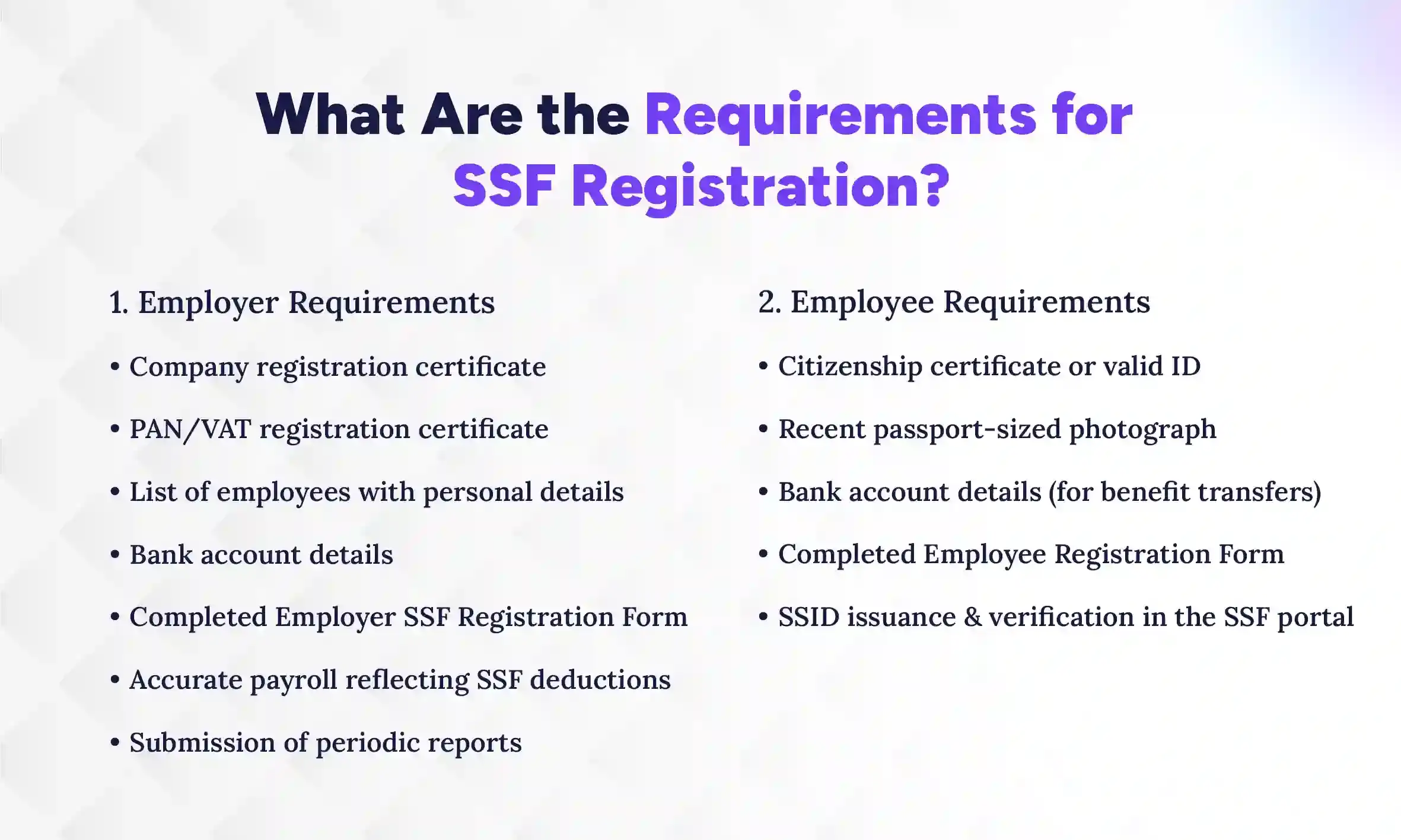
To register with SSF in Nepal, both employers and employees need to provide certain documents and details. While the process is straightforward, having everything ready in advance helps avoid delays and errors.
Let’s look at the requirements for each side:
1. Employer Requirements for SSF Registration
For businesses, SSF registration starts at the organizational level. Employers must submit the following:
Company registration certificate
PAN/VAT registration certificate
List of employees with personal details (such as name, date of birth, and position)
Bank account details for contribution payments
Completed Employer SSF Registration Form
In addition, employers are also responsible for ongoing compliance. This includes:
Maintaining accurate payroll with proper SSF deductions
Submitting periodic reports as required by SSF
2. Employee Requirements for SSF Registration
Once the employer is registered, employees must also provide their details for enrollment. These include:
Citizenship certificate or any valid ID
Recent passport-sized photograph
Bank account details (for receiving benefits)
Completed Employee Registration Form
After successful registration, each employee is assigned a Social Security Identification (SSID). It is important to verify this in the SSF portal, as it is used to track contributions and access benefits.
How to Register for SSF in Nepal: SSF Registration 2026
Registering for SSF in Nepal involves three main steps: employer registration on the SSF portal, employee enrollment, and starting monthly contributions. First, the employer registers the company and gets approval. Then, employees are added, SSIDs are generated, and contributions begin. Here’s how it works in detail:
Step 1: Employer Registration on SSF Portal
The process begins with the employer registering the company on the official SSF portal. To do this, the employer needs to fill out an online registration form and provide key details such as the company registration certificate, PAN/VAT certificate, bank account details, and contact information. Once the form is submitted, the SSF office reviews the application. In most cases, approval is completed within one to two working days, after which the company is officially registered in the system.
Step 2: Add and Register Employees
After the employer account is approved, the next step is to register employees. The employer logs into the SSF system and adds employee details, including their full name, date of birth, citizenship or national ID, and employment information. Once the details are submitted and verified, each employee is assigned a unique Social Security Identification number (SSID). This SSID is important, as it is used to track contributions and access SSF benefits.
Insights
Did You Know?
HR software can automatically calculate SSF deductions, reducing errors and saving time. Solutions like Pace HRMS make payroll management simpler.
Step 3: Contribution Setup and Monthly Payments
Once both employer and employees are registered, contributions must begin. The employee contributes 11% of their basic salary, while the employer adds 20%. The employer is responsible for deducting the employee’s share from their salary, adding their own contribution, and depositing the total amount into the SSF system every month. Timely and accurate payments are important to stay compliant and ensure employees can access their benefits without issues.
Step 4: Registration for Self-Employed or Informal Sector (Optional)
SSF also allows individuals who are self-employed or part of the informal sector to register on their own. In this case, individuals can apply through the self-employed SSF portal by providing identity verification from their local authority. They are required to contribute a minimum amount based on their income. This option helps extend social security coverage to people who are not part of formal organizations.
Step 5: SSID Verification and Record Maintenance
After registration is complete, it is important to verify that all employee details are correct in the system. Employers should check each employee’s SSID and ensure that records are properly maintained. Regular updates and accurate record-keeping help avoid errors, especially during audits or when employees need to claim benefits.
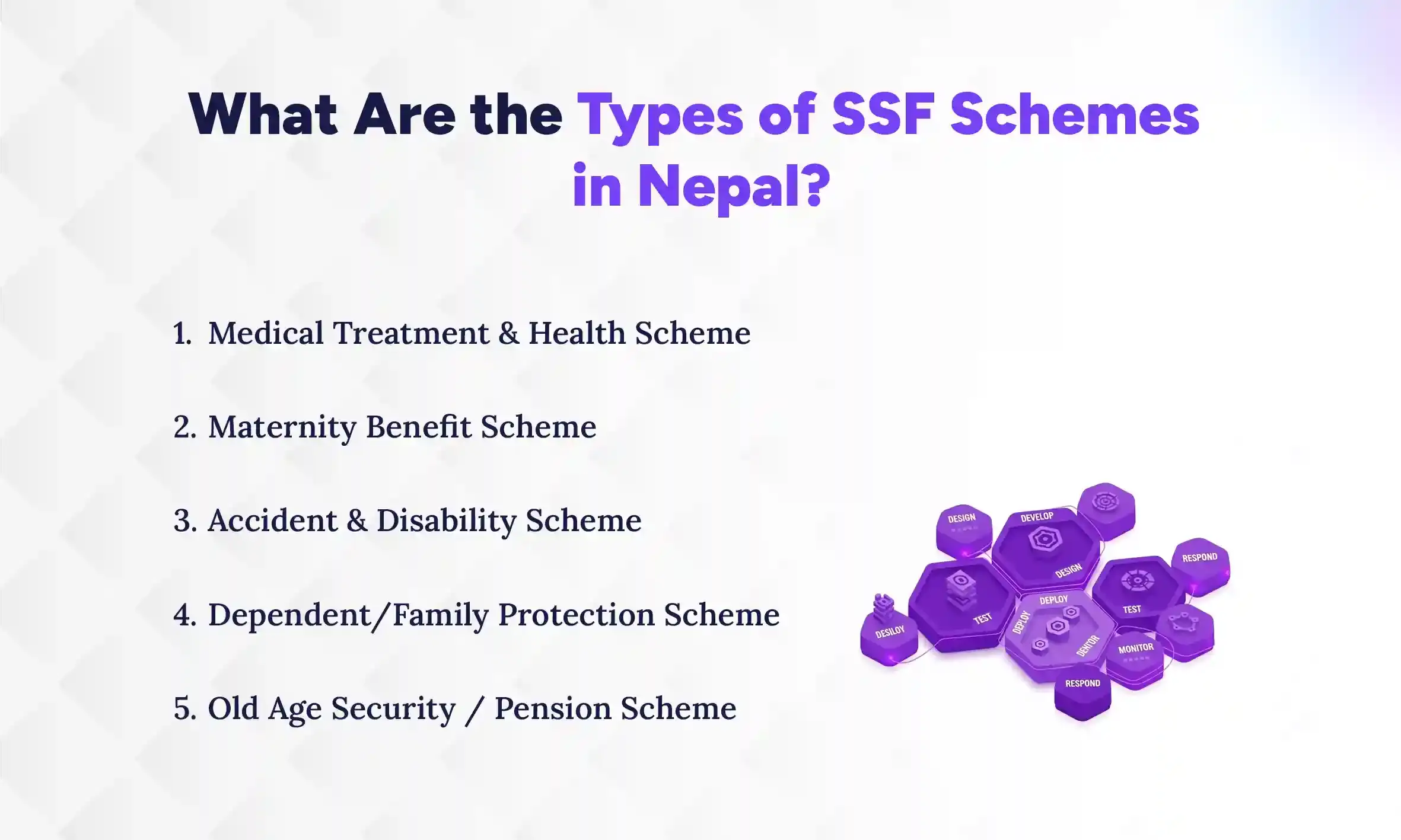
What Are the Types of SSF Schemes in Nepal?
The SSF offers five main schemes including medical care, maternity support, accident coverage, family protection, and a monthly pension for your retirement. These plans are designed to provide a complete financial safety net for every stage of your working life and beyond. Understanding exactly how each one protects you will help you make the most of your monthly contributions.
1. Medical Treatment & Health Scheme
This scheme is designed to take the sting out of high healthcare costs by covering 80% of your hospital bills. You can claim up to NPR 1,00,000 for staying in a hospital and up to NPR 25,000 for regular doctor visits and medicines every single year. To use this benefit, you simply need to have contributed for at least six months and choose a hospital that is partnered with the SSF. It ensures that a sudden illness doesn't drain your personal savings or leave you in debt while you recover.
2. Maternity Benefit Scheme
The maternity plan provides essential financial support for new mothers and their newborn babies during a very important time. You receive a one-time cash grant equal to one month’s minimum wage for every birth to help cover immediate costs. Additionally, the fund pays you 60% of your basic salary for any extra leave you need to take beyond what your employer already provides. This benefit is available to both female contributors and the wives of male contributors, making sure the whole family is supported.
3. Accident & Disability Scheme
This scheme steps in immediately if you are injured, offering full protection whether the accident happens at work or elsewhere. If you have an accident while performing your job, the fund pays for 100% of your medical treatment with no upper limit on the cost. For accidents that happen outside of work, the fund still provides a generous cover of up to NPR 7,00,000 for your recovery. If an injury leads to a permanent disability, you will receive a monthly pension based on the severity of the disability to help maintain your lifestyle.
4. Dependent Family Protection Scheme
The family protection plan ensures that your loved ones are never left stranded if the worst should happen to you. If a contributor passes away, their spouse is entitled to a lifetime monthly pension equal to 60% of the worker's last basic salary. Your children also receive a monthly educational scholarship until they turn 21 to make sure their schooling is never interrupted. Furthermore, the fund provides an immediate grant of NPR 25,000 to the family to help cover funeral expenses during a difficult time.
5. Old Age Security / Pension Scheme
This is your long-term retirement plan, designed to give you a steady and reliable income after you stop working. Once you reach the age of 60 and have made contributions for at least 15 years, you begin receiving a monthly pension check for life. The amount you get is calculated based on your total contributions and the interest they have earned over your entire career. It acts as a guaranteed paycheck that allows you to enjoy your retirement years with dignity and total financial independence.
Insights
Did You Know?
Manual SSF calculations can create compliance risks and reporting errors. Automated HR systems help simplify contribution tracking.
SSF vs. PF vs. CIT: What's the Difference in Nepal?
It is very common to get these three confused because they all involve saving money from your salary. However, while PF and CIT are mostly about saving for the future, SSF is a complete protection package that covers you today and tomorrow.
Here is a simple breakdown to help you see the difference:
Feature
Social Security Fund (SSF)
Provident Fund (PF)
Citizen Investment Trust (CIT)
What is it?
A complete safety net (Insurance + Pension).
A long-term savings account for retirement.
A voluntary investment plan to save on tax.
Is it Mandatory?
Yes, for all registered private businesses.
No longer mandatory if you are already in SSF.
Optional for everyone.
Total Contribution
31% (20% Employer + 11% Employee).
20% (10% Employer + 10% Employee).
You decide the amount (User-defined).
Medical & Insurance
Included. Covers hospital, accidents, and maternity.
Not Included. It is strictly a savings fund.
Not Included. It is an investment/savings tool.
When can you take money out?
Monthly pension after 60 (or lump sum for older enrollments).
Usually when you leave your job or retire.
Whenever you want (subject to certain rules/taxes).
Tax Benefits
You don't pay "Social Security Tax" (1%) if you're in SSF.
Reduces your taxable income.
Reduces your taxable income significantly.
Which one should you choose?
If you are a private-sector employee in Nepal, SSF is now the primary requirement. In the past, companies used PF and CIT to manage retirement, but the government is now moving everyone toward SSF because it offers much better protection, like paying your medical bills and supporting your family if something happens to you.
Many people still use CIT as an extra way to save money and lower their income tax, but it doesn't replace the security that SSF provides.
What Are the Challenges of Managing SSF for HR Teams?
Handling SSF can be a real headache for HR teams because it adds a lot of extra paperwork and strict deadlines to their monthly schedule. If the calculations aren't perfect or a filing is missed, the company could face expensive fines and legal trouble. These daily administrative hurdles make it difficult for teams to stay compliant without the right tools or a clear plan.
1. Manual Calculation of SSF Contributions
Calculating the 31% contribution for every employee is a slow and repetitive task when done by hand. Because you have to use the basic salary instead of the total pay, it is very easy to make a small math mistake. One wrong number can mess up your entire monthly report and cause issues with the government portal. Using a simple automated tool or spreadsheet is the best way to save time and keep your data accurate.
2. Errors in Salary Deductions and Compliance Risks
Making a mistake with salary deductions can lead to serious legal problems and unhappy employees. If the wrong amount is taken out, the company might be flagged for not following labor laws correctly. These errors can also prevent your staff from getting their medical or accident benefits when they need them most. Double-checking every deduction before finishing payroll helps you stay on the right side of the law and keeps your team's trust.
3. Managing Employee Data and SSID Records
Every employee needs a unique Social Security ID (SSID), and keeping track of these numbers for a growing team is a lot of work. HR must make sure that all new hires are registered within three months and that their personal details match the government records exactly. If a name is misspelled or an ID is wrong, the monthly filing will likely fail. Keeping a clean, organized list of these IDs in one central place makes the whole registration process much smoother.
4. Time-Consuming Monthly Contribution Process
The actual work of uploading data and paying the monthly bill is a long cycle that happens every single month. For companies with many workers, entering this data into the SOSYS portal can take hours or even days of focused effort. This monthly rush often leads to high stress levels as the 15th of the month approaches. Creating a clear step-by-step workflow for your team can help finish these tasks much faster and with fewer errors.
5. Difficulty in Generating Reports and Audit Records
When your SSF records are scattered across different folders and emails, preparing for an audit becomes a nightmare. You need to be able to show proof of every payment and registration to prove your business is following the law. If your files are messy, even a simple question from a government officer can turn into a huge, time-consuming project. Keeping a digital folder for all your monthly receipts and registration certificates makes audits fast and worry-free.
6. Lack of Integration with Payroll and Attendance Systems
When your payroll and attendance records aren't connected to your SSF data, you have to type the same information multiple times. This extra work is usually where most data entry mistakes happen, like getting a salary amount wrong. For example, if an employee takes unpaid leave, your SSF payment must change to match their actual pay for that month. Connecting these systems together helps your data flow correctly and ensures your final reports are always right.
How HR Software Simplifies SSF Management
Managing SSF manually can be a real challenge for HR teams. Calculating contributions, keeping track of employee SSIDs, updating payroll every month, and ensuring compliance with changing rules takes a lot of time and effort. Mistakes can happen easily, and even small errors may lead to penalties or delays in employee benefits.
This is where an SSF-integrated payroll or HRMS system can make a big difference. With the right software, employers no longer need to calculate contributions manually. The system automatically computes both employee and employer portions, updates for any changes in SSF rules, and keeps every record organized in one place.
If you want to see how this works in practice, tools like Pace HRMS offer full SSF integration, helping businesses manage contributions and compliance effortlessly.
Some of the key benefits include:
Automatic Contribution Calculations – eliminates manual math and reduces errors.
Accurate Employee Records & SSID Tracking – ensures every employee is properly registered and tracked.
Timely Submission & Compliance – deposits are made on schedule, avoiding late penalties.
Integrated Payroll & Attendance – links employee hours, leaves, and salaries to SSF contributions automatically.
Audit-Ready Reports – generates reports quickly for inspections or internal checks.
For businesses looking to save time, reduce errors, and stay compliant, HRMS tools with SSF integration are a practical solution. By automating routine tasks, HR teams can focus more on people management and less on paperwork, while employees get their benefits without delay.
Conclusion
We all want to work in a place where we feel valued and safe, and as a business owner, providing that peace of mind is one of the best things you can do for your team. When your employees know their health and future are protected, they can focus on doing their best work without worrying about the "what-ifs." It’s a simple step that builds a loyal, happy, and professional workplace for everyone involved.
Now that you know exactly how the fund works, you don't have to let the paperwork slow you down. Instead of struggling with manual math and portal errors, you can use a smart HRMS to automate your entire SSF process from registration to monthly audits. Take the stress out of compliance and let technology handle the heavy lifting for you.