HR and finance need shared visibility into payroll costs because each department manages a different part of the same payroll process. Without a connected system, their reports can gradually drift apart, and those differences often surface only during budget reviews or month-end reconciliation.
HR works with attendance, leave, overtime, and compensation changes, while finance focuses on payroll payments, accounting records, and statutory reporting. When these data sources are not connected, payroll becomes harder to verify, financial close takes longer, and unexpected payroll costs can catch businesses off guard. A shared payroll view helps both teams work from the same reliable information, improving accuracy, collaboration, and faster decision-making.
What Does Shared Visibility Into Payroll Costs Actually Mean?
Shared visibility into payroll costs means HR and finance work from the same real-time payroll data, use consistent definitions across departments, and access the information they need without duplicating work or maintaining separate spreadsheets.
1. Real-Time Access to the Same Numbers
Instead of relying on different reports, both HR and finance can view the same payroll figures as they are updated. This helps everyone work with current salary, attendance, and payroll information without waiting for manual updates.
2. Consistent Definitions Across Departments
When both teams use a single payroll system, terms like gross pay, net pay, overtime, and complex payroll deductions have the same meaning everywhere. This consistency reduces confusion during payroll reviews and financial reporting.
3. Visibility Without Duplicated Work
HR can manage employee records and attendance while finance handles payroll accounting without re-entering the same information. A connected system reduces repetitive tasks and lowers the chance of data-entry errors.
How Come HR and Finance Often Work From Separate Payroll Data?
HR and finance often work from separate payroll data because they often rely on different software, payroll ownership has traditionally been split between departments, and there isn't always a shared reporting system that keeps both teams aligned.
1. Different Tools for Different Functions
HR uses systems designed around attendance and compensation planning. Finance uses accounting software built around cost allocation and tax reporting. Understanding the difference between standalone payroll software and an HRMS highlights exactly why these disconnected platforms rarely talk to each other, meaning leave adjustments processed in HR don't automatically flow to accounting software.
2. Historically Separate Departmental Ownership
In many organizations in Nepal, payroll responsibility fell either to HR or finance, and each built its own processes around the part of payroll they controlled. Even when companies grew, the old silos persisted.
3. Lack of a Shared Reporting Standard
Without a common reporting format or centralized dashboard, HR and finance may generate different payroll reports from the same underlying data. This makes reconciliation slower and increases the risk of errors.
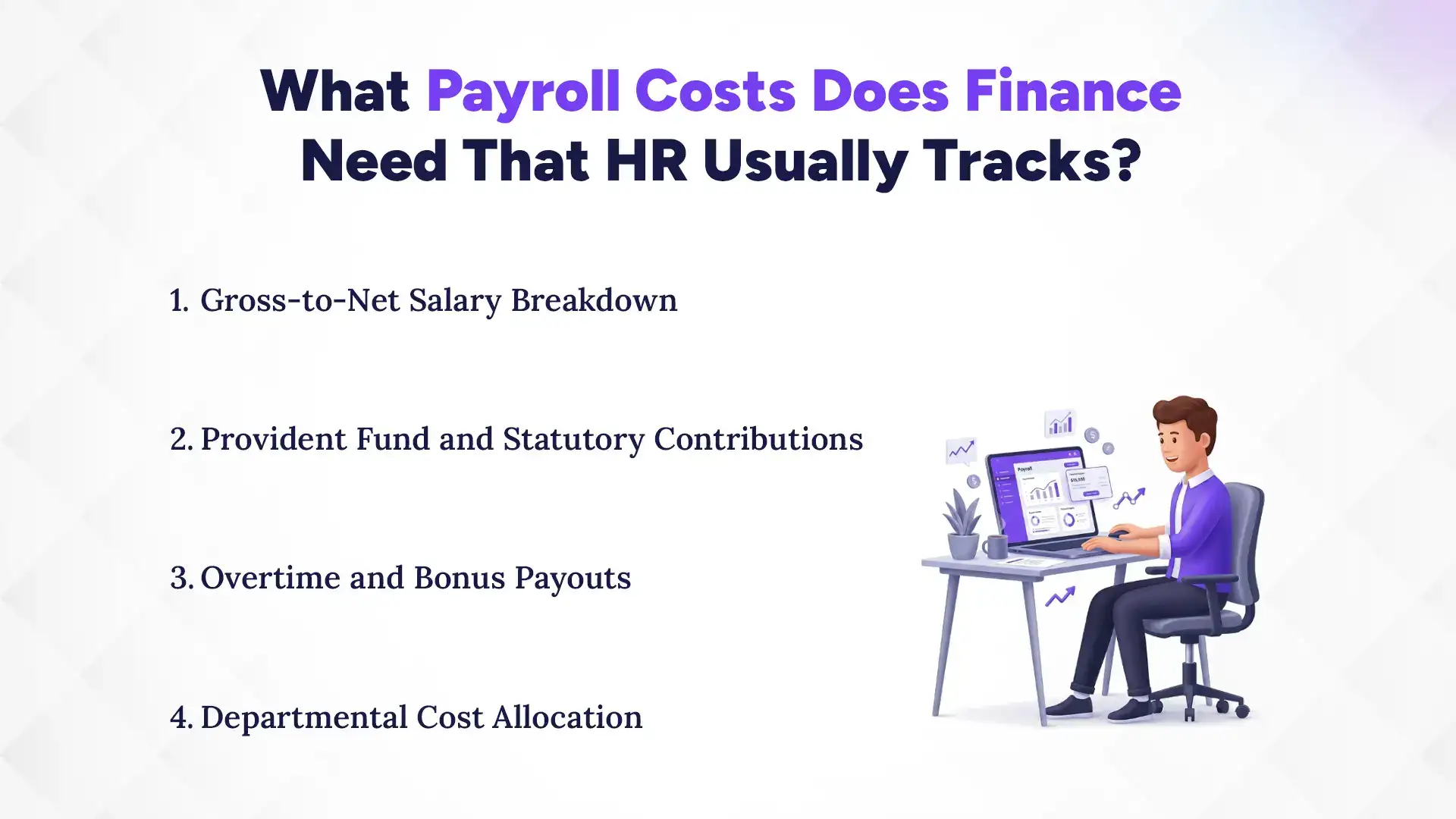
What Finance Needs That HR Usually Tracks
Finance relies on payroll costs that HR often manages first, including salary calculations, statutory contributions, overtime payments, and department-wise employee expenses. When both teams share this information, payroll reporting becomes more accurate and easier to reconcile.
1. Gross-to-Net Salary Breakdown
HR tracks salary structures, allowances, deductions, and other employee-specific details that determine how gross salary becomes net pay. Finance needs this breakdown to verify payroll expenses and maintain accurate accounting records.
2. Provident Fund and Statutory Contributions
Payroll also includes statutory deductions and employer contributions, such as provident fund, taxes, and other mandatory payroll obligations. Shared visibility helps finance reconcile these amounts while ensuring HR's employee records match payroll calculations.
3. Overtime and Bonus Payouts
Overtime approvals, incentive payments, and bonuses often originate from HR processes before appearing in payroll. Finance needs visibility into these adjustments to avoid unexpected payroll costs and improve budget planning.
4. Departmental Cost Allocation
Finance frequently analyzes payroll costs by department, branch, or cost center for budgeting and performance reporting. HR's employee assignment data provides the context needed to allocate payroll expenses accurately across the organization.
What Payroll Context Does HR Have That Finance Usually Lacks?
HR usually has the context behind leave and attendance changes, employee compensation history, and payroll exceptions that finance often cannot see directly through financial reports alone.
1. Reasons Behind Leave and Attendance Adjustments
HR manages leave requests, attendance records, overtime approvals, and shift changes. This helps explain why an employee's pay changed in a particular payroll cycle.
2. Employee-Specific Compensation History
HR tracks salary revisions, promotions, bonuses, allowances, and employment status changes over time. This historical context helps verify whether payroll updates match approved employee records.
3. Context Behind Payroll Exceptions
When payroll exceptions occur, such as unpaid leave, retroactive salary changes, or one-time adjustments, HR usually knows the reason behind them. Finance may see the numbers, but HR provides the explanation needed for accurate payroll reconciliation.
What Happens When HR and Finance Don't Share Payroll Visibility?
When HR and finance don't share payroll visibility, reports end up with conflicting numbers, budget surprises show up at month-end, financial close processes slow down, and distrust builds between the two departments.
1. Conflicting Numbers in Reports
HR's payroll report shows 50 lakhs gross salary; finance's report shows 48 lakhs after deductions and statutory adjustments. Neither team is wrong; they're just measuring different things, but this forces time-consuming investigation that could have been avoided with unified data.
2. Budget Surprises at Month-End
Finance budgets based on assumptions, but when month-end arrives and HR's actual payroll is reconciled, the real number differs significantly. If it exceeded budget, it's too late to adjust spending or communicate changes to leadership with enough lead time.
3. Slower Financial Close Processes
Month-end reconciliation consumes 2-3 days of manual work: pulling reports from multiple systems, comparing numbers line by line, and investigating discrepancies. Shared visibility collapses this into near-automatic agreement, accelerating close by a week or more.
4. Distrust Between Departments
When reports don't match, each department questions the other's accuracy. Finance suspects HR is over-recording costs; HR suspects finance is misallocating payroll. This distrust poisons collaboration and makes future improvements harder.
What Should You Look for in a System That Connects HR and Finance?
A system that connects HR and finance should provide real-time data synchronization, role-based access for each department, and standardized reports that keep payroll information consistent across both teams. When deciding between standalone payroll or a full HRMS, real-time data sync should be a top priority.
1. Real-Time Data Sync Between Functions
Payroll, attendance, leave, and employee updates should flow automatically between HR and finance. Real-time synchronization is one of the primary benefits of using HR software that eliminates manual data entry and helps both teams work from the latest information.
2. Role-Based Views for Each Department
HR and finance need access to the same payroll data but with different priorities. A role-based system lets HR manage employee records while finance focuses on payroll costs, taxes, and accounting without exposing unnecessary information.
3. Consistent Reporting Formats
A unified reporting format ensures both departments see the same payroll totals, deductions, and headcount figures. Consistent reports make reconciliation faster, improve accuracy, and support smoother month-end financial closing.
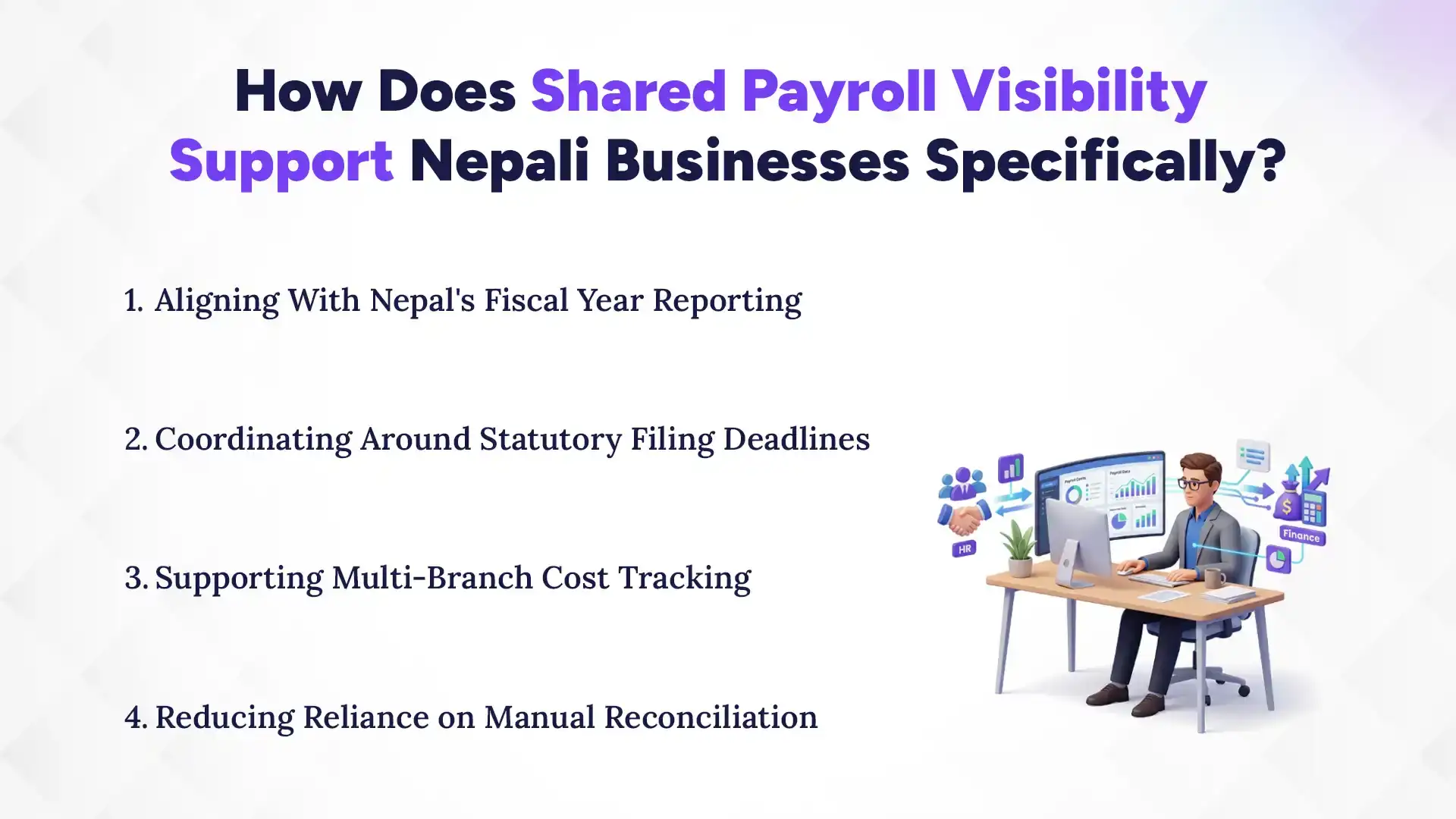
How Does Shared Payroll Visibility Support Nepali Businesses Specifically?
Shared payroll visibility helps Nepali businesses keep HR and finance aligned with local reporting requirements, statutory deadlines, and branch-level payroll tracking. It also reduces manual reconciliation, making payroll management more accurate and efficient.
1. Aligning With Nepal's Fiscal Year Reporting
Nepal's fiscal year runs from Shrawan to Ashadh. Shared visibility ensures both departments are aligned on the fiscal year cutoff and that all payroll transactions are recorded in the correct fiscal year.
2. Coordinating Around Statutory Filing Deadlines
Nepal's statutory bodies have specific deadlines for payroll tax filings. Shared visibility means finance can review HR's payroll data in advance, flag discrepancies early, and coordinate corrections before submission deadlines.
3. Supporting Multi-Branch Cost Tracking
Many Nepali organizations operate across multiple locations with different compensation structures. Shared visibility lets finance track payroll costs by branch and HR maintain location-specific policies without creating gaps.
4. Reducing Reliance on Manual Reconciliation
Manual reconciliation is time-consuming and doesn't scale. Shared payroll visibility eliminates it by ensuring both departments work from the same system from the start.
Which HRMS Gives HR and Finance the Best Shared Payroll Visibility in Nepal?
Pace HRMS gives HR and finance access to the same payroll data through real-time updates, role-based reporting, and consistent records that reduce manual reconciliation for Nepali businesses.
Instead of relying on separate spreadsheets or disconnected systems, Pace HRMS brings payroll, attendance, leave, and employee records into one platform. This gives HR the employee context behind payroll changes while finance gets accurate payroll figures for budgeting, reporting, and month-end closing.
Conclusion
HR and finance aren't tracking two different things; they're tracking two sides of the same payroll cost. Without shared visibility, those perspectives quietly drift apart until a budget review forces a painful reconciliation that could have been prevented entirely.Shared payroll visibility is essential for any business in Nepal that values accurate reporting, faster closes, and trust between departments.
Ready to give HR and finance shared visibility into payroll costs? Explore Pace HRMS or contact our Pace Infosys team to see how unified payroll management works.
FAQs
How often should HR and finance reconcile payroll data if systems aren't connected?
+
HR and finance should reconcile payroll data monthly, which can take 1–3 days when done manually.
Can HR and finance use the same HRMS without affecting each other's workflows?
+
Yes. A well-designed HRMS uses role-based access so each department sees only the data and functions it needs.
What causes payroll numbers to differ between HR and finance reports?
+
Payroll numbers can differ because of timing, data inclusion, and calculation differences between HR and finance.
Does shared payroll visibility require finance to learn HR software?
+
No. Finance can use finance-specific dashboards and reports within the same HRMS.
Can role-based access keep sensitive HR data separate?
+
Yes. Role-based access can restrict sensitive employee information while allowing finance to view necessary payroll costs.
How does shared visibility affect month-end financial close?
+
Shared payroll visibility reduces manual reconciliation, helping HR and finance complete month-end closing faster and with fewer errors.
Ready to get started?
Book a 30-minute consultation call, and let's talk about your goals.