


Running an engineering company isn’t just about delivering projects on time, it’s about managing people across sites, shifts, and tight deadlines. And that’s exactly where things start to get messy.
Spreadsheets go out of date, attendance from field staff becomes hard to verify, and payroll? It quickly turns into a guessing game with overtime, allowances, and compliance in the mix.
Traditional HR methods simply can’t keep up with this level of complexity. They slow teams down, create errors, and leave too much room for confusion.
That’s why more engineering firms in Nepal are turning to HR software. With the right system in place, you can automate routine tasks, track your workforce in real time, and manage everything with clarity and control. This guide walks you through exactly how it works, and why it matters.
What is HR Software for Engineering Companies?
HR software for engineering companies is a digital system that helps you manage your people in one place. It handles everyday tasks like attendance, payroll, leave, and employee records. Instead of juggling spreadsheets or paperwork, everything is organized, updated, and easy to access. This saves time and reduces mistakes, especially when your team is large or spread across different sites.
But, engineering companies don’t work like regular offices. You have field staff, project-based teams, shifting schedules, and different types of pay. That’s why this kind of HR software is built to handle those specific needs. It can track site attendance, manage overtime, and even assign employees to different projects without confusion.
In contrast, generic HR systems are often too basic. They may work fine for simple office setups, but they struggle with the complexity of engineering work. So, choosing the right HR software means picking a system that understands how your business actually runs and supports it every step of the way.
Why Engineering Companies Need Specialized HR Software in 2026?
Engineering companies need specialized HR software to manage projects, field teams, and complex payroll in one system. It connects HR tasks with project workflows, making daily operations smoother and more accurate. More importantly, it sets the foundation for better control, visibility, and efficiency across your workforce.
- Track field staff attendance with GPS
- Calculate overtime and site pay correctly
- Assign workers to the right projects quickly
- See who is working where in real time
- Reduce manual data entry and paperwork
- Avoid payroll mistakes and delays
- Keep all employee records in one place
- Manage shifts without confusion
- Track leave without affecting project timelines
- Stay updated with labor rules in Nepal
In short, the right HR software brings structure to daily operations. And once that’s in place, managing people becomes simpler, faster, and far more reliable.
Key Features of HR Software for Engineering Companies
HR software for engineering companies includes features like smart attendance, project-based allocation, automated payroll, and more to handle complex workforce needs. These tools work together to reduce manual work, improve accuracy, and give better control over daily operations. Let’s break down each feature of HR software to see how they actually support your team on the ground.
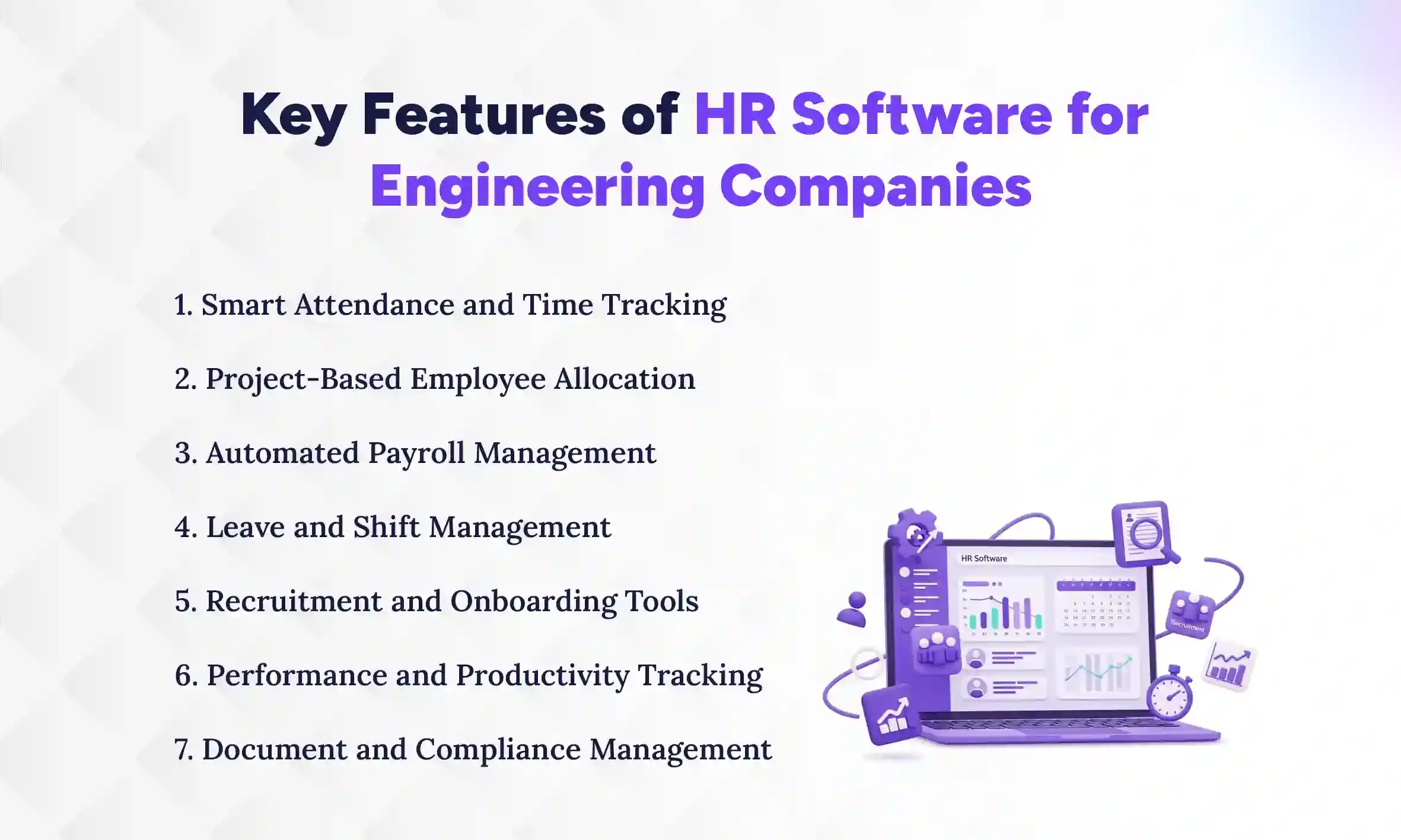
1. Smart Attendance and Time Tracking
Smart attendance and time tracking helps you record when and where employees work, especially for field teams. With GPS-based check-ins, you can verify if someone is actually on-site, which reduces fake entries and time theft. It also tracks work hours automatically, including overtime, so you don’t have to calculate everything manually. Over time, this gives you clear data on attendance patterns, helping you plan shifts better and avoid delays.
2. Project-Based Employee Allocation
This feature lets you assign employees to specific projects based on their skills and availability. Instead of guessing who is free, you can see real-time data and make quick decisions. It also helps track how long someone worked on a project, which is useful for cost control and billing. As a result, you avoid overloading some workers while others stay underused.
3. Automated Payroll Management
Payroll in engineering companies can get complicated with overtime, site allowances, and different pay rates. Automated payroll handles all these factors without errors, ensuring every employee gets paid correctly and on time. It also takes care of tax deductions and compliance, so you don’t have to worry about legal issues. This not only saves time but also builds trust among employees.
4. Leave and Shift Management
Managing leave and shifts becomes easier when everything is handled in one system. Employees can apply for leave, and managers can approve it quickly without back-and-forth calls. At the same time, you can plan shifts in advance, especially for site work that runs in rotations. This ensures projects continue smoothly without sudden staff shortages.
5. Recruitment and Onboarding Tools
Hiring the right engineers and workers is critical, and this feature helps you do it faster. You can track applicants, schedule interviews, and manage hiring in one place. Once hired, onboarding with an HR software becomes simple with digital forms, document uploads, and step-by-step guidance. This helps new employees settle in quickly and start contributing sooner.
6. Performance and Productivity Tracking
This feature allows you to measure how employees perform across different projects. You can track key data like task completion, time spent, and output quality. Instead of relying on guesswork, you get clear insights to support appraisals and promotions. Over time, this helps improve overall team productivity and accountability.
7. Document and Compliance Management
Engineering companies deal with many documents like contracts, certifications, and safety records. This feature keeps everything stored securely in one place, making it easy to access when needed. It also helps you stay compliant by tracking expiry dates of licenses and required documents. As a result, you stay audit-ready and avoid penalties or project delays.
Which Is the Best HR Software for Engineering Companies in Nepal?
Pace HRMS is one of the best HR software options for engineering companies in Nepal because it is built for field teams, project-based work, and complex payroll needs. It helps manage attendance, payroll, and employee data in one simple system. This makes daily HR work easier and more organized for engineering firms.
What makes Pace HRMS strong is its focus on real field operations. It tracks site attendance, supports GPS check-ins, and connects employee work directly with project allocation. Payroll is also calculated automatically based on attendance, overtime, and site allowances, which reduces manual effort and mistakes.
The main benefit is simple and accurate HR management for engineering work. Companies can manage multiple sites and teams without confusion or delays. That is why many engineering firms in Nepal choose Pace HRMS for better control and smoother operations.
Common HR Challenges Faced by Engineering Companies
Engineering companies deal with HR challenges that are more complex than regular office setups, mainly because work is spread across multiple sites and projects. Managing people in such a dynamic environment often leads to confusion, delays, and errors if systems are not strong enough. Let’s look at the most common challenges faced by HR teams in daily operations.
1. Managing Project-Based Workforce
In engineering companies, employees often move from one project to another based on demand and skill. This makes it hard to track who is working on which project at any given time. Without proper systems, resource planning becomes guesswork and can lead to overstaffing or underutilization. As a result, project timelines and costs can easily get affected.
2. Handling Field vs Office Employees
Engineering firms usually have two very different types of employees, generally, field workers and office staff. Field employees work on-site with changing locations and schedules, while office staff follow fixed routines. Managing both groups together using the same process often creates gaps in tracking and communication. This mismatch can lead to missed updates and poor coordination between teams.
3. Complex Payroll Structures
Payroll becomes complicated when employees have different pay structures based on site work, overtime, and allowances. Calculating everything manually increases the chances of mistakes and delays. Even a small error can affect employee trust and create dissatisfaction. Over time, managing these variations without automation becomes a heavy burden for HR teams.
4. Compliance with Labor Laws and Safety Regulations
Engineering companies must follow strict labor laws and safety rules, especially for field operations. Keeping track of working hours, safety training, and required documentation is not easy when done manually. Missing even a small compliance requirement can lead to penalties or project delays. This makes proper tracking and record-keeping very important.
5. Tracking Skill-Based Roles and Certifications
Different engineering projects require specific skills and certifications, and not every employee can work on every task. Tracking who has which qualification becomes difficult when records are scattered. Without a clear system, it is easy to assign the wrong person to a job. This can affect both safety and project quality in the long run.
Benefits of Using HR Software in Nepalese Engineering Firms
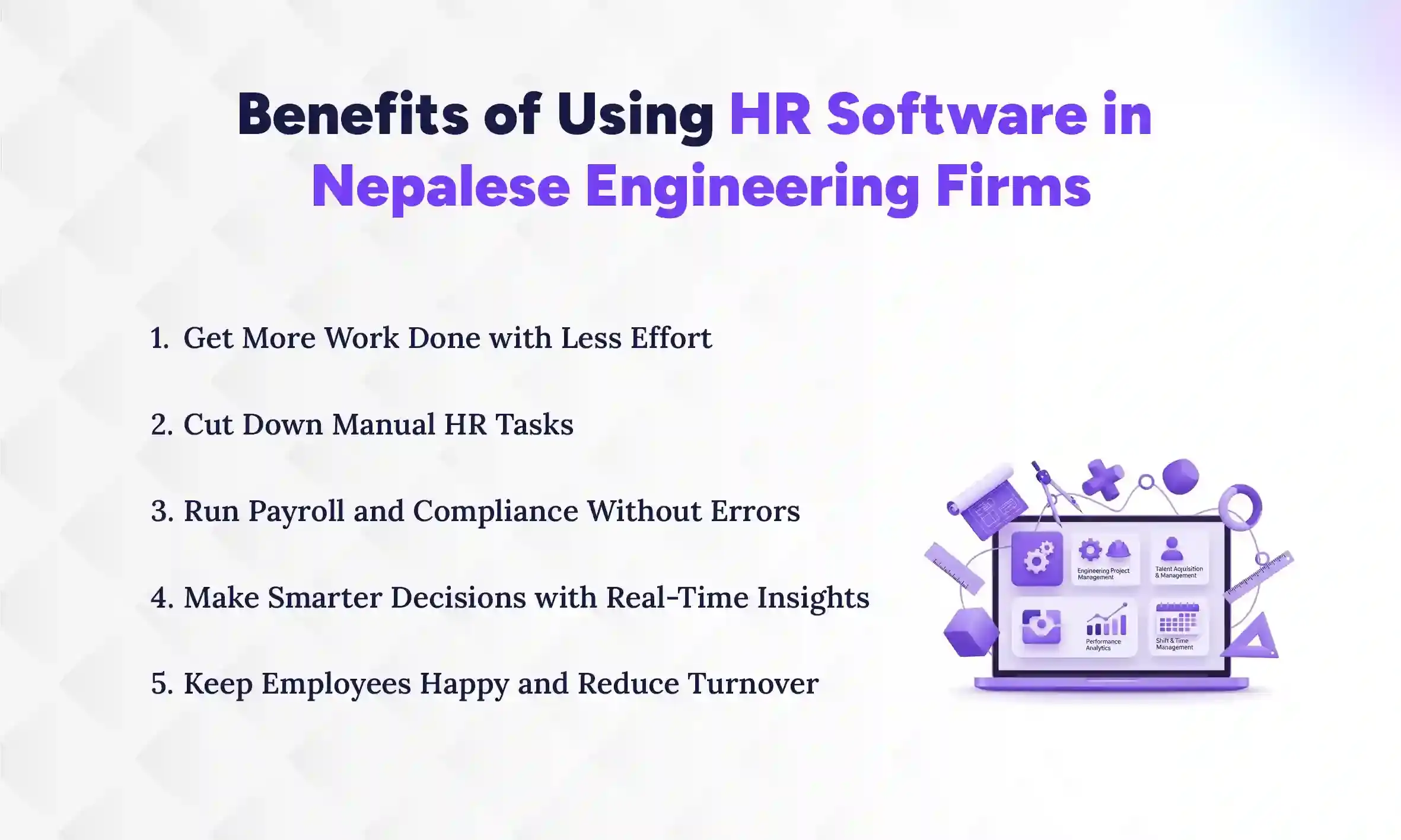
HR software helps engineering companies in Nepal improve efficiency, reduce manual work, ensure accurate payroll, and make better decisions with real-time data. It brings structure to daily HR tasks while supporting both office and field teams with clear and reliable systems. Now, let’s look at how these HRMS benefits actually show up in your day-to-day operations.
1. Get More Work Done with Less Effort
HR software removes the need to handle repetitive tasks manually, which saves time every single day. For example, attendance management, payroll system, and leave tracking all run automatically in the background. This allows your HR team to focus on important work like planning and employee support. As a result, your entire organization becomes faster, more organized, and more productive without increasing effort.
2. Cut Down Manual HR Tasks
Manual processes like updating spreadsheets, checking attendance logs, and preparing reports take up a lot of time. With HR software, all of this is done in one system with just a few clicks. Data updates happen instantly, which reduces back-and-forth work between teams. Over time, this cuts down errors and frees up hours that can be used for more valuable tasks.
3. Run Payroll and Compliance Without Errors
Payroll mistakes can lead to unhappy employees and even legal trouble. HR software calculates salaries, overtime, allowances, and deductions automatically, which reduces the chance of errors. It also helps you stay updated with Nepal’s labor rules and tax requirements. This means you can run payroll smoothly every month without stress or last-minute corrections.
4. Make Smarter Decisions with Real-Time Insights
Good decisions depend on accurate data, and HR software gives you exactly that. You can see real-time reports on attendance, performance, and workforce usage. This helps you spot issues early, like low productivity or high absenteeism. With clear insights, you can plan better, manage resources wisely, and improve overall business performance.
5. Keep Employees Happy and Reduce Turnover
When systems are smooth, employees notice the difference. They get paid on time, their leave is managed properly, and their work is tracked fairly. This builds trust and improves their overall experience at work. As a result, employees feel more satisfied and are more likely to stay with your company longer.
How to Choose the Right HR Software for Your Engineering Company?
To choose the right HR software for an engineer company in Nepal, shortlist options, compare features, and evaluate how each HR software fits your engineering company’s daily operations. Making the best decision is crucial because it directly affects how smoothly your engineering company runs on a daily basis. A good system should match your workflow, support your teams, and reduce manual effort instead of adding complexity. So, let’s go step by step to understand what you should focus on before making a decision.
1. Identify Business Requirements
Start by clearly understanding what your company actually needs from HR software. For example, you may need better attendance tracking for field staff, or stronger payroll management for project-based work. When you know your priorities, it becomes easier to filter out unnecessary features. This step ensures you choose a system that truly fits your operations, not just something popular.
2. Evaluate Core Features
Next, understand how HR software actually works. Check the key features the software offers and see if they solve your real problems. Look for things like payroll automation, project tracking, and leave management, especially if you handle multiple sites. Don’t just focus on feature lists; instead, think about how each feature will help your daily work. This helps you avoid paying for tools you will never actually use.
3. Consider Scalability and Flexibility
Your engineering company will grow, and your HR software should grow with it. A scalable system allows you to add more employees, projects, and locations without performance issues. Flexibility is also important because every project may have different HR needs. So, choose software that adapts easily as your business expands. For the beginning, you can learn about HR software for small businesses, assess their scalability, and adopt the right one accordingly.
4. Check Integration Capabilities
HR software should not work in isolation; it should connect with other tools you already use. For example, it may need to integrate with payroll systems, accounting tools, or project management platforms. This reduces duplication of work and keeps all your data consistent. Better integration means smoother operations and fewer manual updates.
5. Assess User Experience and Support
Even the most powerful software is useless if it is hard to use. A simple and clean interface helps your HR team and employees adopt the system quickly. At the same time, strong customer support is important in case you face issues or need help. Good support ensures your system keeps running smoothly without unnecessary downtime.
How to Implement HR Software in an Engineering Firm in Nepal?
Implementing HR software in an engineering firm is not just about installing a system, it’s about setting up a smoother way of managing people and projects. When done properly, it reduces confusion, improves accuracy, and makes daily HR work much easier. So, let’s go through each step to understand how to implement it effectively.
1. Planning and Requirement Analysis
Start by understanding what your company actually needs from the HR system. Identify key problems like attendance tracking, payroll errors, or difficulty managing field staff. Involve both HR and project teams during this stage so nothing important is missed. A clear plan at the beginning helps you avoid confusion later and ensures the software fits your real workflow.
2. System Setup and Customization
Once planning is done, the next step is setting up the software based on your company structure. This includes adding departments, defining roles, and setting up payroll rules according to your policies. Customization is important because engineering companies often have site-based work and different pay structures. When the system is properly configured, it works exactly the way your business operates.
3. Data Migration and Testing
After setup, you need to move your existing employee data into the new system. This includes records like attendance history, payroll details, and personal information. Before going live, test everything carefully to make sure calculations and reports are accurate. Testing helps you catch errors early, so you don’t face problems during actual use.
4. Employee Training and Adoption
Even the best software fails if employees don’t know how to use it. That’s why proper training is very important, especially for field staff and HR teams. Show them how to mark attendance, apply for leave, and check records easily. When employees understand the system, adoption becomes smooth and resistance is much lower.
5. Continuous Optimization
Implementation does not end after setup; it continues with regular improvements. Monitor how the system is being used and identify areas where processes can be made simpler. As your company grows, you may need to adjust settings or add new features. Continuous optimization ensures your HR software always supports your business needs effectively.
Common Mistakes to Avoid When Implementing HR Software
Many engineering companies rush into HR software implementation without proper planning, and that often leads to confusion and poor results. A good system can improve efficiency, but only if it is set up and used correctly from the start. So, let’s look at some common mistakes you should avoid to make the transition smooth and successful.
1. Ignoring User Training
One of the biggest mistakes is not training employees properly before using the system. Even if the software is simple, field staff and HR teams still need guidance to use it correctly. Without training, people may continue using old methods or make errors in the system. This reduces the actual value of the software and slows down adoption.
2. Choosing Overly Complex Systems
Some companies choose software with too many features that they don’t actually need. While it may look powerful, it often becomes difficult for employees to use on a daily basis. In engineering environments, simplicity matters because teams already handle complex project work. A complicated system only adds more confusion instead of solving problems.
3. Lack of Proper Data Migration Planning
Moving old HR data into a new system needs careful planning, but many companies ignore this step. Poor migration can lead to missing records, incorrect payroll history, or broken reports. This creates problems right from the start and affects trust in the new system. Proper planning ensures all important data is transferred safely and accurately.
Conclusion
HR software is no longer just a support tool for engineering companies in Nepal, it has become a core part of running efficient, organized, and scalable operations. From managing field teams and project-based work to handling payroll, compliance, and performance, it brings everything into one simple system that reduces errors and saves time.
At the end of the day, engineering work is already complex, but managing people shouldn’t feel harder than the projects themselves. With the right system in place, you get more clarity, less stress, and better control over your workforce. It helps your team focus on building and delivering, instead of getting stuck in manual HR tasks.
If you’re ready to make your operations smoother and more future-ready, now is the right time to take that step. Explore affordable HR software in Nepal built for engineering companies and start transforming the way your team works today.