Managing salaries should be simple. Yet for many businesses, payroll day feels stressful. Spreadsheets break. Tax rules change. Attendance records don’t match. And one small mistake can upset employees or attract penalties. That’s where things start getting complicated.
As teams grow, manual systems quietly slow you down. HR spends hours checking numbers instead of focusing on people. Business owners worry about compliance, especially with Nepal’s tax laws and Social Security Fund requirements. It becomes clear that traditional methods are not built for modern workplaces.
This is where HRMS payroll software makes a real difference. It brings payroll, employee data, compliance, and reporting into one smooth system. In this complete guide, you’ll learn what HRMS payroll software is, how it works, and how it helps businesses in Nepal and beyond run smarter and faster.
What Is HRMS Payroll Software?
HRMS payroll software is a system that combines human resources and payroll into one platform. It manages employee records, attendance, leave, salary, taxes, and compliance in a single place.
Also called HRMS payroll, payroll HRMS, or HRMS and payroll software, the tool ensures accurate salaries and reduces manual errors. Everything works together, so HR teams save time and businesses stay compliant.
For growing companies, especially in Nepal, this integration isn’t just convenient, it’s essential.
1. How HRMS and Payroll Software Work Together?
Your HRMS stores employee details, such as joining date, salary structure, leave balance, benefits, department, and more. Meanwhile, the payroll system uses that information to calculate salaries, deductions, bonuses, and taxes.
When both systems work together, such that:
Attendance automatically affects salary.
Leave records adjust pay correctly.
Tax deductions follow updated rules.
Promotions or salary revisions reflect instantly.
So instead of HR updating data manually every month, the system pulls real-time information. This not only saves time but also improves accuracy.
For businesses in Nepal, this integration becomes even more important. Income tax slabs, Social Security Fund (SSF) contributions, and other statutory deductions can change. A connected payroll & HRMS system helps ensure compliance without extra manual effort.
2. Payroll Software vs Payroll HRMS Software: What’s the Difference?
Standalone payroll software focuses only on salary processing. It calculates pay, deducts taxes, and generates payslips. While that sounds useful, it does not manage broader HR functions like recruitment, employee records, leave tracking, or performance management.
On the other hand, payroll HRMS software integrates everything. Employee attendance flows into payroll. Salary revisions update automatically. Compliance data stays consistent across the system.
In short:
Standalone payroll software = salary calculator
HRMS & payroll software = complete workforce management system
If you are running a small team, basic payroll may work for now. But as your business grows, disconnected systems create more work than they solve. An integrated HRMS payroll solution gives you structure, visibility, and control, all in one place.
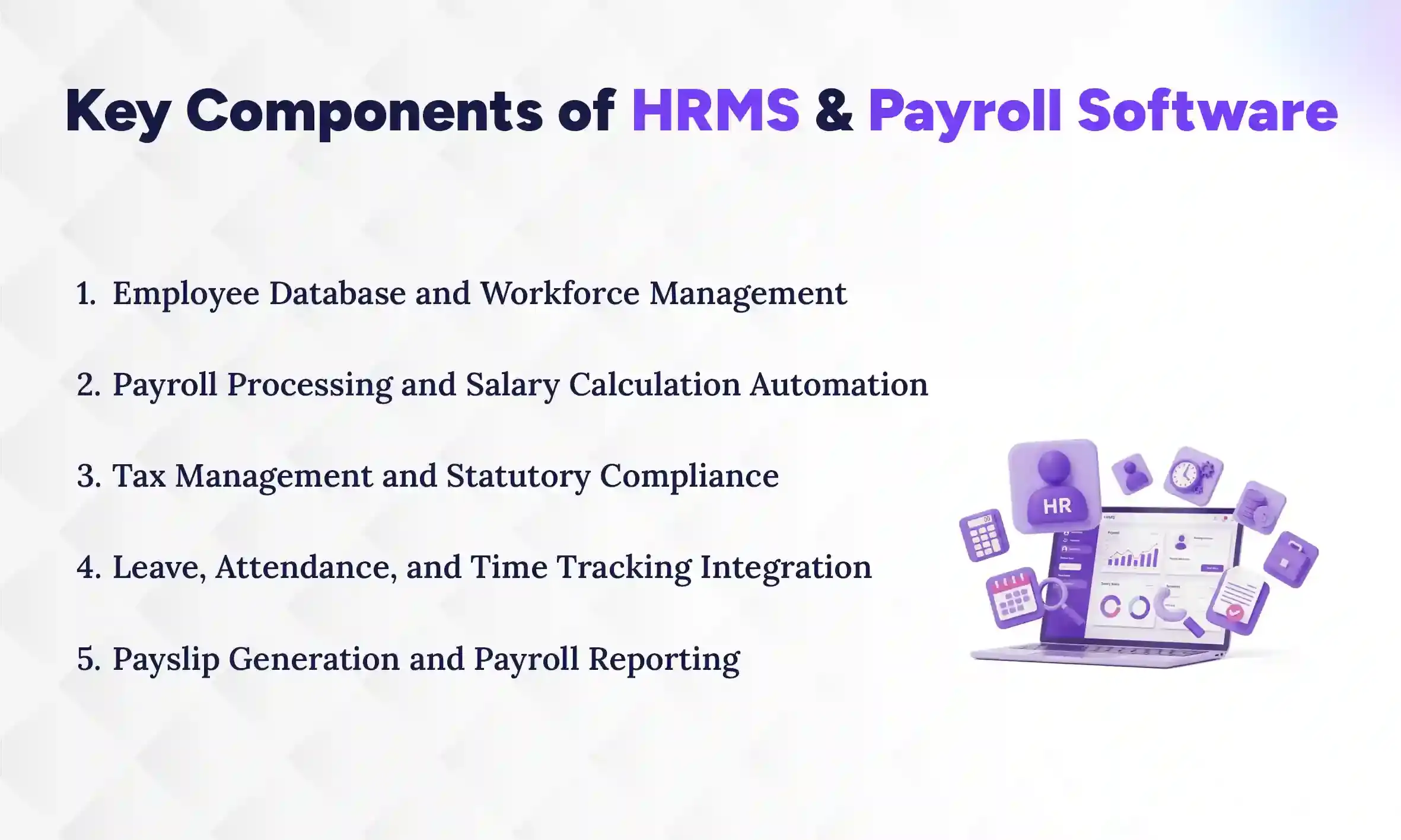
What Are the Key Components of HRMS and Payroll Software?
The key components of HRMS and payroll software cover everything a business needs to manage employees and pay them correctly. These systems organize employee data, automate salary calculations, handle tax compliance, track attendance, and generate reports efficiently. Each part works together to reduce errors and save HR teams a lot of time. This is especially valuable when using payroll software for small business, helping simplify payroll and HR management. Let’s explore these components in detail so you can understand how they make payroll and HR easier.
1. Employee Database and Workforce Management
The employee database is the heart of HRMS payroll software. It stores all essential information like personal details, job role, department, and joining date. This helps HR quickly access and manage employee records without digging through spreadsheets or paper files. Workforce management goes a step further by tracking roles, shifts, and performance, giving managers a clear view of their team at any time. With accurate employee data, every other component, like payroll or leave tracking, works seamlessly.
2. Payroll Processing and Salary Calculation Automation
Payroll processing is where the software truly saves time. It automatically calculates salaries based on attendance, overtime, bonuses, and deductions. This reduces errors from manual calculations and ensures employees are paid correctly every month. Automation also handles adjustments like promotions or salary revisions instantly, so HR doesn’t have to update multiple systems. Accurate payroll processing keeps employees happy and businesses compliant with local regulations.
3. Tax Management and Statutory Compliance
One of the most critical parts of HRMS payroll software is managing taxes and statutory rules. The system calculates income tax, social security contributions, and other mandatory deductions automatically. It also updates whenever tax laws or labor regulations change, which is especially important for businesses in Nepal. By automating compliance, it prevents penalties and saves HR teams from spending hours on paperwork.
4. Leave, Attendance, and Time Tracking Integration
Leave and attendance tracking is integrated directly with payroll, so salary reflects actual work hours. Employees can submit leave requests through the system, and managers can approve them with a click. Attendance can be synced with biometric devices or online check-ins, making the process accurate and transparent. This integration ensures payroll calculations are always up-to-date and reduces disputes over overtime or unpaid leave.
5. Payslip Generation and Payroll Reporting
Finally, HRMS payroll software handles payslip generation and reporting effortlessly. Payslips are created automatically and can be shared digitally with employees. The system also generates reports for salaries, taxes, benefits, and compliance, helping business owners understand costs and make better decisions. With real-time data and easy reporting, HR teams can focus on strategy rather than tedious paperwork, which sets the stage for smoother operations in the next steps of payroll management.
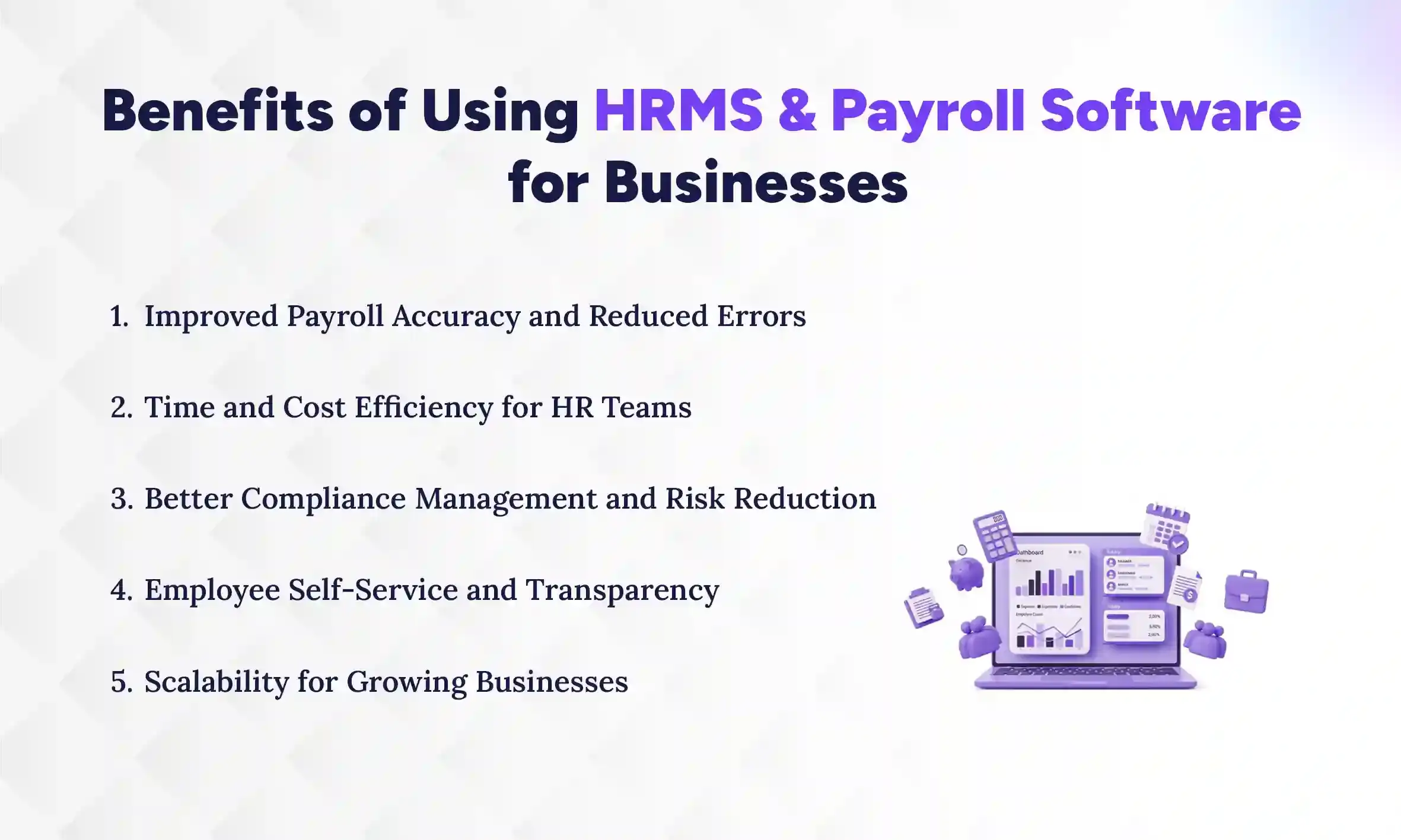
Benefits of Using HRMS & Payroll Software for Businesses
The benefits of using HRMS & payroll software for businesses include improved accuracy, efficiency, compliance, employee experience, and overall growth. Modern research and case studies show that when HR and payroll are automated together, organizations see big improvements across these areas. Here’s how these benefits play out in real life, with simple, practical value for businesses in Nepal and beyond.
1. Improved Payroll Accuracy and Reduced Errors
One of the biggest benefits of HRMS payroll software is that it drastically cuts down payroll mistakes. When data flows automatically between HR and payroll, there’s no need to re‑enter information, which removes common human errors and mismatches. According to a report by HumanSmart, integrated systems can reduce error rates by up to 44–45% or more compared to manual methods, meaning fewer incorrect pays and fewer fix‑ups later. This kind of accuracy boosts trust within your team and gives both employers and employees peace of mind around salary calculations.
2. Time and Cost Efficiency for HR Teams
Automated payroll HRMS systems save a huge amount of time and money. Instead of spending hours on manual data entry, validation, and reconciliation, HR teams can complete payroll tasks faster, reducing processing time by 30% or more, as per HumanSmart. This efficiency is one reason many businesses explore different types of hr software to find solutions that automate payroll and HR operations. It saves HR teams dozens of hours every month, freeing them up for strategic work like culture building, talent development, and planning. When payroll runs smoothly, businesses also cut down on administrative overhead and reduce operational costs tied to manual processes.
3. Better Compliance Management and Risk Reduction
Keeping up with changing tax laws, labor rules, and statutory requirements can be tough, especially across different countries or regions. HRMS payroll solutions automatically handle statutory deductions, update compliance rules, and generate needed reports, significantly reducing the risk of penalties. Integrated systems improve compliance and reduce regulatory issues because the software stays current with legal changes and applies them automatically. That means fewer oversight risks and stronger legal safety for your business.
4. Employee Self-Service and Transparency
Payroll HRMS software often includes employee self‑service portals where team members can view their payslips, tax forms, leave balances, and personal records anytime. This transparency builds trust and reduces repetitive HR queries about pay or policies. When staff can access their information independently, HR spends less time answering routine questions and more time helping with career support and growth. It’s a small feature that makes a big difference in employee satisfaction and engagement.
5. Scalability for Growing Businesses
As your business grows, payroll and HR tasks become more complex. Integrated HRMS payroll systems are built to scale. They handle more employees, more pay structures, and additional locations without extra cost or chaos. Instead of patching together spreadsheets and add‑ons, scalable systems grow with your needs, simplifying expansion and multi‑department management. Scalable HRMS payroll solutions support both small and large businesses, ensuring smooth operations as the workforce grows.
In short, HRMS & payroll software improves accuracy, saves time and money, strengthens compliance, empowers employees, and supports growth, making it a smart investment for businesses of all sizes.
HRMS Payroll vs Traditional Payroll Systems in 2026
The major difference between HRMS payroll software and traditional payroll systems is that HRMS automates and integrates all HR and payroll tasks, while traditional systems rely on manual processes and separate tools. Understanding this difference is key for any business planning to grow. While traditional methods may work for small teams, they often create more problems than they solve as the organization expands. Let’s dive into the main differences and why the shift matters:
1. Manual Payroll vs Automated Payroll HRMS
Manual payroll relies on spreadsheets, paper forms, and repetitive calculations, which leaves room for human error. One missed entry, miscalculated deduction, or wrong attendance record can create discrepancies, delays, and employee frustration. In contrast, automated payroll HRMS software handles calculations in real time, links attendance and leave data directly to salary, and applies tax rules automatically.
As per recent research, businesses using automated payroll report up to 50% faster processing times and significantly fewer errors compared to manual methods. For growing teams, automation isn’t just convenient, it prevents costly mistakes and keeps employees happy.
2. Standalone Payroll Software vs Integrated Payroll & HRMS
Standalone payroll software focuses purely on salary calculation, tax deductions, and payslip generation. While it is better than fully manual methods, it doesn’t connect to other HR functions like employee records, attendance management system, or performance tracking. Integrated HRMS payroll software, however, combines all these functions in one platform. Employee data flows seamlessly across modules, ensuring that payroll reflects real-time changes in roles, leave, or benefits. This integration reduces duplicate work, avoids errors, and gives managers a complete view of workforce costs and productivity.
3. Long-Term ROI of HRMS Payroll Software
Investing in HRMS payroll software may seem like a bigger upfront cost than manual systems or standalone payroll tools. However, the long-term returns are significant. Businesses save time, reduce errors, improve compliance, and empower employees, all of which translate into cost savings and higher efficiency. As per our observation, companies using integrated HRMS payroll solutions typically see a return on investment within the first year through reduced administrative costs and improved accuracy. Over time, these systems scale effortlessly, supporting growth without adding extra HR burden or software tools.
Essential Features to Look for in Payroll & HRMS Software
The essential features to look for in payroll and HRMS software include cloud-based access, multi-location payroll support, compliance management, custom salary structures, and real-time analytics dashboards. Not all HRMS payroll systems are created equal. To truly benefit your business, it’s important to choose features that make payroll and HR management smooth, accurate, and scalable. Here are the key features that every modern HRMS payroll solution should offer:
1. Cloud-Based HRMS Payroll Software
Cloud-based HRMS payroll software allows you to access your system from anywhere, anytime, without relying on office servers. Your HR team can process payroll, manage employee data, or generate reports remotely. Cloud systems also provide automatic updates, backups, and security, so you never have to worry about losing important data. For businesses in Nepal with remote or hybrid teams, cloud access ensures payroll and HR tasks run smoothly no matter where employees are.
2. Multi-Currency and Multi-Location Payroll Support
For businesses expanding internationally or with employees in multiple locations, multi-currency and multi-location payroll support is crucial. The software can calculate salaries in different currencies, account for local tax rules, and manage location-specific allowances. This ensures employees are paid accurately regardless of where they work. Even for Nepal-based businesses planning to expand regionally, this feature saves hours of manual conversions and adjustments.
3. Compliance Management and Tax Updates
One of the most valuable features of HRMS payroll software is automatic compliance management. The system keeps track of local tax laws, social security contributions, and statutory regulations, updating automatically whenever rules change. This ensures your payroll stays compliant without HR constantly checking for new rules. In Nepal, this is especially useful for managing income tax slabs, Social Security Fund contributions, and labor law requirements efficiently.
4. Custom Salary Structures and Benefits Management
Modern HRMS payroll software allows you to create custom salary structures for different roles, levels, or departments. You can include allowances, bonuses, deductions, or benefits unique to your organization. This flexibility ensures every employee’s pay is calculated accurately according to their specific package. It also makes managing promotions, incentives, or special benefits straightforward and error-free.
5. Analytics and Workforce Reporting Dashboard
Finally, analytics and reporting dashboards give business owners and HR teams a clear picture of workforce costs, trends, and performance. You can track payroll expenses, overtime, leave patterns, and compliance reports with a few clicks. Real-time insights help in making informed decisions and planning budgets effectively. This feature turns HRMS payroll software from a simple tool into a strategic resource for growth and workforce management.
Choosing a payroll and HRMS solution with these features ensures your business stays accurate, efficient, compliant, and ready to scale, all while making life easier for HR teams and employees alike.
What is the Best HRMS software?
Pace HRMS is one of the best HR software solutions available today, especially for businesses seeking a unified HRMS payroll system. It brings all critical HR functions, from employee records and payroll to leave, attendance, and performance management into one connected platform.
Designed with a focus on businesses in Nepal, Pace HRMS helps organizations move away from manual spreadsheets and disconnected tools, making HR work faster, easier, and more accurate.
The Pace Infosys, the manufacturer of Pace HRMS, has a strong tech background and works closely with top HR specialists in Nepal to refine features based on real HR needs, not just tech ideas. This blend of engineering strength and HR expertise ensures the software stays practical, reliable, and constantly improving.
Why Choose Pace HRMS?
Pace HRMS stands out because it combines deep HR insights with smart technology, making it one of the best HRMS for businesses in Nepal. Here are the top reasons why Pace HRMS could be the right HR Management System for you:
Centralized employee database for easy access and management
Automated payroll processing with precise salary and deduction calculations
Integrated leave, attendance, and time tracking
Compliance management for Nepal’s tax, SSF, and statutory requirements
Flexible salary structures with custom allowances and benefits
Real‑time reporting and analytics dashboards
Cloud‑based access for remote or hybrid work environments
Continuous updates and feature improvements driven by HR specialist feedback
This mix of solid infrastructure and real user‑focused features makes Pace HRMS a strong, future‑ready HRMS solution for businesses looking to streamline HR and payroll while staying compliant and scalable.
How HRMS Payroll Software Helps Nepal Businesses
HRMS payroll software helps Nepalese businesses by automating salary calculations, tax deductions, and compliance with labor laws from day one. For businesses operating in Nepal, it isn’t just a convenience, it’s a necessity. Let’s break down how this software helps businesses navigate Nepal-specific payroll requirements:
1. Nepal Income Tax and Payroll Compliance Requirements
Nepal’s income tax system requires employers to calculate deductions based on employee salaries, allowances, and benefits. Payroll HRMS software automatically applies the correct tax rates, calculates withholding tax, and generates tax reports ready for submission to the Inland Revenue Department. This eliminates errors caused by manual calculations and ensures compliance with frequent updates to tax slabs. For business owners, this means fewer worries about fines or disputes while keeping employees confident that their salaries and tax deductions are accurate.
2. Social Security Fund (SSF) and Statutory Contributions
Contributions to the Social Security Fund (SSF) are mandatory for employees in Nepal. HRMS payroll software automatically calculates both employer and employee contributions and ensures they are submitted correctly. It also tracks other statutory contributions such as provident fund, gratuity, or insurance where applicable. Automation not only ensures compliance but also saves HR teams from tedious monthly calculations and reporting, keeping businesses on track with legal obligations.
3. Labor Law Compliance and Payroll Regulations in Nepal
Labor laws in Nepal cover everything from working hours and overtime to leave entitlements and termination rules. HRMS payroll software integrates these regulations directly into payroll calculations, attendance tracking, and leave management. This reduces legal risks, prevents payroll disputes, and ensures employees are compensated fairly according to the law. For business owners, having compliance built into the system provides peace of mind and supports smooth HR operations.
Who Should Use HRMS and Payroll Software?
HRMS and payroll software should be used by any organization that wants to streamline HR and payroll tasks, improve accuracy, and stay compliant. From small teams to multi-branch enterprises, the right software simplifies payroll, ensures compliance, and saves time for HR teams. Understanding the features of hr software helps organizations choose the right system for their needs. Let’s see which types of organizations benefit the most.
1. Small and Medium Businesses (SMEs)
SMEs often have limited HR staff but still need to manage payroll, leave, and compliance accurately. HRMS payroll software automates these tasks, reducing errors and freeing up time for strategic work. It also helps SMEs stay compliant with Nepalese tax laws and Social Security Fund contributions, which can be tricky to manage manually. With automated reporting and centralized employee data, even small businesses can maintain professional HR operations without hiring large teams.
2. Startups and Growing Companies
Startups and fast-growing companies face constant change. New hires, evolving salary structures, and expanding teams. HRMS payroll software scales effortlessly, handling onboarding, payroll, and attendance tracking as the team grows. It allows founders and HR managers to focus on growth, employee engagement, and strategy instead of getting bogged down by spreadsheets and manual processes. Real-time data also helps startups make informed decisions about staffing, costs, and benefits.
3. Enterprises and Multi-Branch Organizations
Larger organizations with multiple departments or branches often struggle with coordinating payroll and HR tasks across locations. HRMS payroll software centralizes all employee data, automates multi-location payroll, and ensures compliance across every office. It also supports complex salary structures, allowances, and benefits. With integrated reporting dashboards, enterprise HR teams can track workforce costs, performance, and attendance efficiently, reducing errors and improving decision-making.
4. NGOs and INGOs Operating in Nepal
NGOs and INGOs have unique payroll challenges, including grant-based salaries, international staff, and strict reporting requirements. HRMS payroll software helps these organizations manage salaries, deductions, and compliance in line with Nepalese regulations. It also generates audit-ready reports, ensuring transparency and accountability for donors and stakeholders. By automating repetitive tasks, HR teams can focus on programs and impact rather than paperwork.
HRMS and payroll software is versatile enough to serve businesses of all sizes and types in Nepal, helping them save time, reduce errors, and focus on what truly matters; growth, compliance, and employee satisfaction.
How to Choose the Best HRMS & Payroll Software
Choosing the right HRMS and payroll software can make or break your HR operations. The key is to select a system that fits your business size, workforce complexity, compliance needs, and growth plans. Picking the wrong tool can create more headaches than it solves, while the right one saves time, ensures accuracy, and supports scaling. Let’s break down the factors you need to consider:
1. Assessing Business Size and Workforce Complexity
The first step is to understand your workforce structure. A small team with simple salary structures doesn’t need the same features as a 200+ employee company with multiple departments and roles. Look for software that can handle your current team size but also adapt as you grow. For example, if your business has varying shift schedules, overtime rules, or multiple pay grades, the HRMS must support those complexities without manual overrides. Choosing a system tailored to your workforce complexity avoids unnecessary work and errors later.
2. Evaluating Compliance and Tax Requirements
Compliance is non-negotiable, especially in Nepal where tax laws, SSF contributions, and labor regulations can change frequently. The software should automatically update tax rates, generate reports for government submissions, and apply deductions correctly. It should also help with statutory filings and leave compliance. Before choosing a solution, check if it supports Nepal-specific rules, like income tax slabs, SSF, and labor law provisions, so you’re never caught off guard during audits.
3. Integration with Accounting and ERP Systems
Your HRMS payroll system should not operate in isolation. Payroll data often needs to flow into accounting software for accurate financial reporting. Likewise, if you use an ERP, HR data should integrate seamlessly to avoid duplicate entries. Look for systems with ready-made integrations or APIs that connect with your current tools. This ensures smoother operations, faster reconciliations, and accurate financial insights.
4. Pricing, Scalability, and Vendor Support
Finally, consider cost, future growth, and vendor reliability when choosing cloud based hr software. Avoid solutions that are cheap upfront but charge heavily for additional features or users. Check if the system can scale as your business grows. A system must be scalable to fit more employees, branches, or countries as your business expands. Vendor support is equally important; ensure they provide training, troubleshooting, and regular updates. A reliable vendor with responsive support ensures your HRMS remains effective and stress-free over time.
Selecting HRMS payroll software is about matching your business needs with the system’s capabilities. By evaluating size, compliance, integration, and vendor support carefully, you can choose a tool that streamlines HR, reduces errors, and grows with your business.
Conclusion
HRMS payroll software is a must-have for modern businesses. It automates payroll, attendance, and compliance, reduces errors, saves time, and gives clear insights into your workforce. Solutions like Pace HRMS bring all these benefits together in one easy-to-use platform.
Handling payroll manually or across multiple systems is stressful and full of mistakes. It is something many Nepalese business owners know too well. With HRMS software, your HR team can focus on growth while employees get accurate salaries and benefits on time.
The best step forward is simple! Adopt a trusted HRMS payroll system like Pace HRMS today. Streamline your HR, stay compliant, and let your business run smoothly and efficiently with The Pace Infosys.
FAQs
What Is the Difference Between Payroll HRMS and Payroll Software?
+
Payroll HRMS integrates payroll with HR functions like attendance, leave, and compliance, while standalone payroll software only handles salary calculations and deductions.
Is HRMS Payroll Software Suitable for Small Businesses?
+
Yes. HRMS payroll software scales to small teams, automates payroll, reduces errors, and ensures compliance, making it ideal for SMEs and startups in Nepal.
What Software Is Best for Payroll?
+
Pace HRMS, Zoho Payroll, and QuickBooks Payroll are top choices, offering automation, compliance, reporting, and multi-location support for businesses of all sizes.
How Much Does HRMS and Payroll Software Cost?
+
Costs vary from $10–$50/month for cloud solutions to $300–$5,000+ for enterprise licenses, depending on features, users, and vendor support.
Can Payroll HRMS Software Handle Nepal Tax Laws?
+
Yes. Modern HRMS software automatically applies Nepal’s income tax slabs, SSF contributions, and statutory deductions for full compliance.
Is Cloud-Based HRMS Payroll Software Secure?
+
Absolutely. Cloud HRMS uses encryption, secure servers, regular backups, and access controls to protect employee data and payroll information.
Is Excel a Payroll Software?
+
No. Excel is a spreadsheet tool, not payroll software. It lacks automation, compliance checks, and reporting features necessary for reliable payroll management.
Ready to get started?
Book a 30-minute consultation call, and let's talk about your goals.