Onboarding new employees should feel like a warm welcome, not a paperwork scavenger hunt. Yet too often in Nepali offices, it starts with stacks of forms, missing documents, and frustrated teams chasing approvals. That confusion wastes time, risks compliance, and gives new hires a shaky first impression.
This guide shows how HR software for onboarding fixes those problems. An HR Management software automates document collection, centralizes new-hire data, and streamlines approvals. The right tool turns chaos into a smooth, professional experience.
Whether you run a startup in Thamel, an SME in Pokhara, or a growing firm in Kathmandu, this guide will help you pick and use the best onboarding software in Nepal that saves time, keeps you compliant, and helps new employees feel at home from day one. Ready? Let’s dive in!
What Is HR Software for Onboarding?
HR onboarding software is a simple digital system that handles everything involved in bringing a new employee into your company. The software automates repetitive tasks, like, collecting forms, verifying documents, sending reminders, so that your HR team spends less time chasing and more time helping new hires settle in.
Think of it as a control center for new employees. Instead of juggling emails, spreadsheets, and loose paper, the whole process lives in one organized place. A clear dashboard shows where each hire is in the process. Documents are collected and signed electronically, compliance rules are tracked, and audit trails are kept for inspections.
The onboarding system usually integrates with payroll and your main HRMS, so data moves automatically between tools without retyping and manual stress. Put together, these HRMS features reduce errors, speed up onboarding, and give new staff a smooth, professional start.
Why Nepali Businesses Need Onboarding Software in 2026?
Nepali businesses need onboarding software because manual hiring processes are slowing down growth, creating compliance risks, and making new employees feel forgotten before they even start. As your company grows and hiring moves faster, doing everything by hand becomes impossible to manage properly. You do not want to collect forms, chase signatures, and track compliance one-by-one, wasting your valuable time and energy.
The HR software automates workflows, so tasks move forward automatically without someone having to follow up constantly. Apart from efficiency, there's compliance and legal risk. Nepali businesses face labor regulations and tax requirements that need proper documentation and audit trails. Poor onboarding also means new employees feel lost and undervalued, which leads to higher turnover and lower productivity. Onboarding software fixes all of this by:
Automating forms and paperwork instantly
Cutting errors and approval delays
Keeping compliance records automatically safe
Making new hires feel welcomed immediately
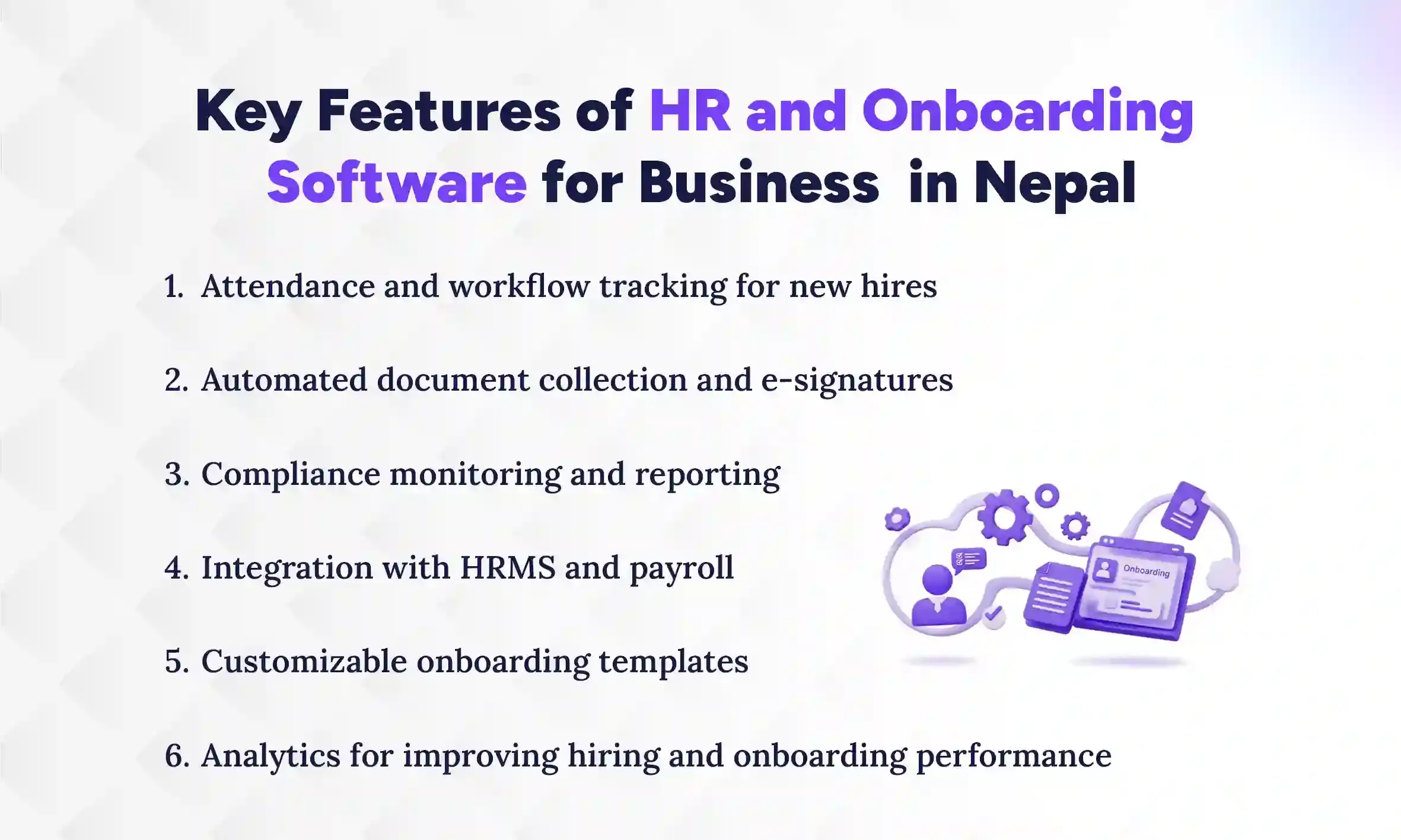
Key Features of HR and Onboarding Software for Businesses in Nepal
HR and onboarding software for businesses in Nepal offers features like attendance tracking, automated document collection, and compliance monitoring to simplify the hiring process. These tools help manage new hires efficiently, ensuring all necessary steps are completed smoothly and correctly. Let's explore these valuable features in more detail.
1. Attendance and Workflow Tracking for New Hires
The attendance management system allows HR to easily keep an eye on when new employees start their work and what tasks they need to complete. It's like a digital checklist that ensures everyone is on track with their onboarding schedule, from their first day's tasks to completing required training modules. This helps prevent new hires from feeling lost and ensures they're progressing smoothly.
2. Automated Document Collection and E-signatures
Instead of dealing with piles of paper, this software automatically requests and collects important new hire documents, like identification or employment contracts. It also enables new hires to sign these documents digitally, saving time and reducing the risk of lost paperwork. This makes the entire process much faster and more organized for both the employee and the HR team.
3. Compliance Monitoring and Reporting
Staying compliant with labor laws and regulations is crucial, and this feature helps tremendously. It ensures all necessary legal documents are collected and properly stored, and it can flag any potential compliance issues. This provides HR with peace of mind, knowing that they are meeting all legal requirements and avoiding costly penalties.
4. Integration with HRMS and Payroll
This software can connect seamlessly with your existing Human Resource Management Systems (HRMS) and payroll systems. This means that once a new employee's information is entered and approved during onboarding, it automatically transfers to other systems, eliminating the need for duplicate data entry. This streamlined connection ensures accuracy and efficiency across all HR functions.
5. Customizable Onboarding Templates
Every business is unique, and so are its onboarding needs. This feature allows you to create personalized onboarding plans and templates that fit your company culture and specific role requirements. You can tailor checklists, training materials, and welcome messages to ensure a consistent and engaging experience for every new employee.
6. Analytics for Improving Hiring and Onboarding Performance
This feature provides valuable insights into how well your onboarding process is working. It can track metrics like how long it takes to onboard a new hire, where bottlenecks might occur, and how satisfied new employees are. By analyzing this data, businesses can identify areas for improvement and continuously refine their onboarding strategy for better results.
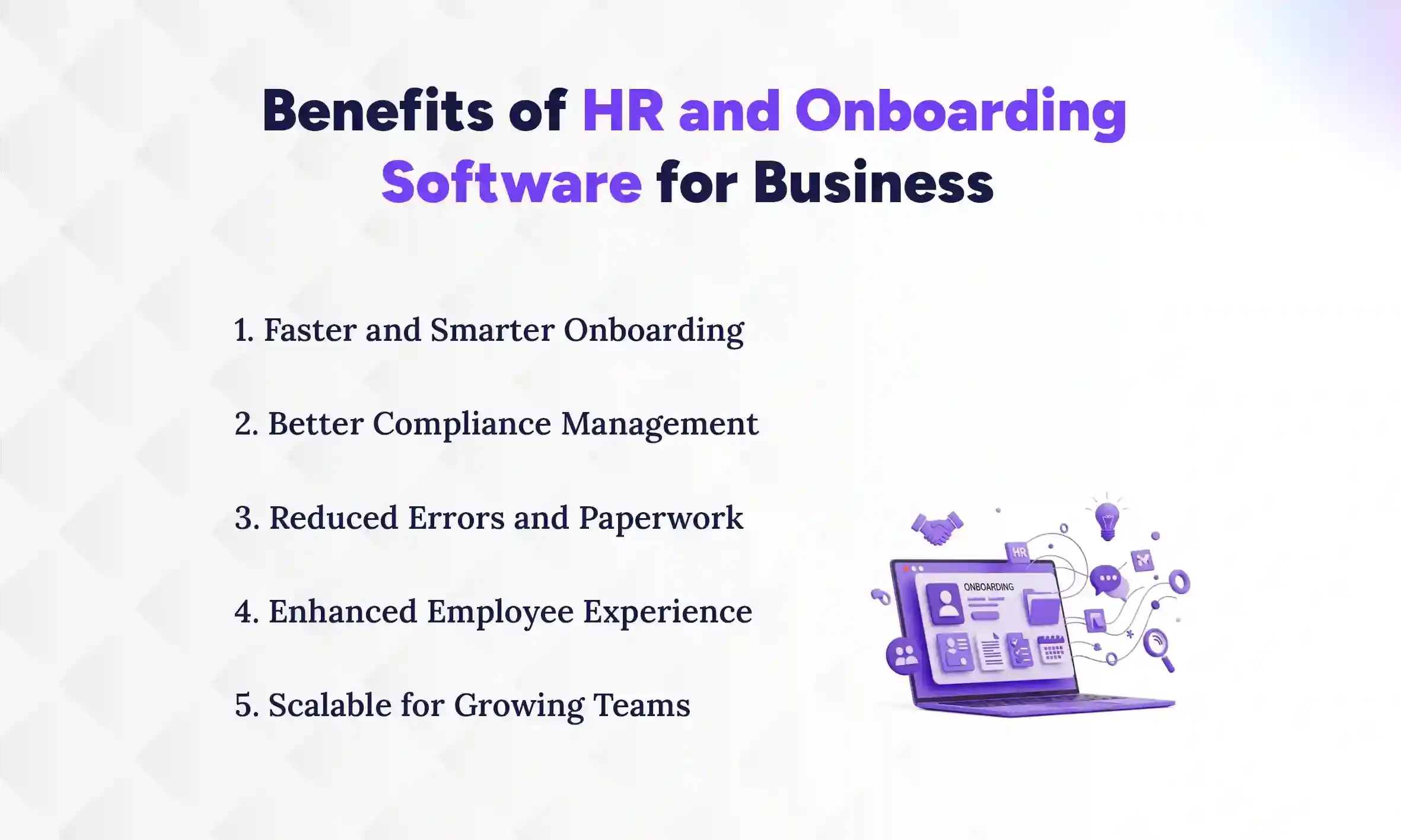
Benefits of HR and Onboarding Software for Businesses
HR and onboarding software brings faster onboarding, stronger compliance, fewer errors, better employee experience, and scalable processes for growing teams. These benefits free HR from routine work, reduce legal and operational risk, and help new hires become productive sooner. Below we explain each benefit of HR software and its onboarding feature clearly and practically, so you can see how they help your business today and as you grow.
1. Faster and Smarter Onboarding
This software dramatically speeds up the onboarding process by automating many of the time-consuming tasks. Instead of manual form filling and document chasing, new hires can complete most of their paperwork digitally before their first day, or at least very quickly. This means your new team members can start contributing to your business sooner and more effectively, making the entire process smarter and more productive.
2. Better Compliance Management
Ensuring new hires meet all legal requirements can be complex and prone to error with manual systems. Onboarding software helps by automatically collecting and storing necessary documents, tracking required training, and flagging any compliance gaps. This significantly reduces the risk of legal issues and penalties, giving you confidence that your hiring practices are always up to par.
3. Reduced Errors and Paperwork
By automating document collection and verification, and by integrating with other HR systems, this software minimizes the chances of human error. Less manual data entry means fewer mistakes in employee records, payroll, and compliance tracking. Furthermore, it drastically cuts down on the sheer volume of paper involved, contributing to a more eco-friendly and organized workplace.
4. Enhanced Employee Experience
A positive onboarding experience is crucial for employee retention and engagement. When new hires feel welcomed, organized, and supported from day one, they are more likely to be happy and productive. This software ensures a smooth, clear, and professional onboarding journey, making a great first impression that sets the tone for their entire tenure with your company.
5. Scalable for Growing Teams
Templates, automation, and integrations let you onboard many people without adding headcount to HR. As your company hires across locations or roles, you reuse workflows and adjust templates instead of rebuilding processes each time. That scalability keeps operations efficient and consistent during rapid growth.
How to Choose the Best HR Software for Onboarding in Nepal?
Choosing the right onboarding software requires you to understand your specific business needs, test options before committing, and compare vendors honestly on what matters most. The priorities guiding your buying decision could perhaps be features, support quality, and real value for your money.
The wrong choice of software wastes time and money; the right choice transforms how you hire and keeps employees happy. Howsoever, the process of choosing the right HR software doesn't have to be complicated; you just need to follow a clear path from identifying problems to making your final decision. Here's how to do it step by step.
1. Indentifying HR Needs and Onboarding Pain Points
First, take a close look at what your HR department currently struggles with. Are you spending too much time on paperwork? Are new hires often confused about their first steps? Pinpointing these specific issues, like difficulty tracking documents or ensuring compliance, will help you understand what features are most important in an onboarding software. Knowing your exact needs ensures you don't pay for features you won't use and that the software you choose actually solves your problems.
2. Analyze Existing Workflows
Before you even look at software, map out your current onboarding process from start to finish. Understand each step, who is responsible for it, and how long it takes. This analysis will reveal inefficiencies and areas where automation would be most beneficial. By understanding your current system, you can better evaluate how a new software will integrate and improve your existing operations, making the transition smoother.
3. Test Software with Trials or Demos
Once you have a shortlist of potential software solutions, don't just rely on marketing materials. Most vendors offer free trials or personalized demos. Use these opportunities to actively test the software with realistic scenarios relevant to your business. See how easy it is to set up new hire profiles, upload documents, and track progress. This hands-on experience is invaluable for assessing usability and functionality.
4. Compare Vendors on Features, Support, and Value
When comparing different software options, look beyond just the price tag. Evaluate the core features offered and ensure they align with the needs you identified earlier. Crucially, consider the level of customer support provided. Is it readily available, knowledgeable, and helpful? Also, assess the overall value proposition: does the software offer a good return on investment by saving time, reducing errors, and improving employee retention?
5. Consider Implementation Timeline, Integrations, and Pricing
Finally, think about the practicalities of adopting new software. How long will it take to implement and get your team trained? Does the software integrate smoothly with your existing HRMS, payroll, or other business systems? Understanding these aspects is vital for a successful rollout. Also, be sure to get a clear picture of all costs involved, including any potential hidden fees for customization, training, or ongoing support, to ensure it fits your budget.
Pricing and Plans for HR Onboarding Software in Nepal
Investing in HR onboarding software in Nepal is about choosing a solution that fits your team’s size, workflows, and growth plans. HRMS Pricing in Nepal varies depending on the provider, employee count, and features, with local vendors offering all-in-one packages for small businesses and tiered or customized plans for larger organizations. In this section, we break down pricing models, typical costs, and extra fees of purchasing and implementing an HR software:
1. Common Pricing Models for HR Onboarding System in Nepal
HR onboarding software in Nepal is usually offered as flat subscription packages or per-user/tiered plans. Flat packages bundle HR and onboarding tools for a fixed annual fee, typically NPR 9,000 – 45,000/year, depending on features. Per-user plans charge per employee per month. Pace HRMS charges NPR 50 – NPR 500 per month for the complete HR management software. For businesses, this pricing model offers flexibility to scale, with local vendors often using headcount-based tiers for easier budgeting.
Overall, flat packages suit small teams, while tiered plans are ideal for growing or larger organizations.
2. Additional HRMS Costs to Consider
The subscription fee is just part of the total cost of HR onboarding software. Many businesses also encounter implementation or setup fees to configure the system and import employee data. Training sessions for HR teams and onboarding support may be charged separately, especially for larger organizations. Integrating the software with payroll systems, attendance devices, or third-party apps can also add to costs. Additionally, premium support, custom dashboards, or branded onboarding portals may require extra investment, so it’s important to confirm what’s included in your plan before committing.
Which Is the Best HR Onboarding Software in Nepal?
For businesses in Nepal, Pace HRMS stands out as a reliable, flexible, and highly efficient HR onboarding solution. Whether you run a small startup, a mid-sized company, a large enterprise, or a remote-first organization, Pace HRMS adapts seamlessly to your HR needs, from recruitment and onboarding to payroll and workforce management. Its intuitive interface and scalable design ensure smooth onboarding processes, reduce manual work, and keep new hires productive from day one.
Why Choose Pace HRMS for Your Organization?
Pace HRMS is the preferred choice for Nepalese companies seeking a centralized HR platform that automates workflows, ensures compliance, and provides real-time insights. It simplifies everyday HR tasks, improves new hire experiences, and helps HR teams focus on strategic priorities instead of paperwork.
Pace HRMS enhances HR operations by offering:
Automated onboarding workflows to guide new hires through documentation, training, and approvals quickly.
Compliance tracking to ensure labor law adherence and secure record keeping.
Document management for contracts, policies, and employee files in a centralized dashboard.
Analytics and reporting to track onboarding effectiveness and optimize HR processes.
Integration with payroll, attendance, and HRMS systems for seamless data flow across all departments.
With Pace HRMS, businesses of all sizes can streamline onboarding, reduce errors, save time, and scale HR operations effortlessly, making it one of the best HR software solutions available in Nepal.
Conclusion
A good HR and onboarding software is a smart investment for Nepalese businesses. It speeds up onboarding, keeps you compliant, cuts paperwork, improves new-hire experience, and scales as you grow.
Throughout this blog, we looked at key features, clear benefits, how to choose the right tool, and what pricing to expect, so you now have a practical roadmap to pick the best fit for your team.
If you’ve ever felt frustrated by lost forms, slow approvals, or new hires taking too long to settle in, this change will make work easier and people happier. Start small with a clear checklist and a demo, then measure the savings and time gained.
Ready to reduce headaches and onboard better? Explore the top 5 HR software for Nepali businesses. Pick two vendors, run a trial, and decide based on real results. Your HR team and new hires will thank you!
FAQs
How do HR teams use project management software for onboarding?
+
HR teams track tasks, deadlines, and employee progress, ensuring smooth onboarding and clear accountability for all new hire activities.
Can onboarding software integrate with payroll and HRMS?
+
Yes, most onboarding software connects with payroll and HRMS systems for seamless data transfer, automated payments, and unified employee records.
What features improve compliance during onboarding?
+
Automated document collection, e-signatures, audit logs, and mandatory policy acknowledgments ensure legal and internal compliance for all new hires.
How long does it take to implement onboarding software?
+
Implementation typically takes 2–6 weeks, depending on company size, data migration needs, and workflow complexity.
Can small businesses benefit from onboarding software?
+
Absolutely. Small businesses save time, reduce errors, ensure compliance, and improve new hire experiences with affordable onboarding software solutions.
Which HR onboarding software is best for remote teams?
+
Cloud-based platforms like Pace HRMS enable remote onboarding with digital forms, task tracking, virtual training, and real-time collaboration.
Can onboarding software automate repetitive HR tasks?
+
Yes, it automates document collection, approvals, reminders, and workflow tasks, reducing manual effort and improving efficiency across HR operations.
Ready to get started?
Book a 30-minute consultation call, and let's talk about your goals.