


Running a digital marketing agency in Nepal means managing creative teams who work from home, client sites, and coffee shops, rarely from a central office. Traditional attendance systems and manual payroll spreadsheets weren't built for this reality.
HR software designed for Nepal-based agencies solves these problems by combining geo-fenced attendance tracking, automated SSF and TDS calculations, and flexible leave management in one platform. This guide covers the top HR software options available in Nepal, the features that matter most for marketing agencies, and how to choose a system that fits your team's workflow.
What is HR Software and Why Nepal Agencies Need It
HR software, often called an HRMS (Human Resource Management System), is a digital platform that puts employee data, payroll, attendance, and leave tracking in one place. Instead of juggling spreadsheets and paper files, you get a single system that does the math automatically.
For agencies in Nepal, this matters because payroll involves SSF (Social Security Fund) contributions and TDS (Tax Deducted at Source) calculations. Keeping up with changing government rates manually takes time and creates room for costly errors. With the right HR software, compliance stays automatic, and you can focus on client work instead of chasing payroll mistakes.
Why Digital Marketing Agencies Face Unique HR Challenges?
Digital marketing agencies face unique HR challenges because they must manage a highly fluid, remote-first workforce that fluctuates rapidly based on project demands and specialized freelance requirements. They face distinct HR challenges: project-based work cycles, remote team structures, and a workforce mix of full-time employees, freelancers, and contractors. Standard HR processes weren't designed for this complexity.
Unlike traditional businesses with fixed office hours and stable staffing, agencies scale teams up and down based on client projects. Your content writer might work from home on Monday, at a client's office on Tuesday, and at a coffee shop on Wednesday. Meanwhile, you're managing payroll for five full-timers, three part-timers with different leave policies, and four freelancers on separate payment schedules. This operational reality requires HR systems built specifically for flexibility.
1. Managing Remote and Hybrid Creative Teams
Your designers and content writers probably work from home, client offices, or coffee shops, not a central office with a punch clock. Traditional attendance systems don't work here.
Geo-fencing solves this problem. In simple terms, geo-fencing creates a virtual boundary around approved work locations. When an employee opens the attendance app within that boundary, they can check in. Outside it, they can't. This approach tracks hours accurately without micromanaging your creative team.
2. Handling Project-Based and Flexible Staffing
Agencies scale teams up or down based on client projects. One month you might have five people on a campaign; the next month, fifteen.
Your HR system has to handle different worker types seamlessly, full-time employees with benefits, part-time staff with different leave rules, and contractors with separate payment schedules. A rigid system that treats everyone the same creates more problems than it solves.
3. Reducing High Turnover in Marketing Roles
Marketing is a fast-paced industry where job changes happen frequently. Manually onboarding new hires and processing exits eats up significant HR time. Automation in onboarding and offboarding, digital offer letters, automated document collection, streamlined exit workflows, saves administrative hours and keeps nothing from falling through the cracks.
4. Coordinating Freelancers and Contractors
Many agencies rely on freelance specialists for specific projects. Freelancers require different tracking and payment rules than full-time staff.
Your HR software allows separate contractor profiles with different payment schedules, tax treatments, and attendance rules. Without this flexibility, you end up managing freelancers in a separate spreadsheet, defeating the purpose of centralized software.
Top HR Software Options for Digital Marketing Agencies in Nepal
Here's a practical comparison of leading HR software options for Nepal-based agencies. Each platform has different strengths depending on your team size and specific workflow.
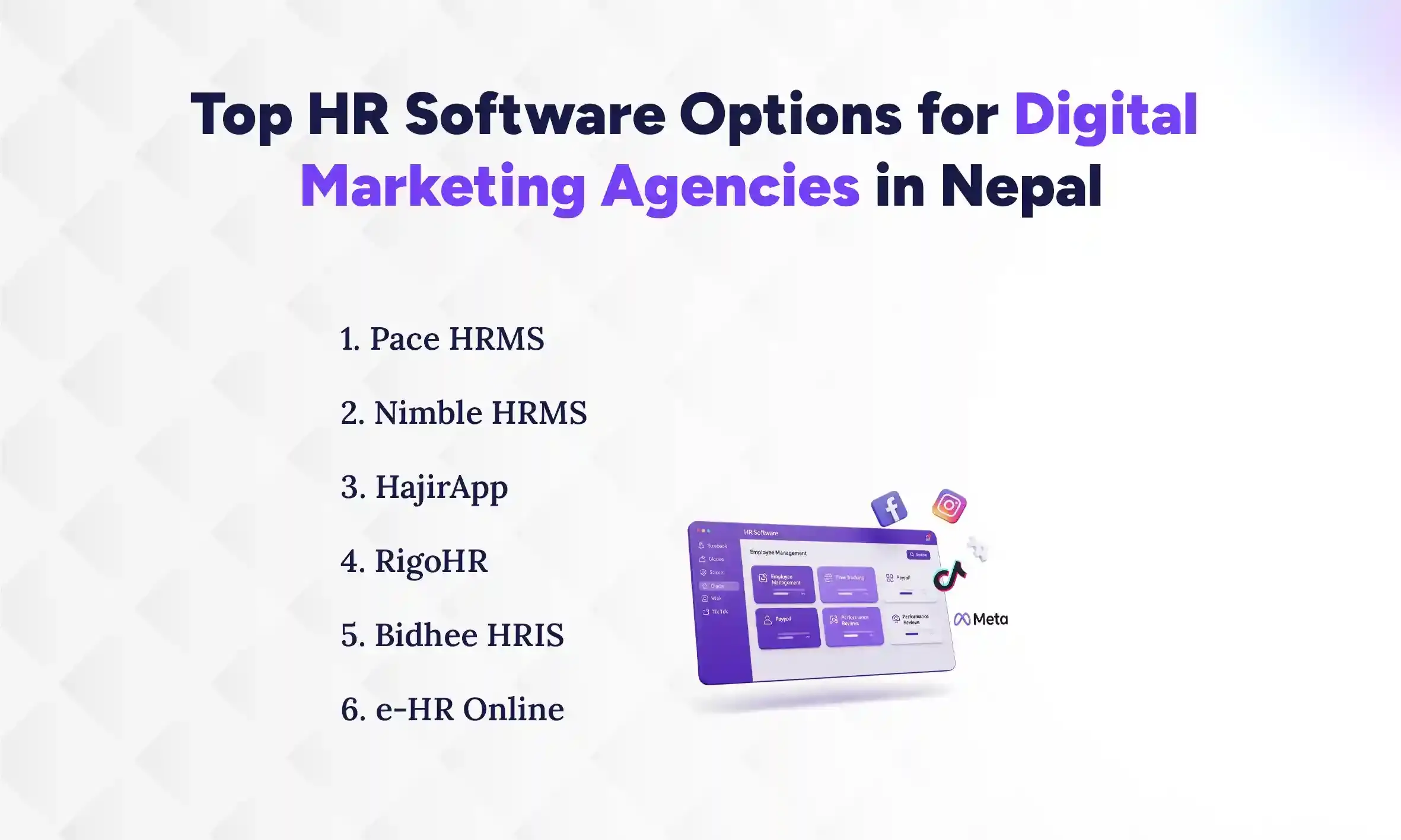
| Software | Best For | Standout Feature | Nepal Payroll Support |
|---|---|---|---|
| Pace HRMS | Agencies needing full HR + payroll | Geo-fence attendance, training module | Yes |
| Nimble HRMS | Mid-size companies | Comprehensive automation | Yes |
| HajirApp | Startups | Simple mobile attendance | Yes |
| RigoHR | Growing teams | Scalable modules | Yes |
| Bidhee HRIS | SMEs | Employee self-service | Yes |
| e-HR Online | Cloud-first teams | Online accessibility | Yes |
1. Pace HRMS
Pace HRMS combines payroll, attendance (with biometric and geo-fencing options), leave management, and training tracking in one platform. Built by The Pace Infosys, it has Nepal's SSF and TDS compliance built directly into the system.
The geo-fence attendance feature is particularly useful for agencies; your remote marketers can check in from approved locations without physical biometric devices. The training module also helps track professional development, which matters for retaining creative talent.
2. Nimble HRMS
Nimble HRMS has been a trusted name in Nepal's HR software market for over a decade. It offers robust payroll automation and handles the complete employee lifecycle from recruitment to retirement.
This platform works well for mid-sized agencies that have outgrown basic tools and want comprehensive automation. However, it may offer more features than a small startup actually uses.
3. HajirApp
HajirApp is a mobile-first solution designed with startups in mind. It excels at simple attendance tracking and basic HR tasks without overwhelming users with complex features.
If you're a smaller agency just getting started with digital HR, HajirApp offers an affordable entry point. You can migrate to a more comprehensive system as your team grows.
4. RigoHR
RigoHR takes a modular approach, allowing agencies to pick and choose features now and add more later. This scalability makes it attractive for growing teams. The user interface is modern and intuitive, which helps with adoption. Your team is more likely to actually use software that doesn't feel clunky.
5. Bidhee HRIS
Bidhee HRIS focuses on employee record management and self-service portals. Employees can manage their own information, check leave balances, and download payslips without constantly asking HR. For mid-size agencies where HR staff are stretched thin, this self-service capability reduces administrative burden significantly.
6. e-HR Online
e-HR Online emphasizes cloud-based accessibility. Your team can access HR information from anywhere, which aligns well with the distributed nature of marketing agency work. This platform is a solid choice for agencies with team members spread across different locations who want consistent access to HR systems.
Ready to Accelerate Your Digital Growth?
Partner with The Pace Infosys to build scalable web and mobile solutions tailored to your business goals.
Essential HR Software Features for Marketing Agencies
When evaluating options, certain features matter more for agencies than for traditional businesses. Your team's distributed work style, project-based staffing, and mix of employees and freelancers create specific requirements that generic HR systems don't address well. Focus on features that solve your actual operational challenges rather than chasing the longest feature list. Here's what to prioritize.
1. Attendance Tracking with Geo-Fencing for Remote Teams
Geo-fencing creates virtual boundaries around approved work locations. When an employee opens the attendance app within that boundary, they can check in. This feature solves the "how do we track remote workers?" problem without requiring everyone to come to an office or install invasive monitoring software. It's particularly valuable when marketers work from home, client sites, or co-working spaces on different days.
2. Payroll Management with Nepal Tax Compliance
Any HR software for a Nepal-based agency has to handle local payroll correctly. Key calculations include:
- SSF contributions: The 31% total contribution (20% employer, 11% employee) based on current government rates
- TDS deductions: Income tax calculations based on Nepal's tax brackets
- Statutory requirements: Any other legally required deductions or contributions
Manual calculation of SSF and TDS is where most payroll errors happen. Automated systems eliminate this risk and update automatically when government rates change.
3. Leave Management and Multi-Level Approval Workflows
Agencies typically have team leads, department heads, and HR managers, and leave requests often require approval from multiple levels. Your software supports multi-level workflows where a request goes to a team lead first, then to HR.
You'll also want flexibility in leave types. Beyond standard sick and annual leave, agencies often have policies for work-from-home days, client travel, or project-based time off that don't fit neatly into standard categories.
4. Employee Self-Service Portal
An Employee Self-Service (ESS) portal lets staff view payslips, apply for leave, check remaining balances, and update personal information on their own.
When employees can see exactly how their pay was calculated, including all deductions and additions, it builds trust and reduces disputes about "missing" money. It also dramatically cuts the number of routine questions your HR team handles.
5. Recruitment and Applicant Tracking System
Fast-growing agencies are constantly hiring. An Applicant Tracking System (ATS) helps manage job postings, track candidates through the hiring pipeline, and streamline onboarding for new hires.
Without this, you're probably managing recruitment in a separate tool or spreadsheet, which creates data silos and extra work when new hires join the HR system.
6. HR Analytics and Performance Reporting
Good HR software provides dashboards showing key metrics at a glance, attendance patterns, leave trends, payroll costs by department, and turnover rates.
Instead of guessing how much you're spending on overtime, you can see exact numbers. This helps agency leaders make better decisions about hiring, budgeting, and resource allocation.
How HR Software Handles Nepal Payroll and Compliance?
HR software automates SSF contributions, TDS calculations, and statutory deductions, keeping you compliant without becoming a tax expert. Nepal's payroll regulations are complex, and manual processing creates a significant risk of errors. The right system handles these calculations automatically, updating rates as government regulations change.
1. Automating SSF Contribution Calculations
The Social Security Fund requires contributions from both employers and employees. Currently, the total is 31%, with 20% from the employer and 11% from the employee.
HR software calculates SSF amounts automatically based on each employee's salary and current government rates. When rates change, the software updates accordingly, so you're always compliant without manual intervention.
2. Managing TDS and Statutory Deductions
Tax Deducted at Source is Nepal's system for collecting income tax directly from salaries. The calculation depends on the employee's income level and current tax brackets.
Automated payroll applies the correct tax rates to each employee's salary, handles other statutory deductions, and generates documentation for tax filing. This eliminates hours of manual calculation and significantly reduces error risk.
3. Generating Compliant Payslips and Records
Modern HR software generates professional payslips that meet Nepal's labor law requirements. More importantly, it stores all payroll records digitally, making them instantly accessible for audits or employee requests.
If an employee asks for a payslip from six months ago, you can retrieve it in seconds rather than digging through filing cabinets.
HR Software Comparison for Nepal Digital Agencies
This side-by-side comparison focuses on features most critical for digital marketing agencies operating in Nepal.
| Feature | Pace HRMS | Nimble HRMS | HajirApp | RigoHR |
|---|---|---|---|---|
| Deployment | Cloud | Cloud/On-premise | Cloud | Cloud |
| Geo-fence Attendance | Yes | Yes | Yes | Limited |
| Nepal Payroll | Full | Full | Basic | Full |
| Training Management | Yes | Limited | No | No |
| Free Trial | Yes | Yes | Yes | Yes |
Tip: Most platforms offer free trials or demos. Take advantage of testing before committing. The best way to evaluate software is to actually use it with your real data and workflows.
How to Choose the Right HR Management System for Your Agency?
To choose the right HRMS, you must align the software’s technical capabilities with your specific team size, remote workflow requirements, and the complexity of Nepal's legal compliance. Choosing the right HR management system comes down to matching software capabilities with your agency's specific needs. Here is a detailed overview:
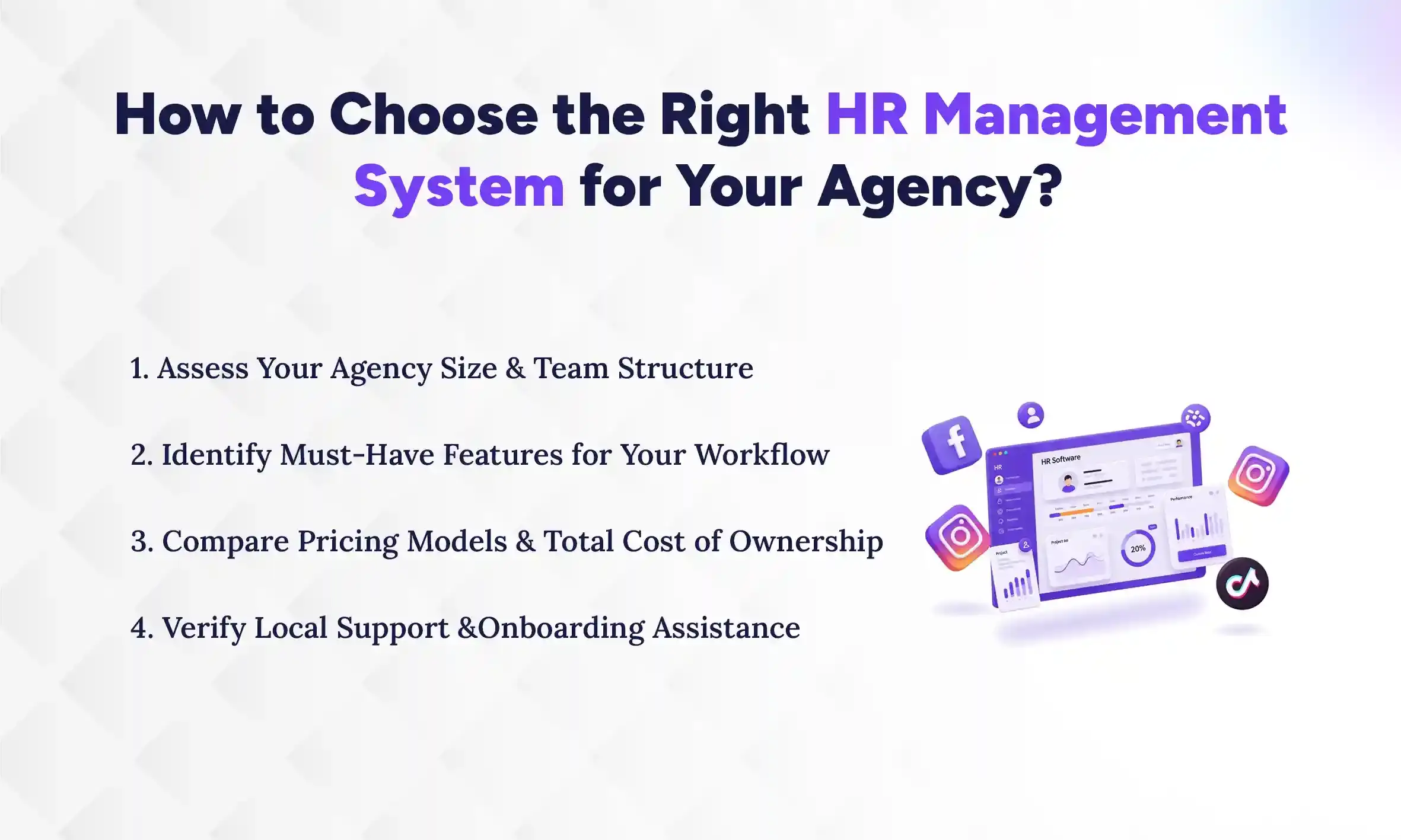
1. Assess Your Agency Size and Team Structure
A 5-person startup has very different requirements than a 50-person agency. Consider your current team size, but also think about where you'll be in two years.
Ask yourself: What's your mix of full-time employees versus freelancers? Do you have multiple office locations? How many people work remotely? The answers help narrow down which features are essential versus nice-to-have.
2. Identify Must-Have Features for Your Workflow
Make a list of non-negotiable features based on your specific situation:
- Fully remote team? Geo-fence attendance becomes essential
- Handle payroll in-house? Comprehensive Nepal compliance is critical
- High turnover? Strong onboarding/offboarding automation matters
Multiple locations? Multi-branch management becomes important.
Prioritize software that excels at your most important tasks rather than choosing the platform with the longest feature list.
3. Compare Pricing Models and Total Cost of Ownership
Look beyond the sticker price. Some software charges monthly per employee, while others offer flat annual plans. A per-employee model might be cheaper for small teams but expensive as you grow.
Ask about hidden costs: implementation fees, training costs, charges for additional modules, and ongoing support fees. Understanding the total cost of ownership prevents budget surprises later.
4. Verify Local Support and Onboarding Assistance
When you have a question about Nepal's SSF rules or help configuring a payroll setting, you want someone who understands the local context. International software with generic support often can't help with Nepal-specific compliance questions.
Prioritize vendors that offer Nepal-based support and can provide hands-on assistance during setup. The onboarding period is when you'll have the most questions, so responsive support during this phase is particularly valuable.
Ready to see how HR software can simplify your agency's operations? Schedule a free consultation to discuss your specific workflow.
Simplify Your Agency HR with the Right Software Partner
The right HR software does more than automate tasks; it gives you back time. Reducing manual work and ensuring compliance with Nepal's regulations, it allows agency leaders to focus on client work and business growth.
For agencies looking for a solution built with local compliance in mind, Pace HRMS from The Pace Infosys offers comprehensive features, including geo-fence attendance, Nepal payroll compliance, and training management, all backed by local support from a team with over a decade of experience in Nepal's business landscape.
The investment in proper HR software typically pays for itself within months through reduced errors, saved administrative time, and avoided compliance penalties.
Conclusion
Choosing the best HR software for a digital marketing agency in Nepal in 2026 requires moving beyond basic record-keeping to a system that mirrors the industry’s agility. For most agencies, the definitive choice is Pace HRMS, as it offers the most specialized balance of creative-sector features (like training modules) and strict local compliance, similar to how hr software for government in Nepal supports structured workflows and regulatory requirements. However, the best choice is ultimately determined by your scale.
To thrive in Nepal's unique regulatory environment, your selected platform must automate SSF and TDS by default, turning HR from a manual administrative burden into a strategic asset that supports your remote-first, project-driven growth.