Managing payroll is already a lot, but once SSF comes into the picture, things get even more complicated. In Nepal, the Social Security Fund (SSF) isn’t just another deduction; it’s a legal responsibility every eligible business must follow. And with growing government oversight, even small mistakes can lead to penalties or compliance issues.
The real problem? Many businesses still rely on manual calculations, spreadsheets, or disconnected systems. This often leads to wrong contributions, missed deadlines, and hours wasted fixing errors. It’s frustrating, time-consuming, and honestly, avoidable.
That’s exactly why more companies are now shifting toward SSF-integrated HR software in Nepal. In this guide, we’ll break down how it works, why it matters, and how you can simplify SSF compliance without the stress.
What Is SSF (Social Security Fund) in Nepal?
The Social Security Fund (SSF) in Nepal is a government program that helps employees stay financially secure in the long run. It covers benefits like retirement savings, medical support, accident protection, and more. In simple terms, it works like a safety net for employees while also ensuring employers follow proper labor laws.
Now, when it comes to contributions, both the employer and employee need to contribute a fixed percentage of the employee’s salary every month. The employer usually contributes a larger share, while the employee contributes a smaller portion from their salary. These contributions are then deposited into the SSF account, building a fund that employees can use under different schemes.
SSF is mandatory for most registered businesses and employees in Nepal, especially those working in formal sectors. If a company fails to comply, whether by not registering, underreporting salaries, or missing payments, it can face penalties, fines, or legal trouble. So, staying compliant isn’t optional; it’s a responsibility every business must take seriously.
Managing SSF for HR teams often means dealing with manual calculations, tracking updates, and meeting strict deadlines all at once. As teams grow, even small errors or delays can quickly turn into compliance issues. This is where the real HR management challenges start to show.
Incorrect SSF deductions due to manual calculations
Missed updates when employees join or leave
Late SSF payments leading to penalties
Time-consuming monthly report preparation
Difficulty tracking salary and contribution changes
Records not ready during audits or inspections
Struggle to keep up with SSF rule updates
What Is SSF Integrated HR Software?
SSF integrated HR software is a digital tool that helps businesses automatically manage Social Security Fund contributions along with other HR tasks. Instead of doing everything manually, it brings payroll, attendance, and compliance into one system. This makes SSF calculations more accurate and much easier to handle.
It works by connecting employee attendance and salary data directly to payroll processing. So, when salaries are calculated, SSF contributions are automatically included based on updated records. This reduces errors and ensures everything stays aligned with legal requirements without extra effort from HR teams.
HR software with SSF integration allows you to handle payroll or attendance, combining everything into one smooth workflow. This means fewer manual steps, better accuracy, and stronger compliance with Nepal’s SSF rules.
Who Needs SSF Integrated HR Software in Nepal?
SSF integrated HR software is useful for any business that wants to simplify payroll and stay compliant with SSF rules in Nepal. It is especially important for organizations where salary processing and employee management are done regularly and need accuracy. As operations grow, manual handling becomes harder, so this software becomes a practical solution.
SMEs and growing companies managing expanding teams
Large corporates with complex workforce structures
What Are the Top Features of SSF Integrated HR Software?
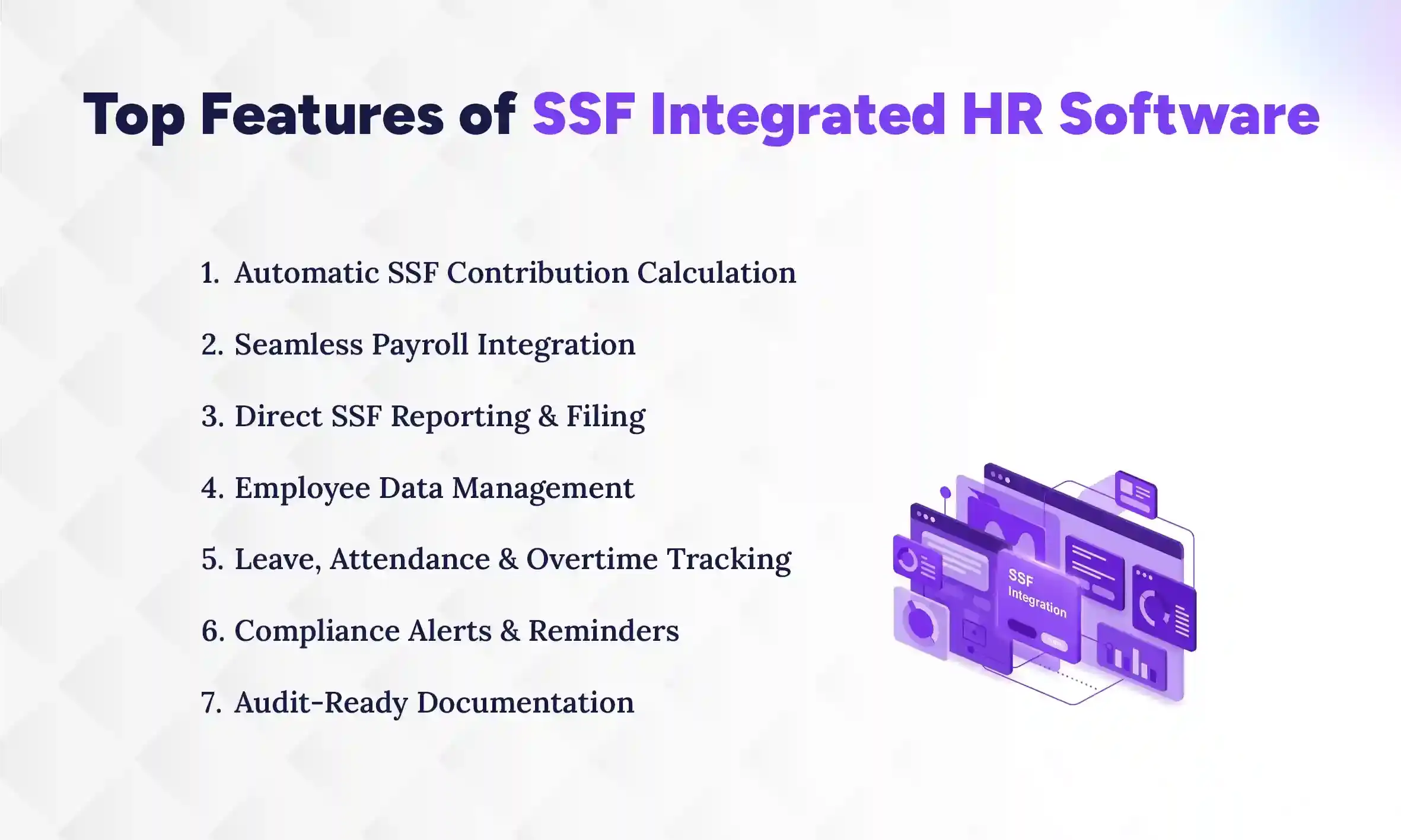
SSF integrated HR software comes with key features like automatic SSF calculation, payroll integration, reporting tools, and employee data management that make compliance much easier for businesses in Nepal. These HRMS features work together to reduce manual effort and improve accuracy in daily HR operations. Instead of handling everything separately, HR teams get a single system that manages SSF smoothly. Let’s look at these features one by one to understand their real value.
1. Automatic SSF Contribution Calculation
This feature automatically calculates SSF contributions based on employee salary details. It removes the need for manual percentage calculations every month. Once salary data is entered, the system applies the correct SSF rules instantly. This helps reduce human errors and ensures every employee’s contribution is accurate and consistent.
It also updates calculations when salary changes happen, such as increments or bonuses. So HR teams don’t need to redo calculations again and again. Everything stays aligned with SSF guidelines without extra effort. This saves time and improves trust in payroll accuracy.
2. Seamless Payroll Integration
SSF integrated software connects payroll and SSF processing in one system. This means salaries, deductions, and contributions are all calculated together. HR teams do not need to switch between multiple tools or spreadsheets. Everything is handled in a single workflow.
Because of this automated salary processing system, payroll becomes faster and more reliable. It also reduces the chances of mismatched records between salary and SSF reports. As a result, monthly payroll processing becomes smoother and stress-free.
3. Direct SSF Reporting & Filing
This feature allows HR teams to generate SSF reports directly from the system. Instead of preparing reports manually, the software compiles all required data automatically. This makes submission to SSF much quicker and more accurate.
It also ensures reports follow the required government format. So businesses don’t have to worry about formatting issues or missing details. This helps avoid delays and keeps compliance on track every month.
4. Employee Data Management
This feature keeps all employee information in one centralized system. It includes salary details, job roles, SSF status, and personal records. HR teams can easily update or access data whenever needed. Because everything is stored digitally, it reduces the risk of missing or duplicate records. It also helps during audits or compliance checks. This makes employee management more organized and efficient.
5. Leave, Attendance & Overtime Tracking
The system tracks employee attendance, leave, and overtime in real time. This data directly connects to payroll and SSF calculations. So, every working hour and absence is properly recorded. A combined payroll and attendance management system ensures salary and SSF contributions are always based on correct attendance data. It also helps HR teams manage shift-based or field employees easily. Overall, it improves accuracy in both payroll and compliance.
6. Compliance Alerts & Reminders
This feature sends alerts for SSF deadlines and compliance tasks. It helps HR teams stay on top of monthly submissions and payments. So nothing important gets missed or delayed. It also notifies users when there are rule changes or updates. This keeps businesses aligned with the latest SSF requirements. As a result, compliance becomes proactive instead of reactive.
7. Audit-Ready Documentation
This feature automatically stores all payroll and SSF-related records. HR teams can quickly access documents whenever needed. This is especially helpful during audits or inspections. It ensures data is properly organized and easy to retrieve. So businesses don’t waste time searching for old records. Everything stays clean, structured, and ready for verification at any time.
Ready to Accelerate Your Digital Growth?
Partner with The Pace Infosys to build scalable web and mobile solutions tailored to your business goals.
SSF integrated HR software helps businesses in Nepal save time, stay fully compliant with SSF rules, reduce payroll mistakes, and manage employees more efficiently as they grow. It brings all HR tasks into one system, which makes daily operations much smoother. Because of this, HR teams can focus more on people and less on manual work. Let’s break down the key benefits in detail.
1. Saves Time and Reduces Manual Work
This software removes the need for repetitive manual calculations and spreadsheet updates. HR teams can process payroll, SSF deductions, and reports in just a few clicks. This significantly reduces the time spent on monthly HR tasks.
It also automates routine work like data entry and contribution updates. So, HR staff don’t have to handle the same tasks again and again. As a result, they can focus on more important decisions instead of manual processing.
2. Ensures 100% SSF Compliance
The system is built to follow SSF rules and updates automatically. This ensures contributions are always calculated and reported correctly. HR teams don’t need to worry about missing any legal requirement. It also reduces the risk of penalties caused by delays or errors. Since everything is system-driven, compliance becomes consistent and reliable. This gives businesses peace of mind during audits and inspections.
3. Minimizes Payroll Errors
By automating calculations, the software reduces human mistakes in payroll processing. Salary, overtime, and SSF deductions are all calculated using accurate data. This ensures employees are always paid correctly. It also prevents mismatches between payroll and SSF records. So, HR teams don’t need to fix errors at the end of every month. This improves accuracy and builds trust within the organization.
4. Improves Transparency for Employees
Employees can clearly see their salary breakdown and SSF contributions. This builds trust between staff and the organization. It also reduces confusion or disputes about deductions. Many systems also allow employees to access their records anytime. So, they stay informed about their savings and benefits. This transparency improves overall employee satisfaction.
5. Scales Easily with Business Growth
As a business grows, managing more employees becomes harder without automation. SSF integrated HR software adjusts easily to increasing workforce size. It handles more data without slowing down processes.
It also supports new branches, departments, or remote teams. So, companies don’t need to change systems as they expand. This makes it a long-term solution for growing businesses.
Insights
Did You Know?
The Pace Infosys has delivered over 100+ successful mobile applications and websites globally. From custom web design to integrated digital marketing, we help businesses achieve a complete 360-degree digital transformation.
How SSF Integrated HR Software Works for Nepalese Businesses?
SSF integrated HR software works by connecting all HR processes into one smooth system that automatically handles employee data, payroll, attendance, and SSF compliance. Instead of doing each task separately, everything flows in a structured process inside the software. This reduces confusion and makes HR operations much faster and more accurate. Let’s break it down step by step:
1. Employee Onboarding and Data Entry
The process starts when a new employee joins the company and their details are entered into the system. This includes personal information, salary structure, job role, and SSF eligibility. Once added, the data becomes the foundation for all future HR operations.
This step ensures that all employee records are stored in one place from the beginning. It also reduces the need for manual files or scattered spreadsheets. So, HR teams can easily manage and update information whenever needed.
2. Attendance and Salary Tracking
Next, the system tracks employee attendance, working hours, leave, and overtime. This data is captured automatically through attendance and leave management tools or manual updates. It ensures that every working day is recorded properly.
Based on this data, the system also helps prepare salary inputs. So, HR teams always work with accurate and updated information. This reduces confusion during payroll processing.
3. Automatic SSF calculation
Once salary data is ready, the system automatically calculates SSF contributions. It applies the correct percentage based on government rules. This removes the need for manual calculations every month. It also adjusts calculations when salaries change due to increments or bonuses. So, everything stays accurate and consistent. This step greatly reduces human errors in SSF deductions.
4. Payroll Processing
After SSF calculation, the system processes the full payroll in one go. This includes salary, deductions, overtime, and allowances. Everything is combined into a final payable amount. This makes payroll faster and more organized. HR teams do not need to switch between different tools or sheets. So, monthly salary processing becomes simple and stress-free.
5. Report Generation and Submission
Finally, the system generates SSF and payroll reports automatically. These reports follow the required government format. So, HR teams can directly use them for submission. It also keeps a record of all past reports for future reference. This makes audits and inspections much easier. As a result, compliance becomes smooth and well-managed.
Which is the Best SSF-Integrated HR Software in Nepal?
Pace HRMS stands out as one of the best SSF-integrated HR software in Nepal, given its SSF compliance, payroll accuracy, and overall HR automation . It is designed to simplify how businesses manage Social Security Fund contributions along with payroll, attendance, and employee data in one unified system. Instead of relying on manual calculations or separate tools, companies get a smooth, connected workflow that reduces errors and saves time every month.
What makes Pace HRMS even more practical is its strong focus on Nepal-specific compliance needs, including SSF requirements. It automatically handles contribution calculations, reporting, and payroll syncing, so HR teams don’t have to worry about missing deadlines or making calculation mistakes. This makes it especially useful for growing businesses that want both accuracy and ease in their HR operations.
Why Choose Pace HRMS for SSF Compliance in Nepal?
Pace HRMS is built with the real challenges of Nepalese businesses in mind, especially those struggling with SSF management and payroll complexity. It works well for small teams as well as large organizations, making it flexible for different business sizes.
Fully supports SSF contribution calculation and reporting
Automates payroll with accurate deductions and updates
Designed for easy compliance with Nepalese labor regulations
Suitable for SMEs, corporates, and growing enterprises
Overall, Pace HRMS helps businesses move away from manual SSF tracking and shift toward a more reliable, automated, and stress-free HR system that keeps everything compliant and organized.
How to Choose the Best SSF Integrated HR Software?
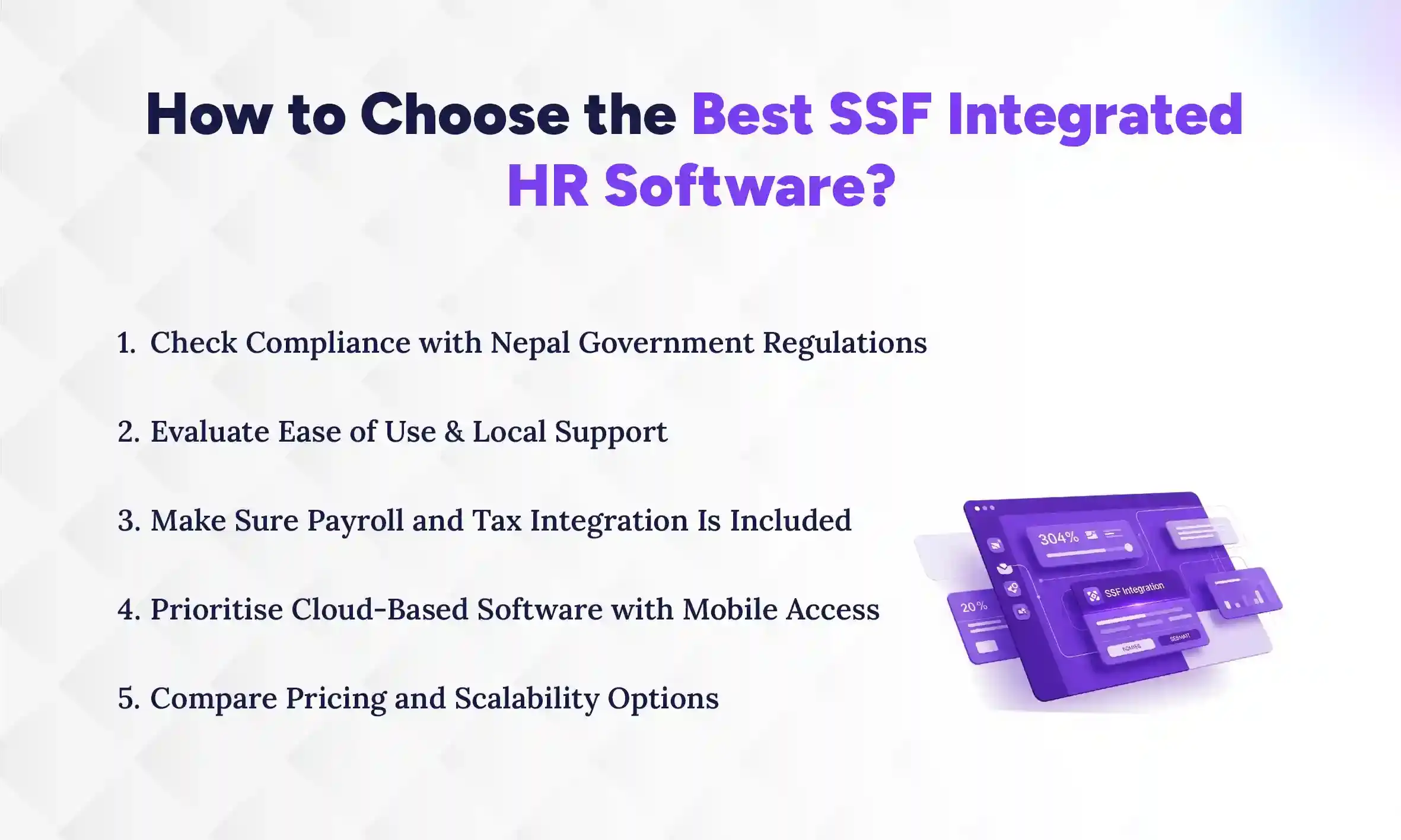
Choosing the best SSF integrated HR software in Nepal means checking compliance features, ease of use, payroll integration, accessibility, and long-term cost value. Each of these factors directly affects how smoothly your HR and SSF processes run every month. When selected carefully, the right system can remove most manual workload. Let’s go through each point step by step to help you select the perfect HR software for your business:
1. Check Compliance with Nepal Government Regulations
First, make sure the software fully supports SSF rules and updates in Nepal. This includes correct contribution rates, reporting formats, and legal requirements. If compliance is not built in, it can lead to errors and penalties.
You should also check whether the system updates automatically when government rules change. This ensures your business always stays aligned with the latest regulations. So, compliance should be the first thing you verify before choosing any software.
2. Evaluate Ease of Use & Local Support
The software should be simple enough for your HR team to use without long training. A clean dashboard and easy navigation make daily tasks faster. If the system feels complex, it can slow down your entire HR process. At the same time, local support is very important for quick issue resolution. You may need help during payroll cycles or SSF filing. So, choose a provider that offers responsive support in Nepal.
3. Make Sure Payroll and Tax Integration Is Included
Payroll and SSF should work together in one system. This ensures salaries, deductions, and contributions are calculated in one flow. It reduces the need to switch between different tools or spreadsheets. Tax integration is also important for complete salary processing. When everything is connected, errors become less likely. So, integration helps improve both accuracy and efficiency.
4. Prioritise Cloud-Based Software with Mobile Access
Cloud-based HR software allows you to access HR data from anywhere. This is useful for companies with remote or field employees. It also ensures data is safely stored and updated in real time. Mobile access adds even more flexibility for HR teams and managers. They can approve leaves, check reports, or track attendance on the go. So, cloud and mobile features make the system more practical for daily use.
5. Compare Pricing and Scalability Options
Before choosing, always compare HRMS pricing based on your business size and needs. Some software may look affordable at first but becomes costly as your team grows. So, long-term cost matters more than initial pricing.
Scalability is also important because your business will grow over time. The software should handle more employees without slowing down. This ensures you don’t need to switch systems later.
Why Nepalese Businesses Are Moving to SSF-Ready HR Software
More businesses in Nepal are shifting toward SSF-ready HR software because SSF compliance has now become large-scale and strictly regulated. With over 2.59 million workers already registered under SSF and more than 22,000 employers enrolled, the system is no longer optional for formal businesses. This level of adoption shows that SSF management is now a core part of payroll and HR operations, not just a policy requirement. As a result, companies are under more pressure to manage contributions accurately and on time.
At the same time, SSF is legally backed under Nepal’s Contribution-Based Social Security Act, 2018, which makes registration and reporting mandatory for employers and employees. However, challenges still exist, especially with accurate reporting and timely compliance across thousands of businesses. Because of this, companies are increasingly turning to digital HR systems to reduce errors and stay compliant without adding extra workload.
Let’s look at the main reasons behind this shift.
1. Digital transformation Trend
As SSF adoption grows across Nepal, businesses are naturally moving toward digital HR systems to manage increasing complexity. Manual tools like spreadsheets are no longer practical when handling payroll, contributions, and employee records at scale. This is especially true for growing companies managing multiple employees and departments.
With thousands of employers already in the SSF system, HR processes need to be faster and more accurate than ever. Digital HR software helps automate these tasks, reducing human error and saving time. So, digital transformation is becoming a practical necessity rather than just a trend.
2. Increased compliance pressure
SSF compliance is now legally required, and businesses must ensure accurate reporting every month. With millions of workers already enrolled in the system, even small mistakes in contribution or reporting can lead to penalties or compliance issues. This increases pressure on HR teams to be more precise and consistent.
Because of this, companies are moving away from manual tracking methods that are prone to errors. HR software helps ensure contributions are calculated correctly and records stay updated. So, compliance becomes more structured and less risky.
3. Need for Real-time Reporting
As SSF-related data grows, businesses need quick access to payroll and contribution information. Waiting for end-of-month reports is no longer efficient for decision-making or compliance checks. Real-time reporting helps HR teams stay updated throughout the month.
Modern HR systems automatically update employee and payroll data as changes happen. This reduces delays and ensures accurate reporting whenever needed. So, businesses can respond faster and avoid last-minute compliance stress.
4. Workforce Mobility
Many companies in Nepal now manage employees across different locations, including field and remote teams. This makes manual attendance and payroll tracking difficult and error-prone. As SSF compliance depends on accurate employee data, this becomes a major challenge.
SSF-ready HR software solves this by allowing mobile access for attendance, updates, and approvals. It ensures HR teams can manage employees regardless of where they work. So, workforce mobility is another strong reason behind the shift toward digital HR systems.
Best Practices for SSF Compliance Using HR Software
SSF compliance becomes much easier when businesses use HR software along with simple but consistent practices like updating employee data, checking monthly records, informing employees, and doing regular internal reviews. These steps help ensure that SSF contributions are always accurate and submitted on time. When followed properly, they reduce errors and improve overall compliance. Let’s break them down one by one.
1. Keep Employee Records Updated Regularly
Regularly updating employee details ensures SSF calculations are always based on correct information. This includes salary changes, job role updates, new joiners, and resignations. If records are not updated on time, it can lead to incorrect contributions. HR software makes this process easier by allowing quick edits and real-time updates. So, HR teams don’t need to maintain separate files or spreadsheets. This helps keep all SSF data accurate and up to date.
2. Review SSF Records Through Monthly Reconciliation
Monthly reconciliation means checking SSF contributions against payroll records at the end of each month. This helps identify any differences or missing entries before submission. It is an important step to avoid compliance mistakes. With HR software, this process becomes faster because all data is already connected. HR teams can compare reports in just a few clicks. So, issues can be fixed before they become bigger problems.
3. Improve Employee Awareness About SSF Contributions
Employees should clearly understand how SSF works and how much is being contributed from their salary. This reduces confusion and builds trust within the organization. It also helps employees stay informed about their long-term benefits. HR software can support this by showing clear salary breakdowns and contribution details. So, employees can easily access their records anytime. This transparency improves communication between HR and staff.
4. Conduct Regular Internal SSF Compliance Audits
Internal audits help businesses check whether SSF processes are being followed correctly. This includes reviewing payroll data, contribution accuracy, and report submissions. It helps catch mistakes early before official inspections. HR software makes audits easier by storing all records in one place. So, HR teams can quickly access historical data whenever needed. This ensures better control and long-term compliance stability.
Conclusion
At the end of the day, every business wants the same thing. Less stress, fewer errors, and more time to focus on growth instead of paperwork. When SSF processes run smoothly, HR teams feel more in control, and employees also gain more trust in the system.
With strict regulations, growing employee numbers, and constant reporting needs, HR teams need a more reliable and automated system to stay accurate and stress-free. That’s where SSF-integrated HR software makes a real difference by bringing payroll, attendance, and compliance together in one place.
If you are still managing SSF manually, now is the right time to switch. A simple upgrade can save hours of work every month and help your business stay fully compliant without the daily hassle. Explore Pace HRMS Today for seamless payroll and HR management!
FAQs
Is SSF mandatory for all businesses in Nepal?
+
Yes, SSF is mandatory for all registered businesses in Nepal under the Social Security Fund Act. Employers and employees in formal sectors must both contribute monthly.
How is SSF contribution calculated?
+
SSF is calculated as a fixed percentage of an employee’s salary shared by employer and employee. In systems like Pace HRMS, this calculation is automated based on payroll data.
Can HR software automatically file SSF reports?
+
Yes, SSF-integrated HR software can generate and prepare SSF reports automatically for submission.
What happens if SSF is not paid on time?
+
Late SSF payments can lead to penalties, interest charges, and compliance issues. It may also create problems during audits and government inspections.
Is SSF integrated HR software suitable for small businesses?
+
Yes, it is highly useful for small businesses as it reduces manual HR work and ensures compliance. Platforms like Pace HRMS make it easier for small teams to manage payroll and SSF together.
Can employees view their SSF contributions in HR software?
+
Yes, employees can view their SSF details through most HR software portals or mobile apps.
Does SSF integration reduce payroll errors?
+
Yes, it reduces errors by automating salary, attendance, and deduction calculations.
How secure is HR software for SSF data?
+
HR software uses encrypted systems and restricted access to protect sensitive SSF data. Platforms like Pace HRMS are built with strong security measures to safeguard employee information.
Ready to get started?
Book a 30-minute consultation call, and let's talk about your goals.