Does the end of the month bring a little extra stress to your HR desk? We get it. You are juggling attendance, managing leaves, and then payroll tricks you.
When it comes to TDS, things can quickly get confusing. What amount is actually taxable? Which deductions apply? And how do you make sure you’re not overpaying or underpaying tax? These are common questions for many business owners and even employees in Nepal.
But don't worry, we’ve got your back. We have put together this simple, step-by-step guide to help you understand what TDS is and how to calculate TDS on salary in Nepal. Let’s clear up the confusion and get those numbers right, shall we?
What is TDS in Nepal?
TDS stands for Tax Deducted at Source. In Nepal, the government has a system to collect tax at the very moment income is generated. Instead of waiting for the end of the year to collect taxes, the government prefers to get it in small portions throughout the year.
This deduction of tax directly from your income at the time of payment is called TDS. It keeps the cash flow running for the nation and, honestly, makes it easier for employees too, so they don't face a huge tax bill all at once.
Technically, TDS is the specific amount of tax that an employer reduces from a salary before handing it over to the employee. Think of it as a "pay-as-you-earn" system.
Whether it is a monthly salary, a contract payment, or a consultant fee, a certain percentage is cut right at the source, hence the name. This deducted amount doesn't stay with the company; it gets deposited directly into the government's account on behalf of the person earning the money.
The main difference between TDS and income tax is the timing and the method. Income Tax is the total tax you owe the government based on your total earnings for the entire fiscal year. TDS, on the other hand, is just an advance payment of that income tax.
Imagine buying a phone on installment. You pay a little bit every month (TDS). By the end of the year, those monthly payments should cover the total cost of the phone (Income Tax). If you paid too much via TDS, you can claim a refund. If you paid too little, you pay the remaining balance when filing your tax return.
2. Who Must Deduct TDS?
In Nepal, the responsibility falls squarely on the employer or the entity making the payment. It is not the employee's job to calculate and deposit this monthly amount. If you are running a business or managing an organization, you are legally required to deduct TDS from your employees' salaries before you transfer their pay. It is a big responsibility, which is why getting the calculation right is so important for every HR department.
Insights
Did You Know?
Salary TDS is based on an employee’s annual tax calculation, not simply a fixed percentage of monthly pay. Pace HRMS can automate payroll calculations and deductions to simplify salary processing.
Understanding TDS (Tax Deducted at Source) on Salary
Now that we have the basics covered, let’s get into the nitty-gritty of how TDS on salary actually works. It might seem a bit complicated at first with all the percentages and rows of numbers, but once you break it down, it is quite logical.
1. TDS Rates for Employees in Nepal
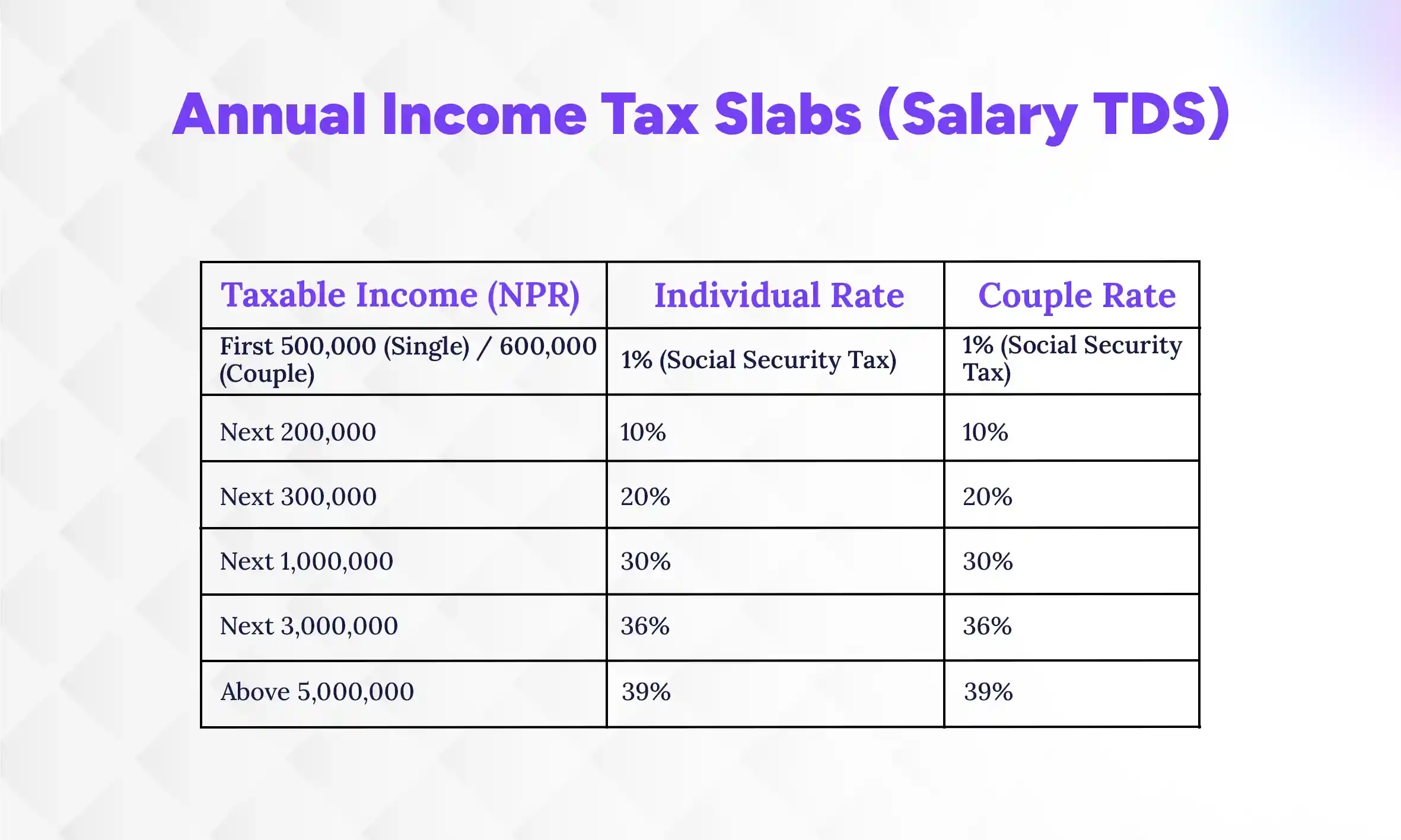
In Nepal, the tax you pay depends entirely on how much you earn in a fiscal year. The government has set specific "slabs" or brackets for this. Also, the rules are slightly different depending on whether you choose the "Single" status or the "Married/Couple" status.
Here is exactly how the current annual tax slabs break down:
You will calculate your taxes based on your total annual income, and the tax rate set for your salary range. We will discuss how to calculate the exact TDS on salary in detail, in this very blog right after.
2. Exemptions and Deductions on TDS
Now, here is the part everyone likes! How to legally lower that taxable amount? You don't necessarily pay tax on your gross salary. The government allows you to subtract certain savings and expenses before the tax is calculated.
Common deductions that lower your taxable income include:
Retirement Savings: Contributions to PF (Provident Fund) or CIT (Citizen Investment Trust) are deductible. You can deduct up to 1/3rd of your assessable income or a maximum of NPR 300,000 per year (whichever is lower).
SSF Contributions: Any amount you contribute to the Social Security Fund is deductible.
Life Insurance: You can deduct premiums paid, up to NPR 40,000.
Medical Insurance: You can deduct premiums paid, up to NPR 20,000.
By using these options wisely, you reduce the "Taxable Income" we looked at in the table above.
3. Tax Waive for SSF Contributors
If your company is enrolled in the Social Security Fund (SSF) and you are contributing, the initial 1% Social Security Tax is completely waived for you.
Without SSF: You pay 1% on the first 500,000 (or 600,000 with your partner).
With SSF: You pay 0% tax on that first slab.
4. Effect on Take-Home Salary (Net Salary)
Basically, your Take-Home Salary (or Net Salary) is your Total Earnings minus the TDS and other mandatory deductions like PF or SSF.
The Simple Formula: Gross Salary - (TDS + PF/CIT/SSF) = Net Salary
This net salary is the money that actually lands in your bank account.
While seeing a chunk of money deducted might feel like a pinch, remember that TDS is just paying your dues in advance. It prevents the shock of a huge tax bill at the end of the year. Plus, with the right planning and understanding of exemptions, you can maximize what you take home.
How to Calculate TDS on Salary in Nepal?
Find taxable salary, understand your tax slab, and then calculate manually or use a tax calculator. Even better, adopt an HR management software that not only helps you view balances and applicable tax slabs but also simplifies and automates the entire payroll calculation.
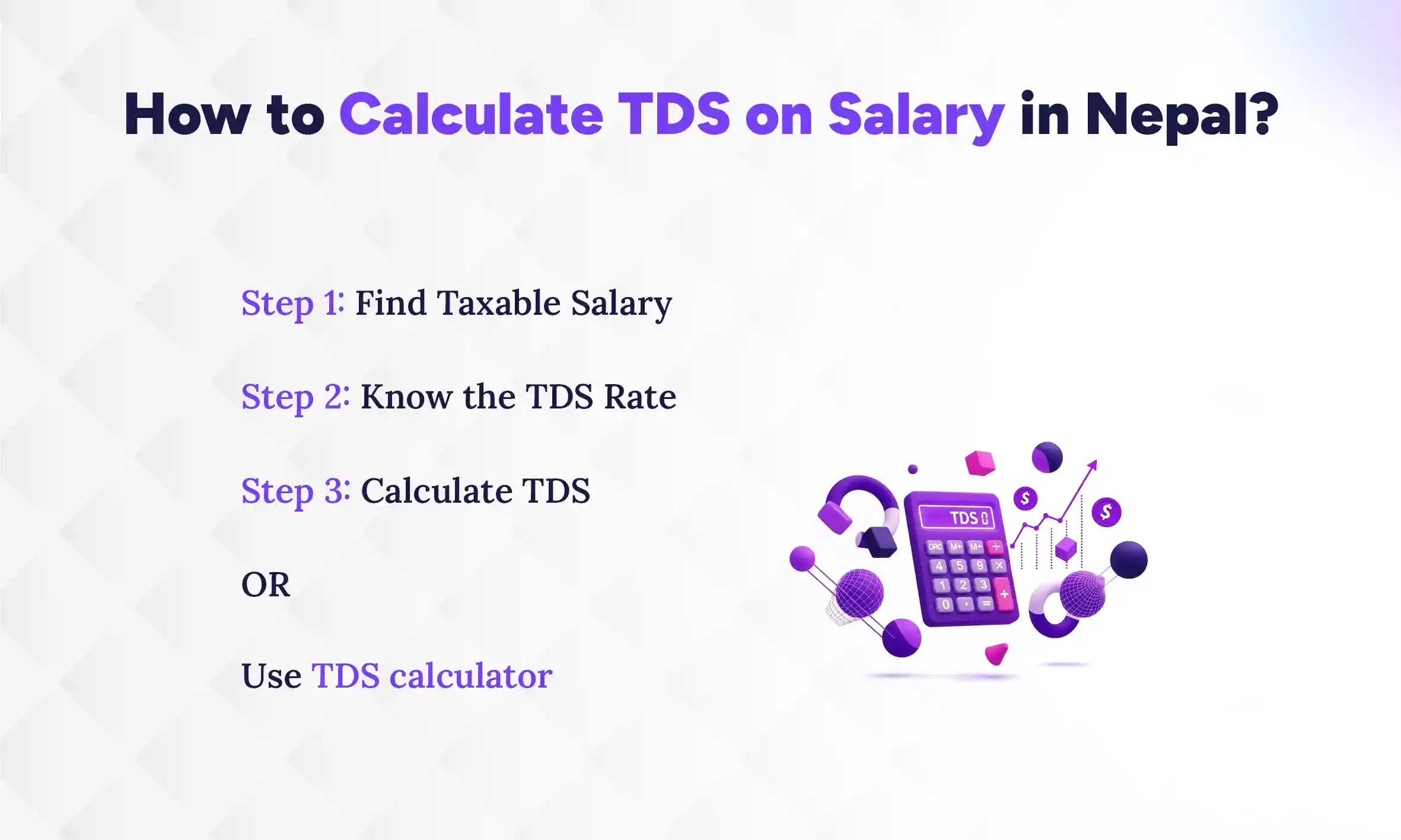
Here's a step by step guide to help you calculate your TDS on salary:
To illustrate the process, we will use an example of an unmarried employee named Rahul, who earns a gross annual salary of NPR 800,000 and deposits NPR 100,000 annually into the Citizen Investment Trust (CIT).
Step 1: Find the Taxable Salary
Income tax is not calculated on your full salary (gross salary). It is rather calculated on your taxable salary, which is the amount that remains after deductions.
To find this taxable amount, subtract things like SSF, CIT, Provident Fund (PF), or insurance from your total yearly salary.
For example:
Rahul’s salary = NPR 800,000
Deductions = NPR 100,000
Taxable Salary = 800,000 − 100,000 = NPR 700,000
So, Rahul’s taxable salary is NPR 700,000, and this is the base amount used for tax calculation.
Step 2: Know the TDS Rate (Identify the Slabs)
Next, you must determine which tax slabs apply to Rahul's NPR 700,000. Because Rahul is filing as a single individual, we refer to the "Individual" column in the tax slab table. We’ll segment his taxable salary in two parts:
First Slab: Covers the first NPR 500,000 (Taxed at 1%).
Second Slab: Covers the next NPR 200,000 (Taxed at 10%).
In this scenario, Rahul's income perfectly fills the first two slabs, with no remaining amount extending into the 20% bracket.
Step 3: Calculate the TDS
Now, calculate the tax for each applicable slab separately and sum the results to find the total annual tax liability.
Tax for the first slab (1% of 500,000): NPR 500,000 times 0.01 = NPR 5,000
Tax for the second slab (10% of the remaining 200,000): NPR 200,000 times 0.10 = NPR 20,000
Total Annual Tax for Rahul: NPR 5,000 + 20,000 = NPR 25,000
Rahul's total tax liability for the year is NPR 25,000. Since TDS is deducted on a monthly basis, divide this annual total by 12 to determine the monthly deduction amount.
This NPR 2,083.33 is the precise amount that must be deducted from Rahul's monthly salary.
Or... Use a TDS Calculator
While understanding the manual calculation is important, performing these steps by hand for an entire organization each month can be time-consuming and prone to human error.
To ensure accuracy and efficiency, using a digital Salary TDS Calculator is highly recommended for HR and finance professionals. By simply entering the gross salary and applicable deductions, the tool automates the entire process and provides instant, accurate results. This minimizes calculation errors and allows teams to focus on more strategic tasks rather than routine manual math.
Managing TDS manually for an entire workforce is not just time-consuming; it also leaves room for costly administrative errors. Fortunately, there are modern solutions and resources designed to streamline these complex calculations and ensure your organization remains fully compliant with Nepal’s tax regulations.
1. Online TDS Calculators
For quick estimations or small teams, online TDS calculators are highly effective resources. These free digital tools allow HR professionals or employees to input gross income, marital status, and eligible deductions, such as SSF, PF, CIT, or insurance premiums.
Within seconds, the calculator computes the exact annual and monthly tax liability based on the latest government tax slabs. Using an online calculator eliminates the need to build complex manual spreadsheet formulas and provides a fast, accurate baseline for processing monthly tax deductions.
2. Payroll Software for TDS Compliance
While online calculators are excellent for individual checks, managing TDS at scale requires a more comprehensive approach. Dedicated payroll software completely automates the entire TDS lifecycle, handling everything from real-time deductions and statutory reporting to the issuance of tax certificates.
This is exactly where a robust solution like Pace HRMS becomes an invaluable asset for your organization. Built to handle the specific complexities of payroll and taxation in Nepal, Pace HRMS transforms how businesses manage employee compensation.
Here is how HR payroll software can help your organization streamline TDS management:
Automates complex TDS calculations instantly and accurately.
Ensures 100% compliance with IRD tax regulations.
Generates instant tax reports for seamless filing.
Delivers clear, transparent payslips for every employee.
Eliminates manual math errors and saves time.
3. Which is the Best Payroll Software in Nepal?
Pace HRMS stands out as a modern and reliable HR and payroll solution built for Nepalese businesses. It brings payroll, attendance, leave, and tax management into one simple system, making HR operations much smoother and more accurate.
Make Payroll Calculations Easier
Automate salary tax, TDS, SSF, and payroll calculations with Pace HRMS for simpler and more accurate payroll management.
Pace HRMS is not just a tool; it is a complete HR system that helps businesses move from manual processes to automated, stress-free payroll management.
Conclusion
Calculating TDS on salary in Nepal is simple once you understand the basics. Find your taxable salary, apply the correct rate, and deduct the tax accurately. When done right, it keeps your business compliant and your payroll process smooth.
At the same time, many business owners struggle with changing rules, manual errors, and tight deadlines. That’s completely normal. But with the right approach, you can avoid last-minute stress, build trust with your employees, and stay confident during tax season.
So, instead of guessing or doing everything manually, take a smarter step. Use reliable tools or systems to handle TDS with ease, save time, and focus more on growing your business.
Yes, TDS is adjusted against your total annual income tax when you file your return. If excess tax has been deducted, you can claim a refund from the tax authority.
Is TDS Compulsory for All Salaries?
+
No, TDS is not compulsory for all salaries. It only applies when an employee’s income exceeds the taxable limit set by the government for that fiscal year.
What Happens If TDS Is Not Deducted?
+
If TDS is not deducted, the employer may face penalties, interest charges, and possible legal consequences. It can also create complications for employees when filing their income tax returns.
What is the Formula for Calculating TDS?
+
The basic formula is: TDS = (Annual Gross Salary − Total Exemptions) × Applicable Tax Rate. This helps determine how much tax should be deducted from salary.
When Should TDS Be Deducted from Salary?
+
TDS should be deducted at the time of salary payment, usually every month. This ensures tax is collected gradually and avoids a large payment at the end of the year.
Who is Responsible for Deducting TDS?
+
The employer is responsible for calculating, deducting, and depositing TDS with the tax authority. They must also ensure accurate reporting and provide employees with TDS certificates.
Can Employees Reduce Their TDS Amount?
+
Yes, employees can reduce their TDS by investing in tax-saving schemes like CIT, Provident Fund, or insurance, which are eligible deductions under Nepal’s tax rules.
Is TDS the Final Tax for Employees?
+
For most salaried employees, TDS covers their tax liability. However, they still need to file a tax return to confirm the final amount or claim any refund if applicable.
Ready to get started?
Book a 30-minute consultation call, and let's talk about your goals.