HR teams can lose significant time handling repetitive employee requests, such as payslip copies, leave balance checks, attendance queries, and personal detail updates. An employee self-service portal, as part of an HRMS, removes much of this routine work by allowing employees to access and manage their own information directly.
For multi-branch Nepali businesses, this can be especially useful when employees primarily rely on mobile phones rather than desktop computers. However, the benefits depend on having a portal that is easy to use, mobile-friendly, and designed to support the practical needs of employees and HR teams in Nepal. If you're unclear on what HRMS is and how self-service fits into it, the portal is one of its most immediately useful features.
What Is an Employee Self-Service Portal?
An employee self-service portal is a feature within an HRMS that allows employees to directly view and manage their own information, including payslips, leave, attendance, and personal details, without routing every request through HR. It gives employees a convenient way to access common HR services whenever they need them.
Instead of constantly emailing HR for a payslip, checking a leave balance, or asking a manager to confirm attendance details, employees can simply log in and find the information themselves. By providing self-service through a centralized HRMS portal, businesses can reduce repetitive HR requests and give employees more control over routine tasks. This saves time for both employees and HR teams while making everyday HR processes more efficient. Understanding what HRMS software does helps clarify where self-service fits among the broader capabilities an HRMS provides.
Why Does an Employee Self-Service Portal Matter for Nepali Businesses?
An employee self-service portal matters because it reduces the amount of routine HR work that employees and HR teams need to handle manually. Instead of depending on HR for payslips, leave balances, attendance records, or personal information updates, employees can access these services themselves.
For Nepali businesses with multiple branches, growing teams, and employees who often rely on mobile devices, self-service can make HR operations more efficient and accessible. It also gives HR teams more time to focus on important work while employees get faster access to the information they need.
Core Features of an Employee Self-Service Portal
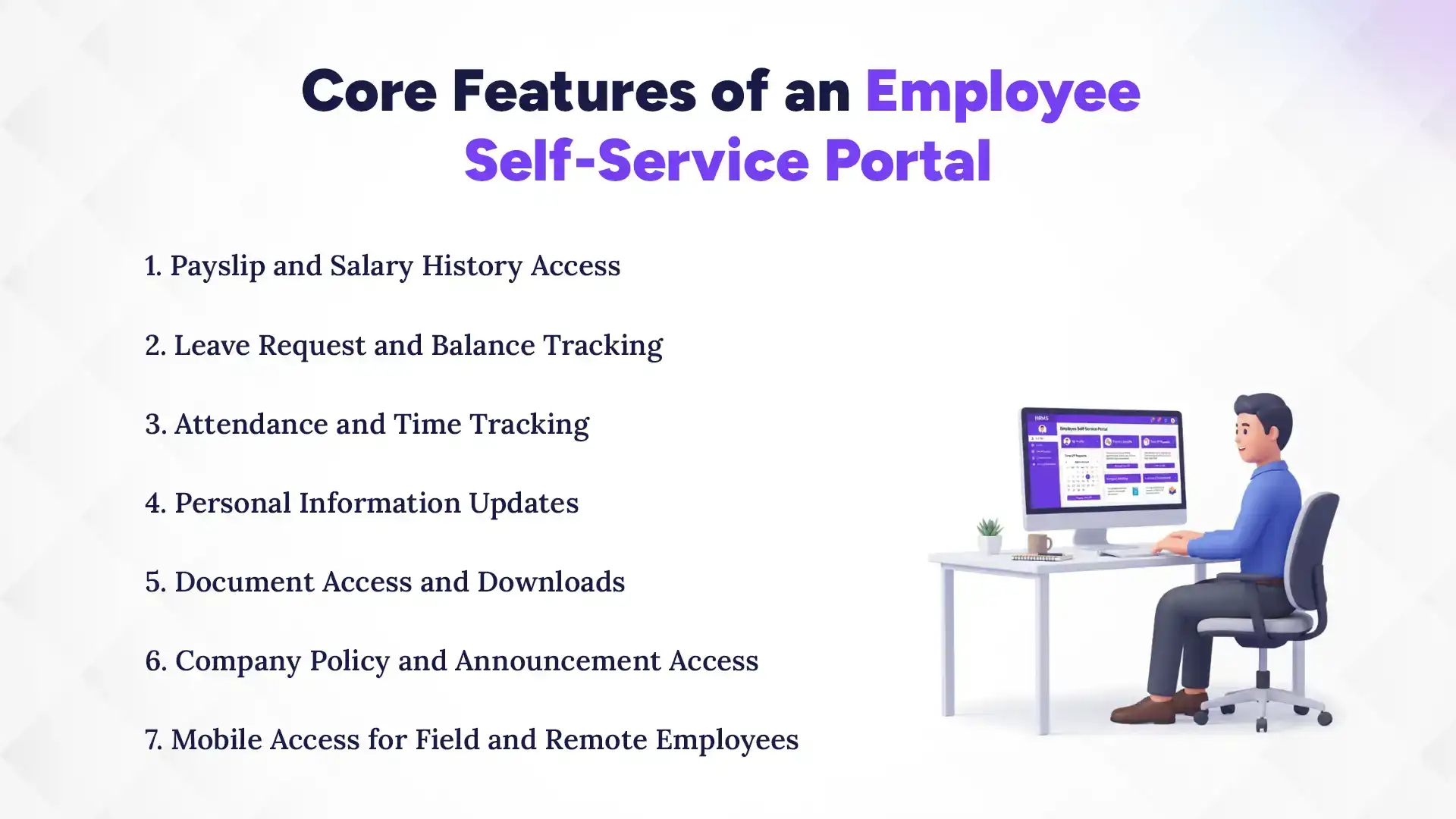
The core features of an employee self-service portal typically include payslip and salary history access, leave requests and balance tracking, attendance and time tracking, personal information updates, document access, company policies and announcements, and mobile access. For Nepali businesses, these features can reduce routine HR requests, improve employee access to information, and make everyday HR processes easier to manage. The features of HRMS software that matter most in practice are often the ones employees interact with directly; self-service sits at the top of that list.
1. Payslip and Salary History Access
Employees can view and download current and past payslips directly, without emailing HR for a copy every time one is needed. Providing payslip and salary history access on demand removes one of the most common sources of routine HR requests.
2. Leave Request and Balance Tracking
Employees can submit leave requests and see their current balance in real time, instead of asking HR or a manager to check for them. Leave request and balance tracking through the portal also gives managers a clearer, faster view of who's requesting time off. Understanding what leave management software is helps explain how self-service integrates with the broader leave tracking system.
3. Attendance and Time Tracking
Employees can view their own attendance records and flag discrepancies directly, rather than relying on HR to pull and share this data manually. Self-service attendance and time tracking catches errors earlier, before they turn into a payroll dispute.
4. Personal Information Updates
Employees can update contact details, emergency contacts, and other personal information themselves, keeping records current without a manual update request. Letting employees handle their own personal information updates keeps HR's data accurate without adding to their workload.
5. Document Access and Downloads
Employees can access contracts, tax documents, and other personal paperwork on demand, instead of requesting copies each time one is needed. Centralized document access and downloads means employees aren't dependent on HR's availability just to find their own paperwork.
6. Company Policy and Announcement Access
Employees can view current policies and company announcements in one place, removing the need for HR to redistribute the same information repeatedly. Centralized company policy and announcement access ensures everyone is working from the same, current version.
7. Mobile Access for Field and Remote Employees
Employees working outside the office can access all of the above from a phone, which matters for field staff and remote workers who rarely sit at a desk. Mobile access for field and remote employees is what makes self-service actually usable for a large share of a typical Nepali workforce.
Benefits of an Employee Self-Service Portal for Nepali Businesses
The benefits of an employee self-service portal include reducing HR's time spent on repetitive requests, giving employees faster access to information, reducing manual data entry errors, improving transparency and employee experience, making it easier to scale HR operations, and providing consistent access across multiple branches. For Nepali businesses, these benefits can help simplify daily HR operations while giving employees more convenient access to essential HR services.
1. HR Spends Less Time on Repetitive Requests
Routine questions that used to require a person to answer are instead handled by employees checking the portal directly, freeing HR for higher-value work. Reducing time spent on repetitive requests is often the single biggest, most immediate return a business sees after adopting self-service.
2. Employees Get Faster Answers to Common Questions
Employees no longer wait on HR's availability to check a leave balance or download a payslip, since the information is available whenever they need it. Getting faster answers to common questions improves the day-to-day experience of working at the company, even in small, easy-to-overlook ways.
3. Fewer Errors From Manual Data Entry
When employees update their own information directly, there's one less manual step where a transcription error could be introduced. Fewer errors from manual data entry means HR spends less time correcting mistakes after the fact.
4. Improved Transparency Around Pay and Leave
Employees can see exactly what they've been paid, what's been deducted, and how much leave they have, without having to take HR's word for it secondhand. Improved transparency around pay and leave builds trust simply by making information visible instead of hidden behind a request process.
5. Better Employee Experience and Satisfaction
A portal that respects employees' time and gives them direct control over their own information tends to be noticed and appreciated, even when it's a small convenience. Better employee experience and satisfaction compounds over time, shaping how employees feel about the company more broadly.
6. Easier Scaling as Headcount Grows
Self-service scales naturally as a business adds employees, unlike a manual process where every new hire adds more repetitive work for HR. Easier scaling as headcount grows means HR's workload doesn't increase in lockstep with the size of the team.
7. Consistent Access Across Multiple Branches
Every branch's employees get the same self-service experience, rather than access and processes varying depending on which office someone works from. Consistent access across multiple branches keeps the employee experience uniform, regardless of location.
What Should You Look for in an Employee Self-Service Portal?
When choosing an employee self-service portal, look for features that make HR processes simple, accessible, and secure for employees. For Nepali businesses, the portal should also work well across mobile devices, connect with existing HR systems, and be easy for employees with different language preferences to use. If you're evaluating options, learning how to choose HR software with self-service as a specific criterion helps narrow the field.
1. Mobile-Friendly Access
The portal needs to work well on a phone, not just a desktop browser. This is especially important for field-based and remote employees who may rely primarily on mobile devices for accessing HR services.
2. Role-Based Permissions
Access should reflect what each employee actually needs to see and do. This helps employees access relevant HR services while protecting sensitive information from unnecessary access.
3. Integration With Payroll and Attendance
Self-service data should connect directly to payroll and attendance systems rather than sitting in a separate silo. This can reduce duplicate data entry and help keep employee information consistent across HR processes.
4. Local Language Support
The interface should be usable for employees who are not fluent in English. Local language support can make the portal easier to understand and encourage wider adoption across a diverse workforce.
How Does an Employee Self-Service Portal Work With an HRMS?
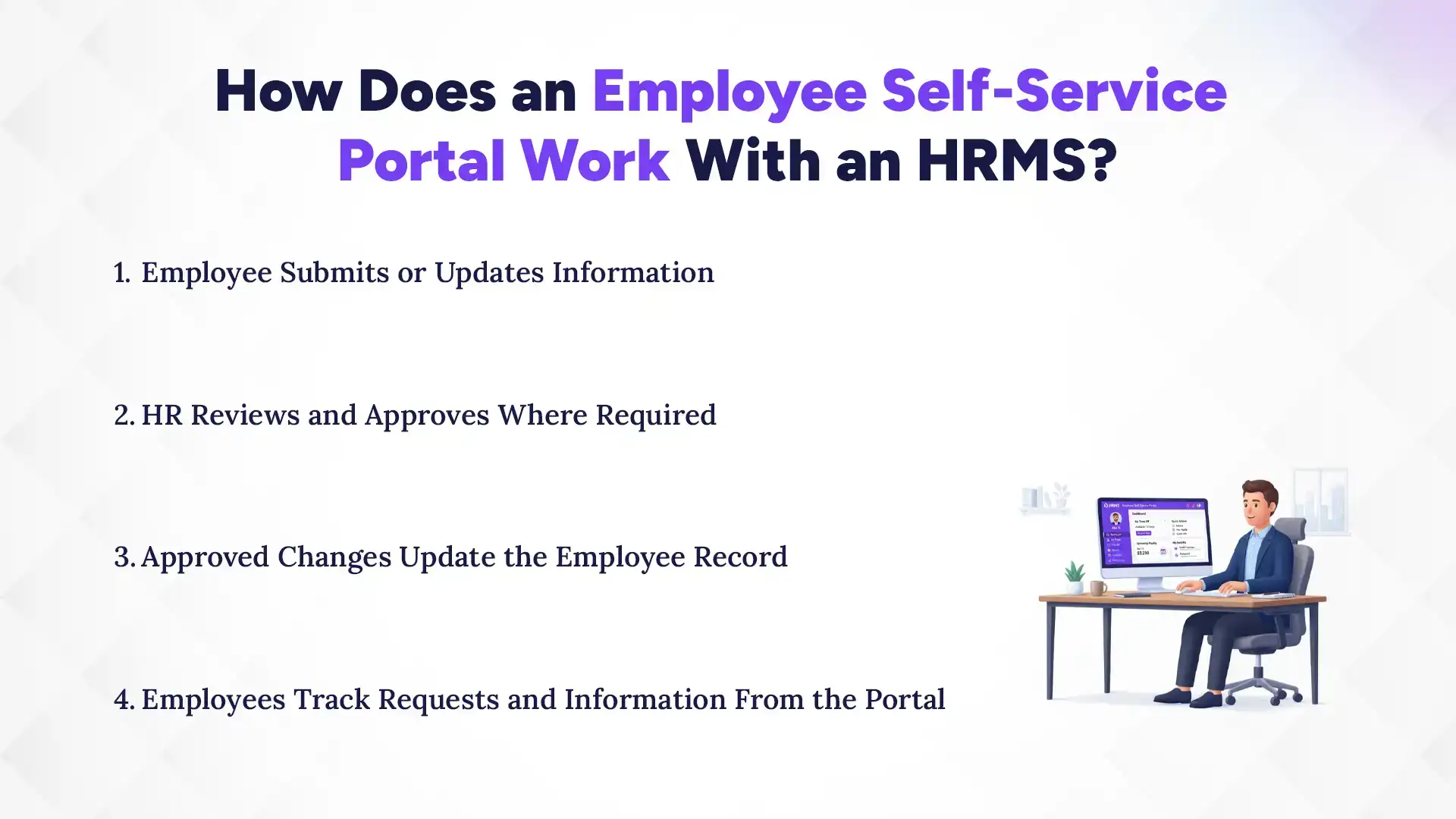
An employee self-service portal works with an HRMS by allowing employees to submit requests, update their information, and access HR records directly. The HRMS then manages the workflow, routes requests that require approval to the appropriate person, updates official records once approved, and allows employees to track the status of their requests. Among the different types of HR software, those with integrated self-service portals handle this workflow automatically rather than requiring separate tools.
1. Employee Submits or Updates Information
The process starts with an employee entering a request or update directly through the portal, whether that's a leave request or a change to their contact details. Having the employee submit or update information themselves is the starting point that removes HR from the initial step entirely.
2. HR Reviews and Approves Where Required
Certain changes, like leave requests or sensitive personal updates, are routed to HR or a manager for approval before they take effect. HR reviewing and approving where required keeps oversight in place without requiring HR to handle every step of the process manually.
3. Approved Changes Update the Employee Record
Once approved, the change is reflected automatically in the employee's official record within the HRMS, without requiring a separate manual update. Having approved changes update the employee record automatically keeps the system accurate without extra administrative work.
4. Employees Track Requests and Information From the Portal
Employees can check the status of a pending request or review their updated information directly through the same portal they submitted it from. Letting employees track requests and information from the portal removes the need to follow up with HR just to check on progress.
Which HRMS Offers the Best Employee Self-Service Portal for Nepali Businesses?
HR and payroll software from Pace HRMS includes a self-service portal built specifically around how Nepali businesses actually operate. It supports mobile access for field and branch employees, role-based permissions that keep sensitive data appropriately restricted, and direct integration with payroll and attendance so self-service updates flow straight into the records that matter.
These capabilities map directly onto what growing Nepali businesses need: employees working outside a central office can access their information from a phone, HR gets relief from repetitive requests, and every branch works from the same consistent system. Rather than a generic self-service feature bolted onto a larger platform, a complete HRMS solution for Nepali businesses treats this as core functionality built for how Nepali teams are actually structured. When reviewing the best HR software in Nepal, self-service depth is what separates platforms designed for modern workplaces from those still built around manual HR workflows.
Conclusion
An employee self-service portal removes HR from routine requests while giving employees faster, more transparent access to their own information. The right fit depends on team size, branch structure, and how much of HR's time is currently going toward requests that don't need a person to handle them. For most growing Nepali businesses, that time adds up quickly, and self-service is what gives it back.
Not sure if self-service is the right fit for your team yet? Leave a message with Pace Infosys, and we'll walk you through what it looks like for a setup like yours. No pressure, just a straightforward conversation.
FAQs
Can employees edit sensitive information themselves, or only view it?
+
This depends on configuration, but sensitive changes are typically routed through an approval step rather than being editable outright by the employee.
Does an employee self-service portal work well on low-end smartphones?
+
A well-built portal should work smoothly on lower-end smartphones, which matters given how many employees primarily access systems from mobile devices.
How much HR time does self-service typically save in practice?
+
The time saved varies by business size, but HR teams commonly report a significant reduction in time spent on routine, repetitive requests after adopting self-service.
Can access be customized by role or department?
+
Yes. Role-based permissions typically allow access to be customized so employees, managers, and HR each see what's relevant to them.
Is an employee self-service portal useful for very small businesses?
+
It can be, though the benefit becomes more pronounced as headcount grows and the volume of repetitive requests increases.
Does self-service reduce the need for HR staff or just their workload?
+
Self-service primarily reduces the routine workload on existing HR staff, freeing their time for more strategic work rather than eliminating the need for HR entirely.
Ready to get started?
Book a 30-minute consultation call, and let's talk about your goals.