Search is no longer just about ranking websites on Google. Today, AI-powered tools are changing how users find answers instantly without clicking multiple links. This shift is transforming digital marketing and pushing businesses to rethink their SEO strategies. Generative Engine Optimization is emerging as a powerful approach in this new AI-driven search era.
In this blog on what generative engine optimization (GEO), we will explore its meaning, importance, and how it works in modern digital marketing. You will learn step-by-step strategies to implement GEO effectively for your website. We will also cover its benefits, tools, mistakes to avoid, and future trends. By the end, you will clearly understand how to optimize content for AI-powered search engines.
What is GEO (Generative Engine Optimization)?
GEO (Generative Engine Optimization) is the process of optimizing content so it appears in AI-generated answers from search engines and AI tools. It focuses on helping AI systems understand, extract, and present your content directly in response to user queries. Instead of only targeting traditional search rankings, understanding what is seo GEO targets visibility in answer engines and AI platforms. It improves how content is structured, written, and interpreted for modern search experiences.
Why is Generative Engine Optimization Important?
Generative Engine Optimization is important because it helps businesses stay visible in AI-driven search environments where users receive direct answers instead of traditional links. As search behavior shifts toward AI tools and chatbots, GEO ensures content is properly structured for these systems. It improves how information is understood and delivered by AI platforms. This makes content more relevant, accessible, and competitive in modern digital marketing.
1. Growth of AI-Driven Search And Chatbots
AI-driven search engines and chatbots are changing how users access information online. Instead of browsing multiple websites, users now get instant answers from AI tools. This reduces reliance on traditional search engine results pages. Businesses need to adapt their content for these platforms. GEO helps ensure content is visible in AI-generated responses. It supports better reach in evolving search ecosystems. It also improves the adaptability of content to future technologies.
2. Rise of Zero-Click And Answer-Based Search Results
Zero-click searches are increasing as users find answers directly on search pages. AI systems often provide complete responses without requiring website visits. This changes how traffic is distributed across the web. GEO helps content appear in these direct answer formats. It increases brand visibility even without clicks. It ensures content remains relevant in modern search behavior. It also enhances exposure in AI-powered summaries.
3. Better Alignment With User Intent And Context
GEO focuses on understanding user intent and delivering contextually relevant answers. It ensures content matches what users are actually searching for. This improves the accuracy and usefulness of information. AI systems prioritize content that aligns with intent. Better alignment increases the chances of selection in AI responses. It improves content relevance and user satisfaction. It also strengthens overall search performance.
4. Improved Visibility In AI-Generated Responses
GEO increases the likelihood of content being selected in AI-generated answers. Structured and clear content is easier for AI systems to process. This improves visibility across voice assistants and generative search platforms. It helps brands gain exposure without relying only on rankings. More visibility leads to stronger brand awareness. It enhances digital presence in AI-powered ecosystems. It also supports long-term search relevance.
How to Optimize Your Page for GEO?
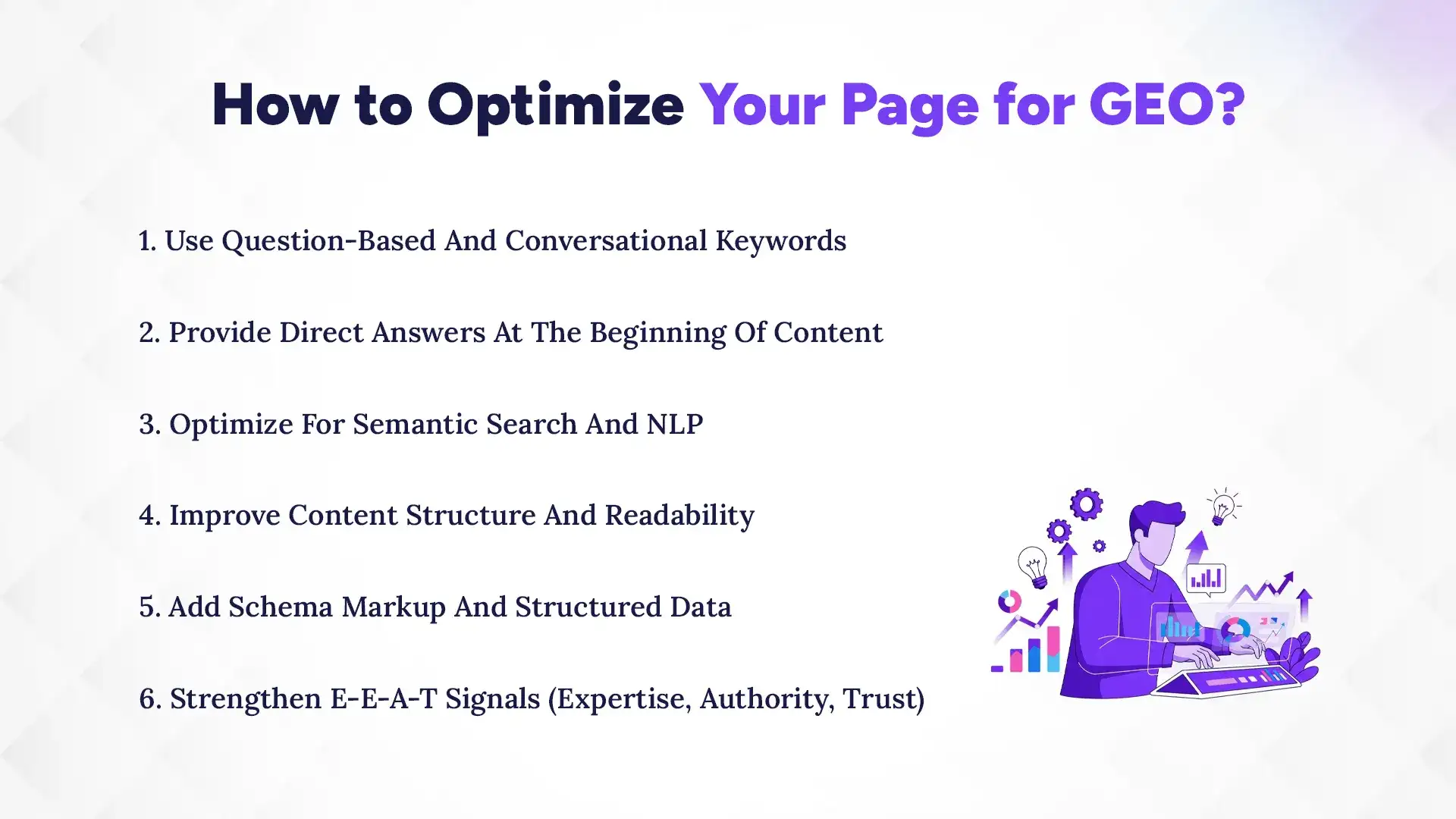
You can optimize your page for GEO by creating content that is clear, structured, and aligned with how AI systems extract and present answers. The focus should be on user intent, conversational language, and structured formatting, similar to AEO. This helps search engines and AI tools easily understand and use your content in generated responses. Proper optimization increases visibility in AI-driven search results.
1. Use Question-Based And Conversational Keywords
Using question-based and conversational keywords helps match how users search on AI platforms. These keywords reflect natural language queries used in voice and chat-based search. It improves relevance and increases chances of appearing in AI answers. Content becomes more aligned with real user intent. It also enhances visibility in conversational search systems. It makes content more discoverable across multiple query formats.
2. Provide Direct Answers At The Beginning Of Content
Starting with direct answers helps AI systems quickly identify key information. It improves chances of selection for featured snippets and AI responses. Users also get immediate value without reading long text. This improves engagement and reduces bounce rates. Clear answers make content more AI-friendly and accessible. It also strengthens snippet eligibility.
3. Optimize For Semantic Search And NLP
Semantic optimization helps search engines understand meaning instead of just keywords. NLP allows AI systems to interpret context and relationships between terms. Using related phrases improves content relevance. It also increases ranking potential in generative search. This makes content more intelligent and context-aware. It enhances visibility across related search queries.
4. Improve Content Structure And Readability
Well-structured content is easier for both users and AI systems to process. Using headings, bullet points, and short paragraphs improves clarity. It enhances user experience and engagement, which is an important part of on-page seo. Clear formatting helps AI extract key information quickly. Good structure improves overall content performance. It also reduces confusion for readers.
5. Add Schema Markup And Structured Data
Schema markup provides additional context to search engines about your content. It improves indexing and visibility in rich results. Structured data helps AI systems better understand content structure, which is a key part of technical seo. It increases the chances of appearing in AI-generated answers. It is essential for technical GEO optimization. It also improves search result presentation.
Strong E-E-A-T signals improve content credibility and ranking potential. High-quality, expert-written content performs better in AI search. Authority is built through backlinks and reliable sources. Trust ensures users and AI systems value your content. It boosts long-term visibility and digital reputation. It also improves brand reliability in competitive markets.
How to Build a GEO Strategy?
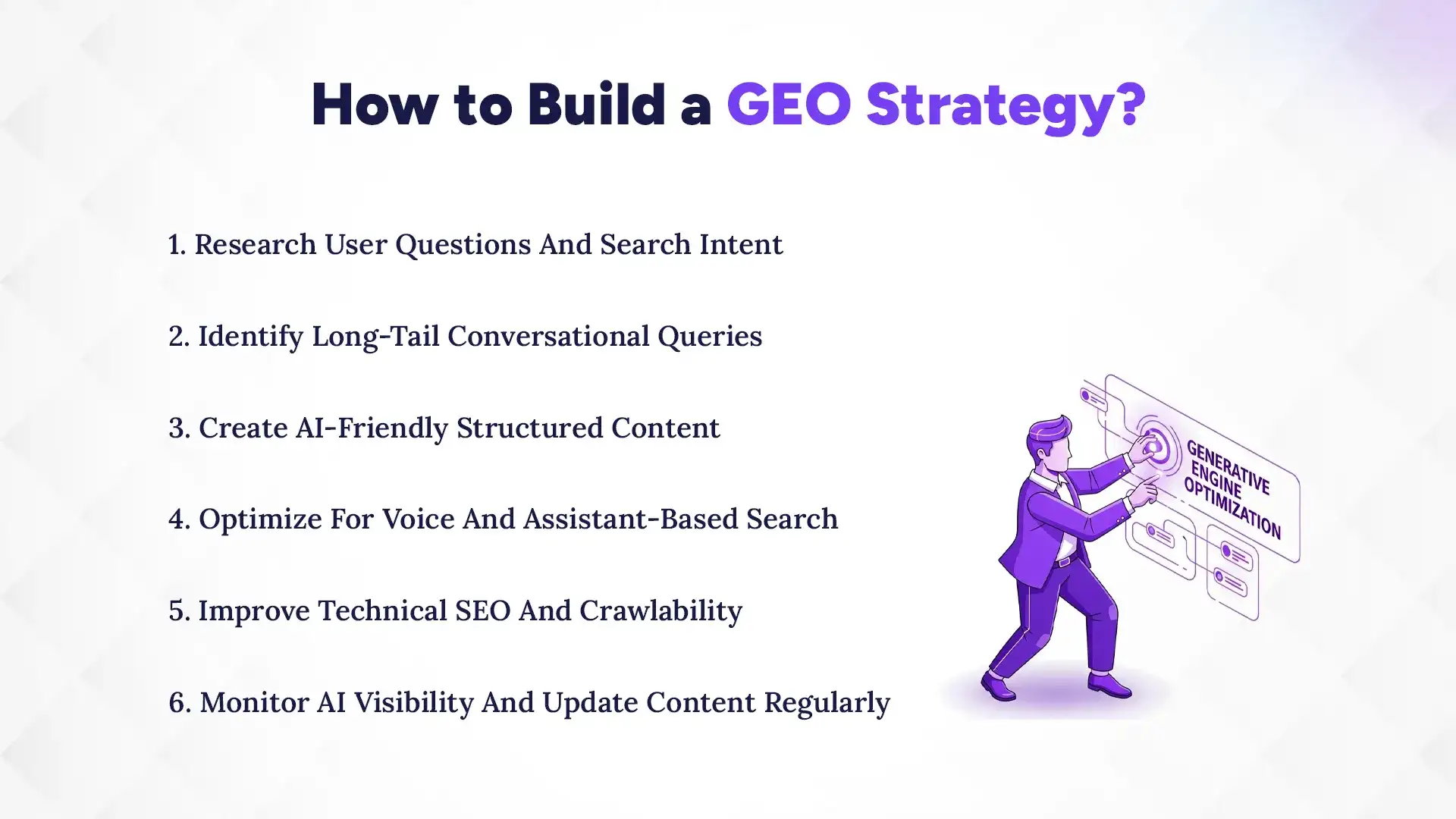
You can build a GEO strategy by aligning your content with how AI systems understand, extract, and present information in search results. It requires a clear focus on user intent, structured content, and conversational optimization. The goal is to make your content easily discoverable and usable by generative AI engines. A strong GEO strategy improves visibility, engagement, and long-term search performance.
1. Research User Questions And Search Intent
Understanding user questions and search intent is the foundation of a GEO strategy. It helps you identify what people are actually asking on search engines and AI tools. This ensures your content directly addresses real user needs. Intent-based research improves relevance and content targeting. It increases the chances of appearing in AI-generated answers. It also helps create more valuable and focused content.
2. Identify Long-Tail Conversational Queries
Long-tail conversational queries reflect how users naturally speak or type questions. These queries are essential for voice search and AI-based search engines. They are less competitive but highly intent-driven. Targeting them improves content precision and visibility, which can be supported through off-page seo. They help match real user search behavior more accurately. It also increases the chances of ranking in niche queries.
3. Create AI-Friendly Structured Content
AI-friendly content is well-organized, clear, and easy to interpret. It uses headings, bullet points, and concise answers for better readability. Structured content helps AI systems extract relevant information quickly. It improves chances of being selected for AI-generated responses. Good structure enhances both user and machine understanding. It also improves overall SEO performance.
4. Optimize For Voice And Assistant-Based Search
Voice search optimization focuses on natural language and conversational tone. Users ask full questions instead of short keywords. GEO ensures content is formatted to match these queries. This increases visibility in voice assistants like Siri and Alexa. It improves accessibility across AI-powered devices. It also enhances user experience in hands-free search.
5. Improve Technical SEO And Crawlability
Technical SEO ensures search engines can properly crawl and index your content. It includes optimizing site speed, structure, and mobile usability. Clean code and proper internal linking improve performance. Crawlability helps AI systems access content efficiently. Strong technical SEO supports better GEO implementation. It also enhances overall website health.
6. Monitor AI Visibility And Update Content Regularly
Monitoring performance helps track how often content appears in AI-generated results. Regular updates keep content fresh and accurate. AI systems prefer up-to-date and relevant information. Analytics tools help measure visibility and engagement. Continuous improvement strengthens GEO performance over time. It also ensures long-term search relevance.
Benefits of GEO in Digital Marketing
Generative Engine Optimization offers significant advantages in modern digital marketing by improving how content is discovered and used by AI-driven search systems. It helps brands appear in AI-generated answers, voice search results, and conversational queries. GEO also enhances content relevance and user satisfaction by focusing on intent-based optimization. Overall, it supports stronger visibility, engagement, and long-term organic growth.
1. Increased Visibility In AI And Voice Search
GEO improves how often your content appears in AI-powered search engines and voice assistants. As users shift toward conversational search, visibility in these platforms becomes crucial. Optimized content is more likely to be selected for direct answers. This expands your reach beyond traditional search results. It helps brands stay visible in evolving search ecosystems. It also increases discovery across multiple AI platforms.
2. Higher Chances Of Featured Snippets And AI Answers
Well-structured GEO content increases the likelihood of being featured in snippets. AI systems prefer clear, concise, and direct answers. This helps your content appear at the top of search results. Featured placement improves credibility and visibility. It reduces dependency on paid ads for exposure. It also strengthens brand recognition in search results.
3. Better User Engagement And Experience
GEO focuses on delivering relevant and easy-to-understand content. This improves user satisfaction and engagement rates. Clear answers reduce confusion and improve readability. Users are more likely to stay longer on well-structured pages. Better engagement signals improve overall SEO performance. It also enhances trust in your content.
4. Strong Brand Authority And Trust Building
Consistently appearing in AI-generated answers builds strong brand authority. High-quality content increases trust among users and search engines. Authority is strengthened through accurate and reliable information. GEO helps position your brand as an industry expert. Trust leads to higher user retention and loyalty. It also improves long-term digital reputation.
5. Long-Term SEO Performance Growth
GEO supports sustainable and long-term growth in search performance. Optimized content remains relevant across evolving AI systems. It helps maintain consistent visibility over time. Regular updates improve rankings and engagement. It ensures stability in competitive digital markets. It also strengthens future-ready SEO strategies.
How to Measure the Success of Generative Engine Optimization Campaigns?
You can measure the success of Generative Engine Optimization campaigns by tracking how often your content appears in AI-generated responses and how users interact with it. The focus is on visibility in answer engines, engagement quality, and intent-based performance rather than only traditional rankings. These metrics help evaluate how effectively your content is optimized for AI-driven search systems. Regular monitoring ensures continuous improvement and better results.
1. Track AI Visibility And Answer Engine Mentions
Tracking AI visibility helps you understand how often your content is being used in AI-generated answers. This includes mentions in chatbots, voice assistants, and generative search engines. Higher visibility indicates strong GEO performance and content authority. It shows whether AI systems trust and select your content. This metric reflects your presence in modern search ecosystems. It also helps identify content that performs well in AI responses.
2. Monitor Organic Traffic And Engagement Metrics
Organic traffic shows how many users are reaching your site through search engines. Engagement metrics like time on page, bounce rate, and scroll depth indicate content effectiveness. High engagement means users find your content useful and relevant. GEO aims to improve both visibility and user interaction. Better engagement signals stronger content quality. It also improves overall SEO performance.
3. Measure Featured Snippet And Zero-Click Performance
Featured snippets and zero-click results indicate how often your content is directly displayed in search results. Even without clicks, these placements increase brand visibility. They show that search engines trust your content as a direct answer source. Tracking these helps measure GEO effectiveness. It highlights your content’s authority in search results. It also improves brand recognition.
4. Analyze Keyword And Intent-Based Ranking Improvements
Keyword ranking analysis helps track how well your content performs in search results. Intent-based analysis ensures your content matches what users are actually looking for. Improvements indicate successful GEO optimization. It also helps identify strong and weak content areas. This ensures better alignment with user behavior. It supports continuous content refinement.
5. Use Analytics Tools For Content Performance Tracking
Analytics tools provide detailed insights into GEO performance and user behavior. Platforms like Google Analytics and Search Console help track traffic and engagement. These tools measure visibility, conversions, and content reach. Data-driven insights support better optimization decisions. They are essential for tracking long-term GEO success. They also help improve overall digital strategy.
What Are the Common Mistakes in GEO?
Common mistakes in Generative Engine Optimization include ignoring user intent, publishing low-quality AI content, and failing to structure content properly for search engines and AI systems. These errors reduce visibility in AI-generated answers and weaken overall content performance. Many businesses also overlook formatting, structured data, and regular updates. Avoiding these mistakes is essential for achieving strong GEO results.
1. Ignoring User Intent And Search Behavior
Ignoring user intent leads to content that does not match what users are actually searching for. This reduces relevance in both search engines and AI-generated responses. Without understanding intent, content may fail to answer real user questions. It also lowers engagement and visibility. User intent is the foundation of effective GEO. It ensures content aligns with search expectations.
2. Overusing AI-Generated Low-Quality Content
Relying too heavily on AI-generated content can result in generic and repetitive information. Such content often lacks depth, originality, and accuracy. Search engines and AI systems may prioritize higher-quality sources instead. This can reduce rankings and trust. Quality always matters more than quantity in GEO. Human editing is essential for better results.
3. Not Optimizing For Structured Data
Failing to use structured data makes it harder for search engines to understand content. Schema markup helps improve visibility in rich results and AI answers. Without it, content may be less discoverable. Structured data enhances indexing and relevance. It is a key technical requirement for GEO success. It improves how AI interprets your content.
4. Poor Content Formatting And Readability
Poor formatting makes content difficult for users and AI systems to process. Long paragraphs and unclear structure reduce engagement. Well-organized content improves readability and scanning. It also helps AI extract key information easily. Good formatting enhances both UX and SEO performance. It increases the chances of being selected in AI responses.
5. Lack Of Regular Content Updates
Not updating content regularly leads to outdated and less relevant information. AI systems prefer fresh and accurate content. Old content may lose visibility in search results over time. Regular updates improve rankings and engagement. Fresh content strengthens long-term GEO performance. It ensures continued relevance in evolving search systems.
Tools for Generative Engine Optimization
Generative Engine Optimization relies on a mix of AI, SEO, and analytics tools to create, optimize, and track content performance in AI-driven search systems. These tools help understand user intent, generate high-quality content, and improve visibility in AI-generated answers. They also support technical optimization and structured data implementation. Using the right tools ensures better efficiency and stronger GEO results.
1. AI Content Tools (ChatGPT, Jasper, Etc.)
AI content tools help create high-quality, conversational, and SEO-friendly content quickly. Platforms like ChatGPT and Jasper assist in drafting ideas, outlines, and optimized text. These tools improve productivity and content consistency. They also help align content with user intent and GEO requirements. Human editing is still important for accuracy and tone. They are useful for scaling content creation efficiently.
2. Keyword And Question Research Tools (AlsoAsked, AnswerThePublic)
These tools help identify real user questions and search patterns. They are essential for finding long-tail and conversational queries used in GEO. They provide insights into what users are actively searching for. This helps create content that directly matches intent. Understanding questions improves content relevance and visibility. It also strengthens AI search optimization.
3. SEO Platforms (Ahrefs, SEMrush)
SEO platforms provide detailed data on keywords, backlinks, and competitors. Tools like Ahrefs and SEMrush help track rankings and content performance. They are useful for identifying optimization opportunities. These platforms support both traditional SEO and GEO strategies. Data-driven insights improve decision-making. They help refine content strategy for better results.
4. Schema Markup And Technical SEO Tools
Schema tools help add structured data to websites for better AI understanding. They improve how search engines interpret and display content. Technical SEO tools help fix site issues and improve performance. This ensures better crawlability and indexing. Structured data is critical for GEO success. It enhances visibility in rich and AI-generated results.
5. Analytics Tools For Tracking AI Visibility
Analytics tools help measure how content performs in AI and search results. Platforms like Google Analytics and Search Console track traffic and engagement. They provide insights into visibility and user behavior. This helps evaluate GEO effectiveness. Tracking performance ensures continuous improvement. It supports long-term optimization strategies.
GEO vs AEO vs SEO: What’s the Difference?
GEO, AEO, and SEO are three different but closely related approaches to improving online visibility in modern search systems. SEO focuses on ranking websites in traditional search engines, AEO focuses on providing direct answers to user queries, and GEO focuses on optimizing content for AI-generated responses. Together, they represent the evolution of search optimization in the AI era.
Aspect
SEO (Search Engine Optimization)
AEO (Answer Engine Optimization)
GEO (Generative Engine Optimization)
Main Focus
Ranking websites on search engines
Providing direct answers to queries
Appearing in AI-generated responses
Goal
Increase organic traffic
Win featured snippets & quick answers
Improve visibility in AI search tools
Content Style
Keyword-focused, long-form content
Concise, question-answer format
Conversational, structured, intent-based content
Search Type
Traditional search engines (Google, Bing)
Voice search & featured snippets
AI tools, chatbots, generative engines
User Experience
Users click links to find answers
Users get direct answers instantly
AI generates full responses from content
Optimization Method
Keywords, backlinks, technical SEO
Q&A formatting, clarity, structure
Semantic search, NLP, structured data
Role in Search Ecosystem
Foundation of digital visibility
Enhances quick answer discovery
Future-focused AI search optimization
How They Work Together
Drives traffic foundation
Improves snippet visibility
Ensures presence in AI-generated answers
Conclusion
Generative Engine Optimization is transforming how content is discovered and delivered in the age of AI-powered search. Unlike traditional SEO, GEO focuses on making content understandable and usable for AI systems that generate direct answers. As search behavior continues to evolve toward conversational and zero-click experiences, GEO is becoming an essential part of modern digital marketing strategies at The Pace Infosys. It helps businesses improve visibility, authority, and relevance in AI-driven platforms.
Overall, GEO works best when combined with SEO and AEO to create a complete optimization strategy. While SEO builds rankings and AEO improves direct answers, GEO ensures presence in AI-generated responses. Businesses that adapt early to this shift will gain a strong competitive advantage. In the future, success in search will depend on how well content is optimized for both users and intelligent AI systems.
FAQs
What is Generative Engine Optimization (GEO)?
+
GEO optimizes content for AI-generated answers in search engines and chatbots. It improves visibility in AI-driven and conversational search results.
How is GEO different from SEO?
+
SEO focuses on rankings, while GEO focuses on AI-generated responses. GEO targets answer engines instead of traditional search results.
What is the main goal of GEO?
+
The main goal is to appear in AI-generated and conversational answers. It ensures content is easily understood by AI systems.
Why is GEO important today?
+
GEO is important due to rising AI search tools and zero-click searches. It improves visibility in modern AI-driven search ecosystems.
How does GEO improve visibility?
+
GEO structures content for AI to easily extract and present answers. It increases chances of appearing in featured AI responses.
Can GEO replace SEO completely?
+
No, GEO complements SEO rather than replacing traditional search optimization. Both work together for better overall digital visibility.
What type of content works best for GEO?
+
Conversational, structured, and question-based content works best for GEO. Clear answers improve chances of AI selection.
Is GEO the future of digital marketing?
+
Yes, GEO is becoming essential in AI-driven digital marketing strategies. It supports long-term visibility in evolving search systems.
Ready to get started?
Book a 30-minute consultation call, and let's talk about your goals.