Why do some websites rank at the top of Google while others struggle to get even a single click? The difference is not always backlinks or budget, it often comes down to how well a page is optimized. On-page SEO plays a major role in making your content visible, readable, and useful for both users and search engines. If done right, it can completely change how your website performs online.
In this blog, we will explain what is on-page SEO and how to do it effectively step by step. You will learn the key elements, best practices, and common mistakes to avoid. We will also cover practical tips that you can start using right away. By the end, you will have a clear understanding of how to optimize your pages and improve your search rankings.
What Is On-Page SEO?
On-page SEO is the process of optimizing individual web pages to improve their rankings in search engines and attract more organic traffic. It involves optimizing content, HTML elements, and page structure to make them more relevant and user-friendly. This includes using the right keywords, improving readability, and understanding what is SEO to align your content with search intent, and ensuring proper formatting. When done correctly, it helps search engines understand your content better and rank it for relevant searches.
Why Is On-Page SEO Important for Rankings?
On-page SEO is important for rankings because it helps search engines clearly understand your content and decide where it should appear in search results. It also improves how users interact with your website, which indirectly affects rankings. When your pages are properly optimized, they become more relevant, accessible, and easier to index. This increases your chances of ranking higher and attracting consistent organic traffic, especially when combined with strong off-page SEO.
1. Helps Search Engines Understand Your Content
On-page SEO provides clear signals to search engines about what your page is about. Elements like keywords, headings, and structured content make it easier for crawlers to interpret your content correctly. Without proper optimization, search engines may struggle to categorize your page. This can lead to lower rankings even if your content is useful. A well-optimized page ensures better indexing and relevance. It also helps Google match your page with the right search queries more accurately.
2. Improves Visibility in SERPs
Optimized pages have a higher chance of appearing on the first page of search results. Better visibility means more impressions and more opportunities for clicks. When your content ranks higher, users are more likely to trust and visit your website. Proper use of titles, meta descriptions, and keywords plays a big role here. Over time, this leads to steady growth in organic traffic. It also helps your brand gain more recognition in search results.
3. Enhances User Experience (UX) and Engagement
On-page SEO focuses on making your website easy to use and navigate. A well-structured page keeps users engaged and encourages them to stay longer. Factors like fast loading speed, mobile responsiveness, and readable content improve the overall experience. When users spend more time on your site, it sends positive signals to search engines. This can help improve your rankings gradually. A better experience also increases the chances of repeat visits.
4. Increases Click-Through Rate (CTR)
Even if your page appears in search results, users still need a reason to click on it. On-page SEO helps create attractive title tags and meta descriptions that grab attention. A higher CTR indicates that your page is relevant to users’ queries. This can improve your overall performance in search rankings. Small improvements in titles can make a big difference. It also helps you stand out from competing search results.
5. Matches Search Intent More Effectively
On-page SEO helps align your content with what users are actually searching for. Understanding search intent allows you to create content that answers specific queries. When your content matches user expectations, visitors are more satisfied. This reduces bounce rates and increases engagement. Search engines prioritize pages that fulfill user intent effectively. It also increases the chances of your content being shared or bookmarked.
6. Strengthens Internal Linking and Site Structure
Internal linking helps connect different pages on your website in a meaningful way. It allows search engines to crawl your site more efficiently and understand the relationship between pages. A strong site structure improves navigation for users as well. It also helps distribute authority across your pages. This makes your entire website stronger in terms of SEO. Over time, it boosts the overall performance of your domain.
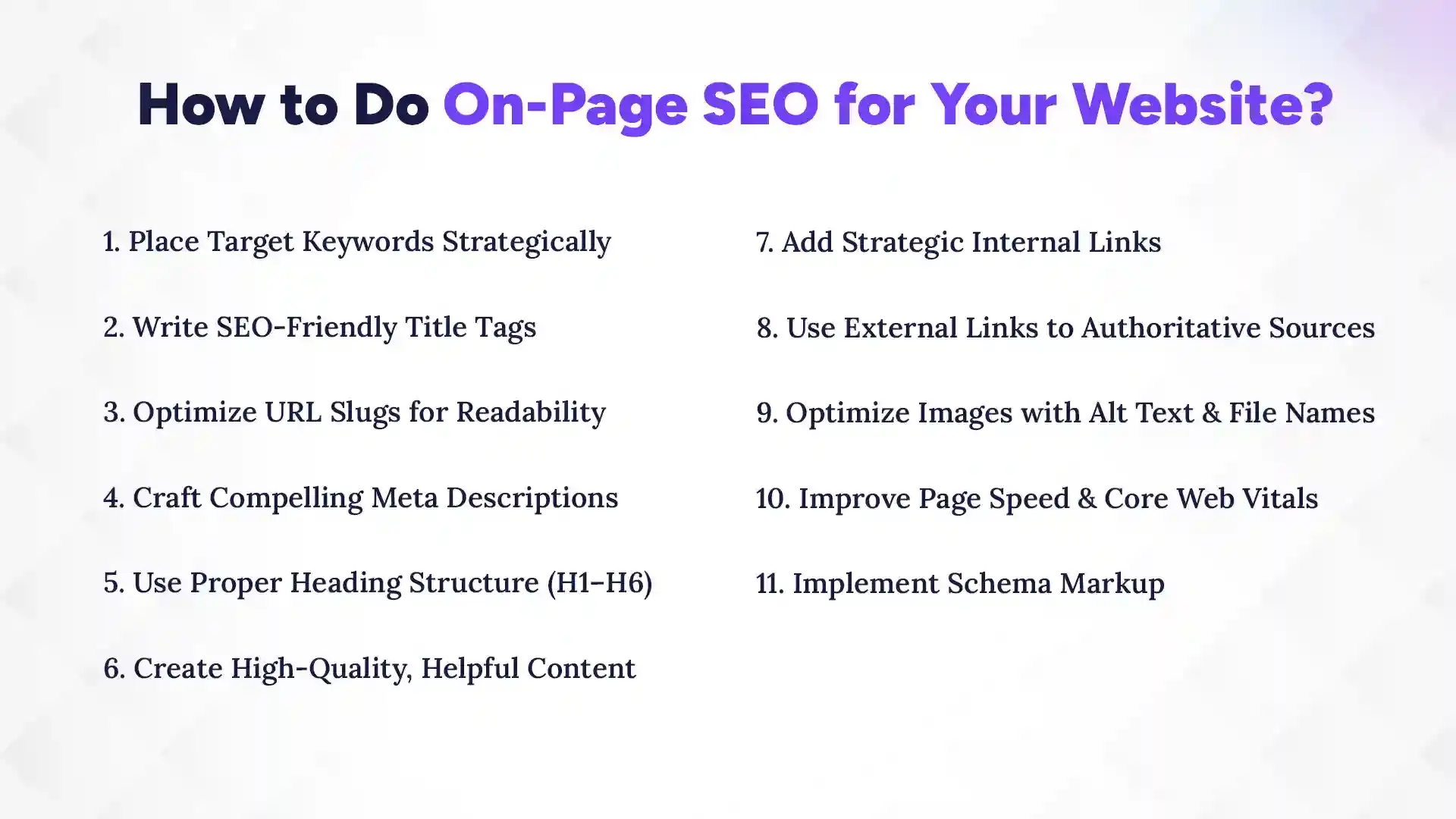
How to Do On-Page SEO for Your Website?
You do on-page SEO by optimizing your website content, HTML elements, and structure so search engines can better understand and rank your pages. It involves improving keywords, titles, meta tags, URLs, and overall content quality, often identified through an effective SEO audit process. The goal is to make your page both user-friendly and search engine-friendly. When all elements work together properly, your chances of ranking higher increase significantly.
1. Place Target Keywords Strategically
Using target keywords in the right places is one of the most important parts of on-page SEO. It helps search engines clearly understand what your page is about and who it should be shown to. The key is to use keywords naturally so the content still reads smoothly for users. You should place keywords in important sections of your page where they carry the most weight. But it’s also important not to overdo it because that can hurt rankings instead of helping.
Include primary keyword in title and H1
Use it naturally in the introduction
Add related keywords in subheadings and body
Avoid keyword stuffing
2. Write SEO-Friendly Title Tags
Title tags are one of the first things users see in search results, and they strongly influence click behavior. A good title clearly tells what the page is about and makes users want to open it. Search engines also use it to understand your topic. A strong title tag should be short, clear, and include your main keyword. It should also feel natural and not forced, because that improves both SEO and user trust.
Keep it under 60 characters
Include primary keyword near the start
Make it engaging and clickable
Avoid vague wording
3. Optimize URL Slugs for Readability
URL slugs are the part of your page link that describes the content. A clean and simple URL helps both users and search engines understand your page easily. It also improves trust and click-through rates. Good URLs are short, readable, and include relevant keywords. They should not contain unnecessary numbers or symbols that confuse users or search engines.
Keep URLs short and simple
Use keywords instead of random strings
Separate words with hyphens
Avoid unnecessary parameters
4. Craft Compelling Meta Descriptions
Meta descriptions are short summaries that appear under your title in search results. While they do not directly affect rankings, they strongly influence whether users click your page or not. A well-written meta description can improve your traffic significantly. It should clearly explain what the page offers and include your main keyword naturally. It should also sound engaging enough to attract attention.
Keep it around 150–160 characters
Include primary keyword naturally
Write in a clear and persuasive tone
Explain value to the user
5. Use Proper Heading Structure (H1–H6)
Headings help organize your content into a clear structure that is easy to read and understand. They also guide search engines in identifying the importance of different sections. Without proper headings, content can feel messy and hard to follow. A good heading structure improves both user experience and SEO performance. It helps break large content into smaller, readable sections.
Use only one H1 per page
Organize content with H2 and H3
Keep headings meaningful and clear
Improve readability and structure
6. Create High-Quality, Helpful Content
High-quality content is the foundation of successful on-page SEO. If your content does not provide real value, no optimization will help in the long run. Search engines prioritize content that answers user queries properly. Your focus should be on clarity, usefulness, and depth. The content should solve problems and keep users engaged till the end.
Write original and detailed content
Focus on user intent and questions
Avoid unnecessary filler words
Add examples for clarity
7. Add Strategic Internal Links
Internal links connect different pages within your website and help users navigate easily. They also help search engines crawl your site more effectively. This improves overall site structure and SEO performance. Good internal linking spreads authority across pages and keeps users engaged longer. It also encourages them to explore more of your content.
Link related pages naturally
Use clear anchor text
Do not overuse links
Guide users to useful pages
8. Use External Links to Authoritative Sources
External links point to other trusted websites and help improve the credibility of your content. They show search engines that your information is well-researched and reliable. This can strengthen your page authority. However, external links should always be relevant and high-quality. Poor or spammy links can harm your SEO instead of helping.
Link to trusted websites
Use only relevant sources
Avoid low-quality links
Add value to your content
9. Optimize Images with Alt Text and File Names
Images are important for user experience, but they also need SEO optimization. Properly optimized images help your page load faster and appear in image search results. They also improve accessibility for users. Alt text helps search engines understand what the image represents. File names should also be descriptive instead of random.
Use descriptive file names
Add relevant alt text
Compress images for speed
Use proper formats like WebP
10. Improve Page Speed and Core Web Vitals
Page speed plays a huge role in both SEO and user experience. Slow websites often lose visitors quickly, which increases bounce rates. Search engines also prefer faster-loading pages. Core Web Vitals measure how fast and stable your page feels to users. Improving these metrics helps your rankings and user satisfaction.
Optimize images and scripts
Use fast hosting
Enable caching
Reduce unnecessary code
11. Implement Schema Markup
Schema markup helps search engines understand your content in a more structured way. It improves how your page appears in search results by enabling rich snippets. This can increase visibility and clicks. It is especially useful for FAQs, articles, products, and reviews. Even basic schema can improve your SEO performance.
Add structured data to pages
Use FAQ and article schema
Improve SERP appearance
Increase click-through rate
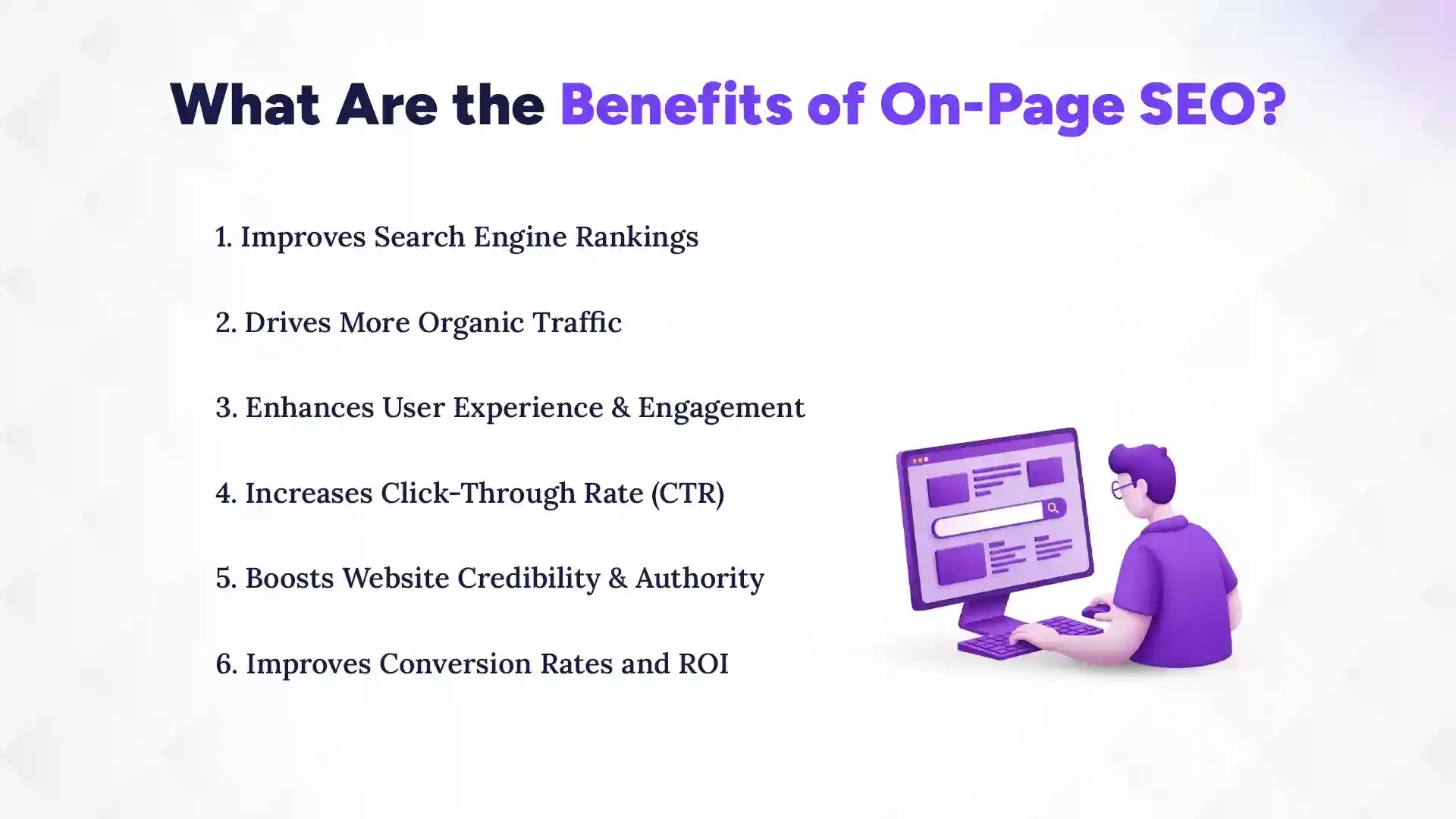
What Are the Benefits of On-Page SEO?
Benefits of on-page SEO are better search rankings, increased organic traffic, improved user experience, stronger credibility, and higher conversions. It helps search engines clearly understand your content while also making your website easier and more useful for visitors. When your pages are properly optimized, they perform better in search results and attract consistent traffic over time. It also creates a strong foundation for long-term SEO growth and visibility.
1. Improves Search Engine Rankings
On-page SEO helps search engines understand what your page is about through proper use of keywords, structure, and content quality. When everything is optimized correctly, your chances of ranking higher in search results increase significantly. Higher rankings naturally lead to more visibility and better performance compared to competitors. Over time, consistent optimization strengthens your overall domain authority. It also helps your content stay competitive in search results for longer periods.
2. Drives More Organic Traffic
A well-optimized page attracts more organic traffic because it ranks better for relevant search queries. This means users can find your website without any paid advertising. The traffic you get is also more targeted since it comes from people actively searching for related topics. This makes it more valuable and consistent in the long run. On-page SEO ensures that your content keeps bringing visitors even months after publishing.
3. Enhances User Experience and Engagement
On-page SEO improves how users interact with your website by making it easier to read, navigate, and understand. When content is well-structured and visually clear, users tend to stay longer on the page. Fast loading speed, mobile optimization, and clean formatting all contribute to better engagement. This reduces bounce rate and increases the time users spend on your site. A positive experience also encourages users to return.
4. Increases Click-Through Rate (CTR)
Optimized titles and meta descriptions make your pages more attractive in search results. Even if your page is ranked, users need a strong reason to click on it. A compelling snippet increases the chances of getting more clicks compared to competitors. Higher CTR also signals to search engines that your page is relevant and useful. Over time, this can help improve your rankings even further.
5. Boosts Website Credibility and Authority
A well-optimized website looks more trustworthy and professional to both users and search engines. High-quality content, proper structure, and relevant internal linking all contribute to building authority. When users trust your website, they are more likely to engage with your content. Search engines also favor websites that consistently provide valuable and reliable information. This strengthens your long-term SEO performance.
6. Improves Conversion Rates and ROI
On-page SEO not only brings traffic but also helps convert that traffic into actual results like leads, sales, or sign-ups. When your content matches user intent, visitors are more likely to take action. Clear messaging and optimized content guide users toward conversion naturally. This improves the return on your SEO efforts without increasing cost. In the long run, it helps your website generate more business value from the same traffic.
On-Page SEO vs Off-Page SEO: What’s the Difference?
On-page SEO and off-page SEO are two core parts of search engine optimization that work together to improve website rankings. On-page SEO focuses on optimizing elements within your website, while off-page SEO deals with actions taken outside your website. Both are essential because one improves your site internally, and the other builds authority and trust externally.
Factor
On-Page SEO
Off-Page SEO
Definition
Optimization done within your website to improve rankings and user experience
Activities done outside your website to improve authority and trust
Control
Fully under your control (content, structure, keywords, HTML)
Partially or not fully under your control (backlinks, mentions, shares)
Main Focus
Content quality, keywords, meta tags, internal linking, site structure
Backlinks, social signals, brand mentions, external authority
Key Techniques
Keyword optimization, title tags, URL structure, content optimization
Link building, guest posting, influencer outreach, social media marketing
Example
Writing optimized blog content with proper headings and keywords
Getting backlinks from high-authority websites
Impact on SEO
Helps search engines understand and rank your pages
Builds website authority and trustworthiness
Speed of Results
Faster improvements when optimized correctly
Takes longer to show strong results
Common On-Page SEO Mistakes to Avoid
Common on-page SEO mistakes to avoid are simple errors that can seriously affect your website rankings and performance. Many websites lose traffic not because of poor content, but because they ignore basic optimization practices. These mistakes can confuse search engines and create a poor user experience. Fixing them can quickly improve both visibility and engagement.
1. Keyword Stuffing
Keyword stuffing happens when you use the same keyword too many times in an unnatural way. This makes the content look forced and difficult to read for users. Search engines also see it as spammy behavior and may reduce rankings. Instead, keywords should be used naturally within helpful and meaningful content. A balanced approach always performs better than over-optimization.
2. Duplicate or Thin Content
Duplicate or thin content refers to pages that either copy other content or provide very little value. Such pages do not help users and are often ignored by search engines. Google prefers original and in-depth content that fully answers user queries. Having weak content can lower your site’s authority over time. It is always better to focus on quality rather than quantity.
3. Ignoring Mobile Optimization
Ignoring mobile optimization is a big mistake because most users browse websites on mobile devices. If your site does not display properly on mobile, users will quickly leave. This increases bounce rate and negatively affects rankings. Search engines also prioritize mobile-friendly websites in search results. A responsive design ensures better usability and performance across all devices.
4. Poor Internal Linking
Poor internal linking makes it difficult for users and search engines to navigate your website. Without proper links, important pages may not get enough visibility or authority. Internal links help distribute SEO value across different pages. They also improve user engagement by guiding visitors to related content. A strong linking structure supports better indexing and ranking.
5. Missing Meta Tags
Missing meta tags like title tags and meta descriptions reduce your visibility in search results. These elements help search engines understand your page content better. They also influence whether users click on your page or not. Without them, your page may appear incomplete or less attractive in SERPs. Proper meta tags improve both SEO and click-through rates.
6. Slow-Loading Pages
Slow-loading pages create a poor user experience and increase the likelihood that users will leave your site. Page speed is also an important ranking factor for search engines. Heavy images, poor hosting, or unoptimized code often cause slow performance. Faster websites keep users engaged and improve overall satisfaction. Improving speed leads to better rankings and higher conversions.
Conclusion
On-page SEO is one of the most important parts of improving your website’s visibility on search engines. It helps you structure your content properly, target the right keywords, and create a better user experience. When done correctly, it not only improves rankings but also increases organic traffic and engagement, which is something often emphasized by The Pace Infosys in digital marketing strategies. Small improvements in on-page elements can lead to noticeable results over time.
At the end of the day, SEO is not a one-time task but an ongoing process. If you consistently optimize your pages, avoid common mistakes, and focus on user intent, your website will grow steadily. The key is to keep things simple, useful, and search-friendly while always prioritizing the reader’s experience, which is exactly what good SEO Services aim to achieve.
FAQs
What is on-page SEO in simple words?
+
On-page SEO is optimizing website pages to improve search rankings. It includes content, keywords, structure, and HTML elements.
Why is on-page SEO important for websites?
+
It helps search engines understand content and improves organic rankings. It also enhances user experience and engagement.
How long does on-page SEO take to show results?
+
Usually takes a few weeks to several months depending on competition. Consistent optimization speeds up results significantly.
What are the main on-page SEO factors?
+
Content quality, keywords, meta tags, internal links, and page speed. These elements directly impact search visibility.
Is on-page SEO enough for ranking?
+
No, it must be combined with off-page SEO strategies. Both work together for strong rankings.
How often should I update on-page SEO?
+
Update whenever content changes or rankings drop noticeably. Regular audits help maintain SEO performance.
What tools are used for on-page SEO?
+
Google Search Console, Ahrefs, SEMrush, and Yoast SEO are popular. They help analyze and improve optimization.
Can beginners do on-page SEO easily?
+
Yes, with basic understanding and practice, it becomes manageable. Start with keywords, content, and structure optimization.
Ready to get started?
Book a 30-minute consultation call, and let's talk about your goals.