Provident Fund (PF) is one of the most important parts of employee benefits in Nepal. It helps employees save a portion of their income every month, while employers also contribute to build long-term financial security. On paper, it sounds simple and well-structured. But in real business settings, managing PF is far from easy.
As companies grow, tracking monthly contributions, salary changes, and compliance rules becomes messy. Even small errors can lead to delays, penalties, or employee dissatisfaction. At the same time, expectations for accurate reporting and timely deposits are increasing.
This is why many Nepalese businesses are now shifting toward HR software. Instead of handling PF manually through spreadsheets and calculations, companies are adopting automated systems that bring accuracy, speed, and peace of mind. In this guide, we’ll break down how PF management works and why the right HR software makes all the difference.
What Is Provident Fund (PF) in Nepal?
Provident Fund (PF) in Nepal is a long-term savings system designed to support employees after retirement. Every month, a small portion of an employee’s salary is set aside, and the employer also contributes an equal or fixed share. Over time, this builds a financial safety net that employees can use in the future, especially after they stop working.
Both employees and employers are responsible for contributing to PF regularly. Usually, the contribution is calculated as a percentage of the basic salary, and it is added automatically through payroll systems in modern setups. This shared contribution structure helps employees save consistently without needing to manage it manually.
Most formal sector employees in Nepal are eligible for PF once they are officially registered under a company. At the same time, PF is not just a benefit, it is also a legal requirement. Businesses must follow PF rules carefully, as missing or delaying contributions can lead to compliance issues, penalties, and legal complications.
HR teams often face multiple challenges while managing Provident Fund, especially when processes are handled manually. These issues usually come from scattered data, changing employee records, and complex payroll calculations. Because of this, PF management becomes time-consuming and increases the risk of compliance errors, which we will look at in more detail below.
Manual errors in PF contribution calculation
Difficulty tracking employee updates accurately
Delays in PF deposits and compliance risks
Time-heavy reporting and reconciliation work
Lack of real-time PF visibility across teams
Inconsistent payroll and PF data syncing
High dependency on manual spreadsheets
Errors during employee exit settlements
What Is PF Management System in HR Software?
PF management software in HR systems is a tool that helps businesses calculate, track, and manage Provident Fund contributions in an automated way. Instead of handling everything manually, it brings all PF-related tasks into one simple system. This makes it easier for HR teams to stay accurate and organized.
This software connects key HR functions like payroll, attendance, and automated salary processing. So, when employee attendance or salary changes, the PF calculation updates automatically. Because of this connection, businesses do not need to adjust PF amounts separately, which reduces confusion and saves time.
The main difference between manual tracking and automated systems is accuracy and speed. Manual methods rely on spreadsheets and human calculation, which increases the chance of errors. On the other hand, automated HR systems handle everything in real time, making PF management faster, more reliable, and much easier to control.
Who Needs PF Management Software in Nepal?
PF management software is useful for any organization in Nepal that handles regular payroll and employee benefits. It becomes especially important when businesses start growing and PF tracking turns more complex and time-sensitive. From small teams to large enterprises, it helps reduce manual work and improves accuracy in every step.
SMEs needing simple PF automation support
Large corporates managing bulk payroll systems
Structured organizations with formal salary cycles
HR teams handling diverse employee categories
Companies with frequent hiring and exits
Businesses struggling with manual PF tracking
Firms needing faster compliance reporting
Teams aiming for error-free payroll processing
What Are the Top Features of PF Management HR Software?
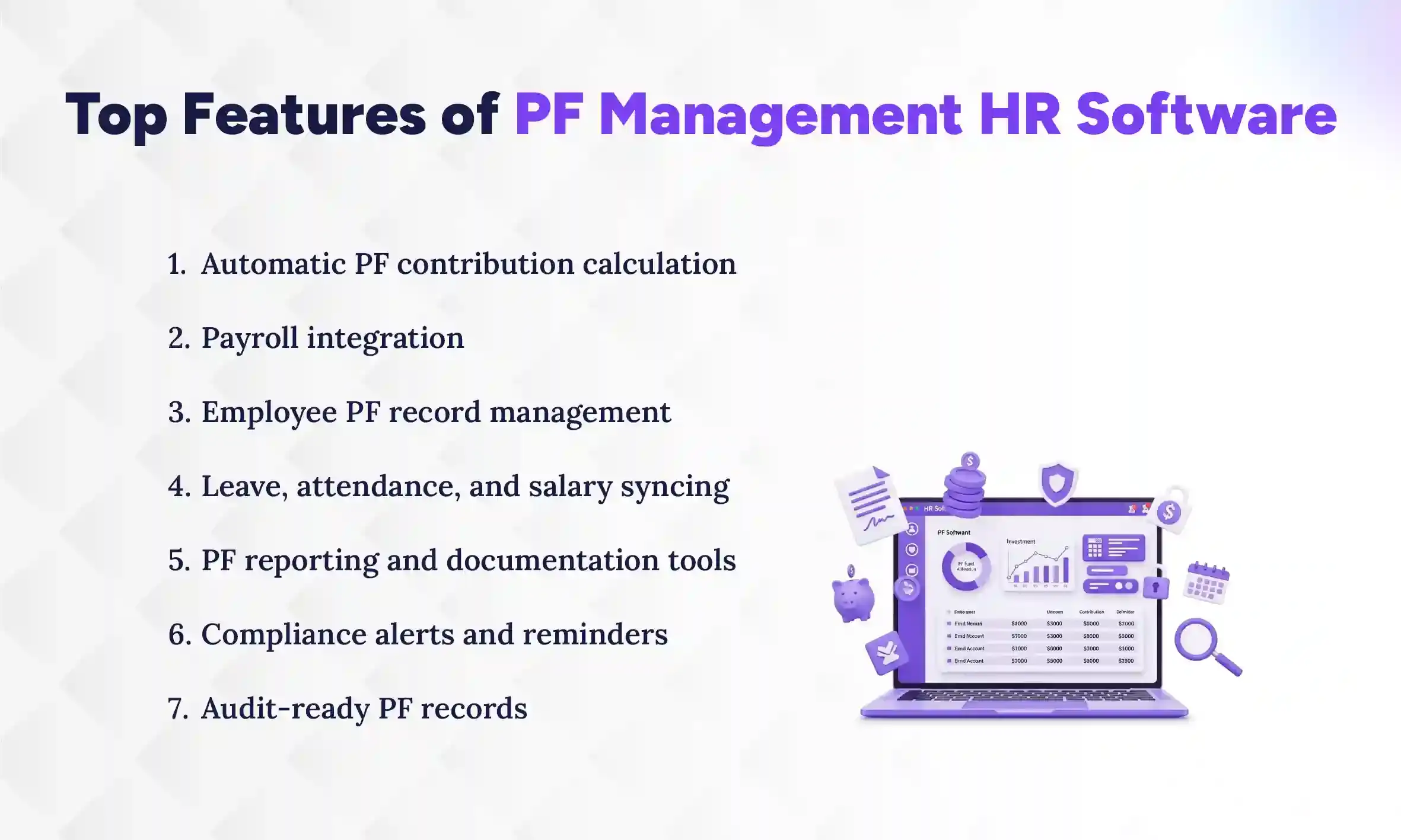
PF management HR software comes with a set of powerful features that help businesses handle Provident Fund work with ease and accuracy. These tools are designed to reduce manual effort and keep everything connected in one system. As a result, HR teams can manage Provident Fund without stress or confusion. Let’s look at the key HRMS features that make it effective.
1. Automatic PF Contribution Calculation
This feature calculates PF amounts automatically based on employee salary data. It removes the need for manual formulas, which often lead to mistakes. The system updates contributions whenever salary or structure changes. Because of this, HR teams can ensure accuracy without extra effort. It also reduces delays in monthly PF processing.
2. Payroll Integration
PF software directly connects with payroll systems to ensure smooth processing. When salaries are calculated, PF deductions are added automatically. This avoids double work for HR teams and keeps records aligned. It also helps reduce mismatches between payroll and PF reports. As a result, everything stays consistent and easy to manage.
3. Employee PF Record Management
This feature stores complete PF details for each employee in one place. It includes contribution history, updates, and changes over time. HR teams can quickly access records without searching through files. This improves transparency and reduces confusion during audits or reviews. It also helps track long-term employee savings clearly.
4. Leave, Attendance, and Salary Syncing
PF calculations depend on accurate salary and attendance data, and this feature connects them all. When attendance or leave data changes, salary updates automatically. This ensures PF is always calculated on correct figures. It also removes the risk of mismatched records. Because of this, payroll becomes more reliable and smooth.
5. PF Reporting and Documentation Tools
This feature generates structured PF reports for internal and external use. HR teams can easily export documents needed for compliance. It saves time during monthly or yearly reporting cycles. The system also keeps reports organized for future reference. This makes documentation simple and error-free.
6. Compliance Alerts and Reminders
The system sends timely alerts for PF deadlines and updates. This helps HR teams avoid late submissions or penalties. It also keeps compliance tasks on track without manual follow-ups. Reminders ensure nothing is missed during busy payroll cycles. As a result, businesses stay compliant without extra pressure.
7. Audit-Ready PF Records
This feature keeps all PF data organized and ready for audits at any time. Records are stored in a clean, structured format for easy review. HR teams do not need to prepare documents manually during inspections. It reduces last-minute stress and improves compliance confidence. This makes audit handling much faster and smoother.
Ready to Accelerate Your Digital Growth?
Partner with The Pace Infosys to build scalable web and mobile solutions tailored to your business goals.
PF management HR software helps businesses handle Provident Fund tasks in a faster and more reliable way. It reduces manual effort and connects all payroll-related processes in one system. This makes daily HR work smoother and less stressful. Let’s look at the key benefits in detail:
1. Reduces Manual Work and Saves Time
This software removes the need for repeated manual calculations and spreadsheet updates. HR teams no longer have to calculate PF for each employee one by one. Instead, the system handles everything automatically in the background. This saves a lot of time during monthly payroll cycles. As a result, HR teams can focus on more important tasks.
2. Ensures Accurate PF Contributions
Accuracy becomes much easier when PF calculations are automated. The system uses real-time salary data to calculate correct contributions. This reduces the chances of human error in payroll processing. Even small changes in salary are updated instantly. Because of this, businesses can avoid costly mistakes and corrections.
3. Improves Compliance with Labor Laws
PF software helps businesses stay aligned with Nepal’s labor regulations. It ensures contributions are calculated and recorded correctly every month. The system also reduces the risk of missing deadlines or incorrect filings. This helps avoid penalties and legal issues. As a result, compliance becomes more consistent and stress-free.
4. Enhances Employee Trust and Transparency
Employees can clearly see their PF contributions through the system. This builds trust because everything is recorded and updated transparently. They no longer need to depend only on HR for PF details. Clear records also reduce confusion or disputes. Over time, this improves employee satisfaction and confidence in the company.
5. Supports Business Scalability
As a business grows, managing PF manually becomes harder. This software easily handles increasing employee numbers without extra effort. It keeps payroll and PF processes organized even during expansion. HR teams do not need to redesign their workflow. Because of this, businesses can scale smoothly without operational stress.
How does the PF Management System Work for HR Teams?
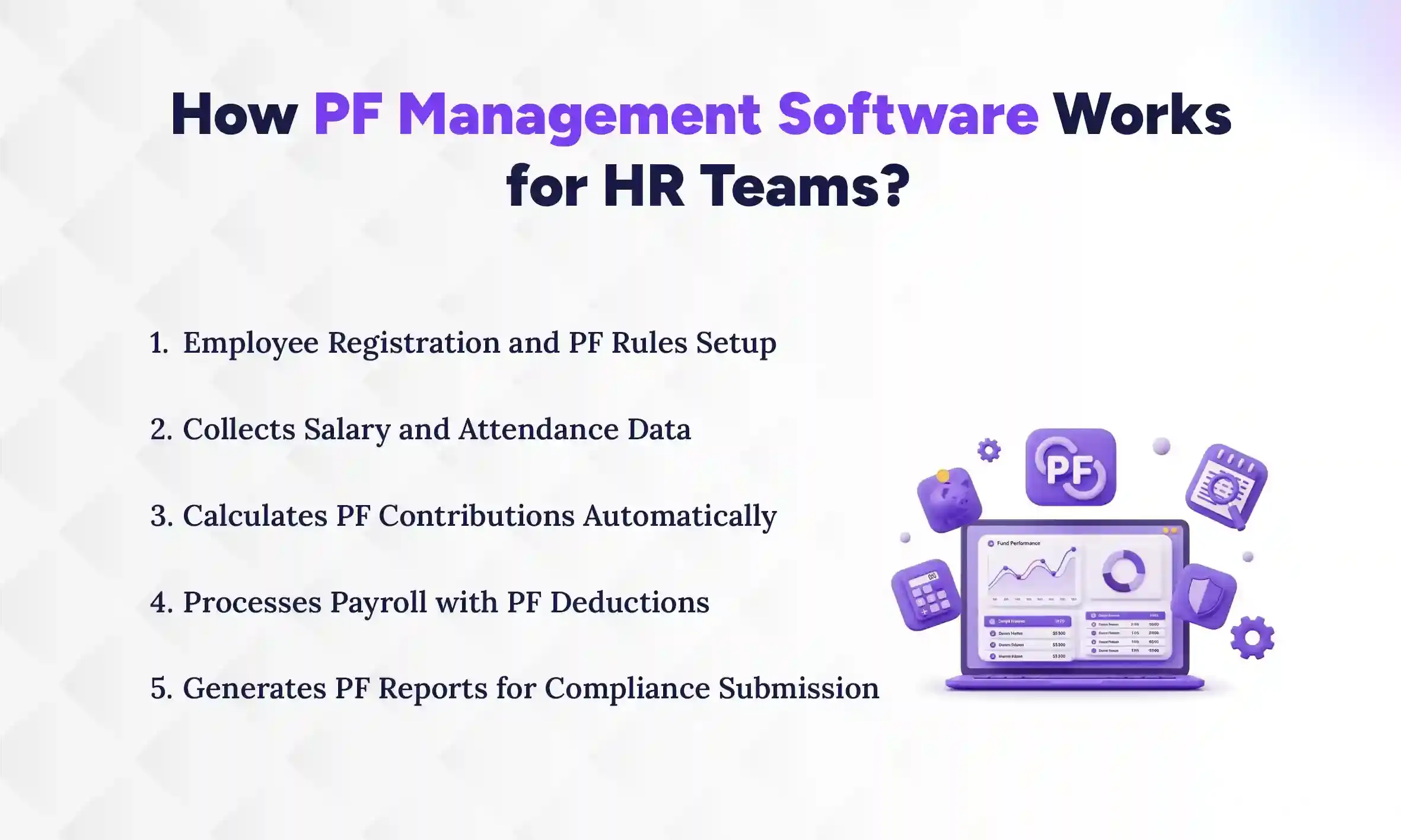
PF management software simplifies how HR teams handle Provident Fund tasks by connecting all payroll activities in one system. It follows a clear step-by-step process that starts from employee setup and ends with compliance reporting. This reduces manual effort and improves accuracy across every stage. Let’s understand how HR software works in practice.
1. Employee Registration and PF Rules Setup
The process begins when HR adds employee details into the system. PF rules like contribution rate and eligibility are also configured at this stage. This ensures every employee is correctly mapped under the PF structure from day one. It removes confusion during later payroll cycles. As a result, the system is ready for accurate tracking from the start.
2. Collects Salary and Attendance Data
The software automatically gathers monthly salary and attendance details from the HR system. This ensures that PF calculations are based on updated and correct information. Any changes in attendance or leave are reflected in real time. It also reduces the need for manual data entry. Because of this, HR teams avoid data mismatches and delays.
3. Calculates PF Contributions Automatically
Once salary data is updated, the system calculates PF contributions instantly. It applies predefined rules to both employee and employer shares. This removes the need for manual formulas or spreadsheets. Even complex salary structures are handled smoothly. As a result, PF calculations remain accurate and consistent every month.
4. Processes Payroll with PF Deductions
After calculation, the system processes payroll with PF deductions included. Salaries are adjusted automatically based on contribution amounts. This ensures employees receive correct net pay without errors. It also keeps payroll and PF records fully aligned. Because of this, HR teams can complete payroll faster and with confidence.
5. Generates PF Reports for Compliance Submission
Finally, the software creates structured PF reports for submission and audits. These reports include all employee contribution details in a clear format. HR teams can download and share them without extra preparation. It saves time during compliance checks and reporting cycles. This makes the entire PF process smooth and stress-free.
Insights
Did You Know?
With Pace HRMS, businesses can manage multi-location teams rack attendance via biometric or GPS, and streamline operations from a single dashboard.
PF Management Software vs Manual PF Tracking
PF management software is far more efficient and reliable compared to manual PF tracking in Nepal, especially when it comes to accuracy, speed, and compliance handling. While manual methods depend heavily on human effort, software automates the entire process and reduces the chances of errors. Because of this difference, many businesses are now shifting toward automated PF systems for better control and consistency.
Aspect
PF Management Software
Manual PF Tracking
Accuracy
Ensures precise, automated calculations
High risk of human errors
Time Efficiency
Fast, real-time processing
Slow and time-consuming
Compliance Risk
Low risk with automated updates
High risk of missed deadlines
Cost & Scalability
Scales easily with business growth
Becomes costly and complex over time
Data Management
Centralized and secure records
Scattered files and spreadsheets
Reporting
Instant, automated PF reports
Manual report creation required
Employee Transparency
Employees can view PF details easily
Limited or no visibility for employees
Now, let’s compare both approaches side by side.
Which Is the Best PF Management HR Software in Nepal?
Pace HRMS stands out as one of the most reliable Provident Fund management solutions along with payroll and compliance in Nepal. It is designed to simplify complex HR processes and bring everything, PF, salary, and employee data into one connected system. This makes it easier for HR teams to manage compliance without extra manual effort or confusion.
What makes Pace HRMS strong is its deep integration of PF with payroll and attendance systems. PF contributions are calculated automatically based on real-time salary data, and everything flows smoothly into payroll processing. On top of that, compliance reporting becomes quick and structured, which reduces delays and manual workload.
The biggest advantage is automation and accuracy. Businesses do not need to worry about calculation errors or missing records because the system handles it consistently. That is why many Nepalese companies prefer Pace HRMS. It reduces HR workload, improves compliance confidence, and supports smoother, more scalable workforce management.
How to Choose the Best PF Management HR Software?
To choose the right PF management HR software, start by evaluating compliance, usability, and overall system reliability. The goal is to pick a system that not only handles Provident Fund calculations but also supports smooth payroll operations. A good solution should reduce manual work while improving accuracy and control. Here’s how you can evaluate the best HR software for your business in Nepal:
1. Check Compliance with Nepal PF Regulations
The software should fully follow Nepal’s Provident Fund rules and legal requirements. This ensures all contributions are calculated and recorded correctly without manual adjustments. It also helps avoid penalties or compliance issues in the future. Always confirm that the system stays updated with regulatory changes. Because of this, compliance becomes easier and more reliable.
2. Evaluate Ease of Use and Support
A good system should be simple enough for HR teams to use without confusion. The interface should make PF tasks easy to manage, even for non-technical users. At the same time, reliable customer support is important for quick issue resolution. This helps teams avoid delays during payroll cycles. As a result, daily HR operations stay smooth and stress-free.
3. Ensure Payroll & PF Integration
For PF management, your HR software should connect directly with payroll to avoid separate calculations. When both systems are linked, salary updates automatically reflect in PF contributions. This reduces duplication of work and prevents mismatched data. It also improves accuracy across HR processes. Because of this, payroll and PF stay perfectly aligned.
4. Prioritize Cloud and Mobile Access
Cloud-based HR systems allow HR teams to access PF data anytime and from anywhere. Mobile access makes it easier to manage approvals and check reports on the go. This is especially useful for growing or remote teams. It also improves speed in handling HR tasks. As a result, PF management becomes more flexible and modern.
5. Compare Pricing and Scalability
Businesses should choose software that fits their current budget and future growth. Affordable HR software pricing is important, but scalability matters just as much. The system should support more employees without performance issues. This avoids the need to switch platforms later. Because of this, businesses can grow without disrupting HR operations.
Best Practices for PF Compliance Using HR Software
PF compliance becomes much easier when HR software is used in a structured and consistent way. However, simply having the tool is not enough. Businesses must follow the right practices to ensure accuracy, transparency, and timely reporting. These steps help HR teams avoid errors and stay fully compliant with PF regulations.
1. Keep Employee Data Updated Regularly
HR teams should update employee details as soon as any change happens. This includes salary changes, role updates, or employment status shifts. Updated data ensures PF calculations remain accurate every month. It also reduces the risk of incorrect deductions or reporting issues. Because of this, maintaining fresh data is the foundation of smooth PF compliance.
2. Do Monthly PF Reconciliation
Every month, HR teams should match PF records with payroll data. This helps identify any mismatch in contributions or salary inputs early. The software makes this process easier by generating structured reports. It also ensures that no employee is left out of contributions. As a result, monthly reconciliation keeps PF records clean and accurate.
3. Build Employee Awareness About PF Benefits
Employees should clearly understand how PF contributions work and why they matter. HR teams can use software reports to show contribution details in a simple way. This builds trust and reduces confusion about deductions. It also encourages employees to value long-term savings. Because of this, awareness improves transparency and workplace confidence.
4. Conduct Internal Audits and Record Checks
Regular internal audits help businesses verify PF accuracy and compliance status. HR software makes it easy to access complete records during audits. Teams can quickly check contribution history and reports without manual searching. This reduces stress during inspections or reviews. As a result, audits become faster, smoother, and more reliable.
Conclusion
Managing Provident Fund manually is no longer practical for growing businesses in Nepal. PF HR software simplifies calculations, reduces errors, and keeps everything organized in one place. It also takes a lot of pressure off HR teams, making payroll and compliance smoother, easier, and more reliable every month.
If you are still managing PF manually, now is the right time to upgrade. A PF-integrated HR system like Pace HRMS can help you simplify processes, stay compliant, and build a more efficient HR workflow for the future.
Curious about SSF-integrated HR software in Nepal? It’s a system that connects payroll, attendance, and Social Security Fund compliance into one automated workflow, definitely worth exploring if you want even more control and efficiency.
FAQs
Is PF mandatory in Nepal?
+
Yes, PF is mandatory for most formal employees in Nepal. Employers must register and contribute regularly to stay compliant and avoid penalties.
How is PF calculated?
+
PF is calculated as a percentage of basic salary, shared by employer and employee. HR software like Pace HRMS automates this to ensure accuracy and consistency.
Can HR software automate PF deductions?
+
Yes, HR software automates PF deductions during payroll. This reduces manual work and ensures timely, error-free contributions every month.
What happens if PF is not deposited on time?
+
Late PF deposits can lead to penalties, interest, and compliance issues. It also increases HR workload during audits and corrections.
Is Provident Fund management system useful for small businesses?
+
Yes, PF software helps small teams manage compliance easily without extra resources. It reduces manual work and improves accuracy from the start.
Does HR software reduce PF errors?
+
Yes, it reduces errors by automating calculations and syncing payroll data. This ensures accurate and consistent PF records every month.
How secure is PF data in HR systems?
+
HR software uses encryption and access control to protect PF data. Systems like Pace HRMS ensure secure handling of sensitive employee information.
Can PF systems adapt to salary changes?
+
Yes, it updates PF calculations automatically when salaries change. This ensures contributions stay accurate without manual adjustments.
Is training required to use PF HR software?
+
Most modern HR software is easy to use with minimal training. However, if required, most software service providers usually train your employees.
Ready to get started?
Book a 30-minute consultation call, and let's talk about your goals.