


Ever tried managing shift rotations for 24/7 money transfer branches while simultaneously calculating agent commissions using scattered spreadsheets? It is absolute chaos. As your transaction volumes grow, those manual registers turn into a massive bottleneck. You lose track of who is supposed to be at which branch, miscalculate an agent's incentive payout, or worse, fail a surprise compliance audit.
The problem isn’t your branch management skills; it is the tools you are using. Generic HR tools don't understand the strict financial compliance required by regulators or the complex, tiered commission structures of remittance agents. Forcing a remittance company's workforce into a traditional HRMS is like trying to track international wire transfers with an abacus.
In this blog, we’ll explore everything you need to know about HR software for remittance companies in Nepal, from what it is and why you need it to key features, benefits, multi-branch management, and how to choose the right system for your remittance business.
What Is HR Software for Remittance Companies in Nepal?
HR software for remittance companies in Nepal is a digital system designed to manage branch-based, highly regulated financial workforces. Understanding exactly what an HRMS is helps clarify its value: it acts as a central hub for attendance across multiple branches, automated commission calculations, shift scheduling, and strict compliance documentation. It replaces manual registers and Excel sheets that cannot survive a strict Nepal Rastra Bank (NRB) audit or the fast pace of agent payouts.
Why Do Remittance Companies in Nepal Need Specialized HR Software in 2026?
Remittance companies in Nepal need specialized HR software because generic HRMS solutions fail the industry due to security risks, complex shifts, strict compliance, and complicated commissions. A tailored system brings structure to branch operations by managing branch-based and shift-driven workforces, tracking complex agent commissions and incentives, ensuring strict compliance with Nepal Rastra Bank guidelines, securing highly sensitive employee and financial data, and automating payroll for diverse roles like cashiers, agents, and back-office staff.
1. Managing Branch-Based and Shift-Driven Workforces
Remittance branches often operate 24/7, requiring complex shift rotations for cashiers and compliance officers. HR software centralizes these schedules, ensuring every branch is adequately staffed at all hours without manual overlap or gaps.
2. Tracking Complex Agent Commissions and Incentives
Agents are the lifeblood of remittance companies, but their payouts are rarely a flat salary. They rely on tiered, volume-based commissions. Manually calculating these on Excel leads to disputes; HR software automates the exact math based on transaction volumes.
3. Ensuring Strict Compliance with Nepal Rastra Bank Guidelines
Financial institutions in Nepal operate under intense regulatory scrutiny. HR software maintains flawless records of employee work hours, training certifications, and statutory compliance, ensuring you are always ready for an NRB or labor department audit.
4. Securing Highly Sensitive Employee and Financial Data
Because your staff handles large sums of money, their personal data, salary details, and access levels must be locked down. Generic tools lack the granular security controls required to prevent internal data breaches in a financial setting.
5. Automating Payroll for Diverse Roles (Cashiers, Agents, Back-Office)
Calculating payroll when you have a mix of salaried managers, hourly cashiers, and commission-only field agents is a nightmare manually. An automated payroll system handles all these diverse structures simultaneously in a single run.
What Are the Key Features of HR Software for Remittance Companies?
The key features of HR software for remittance companies are multi-branch attendance tracking, automated commission calculation, shift roster management, role-based access control, statutory compliance automation, and agent onboarding workflows that work together seamlessly to manage secure, multi-branch financial operations
1. Multi-Branch Attendance & Biometric Integration
A robust attendance management system connects all your branch locations to a single server. Biometric integration ensures that cashiers are physically present at their assigned branch before they can log into core banking systems, eliminating proxy attendance.
2. Automated Commission and Incentive Calculation
The software allows you to set complex, tiered commission rules (e.g., "X% for transactions up to 1 lakh, Y% above that"). As transaction data flows in, the HRMS automatically calculates exactly what each agent or branch staff has earned, removing human error from the payout.
3. Shift Roster and Extended Hours Management
Managing early morning, day, and late-night shifts across dozens of branches requires advanced scheduling tools. The software automatically calculates overtime, night-shift allowances, and weekend differentials based on Nepal's labor laws.
4. Role-Based Access Control (RBAC) and Audit Trails
Security is non-negotiable. RBAC ensures a cashier cannot see the CEO's salary, and a field agent cannot access core compliance documents. Furthermore, every change made in the system, like a salary edit or an attendance override, is logged in an audit trail.
5. Statutory Compliance (TDS, PF, SSF) Automation
The system automatically deducts TDS, Provident Fund (PF), and Social Security Fund (SSF) contributions based on the latest Nepal government slabs, generating compliant reports ready for submission.
6. Agent Onboarding and Offboarding Workflows
Remittance networks frequently onboard new sub-agents and digital promoters. The software provides fast-track onboarding to get them legally registered and paid, while instantly revoking system access the moment their contract ends.
Benefits of Using HR Software for Remittance Companies
The benefits of using HR software for remittance companies directly impact your bottom line and audit readiness by ensuring accurate commission payouts and motivated agents, flawless multi-branch coordination, zero compliance penalties during audits, high-level data security for financial staff, and faster payroll processing across all branches. It brings much-needed structure to highly regulated branch operations.
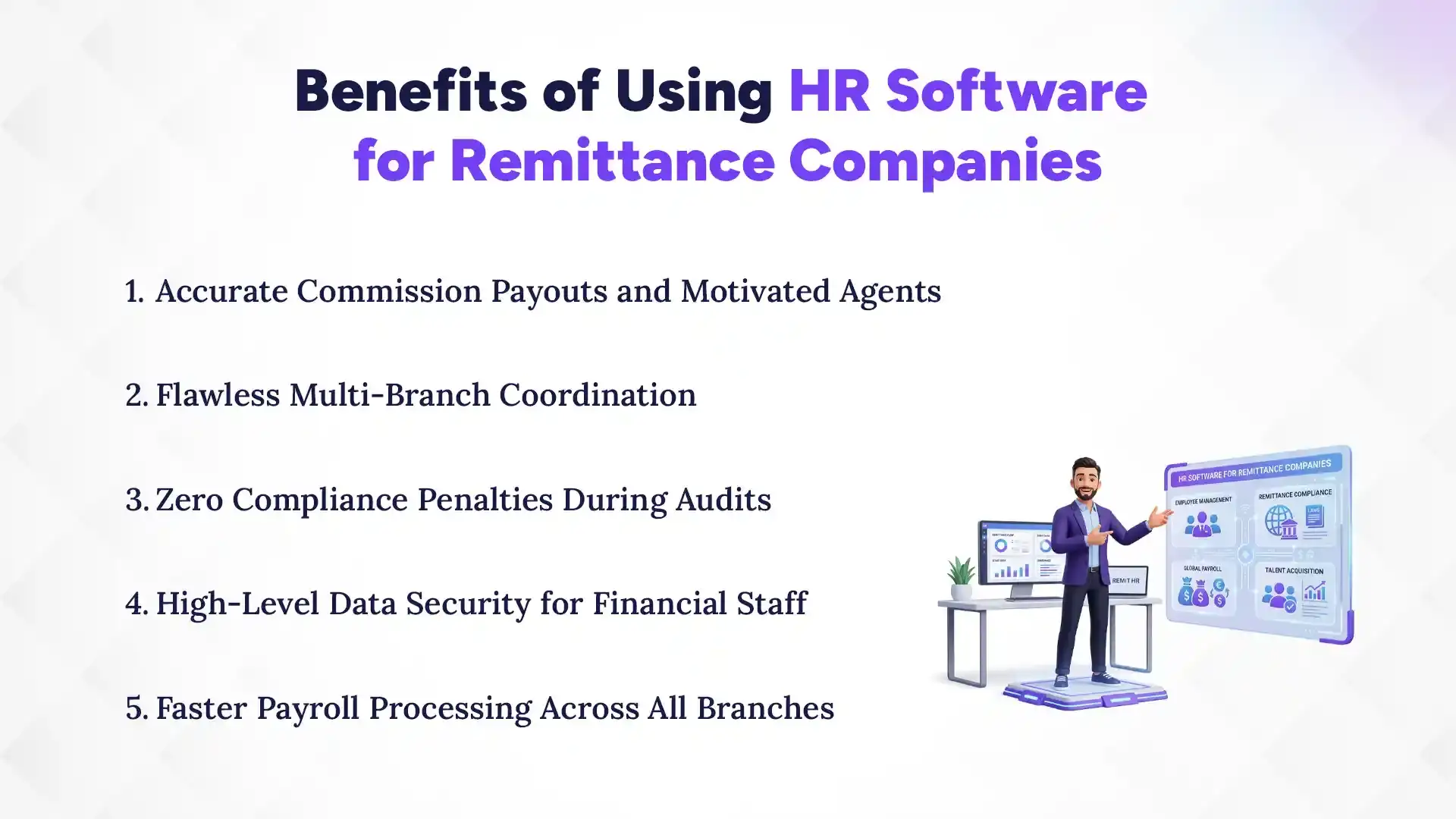
1. Accurate Commission Payouts and Motivated Agents
When agents know their commissions are calculated transparently and paid on time, trust goes up. Accurate payouts eliminate disputes and keep your field network highly motivated to bring in more remittance volume.
2. Flawless Multi-Branch Coordination
HR managers no longer need to call branch managers to verify attendance or shift changes. Everything is visible on a single dashboard, allowing for instant workforce reallocation if one branch is unexpectedly overwhelmed.
3. Zero Compliance Penalties During Audits
With digital records, automated statutory deductions, and strict audit trails, an NRB or labor audit becomes a stress-free verification process rather than a frantic search for paper files.
4. High-Level Data Security for Financial Staff
By restricting data access based on roles and encrypting sensitive information, the company protects itself from internal data theft, which is a critical risk in the financial sector.
5. Faster Payroll Processing Across All Branches
What used to take a week of cross-checking branch Excel sheets now takes hours. Payroll is processed centrally, verified, and disbursed with complete accuracy.
How to Choose the Best HR Software for Remittance Companies in Nepal?
Choosing the best HR software for remittance companies in Nepal means selecting a solution based on fit and security by evaluating specific subjects' compliance and audit readiness, multi-branch and shift management, commission calculation flexibility, data security and access control, and integration with core banking systems rather than just looking at generic features. The system must handle financial sector regulations and 24/7 shifts. Use these core subjects as your ultimate buying checklist.
1. Compliance and Audit Readiness
Select software that generates NRB-compliant reports and maintains unalterable audit trails. If a regulator asks who approved a specific overtime shift six months ago, the system must provide an exact, time-stamped answer instantly.
2. Multi-Branch and Shift Management
Evaluate how the software handles distributed workforces. It must support centralized shift scheduling across all locations and integrate smoothly with on-site biometric devices.
3. Commission Calculation Flexibility
Ensure the HRMS can handle your specific commission logic. If your rules change based on exchange rates, transaction corridors, or agent tiers, the software must allow you to customize these formulas easily.
4. Data Security and Access Control
Verify that the system offers granular, role-based access. In remittance, even a small data leak can cause massive reputational damage. Data encryption and strict user permissions are mandatory.
5. Integration with Core Banking/Accounting Systems
Your HR software shouldn't work in a vacuum. It must integrate with your core banking system (CBS) or accounting software so that payroll figures, commission payouts, and tax deductions sync automatically without manual data entry.
What Makes HR Software for Remittance Different from Other Industries?
HR software for remittance differs from other industries because it is built for financial sector rules rather than standard corporate environments, requiring an extreme focus on regulatory audit trails, complex tiered commission structures, 24/7 shift operations across time zones (especially for international transfers), and stringent data privacy requirements. When you look at various types of HR software on the market, you'll quickly notice generic ones lack these financial safeguards.
1. Extreme Focus on Regulatory Audit Trails
Unlike retail or manufacturing, a remittance company's HR records are subject to financial audits. The software must treat HR data with the same rigor as financial transaction data.
2. Complex, Tiered Commission Structures
Most industries pay fixed salaries or simple bonuses. Remittance HRMS must be fundamentally designed around complex, variable math that changes based on external transaction volumes.
3. 24/7 Shift Operations Across Time Zones
Because remittance depends on international markets, branches often operate around the clock. The HR software must flawlessly calculate hours, overtime, and night differentials for staff working highly irregular hours.
4. Stringent Data Privacy Requirements
Handling employee data in a financial institution means the software must have bank-grade security. Standard HR tools simply do not have the encryption or access controls required to protect sensitive financial staff.
Which Is the Best HR Software for Remittance Companies in Nepal?
Pace HRMS is the best HR software for remittance companies in Nepal because it offers the security and flexibility required to manage highly regulated, shift-driven workforces. It perfectly centralizes branch attendance, automates complex agent commissions, and provides NRB-ready audit trails.
What really makes Pace HRMS stand out for financial institutions is its ability to handle fluctuating transaction-based payouts without a hitch. It offers role-based security that matches banking standards, advanced shift management for 24/7 branches, and seamless scalability for expanding remittance networks. In short, Pace HRMS doesn’t just manage your HR; it quietly upgrades how your entire branch operation stays compliant and secure.
Common Challenges Remittance Companies Face Without HR Software
The main challenges remittance companies face without HR software are manual errors in commission payouts and agent disputes, inability to accurately track multi-branch attendance, high risk of penalties during compliance audits, and security vulnerabilities in handling employee data inefficiencies that create massive operational and legal risks. Facing any challenge in HR management without specialized software in the financial sector is incredibly dangerous.
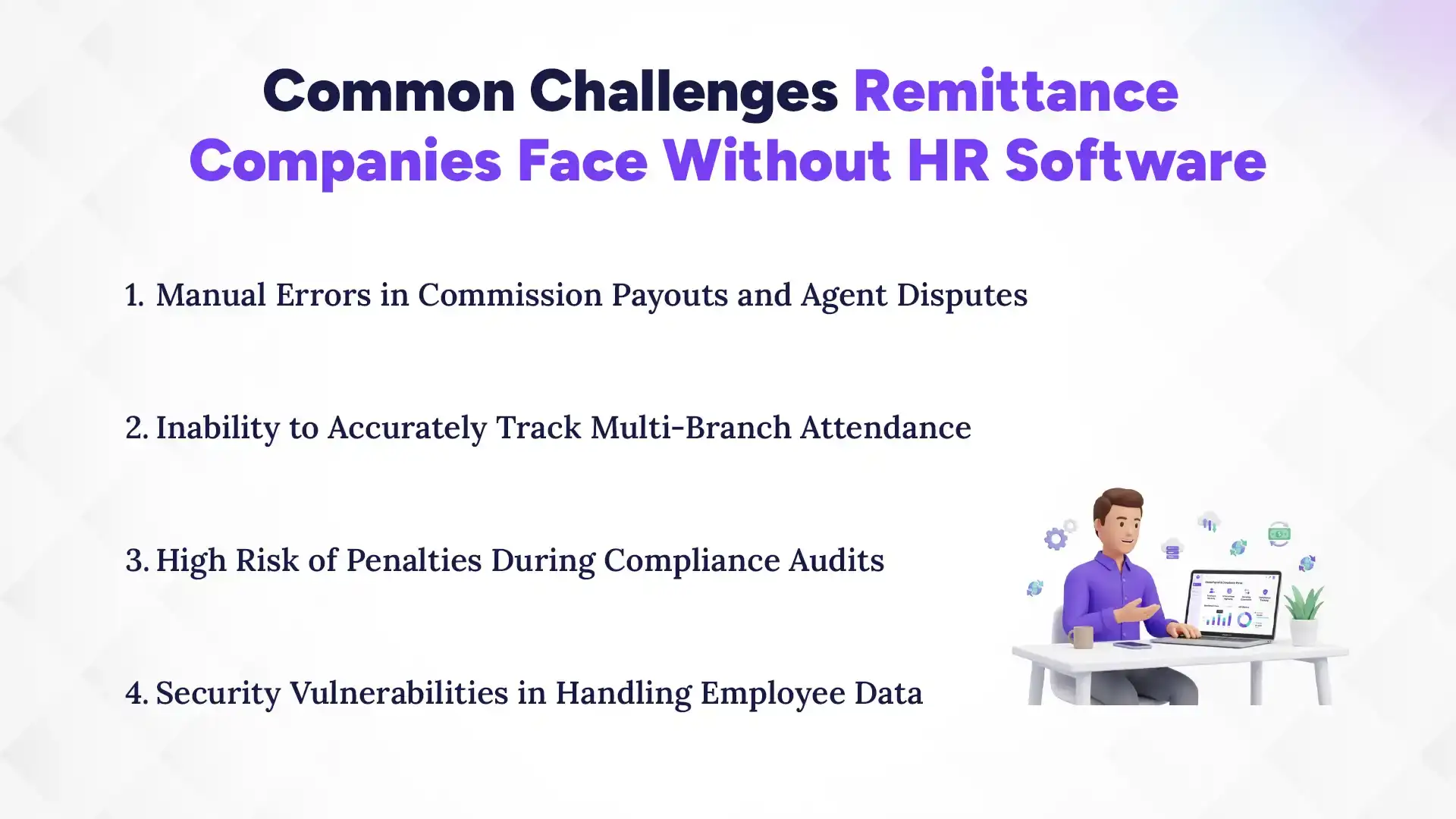
1. Manual Errors in Commission Payouts and Agent Disputes
Calculating tiered commissions on Excel almost always leads to discrepancies. An agent who feels shortchanged will dispute the payment, damaging the relationship and potentially causing them to move your customers to a competitor.
2. Inability to Accurately Track Multi-Branch Attendance
Without centralized biometric integration, branch managers can easily manipulate attendance records. This leads to ghost employees, inflated payroll costs, and a complete lack of visibility for HR at the head office.
3. High Risk of Penalties During Compliance Audits
When TDS or PF records are maintained manually, missing a slab update or failing to deduct the correct amount for even one month can result in heavy fines and legal issues during government audits.
4. Security Vulnerabilities in Handling Employee Data
Storing employee salary details, personal info, and branch access codes in unprotected Excel files or shared drives is a massive security risk that no financial institution can afford to take.
Future of HR Software for Remittance Companies in Nepal
The future of HR software for remittance companies in Nepal is shifting from manual ledger keeping to proactive, AI-driven compliance through AI-based anomaly detection in branch attendance, mobile self-service for field agents and digital promoters, and direct integration with digital remittance platforms.
1. AI-Based Anomaly Detection in Branch Attendance
AI will soon automatically flag suspicious attendance patterns, like a cashier consistently logging in two minutes late or a branch showing identical clock-in times for multiple employees, preventing proxy attendance before it impacts security.
2. Mobile Self-Service for Field Agents and Digital Promoters
Field agents who bring in remittance business will use mobile apps to track their own commission earnings in real-time, submit digital leave requests, and view their payout histories without visiting the head office.
3. Direct Integration with Digital Remittance Platforms
Future HRMS will connect directly with digital wallets and remittance APIs, automatically calculating agent commissions the exact second a customer completes an international transfer, making payouts truly real-time.
Conclusion
Choosing the right HR software for remittance companies in Nepal is no longer a luxury; it is a necessity for surviving strict regulatory scrutiny and managing 24/7 branch shifts. Specialized HR software ensures that complex commission structures and multi-branch compliance are handled smoothly and accurately. Similar to how HR software for banks handles complex corporate regulations, remittance HRMS handles complex branch-level fluidity and agent networks, keeping everything organized when money is constantly moving.
At the end of the day, the goal isn’t just to adopt technology but to adopt technology that actually fits the highly regulated way you operate. If you are still relying on scattered spreadsheets to manage your branch staff and agent commissions, now is the time to rethink your systems.
Contact Pace Infosys today through our contact page to find out how we can create secure, error-free operations for your remittance business. Because in financial services, having the right compliance and HR systems is what keeps your branches running and your reputation intact.