


Ever wondered why some banks run like a well-oiled machine while others feel, well, stuck in paperwork chaos? The difference often isn’t just people, it’s the systems behind them. In Nepal’s fast-evolving banking sector, where compliance is tight and operations are spread across branches, managing HR manually is like trying to count cash in the dark. You might get it right, but chances are, you won’t.
In this blog, we’ll explore everything you need to know about hr software for banks in Nepal, from what it is and why banks are rapidly adopting it, to key features, benefits, and how to choose the right HRMS for your institution. Whether you're a bank manager, HR professional, or decision-maker, this guide will help you make smarter, more confident choices (without the headache).
What Is HR Software for Banks in Nepal?
HR software for banks in Nepal is a digital system (HR software) designed to manage and automate employee-related processes within banking institutions. In simple terms, it acts like a central brain for HR, handling everything from hiring and attendance to payroll and compliance. In the banking sector, where accuracy, security, and regulation matter a lot, this software plays a critical role in reducing manual work and errors. It helps HR teams manage large, multi-branch workforces efficiently while ensuring compliance with Nepal’s labor laws and banking regulations. Think of it as moving from paper files and spreadsheets to a smart, organized system that actually keeps up with the pace of modern banking.
Why Banks in Nepal Need Specialized HR Software in 2026?
Banks in Nepal will need specialized HR software in 2026 to manage complex operations, ensure strict compliance, and efficiently handle growing workforce demands. The banking sector isn’t like other industries, it runs on precision, security, and regulation. As banks expand across branches and deal with increasing employee data, manual HR processes simply can’t keep up anymore. A tailored HRMS helps streamline operations, reduce risks, and shows clearly what does hr software does by bringing everything under one digital roof, clean, fast, and reliable.
1. Managing Large Banking Workforce Efficiently
Banks often employ hundreds (sometimes thousands) of staff across roles, from tellers to senior executives. Managing such a workforce manually is like juggling too many balls at once; something is bound to drop. HR software centralizes employee data, tracks performance, and automates routine tasks. This means HR teams spend less time chasing spreadsheets and more time focusing on people. It also improves visibility, enabling managers to make quicker, smarter decisions.
2. Handling Branch-Based and Multi-Location Operations
Banks in Nepal operate across multiple cities and branches, making HR coordination tricky. Without a unified system, communication gaps and data inconsistencies creep in. HR software connects all branches into one system, ensuring real-time updates and consistency. Whether it’s attendance or leave requests, everything stays synchronized, no more “I didn’t get that update” excuses. It brings everyone onto the same page, literally and digitally.
3. Ensuring Compliance with Nepal Rastra Bank & Labor Laws
Compliance in banking isn’t optional; it’s survival. From Nepal Rastra Bank regulations to labor laws, banks must follow strict guidelines. HR software helps automate compliance tracking, generate reports, and maintain accurate records. This reduces the risk of penalties and audits turning into nightmares. Basically, it keeps you on the right side of the law—without constant stress. And honestly, that peace of mind is priceless.
4. Automating Payroll and Benefits for Bank Staff
Payroll in banks can get complicated with bonuses, allowances, deductions, and tax calculations. Doing this manually is not just time-consuming; it’s risky. HR software automates payroll processing with precision, ensuring employees are paid correctly and on time. It also manages benefits seamlessly, reducing errors and building trust among staff. No more late nights fixing salary sheets before payday.
5. Enhancing Security and Data Privacy in HR Operations
Banks deal with sensitive data, and HR is no exception. Employee records, salaries, and personal details must be protected at all costs. HR software includes advanced security features such as role-based access control and data encryption. This ensures that only the right people access the right information, because in banking, even a small leak can feel like a flood. It’s not just security, it’s responsibility.
What Are the Key Features of HR Software for Banks in Nepal?
The key features of HR software for banks in Nepal include attendance tracking, payroll automation, recruitment tools, performance management, and leave handling, all designed to simplify complex HR tasks. In a banking environment, where accuracy and compliance are everything, these features work together like a well-trained team. Instead of juggling multiple systems (or worse, spreadsheets), everything is managed in one place, clean, organized, and actually reliable.
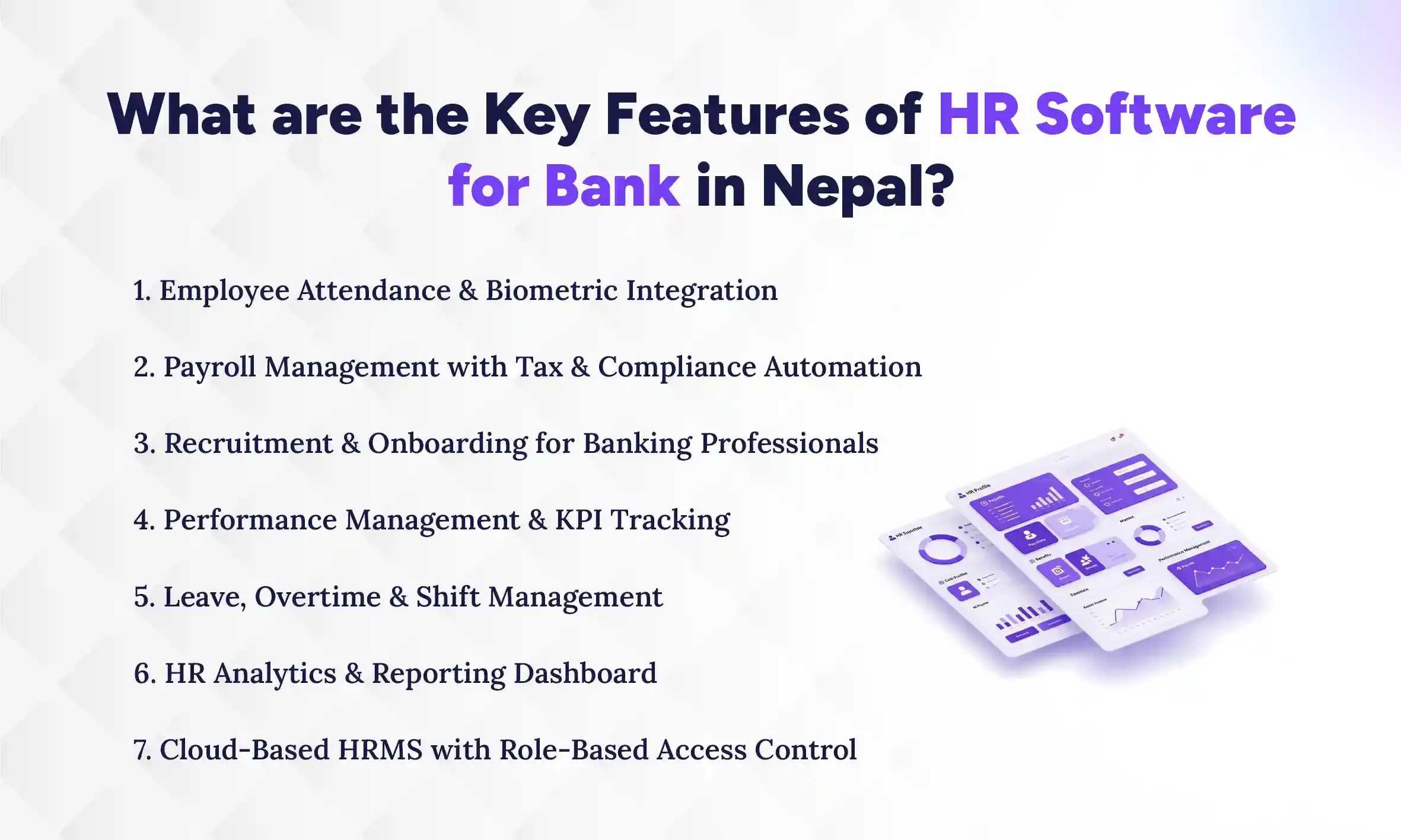
1. Employee Attendance & Biometric Integration
Banks need precise attendance tracking, no guesswork, no manual errors. HR software integrates with biometric devices (such as fingerprint and face recognition) to record real-time attendance. This ensures transparency and eliminates buddy punching (yes, it still happens). It also syncs attendance directly with payroll, saving HR teams from cross-checking data manually every month. Over time, it builds a reliable record of employee discipline and punctuality.
2. Payroll Management with Tax & Compliance Automation
Payroll in banks isn’t just about salaries; it involves taxes, bonuses, allowances, and deductions. HR software automates the entire process, ensuring accurate calculations and compliance with Nepal’s tax regulations. It reduces human errors (which can be costly) and ensures employees are paid correctly and on time. Honestly, it turns payroll from a headache into a smooth routine. And when payroll runs smoothly, employee trust naturally follows.
3. Recruitment & Onboarding for Banking Professionals
Hiring in banking requires precision, you’re not just filling roles, you’re trusting people with financial responsibility. HR software streamlines recruitment by managing job postings, applications, and candidate tracking. Once hired, onboarding becomes faster and more structured with digital documentation and workflows. It creates a professional first impression, which matters more than we sometimes think. A smooth hiring process also helps attract better talent in a competitive market.
4. Performance Management & KPI Tracking
Banks rely heavily on performance metrics, targets, KPIs, appraisals, and all that good stuff. HR software helps track employee performance in real time, making evaluations more objective and data-driven. Managers can easily monitor progress, provide feedback, and identify top performers. It also helps employees understand where they stand, which quietly boosts motivation. Over time, this leads to a more accountable and performance-driven work culture.
5. Leave, Overtime & Shift Management
Managing leave and shifts across multiple branches can get messy, fast. HR software simplifies this by allowing employees to apply for leave digitally, with managers approving it in just a few clicks. It also tracks overtime and shift schedules accurately, ensuring fair compensation. No more confusion, no more “I thought I was off today” situations. Everything stays transparent, which reduces conflicts and miscommunication among teams.
6. HR Analytics & Reporting Dashboard
Banks run on data, and HR should be no different. HR software provides detailed analytics and reporting dashboards that turn raw employee data into meaningful insights. From attendance trends to performance reports, everything is visual and easy to understand. This helps management make smarter, faster decisions instead of relying on guesswork. In a way, it’s like giving HR teams a pair of glasses, they can finally see what’s really going on.
7. Cloud-Based HRMS with Role-Based Access Control
Modern banks need flexibility, and cloud-based HRMS delivers exactly that. It allows HR teams and managers to access the system securely, anytime, anywhere. With role-based access control, sensitive information is only visible to authorized users, reducing the risk of data leaks. This is especially important in banking, where confidentiality is non-negotiable. Plus, cloud systems scale easily as the bank grows, so you’re not stuck upgrading systems every few years.
Benefits of Using HR Software for Banks in Nepal
The benefits of using HR software for banks in Nepal go beyond saving time; they transform how the entire workforce is managed. From improving efficiency to reducing costly errors, HRMS brings structure to what often feels like controlled chaos. In a banking environment, where even small mistakes can have big consequences, a reliable system is like a safety net that highlights the benefits of using software. It helps HR teams work smarter, not harder, while also improving the overall employee experience.
1. Improved Workforce Productivity Across Branches
When employees across different branches are managed through one centralized system, productivity naturally improves. HR software reduces repetitive tasks and manual follow-ups, allowing staff to focus on more meaningful work. Managers can track performance and attendance in real time, which helps in making quicker decisions. It also creates better coordination between branches. In short, less confusion more action.
2. Faster Recruitment and Employee Onboarding
Hiring at banks can be slow and paperwork-heavy, but HR software can significantly speed up the process. It automates job postings, application tracking, and onboarding workflows. New employees can complete documentation digitally, reducing delays and confusion. This means positions get filled faster, and new hires become productive sooner. First impressions improve, and honestly, that matters more than we admit.
3. Accurate Payroll Processing and Reduced Errors
Payroll errors are not just embarrassing; they can damage employee trust. HR software ensures accurate salary calculations by automating taxes, deductions, and allowances. It minimizes human errors and ensures timely payments. Everything is calculated systematically, so there’s no last-minute panic before payday. And when salaries are right, complaints magically reduce.
4. Better Compliance with Financial Regulations
Banks operate under strict regulations, and non-compliance can lead to serious penalties. HR software helps maintain proper records, generate compliance reports, and stay aligned with Nepal Rastra Bank and labor laws. It reduces the risk of missing deadlines or filing incorrect data. Essentially, it acts like a silent watchdog, always alert, always keeping things in check.
5. Enhanced Employee Experience and Retention
A smooth HR system directly impacts how employees feel at work. When processes like leave requests, payroll, and performance reviews are seamless, employees feel valued and supported. HR software makes interactions faster and more transparent. This leads to higher satisfaction and better retention. Because, at the end of the day, happy employees don’t just stay; they perform better, too.
How to Choose the Best HR Software for Banks in Nepal?
Choosing the best HR software for banks in Nepal means selecting a solution that aligns with your operational needs, compliance requirements, and future growth. It’s not just about features, it’s about fit. Banks deal with sensitive data, strict regulations, and multi-branch complexity, so the HRMS you choose should handle all of that smoothly. A good system should feel less like a tool and more like a reliable partner that grows with your bank. To explore better options, you can review the top 5 hr software in Nepal. Take your time here; rushing this decision often leads to bigger problems later.
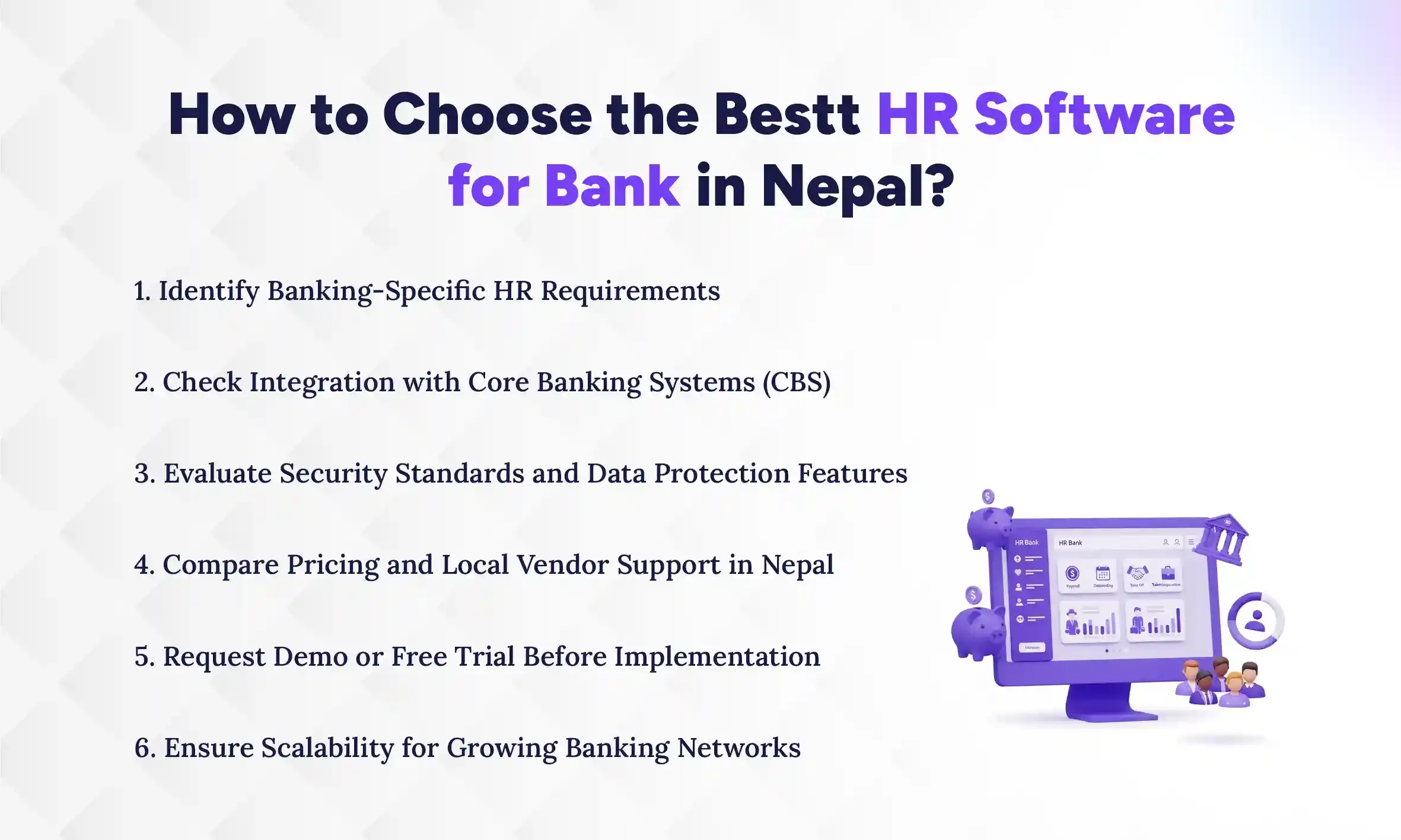
1. Identify Banking-Specific HR Requirements
Start by understanding what your bank actually needs, because not all HR software is built the same. Banking HR involves compliance, branch coordination, and secure data handling. List out your key challenges and priorities before exploring options. This helps avoid paying for features you don’t need (or missing ones you do). Think of it as building a checklist before going shopping, it saves regret later. The clearer your requirements, the easier your final decision becomes.
2. Check Integration with Core Banking Systems (CBS)
Your HR software shouldn’t work in isolation, it needs to connect with your core banking systems. Integration ensures smooth data flow between departments, reducing duplication and errors. For example, employee data, payroll, and reporting can sync automatically. Without integration, you’ll end up doing double work, which defeats the whole point of automation. So yes, this step is non-negotiable. A well-integrated system simply makes everything feel connected.
3. Evaluate Security Standards and Data Protection Features
In banking, security isn’t a feature; it’s a necessity. The HR software must offer strong data protection, encryption, and role-based access controls. Only authorized personnel should access sensitive information, such as salaries and employee records. Check whether the system adheres to global security standards. Because one small vulnerability can turn into a very big problem. It’s better to be overly cautious here than regret it later.
4. Compare Pricing and Local Vendor Support in Nepal
Pricing matters, but so does support, especially local support. Choose a solution that fits your budget without compromising essential features. Also, consider vendors who provide support within Nepal, as they understand local regulations and challenges better. When something goes wrong (and sometimes it will), quick support makes all the difference. Cheap software with no support? Usually, it costs more in the long run. Value always beats just low cost.
5. Request Demo or Free Trial Before Implementation
Never commit to HR software without trying it first. A demo or free trial helps you understand how the system actually works in real scenarios. You can test usability, features, and compatibility with your processes. It also helps your team get familiar with the system before full implementation. Think of it as a test drive, you wouldn’t buy a car without one, right? It gives you confidence before making a long-term commitment.
6. Ensure Scalability for Growing Banking Networks
Banks grow, new branches, more employees, bigger operations. Your HR software should scale with that growth without requiring constant upgrades or replacements. A scalable system saves time, money, and future headaches. It should handle increasing data volumes and user growth effortlessly. Because the last thing you want is to outgrow your own system. Choose something that grows with you, not against you.
What Makes HR Software for Banks Different from Other Industries?
HR software for banks differs because it must handle higher security standards, stricter compliance requirements, and more complex workforce structures than in most industries. Banking isn’t just another sector, it’s built on trust, precision, and regulation. That means HR systems must go beyond basic features and deliver accuracy, control, and real-time visibility when you implement HR software. In simple terms, what works for a retail company might completely fall short in a bank.
1. High Security and Confidential Data Handling Requirements
Banks deal with highly sensitive data, not just customer information, but employee salaries, roles, and internal records. HR software in this sector must offer advanced security features like encryption and role-based access. Only authorized users should access specific data, reducing the risk of internal leaks. Even a small security lapse can have serious consequences. So here, security isn’t optional; it’s the foundation.
2. Complex Organizational Structure with Multiple Branches
Unlike many industries, banks operate through a network of branches, departments, and hierarchies. Managing employees across these layers can get complicated quickly. HR software helps bring everything into one centralized system, ensuring consistency and coordination. It allows HR teams to manage multiple locations without confusion. Think of it as connecting scattered dots into one clear picture.
3. Strict Regulatory and Financial Compliance Needs
Banks must comply with strict rules from Nepal Rastra Bank and labor authorities. HR software helps track compliance, maintain records, and generate necessary reports automatically. This reduces the chances of errors or missed deadlines. It also prepares banks better for audits and inspections. Because in banking, compliance mistakes are not just mistakes, they’re risks.
4. Need for Real-Time Workforce Monitoring and Reporting
Banking operations move fast, and decisions often need to be made quickly. HR software provides real-time data on attendance, performance, and workforce trends. This allows managers to respond instantly instead of waiting for reports. It also improves transparency and accountability across the organization. When you can see what’s happening in real time, you manage better, simple as that.
Which Is the Best HR Software for Banks in Nepal?
Pace HRMS is the best HR software for banks in Nepal because it offers a complete, secure, and scalable solution tailored for complex HR operations. It centralizes payroll, attendance, recruitment, and performance management into one platform, reducing manual work and errors significantly. What really makes it stand out is its strong focus on automation, compliance, and ease of use, something banks truly need. It also provides cloud-based access, seamless integrations, and real-time data insights, helping HR teams make faster and smarter decisions.
On top of that, Pace HRMS is built to scale with growing organizations, making it ideal for multi-branch banking networks. With features like biometric integration, employee self-service, and performance tracking, it simplifies even the most complex HR processes. In short, it doesn’t just manage HR, it quietly upgrades how banks operate.
Common Challenges Banks Face Without HR Software
Banks without HR software often struggle with inefficiency, errors, and a lack of visibility across their workforce. When HR processes rely on manual systems like spreadsheets and paperwork, things start slipping, deadlines get missed, data gets inconsistent, and decision-making slows down across different types of HR. In a sector where precision matters, these small issues can quickly turn into bigger operational risks. Simply put, without HR software, managing people becomes harder than it should be.
1. Manual HR Processes and Administrative Delays
Without HR software, most tasks are handled manually: attendance tracking, leave approvals, payroll calculations, everything. This slows down operations and increases dependency on paperwork or scattered files. HR teams spend more time on repetitive tasks instead of strategic work. Delays become common, especially during busy periods like payroll cycles. It also increases the chances of miscommunication between departments. Over time, this creates frustration for both HR teams and employees.
2. Payroll Errors and Compliance Risks
Manual payroll processing is prone to mistakes, wrong calculations, missed deductions, or delayed payments. In banking, even a small payroll error can damage employee trust and create unnecessary disputes. On top of that, compliance with tax laws and regulations becomes harder to manage without automation. Missing deadlines or incorrect filings can lead to penalties. It’s like walking a tightrope without a safety net. One slip, and the consequences can be serious.
3. Difficulty Managing Multi-Branch Workforce
Banks often operate across multiple branches, making workforce management more complex. Without a centralized system, employee data gets scattered and inconsistent. Coordinating attendance, leaves, and performance across locations becomes a challenge. Communication gaps increase, leading to confusion and inefficiency. Managers struggle to get a clear, real-time view of their teams. And honestly, managing everything manually across branches can feel overwhelming pretty quickly.
4. Lack of Data-Driven HR Decision Making
Without HR software, data is either incomplete, outdated, or difficult to access. This makes it hard for management to make informed decisions about hiring, performance, or workforce planning. Reports take time to prepare and may not always be accurate. As a result, decisions are often based on assumptions rather than actual insights. It’s like trying to navigate without a map, you might move forward, but not always in the right direction.
Future of HR Software for Banks in Nepal
The future of HR software for banks in Nepal is heading toward smarter, faster, and more connected systems. As banking becomes more digital, HRMS is evolving from a support tool into a strategic powerhouse. It’s no longer just about managing employees; it’s about predicting needs, improving decisions, and enhancing employee experience through advanced features of HR software. The shift is clear: from reactive HR to proactive, data-driven HR.
1. AI-Based Workforce Analytics and Forecasting
AI is starting to change how HR works, quietly but powerfully. With AI-based analytics, banks can predict hiring needs, identify performance trends, and even foresee employee turnover. Instead of reacting to problems, HR teams can plan with data-backed insights. It takes guesswork out of decision-making. Over time, this leads to smarter workforce planning and better business outcomes.
2. Mobile HRMS for Banking Employees
Work is no longer tied to a desk, and HR systems shouldn’t be either. Mobile HRMS allows employees to access HR services, like leave requests, payslips, and updates, directly from their phones. This improves convenience and speeds up processes. Managers can also approve requests on the go, without delays. It makes HR feel more accessible and, honestly, a lot less frustrating.
3. Integration with Fintech and Digital Banking Systems
As banks adopt fintech and digital platforms, HR software is also becoming more integrated. Modern HRMS can connect with core banking systems and digital tools, creating a seamless flow of data across departments. This reduces duplication and improves accuracy. It also helps align HR operations with overall business goals. In a way, HR becomes more connected to the heart of banking operations than ever before.
Conclusion
Choosing the right HR software for banks in Nepal is no longer a luxury, it’s becoming a necessity. As banks grow, expand across branches, and deal with stricter regulations, managing HR manually just doesn’t cut it anymore. A well-designed HRMS brings structure, accuracy, and efficiency into everyday operations, similar to how hr software for ngo and ingo in Nepal helps streamline workforce management and compliance in mission-driven organizations. It reduces errors, improves compliance, and gives HR teams the breathing space to focus on what actually matters, people, not paperwork.
At the end of the day, the goal isn’t just to adopt technology, but to adopt the right technology. The kind that fits your bank’s needs, scales with your growth, and quietly makes everything smoother behind the scenes. If you’re still relying on outdated systems, now might be the right time to rethink with The Pace Infosys. Because in banking, even small improvements in HR can create big impacts across the entire organization.