Ever felt like managing HR in an NGO or INGO is less about people and more about juggling spreadsheets, tracking field staff, handling donor reports, and somehow keeping everything compliant at the same time? Between multi-project teams, remote workers, and strict reporting requirements, HR operations can quickly turn into controlled chaos (and not the good kind).
In this blog, we’ll break down everything you need to know about HRMS for NGOs & INGOs in Nepal, from what it is and why it matters to key features, benefits, and how to choose the right system for your organization. Whether you’re managing a small NGO or a large INGO with multiple projects, this guide will help you simplify HR processes and make smarter decisions.
What Is HRMS for NGOs & INGOs?
HRMS for NGOs & INGOs in Nepal is a digital system designed to manage human resources, including employees, volunteers, and project-based staff, in a centralized and automated way. It helps track attendance, payroll, contracts, and performance while handling multi-project and multi-location operations efficiently. Unlike general HR Software, NGO-focused HRMS is built to support donor reporting, grant-based budgeting, and field workforce management. It plays a key role in automating HR processes, improving transparency, and ensuring compliance in development sector organizations.
NGOs & INGOs in Nepal need HRMS in 2026 to efficiently manage complex workforce structures, ensure compliance, and streamline HR operations through automation. With increasing project-based work, donor reporting requirements, and field staff management, manual systems are no longer reliable. An HRMS helps organizations stay organized, reduce errors, and improve overall productivity, highlighting the benefits of hr system for modern organizations. In a fast-evolving development sector, adopting digital HR solutions is becoming a necessity rather than a choice.
1. Managing Diverse Workforce (Staff, Volunteers, Field Workers)
NGOs and INGOs often work with a mix of full-time staff, part-time employees, volunteers, and field workers. Managing such a diverse workforce manually can be confusing and inefficient. An HRMS centralizes all employee data in one place, making it easier to track roles, attendance, and responsibilities. It ensures better coordination across teams. This leads to smoother operations and improved workforce management. It also helps maintain clear role-based accountability.
2. Handling Multi-Project and Multi-Location Operations
Many NGOs operate across multiple projects and locations, sometimes even in remote areas. Tracking staff assignments, attendance, and performance across different sites can be challenging. HRMS allows organizations to manage everything from a single platform. It provides real-time visibility of operations across projects. This improves planning and reduces miscommunication between teams. It also enhances coordination between headquarters and field offices.
3. Ensuring Compliance with Nepal Labor Laws and Donor Requirements
NGOs must comply with Nepal Labor Laws as well as donor-specific guidelines and reporting standards. Manual processes increase the risk of errors and non-compliance. An HRMS helps maintain accurate records and ensures policies are followed correctly. It also simplifies reporting for audits and donor requirements. This reduces legal risks and builds trust with stakeholders. It ensures documentation is always audit-ready.
4. Automating Payroll, Contracts, and Grant-Based Funding Structures
Payroll in NGOs can be complex due to contract-based employees and project-specific funding. HRMS automates salary calculations, contract tracking, and budget allocation based on grants. This reduces manual errors and saves time for HR teams. It also ensures accurate financial management across projects. Automation makes payroll processing much more efficient. It also improves financial transparency and reporting accuracy.
5. Improving Transparency and Accountability in HR Operations
Transparency is critical in NGOs, especially when dealing with donor funds and project reporting. HRMS provides clear and accessible data for attendance, payroll, and performance. This reduces confusion and builds accountability within the organization. Managers and stakeholders can easily track HR activities. It creates a more transparent and trustworthy work environment. It also strengthens credibility with donors and partners.
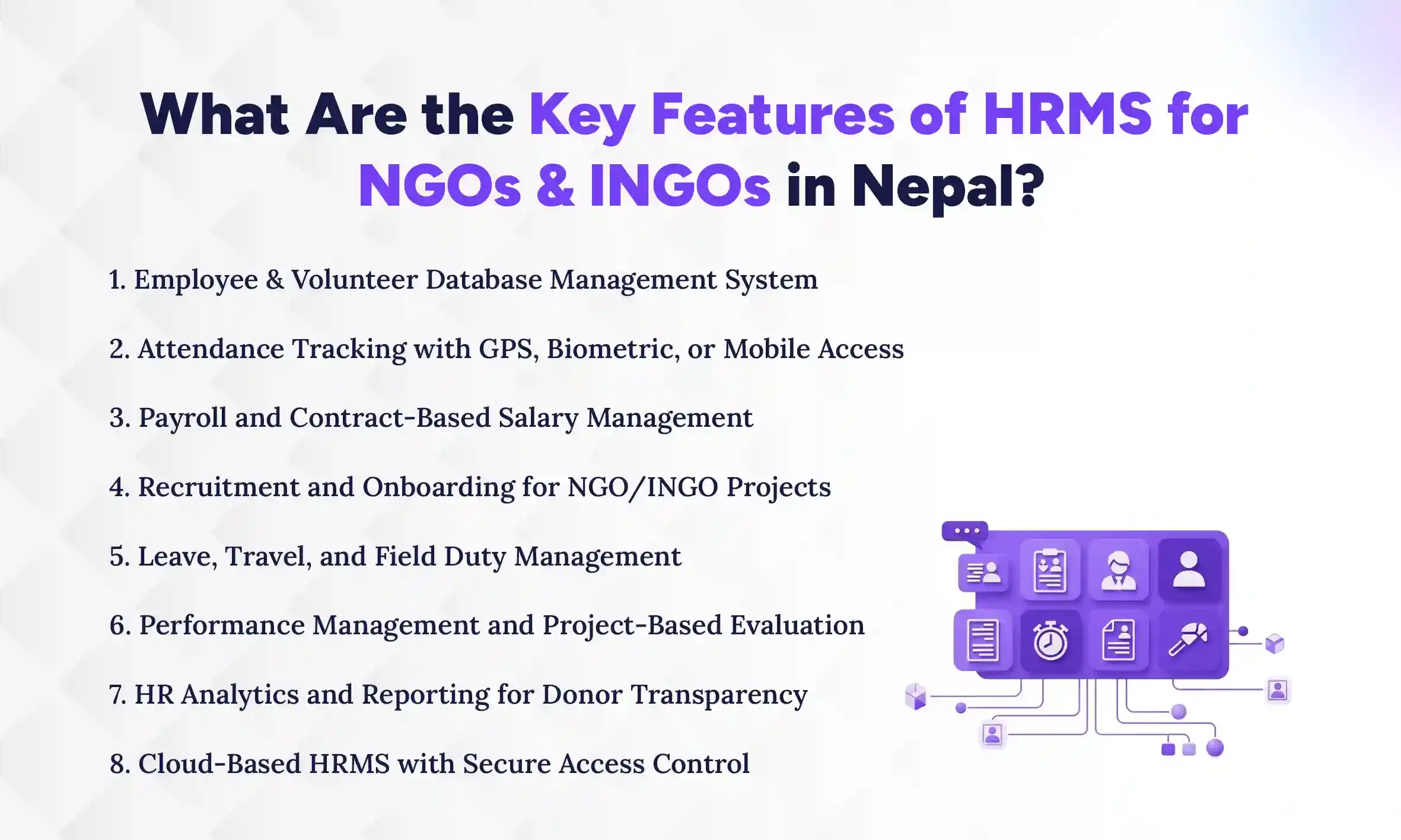
What Are the Key Features of HRMS for NGOs & INGOs in Nepal?
The key features of HRMS for NGOs & INGOs in Nepal include tools that help manage employees, volunteers, payroll, attendance, and project-based operations efficiently in one system. These features are designed to handle the unique needs of NGOs such as multi-project management, donor reporting, and field staff tracking. A well-built HRMS simplifies HR tasks, improves transparency, and ensures compliance. In short, it acts like a central control system for all HR-related activities.
1. Employee & Volunteer Database Management System
HRMS stores all employee and volunteer information in one centralized database. This includes personal details, roles, contracts, and project assignments. It helps HR teams easily access and update records when needed. Managing both staff and volunteers becomes much simpler. It also reduces paperwork and improves data accuracy.
2. Attendance Tracking with GPS, Biometric, or Mobile Access
This feature allows organizations to track attendance using GPS, biometric devices, or mobile apps. It is especially useful for field staff working in remote locations. Real-time tracking ensures accurate attendance records. Managers can monitor who is working and where. It improves accountability across teams.
3. Payroll and Contract-Based Salary Management
NGOs often deal with contract-based employees and project-specific funding. HRMS automates payroll calculations based on contracts and attendance. It ensures accurate salary processing and reduces manual errors. The system can also handle different pay structures. This simplifies complex payroll operations.
4. Recruitment and Onboarding for NGO/INGO Projects
HRMS helps streamline the hiring process for different projects. It allows HR teams to manage job postings, applications, and candidate selection. Onboarding processes can also be automated with document collection and verification. This saves time and ensures consistency. It makes hiring faster and more organized.
5. Leave, Travel, and Field Duty Management
Managing leave and travel is critical for NGOs with field operations. HRMS tracks leave requests, approvals, and travel assignments in one place. It ensures proper coordination between office and field teams. Employees can apply for and track leave easily. This improves planning and reduces confusion.
6. Performance Management and Project-Based Evaluation
HRMS allows organizations to evaluate employee performance based on project outcomes. It helps track goals, achievements, and feedback. Managers can assess staff performance more objectively. This supports better decision-making for promotions or role changes. It also improves overall productivity.
7. HR Analytics and Reporting for Donor Transparency
HRMS provides detailed reports on workforce data, payroll, attendance, and performance. These reports are essential for donor transparency and audits. Organizations can generate reports quickly and accurately. It helps build trust with donors and stakeholders. Data-driven insights improve planning and accountability.
8. Cloud-Based HRMS with Secure Access Control
Cloud-based HRMS allows access from anywhere, which is ideal for NGOs with multiple locations. It ensures data is stored securely with role-based access control. Only authorized users can view or edit sensitive information. It also reduces the need for heavy IT infrastructure. This makes the system flexible and secure.
Ready to Accelerate Your Digital Growth?
Partner with The Pace Infosys to build scalable web and mobile solutions tailored to your business goals.
Using an HRMS for NGOs & INGOs in Nepal helps organizations streamline HR operations, improve coordination, and ensure compliance across multiple projects. It reduces manual workload and minimizes errors in payroll, attendance, and reporting. For NGOs handling donor funds and field teams, having a centralized system brings much-needed clarity and control, similar to how different types of hr system are designed to optimize various HR functions. Overall, it improves efficiency while allowing teams to focus more on impact rather than admin tasks.
1. Improved Workforce Coordination Across Projects
HRMS helps manage staff working across different projects and locations in one centralized system. It ensures better communication and coordination between teams. Managers can easily track roles, assignments, and availability. This reduces confusion and overlaps in responsibilities. It also improves overall project efficiency.
2. Accurate Payroll and Grant-Based Budget Tracking
Payroll in NGOs often involves different funding sources and contract structures. HRMS ensures accurate salary calculations based on attendance and project budgets. It reduces errors and simplifies financial tracking. Organizations can align payroll with grant allocations. This improves financial transparency and accountability.
3. Faster Recruitment and Onboarding Process
HRMS automates recruitment and onboarding, making the hiring process quicker and more organized. It helps manage applications, shortlist candidates, and complete documentation efficiently. New hires can be onboarded smoothly with minimal delays. This saves time for HR teams. It also improves the overall hiring experience.
4. Better Compliance with Donor and Government Regulations
NGOs must follow strict guidelines from donors and government authorities. HRMS helps maintain accurate records and ensures policies are followed properly. It simplifies reporting for audits and compliance checks. This reduces the risk of legal or funding issues. It builds trust with stakeholders and donors.
5. Enhanced Employee and Volunteer Experience
A well-implemented HRMS improves the experience of both employees and volunteers. It provides easy access to information like attendance, leave, and payroll. This reduces dependency on HR for basic queries. Clear processes create a more transparent work environment. It helps build trust and satisfaction within the organization.
What Makes HRMS for NGOs & INGOs Different from Corporate HR Software?
HRMS for NGOs & INGOs is different from corporate HR software because it is designed to handle project-based work, donor funding requirements, and field operations rather than standard office-based structures. NGOs operate in dynamic environments with multiple projects and diverse teams, which require more flexible and transparent systems. Unlike corporate HRMS, NGO-focused systems emphasize reporting, compliance, and accountability. This makes them better suited for development sector needs.
1. Project-Based Workforce and Contract Employees
NGOs often hire staff based on specific projects or short-term contracts. Unlike corporate setups with permanent employees, roles frequently change depending on funding and project duration. HRMS for NGOs helps manage contract timelines, renewals, and role assignments efficiently. It ensures that project-based staffing is well organized. This flexibility is essential for NGO operations. It also helps avoid gaps in staffing across projects.
2. Dependency on Donor Funding and Budget Tracking
NGOs rely heavily on donor funding, which comes with strict budget allocations and reporting requirements. HRMS systems are designed to track salaries and expenses based on specific grants or projects. This ensures accurate financial management and transparency. It also simplifies donor reporting and audits. Corporate HR software usually does not support this level of budget tracking. It ensures funds are used as per donor expectations.
3. Field-Based and Remote Work Environment
Many NGO employees work in remote or field locations rather than a central office. HRMS for NGOs includes features like GPS attendance and mobile access to manage such teams. It allows real-time tracking and communication across locations. This improves coordination and accountability. Corporate systems often focus more on office-based environments. It also supports better monitoring of field activities.
4. Strong Focus on Transparency and Reporting
Transparency is critical for NGOs to maintain trust with donors and stakeholders. HRMS provides detailed reports on payroll, attendance, and performance for easy auditing. It ensures that all HR activities are well-documented and accessible. This level of reporting is more detailed than typical corporate systems. It helps NGOs maintain credibility and compliance. It also supports better decision-making through data insights.
Insights
Did You Know?
With built-in compliance tools, Pace HRMS helps businesses in Nepal stay aligned with labor laws and regulations effortlessly.
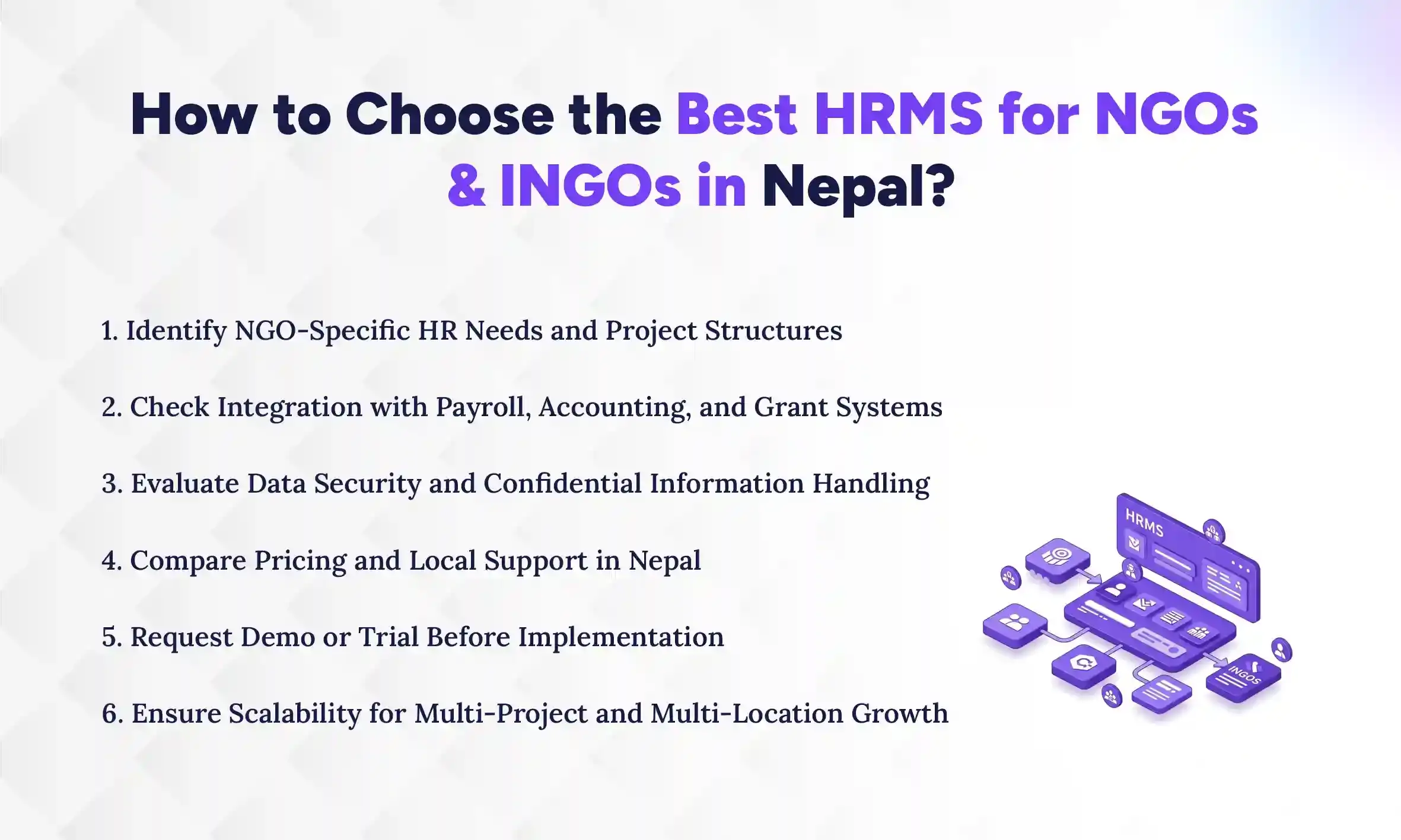
How to Choose the Best HRMS for NGOs & INGOs in Nepal?
To choose the best HRMS for NGOs & INGOs in Nepal, you must evaluate your organization’s project structure, workforce complexity, and compliance needs before selecting a solution. The right HRMS should simplify operations, support donor reporting, and integrate smoothly with payroll and accounting systems. It should also be flexible enough to handle field staff and multi-location projects, which is why understanding how to choose hr software is essential before making a decision. In short, the system should adapt to your organization, not the other way around. A well-chosen HRMS can significantly improve efficiency and transparency.
1. Identify NGO-Specific HR Needs and Project Structures
Start by understanding your organization’s unique HR requirements, including project-based staffing and volunteer management. NGOs often operate differently from corporate organizations, so a generic HRMS may not fit well. Consider factors like contract employees, field workers, and multiple funding sources. Clearly defining your needs helps in choosing the right features. This ensures the system supports your daily operations effectively.
2. Check Integration with Payroll, Accounting, and Grant Systems
An effective HRMS should integrate seamlessly with payroll, accounting, and grant management systems. This ensures accurate salary processing and proper allocation of funds based on projects. Integration reduces manual data entry and minimizes errors. It also improves financial transparency and reporting. A connected system makes overall operations smoother and more efficient.
3. Evaluate Data Security and Confidential Information Handling
NGOs deal with sensitive employee and donor data, so security is critical. Choose an HRMS that offers encryption, role-based access, and secure data storage. It should protect confidential information from unauthorized access. Regular backups and security updates are also important. A secure system builds trust and reduces risks.
4. Compare Pricing and Local Support in Nepal
Budget is always an important factor, especially for NGOs working with limited funding. Compare different HRMS options based on features and value, not just cost. Also, check if the provider offers local support in Nepal for implementation and troubleshooting. Reliable support can save time and reduce operational issues. Good support often matters more than a slightly lower price.
5. Request Demo or Trial Before Implementation
Before making a final decision, always request a demo or free trial of the HRMS. This allows you to understand how the system works in real scenarios. You can test features, usability, and compatibility with your operations. It also helps identify any limitations early. A hands-on trial reduces the risk of choosing the wrong system.
6. Ensure Scalability for Multi-Project and Multi-Location Growth
Your HRMS should be able to grow with your organization as projects expand. It should support additional users, locations, and features over time. Scalability ensures you don’t need to switch systems frequently. Cloud-based solutions are usually more flexible for this purpose. Planning for future growth is just as important as solving current challenges.
Which Is the Best HRMS for NGOs & INGOs in Nepal?
Pace HRMS is the best HRMS for NGOs & INGOs in Nepal because it offers a complete, centralized platform that simplifies complex HR operations, from payroll and attendance to recruitment and performance management. It is specifically designed to automate workflows, reduce manual errors, and ensure compliance with local regulations, which is crucial for NGOs handling donor-funded projects.
The system supports features like employee database management, attendance tracking, payroll integration, and HR analytics, making it ideal for managing multi-project and field-based teams. It is also cloud-based and scalable, allowing NGOs and INGOs to manage operations across multiple locations with ease. Overall, Pace HRMS fits NGO/INGO requirements perfectly by improving transparency, ensuring accurate reporting, and helping organizations focus more on impact rather than administrative workload.
Common Challenges NGOs & INGOs Face Without HRMS
Without an HRMS for NGOs & INGOs in Nepal, organizations often struggle with inefficiencies, errors, and lack of coordination in daily HR operations. Managing multiple projects, field staff, and donor requirements manually can quickly become overwhelming. Important data gets scattered across spreadsheets, emails, and paperwork. This not only slows down processes but also increases the risk of mistakes. Over time, these challenges can impact both operational efficiency and organizational credibility.
1. Manual HR Processes and Documentation Issues
Managing HR through spreadsheets and paperwork leads to disorganized records and time-consuming processes. Documents can be misplaced, duplicated, or outdated. HR teams spend extra time searching for information and updating records. This slows down operations and increases the chances of errors. It also makes it difficult to maintain consistency across projects. Overall, manual systems create unnecessary workload and confusion.
2. Errors in Payroll and Grant Allocation
Payroll in NGOs often involves multiple funding sources and project-based budgets. Without an HRMS, calculating salaries and allocating funds accurately becomes difficult. Payroll errors can lead to financial discrepancies and employee dissatisfaction. It also affects proper utilization of donor funds. Fixing these mistakes takes additional time and effort. Inaccurate financial tracking can harm organizational transparency.
3. Difficulty Managing Field Staff and Volunteers
NGOs frequently work with field staff and volunteers across different locations. Tracking their attendance, performance, and assignments manually is challenging. There is often a lack of visibility into who is working where. Communication gaps can lead to coordination issues. This affects project execution and team efficiency. Managing remote teams without a system becomes increasingly difficult.
4. Lack of Real-Time Data and Reporting
Without a centralized system, accessing real-time HR data is nearly impossible. Reports have to be prepared manually, which is time-consuming and prone to errors. This delays decision-making and affects planning. NGOs also struggle to provide accurate reports to donors and stakeholders. Lack of timely data reduces transparency. It makes it harder to monitor performance and progress effectively.
Conclusion
Managing HR in NGOs and INGOs isn’t just about people, it’s about handling projects, donors, compliance, and field operations all at once. That’s exactly where an HRMS for NGOs & INGOs in Nepal becomes a game-changer. It simplifies complex processes, reduces manual errors, and brings everything into one centralized system. From payroll to reporting, it helps organizations stay organized, transparent, and efficient, something solutions like The Pace Infosys are designed to deliver.
As the development sector in Nepal continues to grow, adopting the right HRMS is no longer optional; it’s essential. Whether you’re a small NGO or a large INGO, the right system can save time, improve accountability, and support better decision-making. In the end, when your HR processes run smoothly, your team can focus on what truly matters, creating real impact where it’s needed most. You can also check hr software for hospitality to explore industry-specific solutions.
FAQs
What is HRMS for NGOs & INGOs in Nepal?
+
It is a software system that manages employees, volunteers, payroll, and projects efficiently.
Why do NGOs in Nepal need HRMS?
+
To manage complex workforce structures, ensure compliance, and improve efficiency across multiple projects.
How does HRMS help in donor reporting?
+
It generates accurate reports on payroll, attendance, and projects, ensuring transparency for donors.
Can HRMS manage field staff and remote teams?
+
Yes, it tracks attendance, location, and performance of field staff using mobile or GPS features.
Is HRMS suitable for small NGOs in Nepal?
+
Yes, scalable HRMS solutions are available that fit both small NGOs and large INGOs.
What features should NGOs look for in HRMS?
+
Look for payroll, attendance, reporting, project tracking, and compliance management features.
How does HRMS improve payroll accuracy?
+
It automates salary calculations based on attendance, contracts, and project-based funding structures.
Which is the best HRMS for NGOs & INGOs in Nepal?
+
Pace HRMS is a reliable choice due to automation, compliance, and multi-project management features.
Ready to get started?
Book a 30-minute consultation call, and let's talk about your goals.