Managing a hospital is no small task, between handling medical staff, shift rotations, payroll, and compliance, even a small error can disrupt patient care. That’s where modern HR solutions step in. The right system can transform how hospitals operate by reducing manual work, improving accuracy, and ensuring that every department runs smoothly without administrative bottlenecks.
In this blog, we’ll explore hr software for hospitals in Nepal and how it helps healthcare institutions manage their workforce more efficiently. You’ll learn about key features, benefits, challenges, and how to choose the right solution for your hospital. Whether you run a clinic or a large hospital, this guide will help you understand how HR technology can streamline operations and improve overall productivity.
What Is HR Software for Hospitals?
HR software for hospitals is a digital system designed to manage hospital staff, automate HR tasks, and streamline workforce operations. It helps handle functions like employee records, shift scheduling, payroll, attendance, and compliance through hr software in one centralized platform. By reducing manual work and improving accuracy, it ensures smoother coordination among medical and administrative staff. This allows hospitals to focus more on patient care while maintaining efficient internal operations.
Why Hospitals in Nepal Need Specialized HR Software in 2026?
Hospitals in Nepal need specialized HR software in 2026 to manage complex healthcare workforce operations more efficiently and accurately. Unlike other industries, hospitals deal with shift-based work, emergency staffing, and strict compliance requirements. Manual systems often lead to errors in scheduling, payroll, and staff coordination. What does HR software do? It helps streamline these processes, improve transparency, and ensure smooth hospital operations while allowing healthcare professionals to focus more on patient care.
1. Managing Doctors, Nurses, and Medical Staff Efficiently
Hospitals employ a wide range of staff, including doctors, nurses, technicians, and administrative personnel, each with different roles and responsibilities. Managing such a diverse workforce manually can lead to confusion and inefficiencies. HR software centralizes employee data, making it easier to track roles, responsibilities, and performance. It also helps in assigning duties more effectively, ensuring the right staff is available at the right time. This leads to better coordination and improved patient service. Additionally, it enhances communication between departments for smoother daily operations.
2. Handling Shift-Based Scheduling and Emergency Staffing
Healthcare facilities operate 24/7, requiring proper shift planning and quick adjustments during emergencies. Manual scheduling can result in overlaps, gaps, or staff shortages during critical times. HR software automates shift scheduling, making it easier to assign and adjust shifts based on availability and workload. It also allows quick response to emergencies by identifying available staff instantly. This ensures continuous patient care without disruptions. Moreover, it reduces burnout by balancing workloads more effectively.
3. Ensuring Compliance with Nepal Healthcare Regulations
Hospitals must follow strict labor laws, healthcare regulations, and reporting requirements in Nepal. Managing compliance manually increases the risk of errors, penalties, or legal issues. HR software helps maintain accurate records, automate compliance tracking, and generate necessary reports. It ensures that hospitals meet all regulatory requirements consistently. This reduces risks and builds trust with authorities and stakeholders. It also makes audits and inspections much easier to handle.
4. Improving Payroll Accuracy for Medical Staff
Medical staff often have complex pay structures, including overtime, night shifts, and allowances. Calculating payroll manually can lead to errors and dissatisfaction among employees. HR software automates payroll processing, ensuring accurate calculations based on attendance and work hours. It also reduces delays and improves transparency in salary distribution. This helps maintain staff trust and morale. In addition, it minimizes disputes related to salary and benefits.
5. Enhancing Productivity in Hospital Operations
Efficient workforce management directly impacts overall hospital productivity. When administrative tasks are handled manually, they consume time and resources. HR software automates routine processes, reduces paperwork, and improves communication across departments. This allows staff to focus more on critical healthcare tasks. As a result, hospitals can operate more smoothly and deliver better patient outcomes. It also supports faster decision-making with real-time workforce insights.
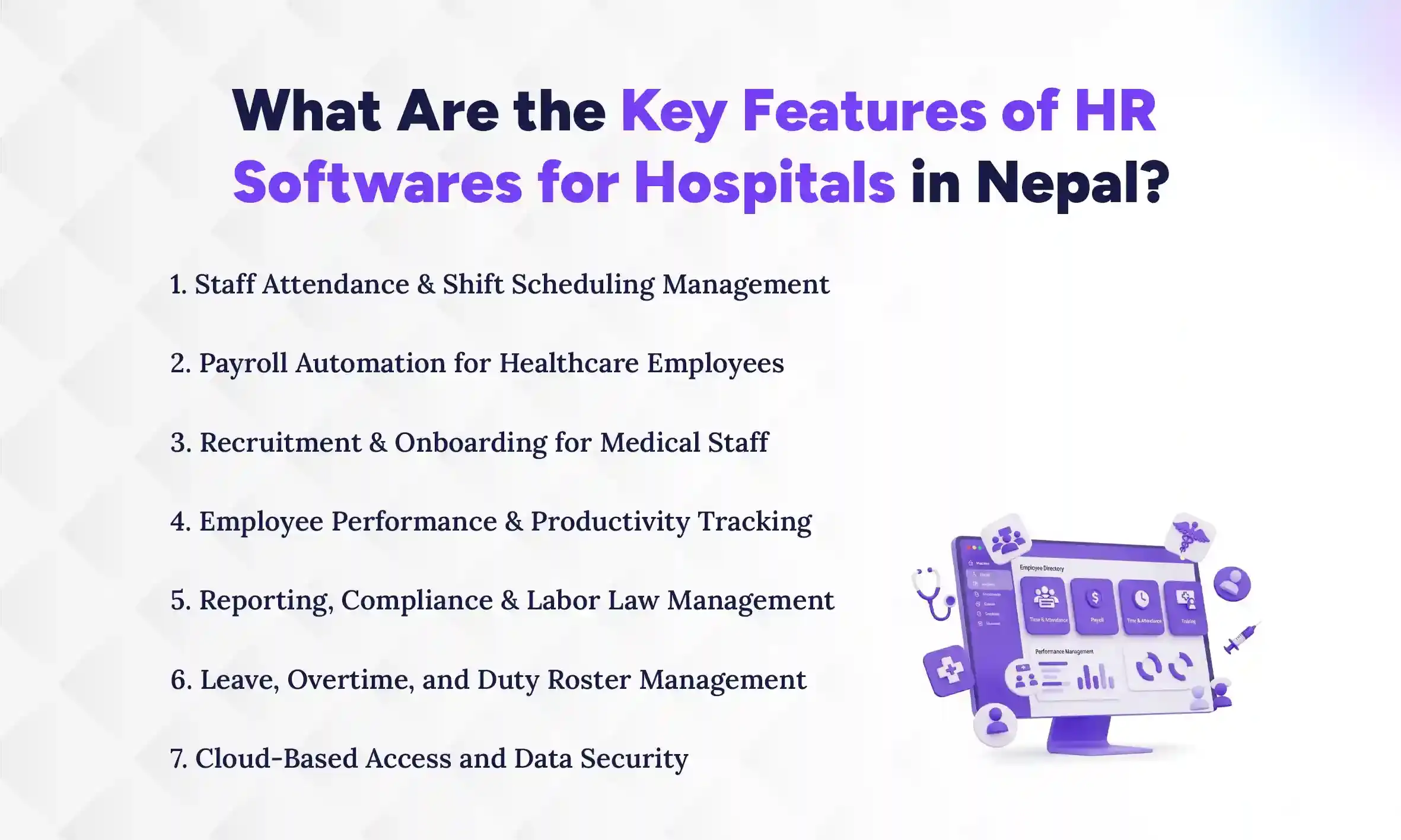
What Are the Key Features of HR-Softwares for Hospitals in Nepal?
The key features of HR software for hospitals in Nepal include tools that help manage staff, automate HR processes, and ensure smooth hospital operations. These features are designed to handle the unique challenges of healthcare environments, such as shift-based work and compliance requirements. By centralizing all HR functions into one system, hospitals can reduce manual work and improve accuracy. This ultimately leads to better workforce management and more efficient healthcare delivery.
1. Staff Attendance & Shift Scheduling Management
Hospitals operate around the clock, making attendance and shift management critical. HR software tracks employee attendance in real time and automates shift scheduling based on availability and workload. It helps avoid conflicts like overlapping shifts or staff shortages. Managers can easily adjust schedules when needed, especially during emergencies. This ensures continuous patient care and better staff utilization. It also improves accountability by maintaining accurate attendance records.
2. Payroll Automation for Healthcare Employees
Payroll in hospitals is complex due to overtime, night shifts, and various allowances. HR software automates salary calculations based on attendance and predefined rules. It reduces errors, ensures timely payments, and improves transparency. Employees can also access their payslips and salary details easily. This helps build trust and satisfaction among medical staff. Additionally, it saves time for HR teams by minimizing manual calculations.
3. Recruitment & Onboarding for Medical Staff
Hiring qualified medical professionals is crucial for hospitals. HR software streamlines the recruitment process by managing job postings, applications, and candidate tracking. It also simplifies onboarding by organizing documents and training schedules. This ensures new hires are integrated quickly and efficiently. As a result, hospitals can fill positions faster and maintain quality care. It also enhances the overall hiring experience for candidates.
4. Employee Performance & Productivity Tracking
Tracking staff performance is important for maintaining high standards of healthcare. HR software provides tools to monitor employee productivity, attendance, and task completion. It helps identify top performers and areas that need improvement. Managers can use this data to provide feedback and training. This leads to better staff performance and improved patient outcomes. It also supports data-driven decision-making for management.
5. Reporting, Compliance & Labor Law Management
Hospitals must comply with labor laws and healthcare regulations in Nepal. HR software generates accurate reports and maintains records required for compliance. It helps track working hours, leaves, and employee data systematically. This reduces the risk of legal issues and penalties. It also makes audits and reporting much more efficient. Furthermore, it ensures transparency in all HR-related processes.
6. Leave, Overtime, and Duty Roster Management
Managing leaves and overtime manually can be time-consuming and error-prone. HR software allows employees to apply for leave digitally and managers to approve them easily. It also tracks overtime and updates duty rosters automatically. This ensures fair workload distribution and proper staffing at all times. It improves transparency and reduces administrative burden. It also helps prevent staff burnout by balancing shifts effectively.
7. Cloud-Based Access and Data Security
Modern HR software offers cloud-based access, allowing hospitals to manage HR operations from anywhere. Data is stored securely with proper encryption and backup systems. This ensures sensitive employee information is protected. Authorized users can access data anytime without dependency on physical records. It also improves flexibility and supports remote management. Additionally, it reduces the risk of data loss and enhances system reliability.
Benefits of Using HR-Software for Hospitals in Nepal
HR software for hospitals in Nepal helps improve workforce management, reduce manual tasks, and increase overall operational efficiency. It simplifies complex HR processes like scheduling, payroll, and compliance, which are critical in healthcare environments. By automating routine tasks, hospitals can minimize errors and save valuable time. It also highlights the benefits of hr software, enhancing transparency and coordination across departments. Ultimately, it allows medical staff to focus more on patient care while ensuring smooth internal operations.
1. Better Shift and Workforce Management in Hospitals
Managing shifts in hospitals can be challenging due to 24/7 operations and varying staff availability. HR software helps create and manage schedules efficiently, ensuring proper staffing at all times. It reduces issues like shift overlaps, understaffing, or overworking employees. Managers can easily adjust shifts during emergencies or peak hours. This leads to better workforce utilization and uninterrupted patient care.
2. Faster Hiring and Onboarding of Medical Staff
Hospitals often need to fill positions quickly to maintain service quality. HR software streamlines recruitment by managing applications, shortlisting candidates, and tracking hiring progress. It also simplifies onboarding by organizing documents and training processes. This ensures new employees are ready to work in less time. Faster hiring helps hospitals maintain adequate staffing levels and improve service delivery.
3. Accurate Payroll and Overtime Calculations
Payroll in hospitals involves multiple variables like overtime, night shifts, and allowances. HR software automates these calculations, reducing the chances of errors. It ensures employees are paid accurately and on time. This improves transparency and builds trust among staff. It also reduces the workload on HR teams and minimizes payroll-related disputes.
4. Reduced HR Workload and Administrative Errors
Manual HR processes are time-consuming and prone to mistakes. HR software automates tasks like attendance tracking, leave management, and record-keeping. This reduces paperwork and administrative burden significantly. It also improves accuracy by minimizing human errors. As a result, HR teams can focus on more strategic tasks instead of routine operations.
5. Improved Employee Retention in the Healthcare Sector
Employee satisfaction plays a key role in retaining skilled healthcare professionals. HR software improves transparency in payroll, scheduling, and performance management. It ensures fair treatment and better communication within the organization. Employees feel more valued when processes are clear and efficient. This leads to higher job satisfaction and better retention rates in hospitals.
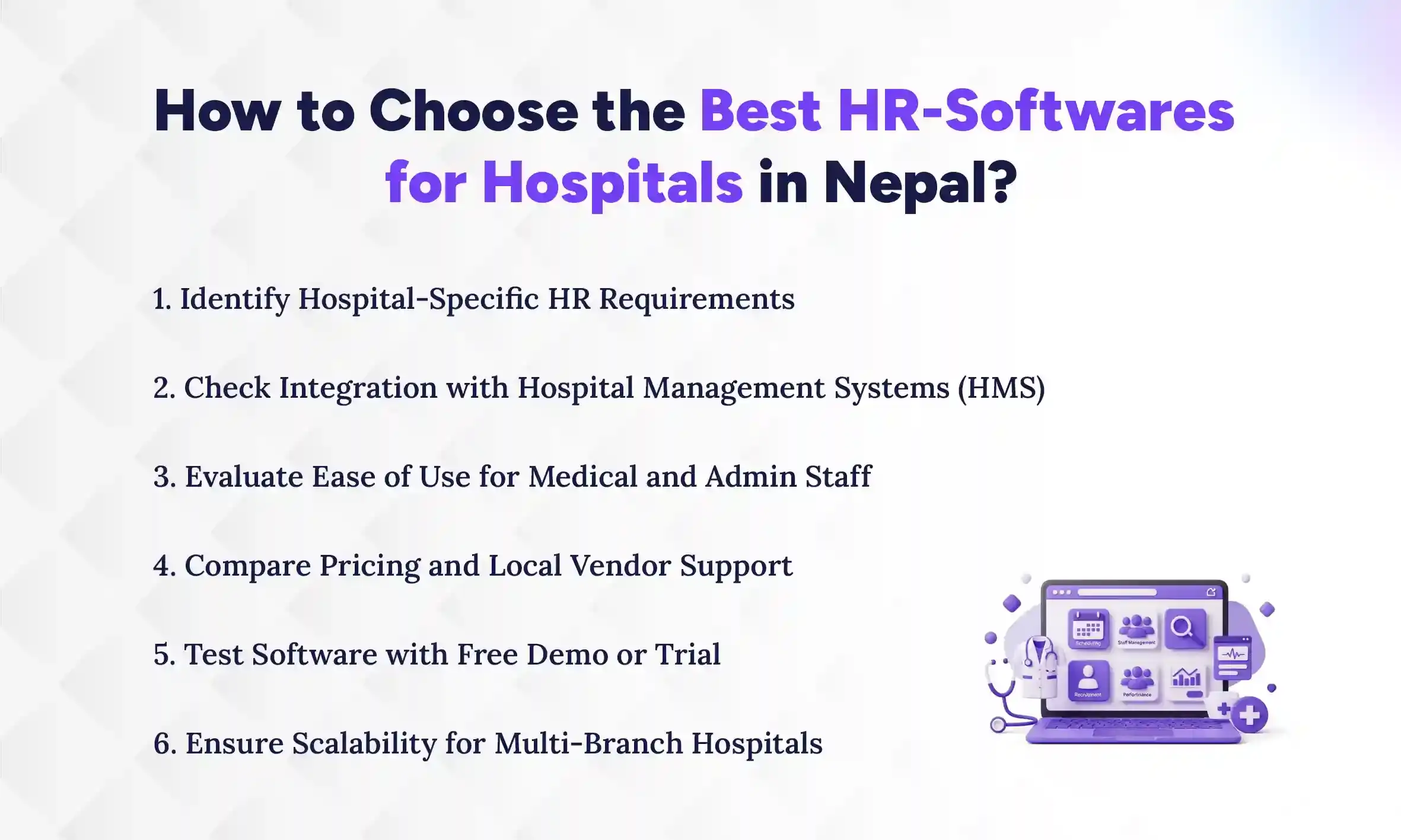
How to Choose the Best HR-Softwares for Hospitals in Nepal?
To choose the best HR software for hospitals in Nepal, you need to select a solution that matches your hospital’s specific needs, integrates with existing systems, and is easy to use for your staff. Hospitals have complex workflows, so the right cloud based hr software should simplify operations like scheduling, payroll, and compliance. It’s important to evaluate features, usability, support, and scalability before making a decision. A well-chosen system can improve efficiency, reduce errors, and support long-term growth.
1. Identify Hospital-Specific HR Requirements
Every hospital has different needs based on its size, departments, and services. Start by identifying key HR challenges such as shift scheduling, payroll complexity, or compliance tracking. Make a list of must-have features that solve these issues. This helps avoid choosing software with unnecessary or missing functionalities. Clear requirements make the selection process easier and more focused. It also ensures the software aligns perfectly with your daily hospital operations.
2. Check Integration with Hospital Management Systems (HMS)
Hospitals often use multiple systems like HMS, accounting tools, or patient management software. HR software should integrate smoothly with these systems to avoid data duplication and errors. Proper integration ensures seamless data flow between departments. It also improves efficiency by reducing manual data entry. This leads to better coordination across hospital operations. Additionally, it provides a unified system for managing both HR and hospital data.
3. Evaluate Ease of Use for Medical and Admin Staff
Healthcare staff are often busy, so the software must be simple and user-friendly. A complicated system can slow down adoption and create confusion. Look for intuitive dashboards and easy navigation. This ensures both medical and administrative staff can use it without extensive training. User-friendly software improves productivity and reduces resistance to change. It also speeds up daily HR tasks and reduces dependency on technical support.
4. Compare Pricing and Local Vendor Support
Budget is an important factor when choosing HR software. Compare pricing plans based on features, customization, and number of users. Also, ensure the vendor provides reliable local support in Nepal. Quick support is essential for resolving issues without disrupting hospital operations. Good vendor support ensures smooth implementation and long-term usability. It also helps in handling technical issues and updates efficiently.
5. Test Software with Free Demo or Trial
Before making a final decision, always request a demo or trial version. This allows you to test the software using real hospital scenarios. You can evaluate performance, features, and ease of use. Trials help identify any limitations or issues in advance. This reduces the risk of choosing the wrong system. It also gives your team confidence before full implementation.
6. Ensure Scalability for Multi-Branch Hospitals
If your hospital has multiple branches or plans to expand, scalability is crucial. The software should handle increasing staff, departments, and locations without performance issues. Scalable systems grow with your organization and avoid the need for frequent replacements. This ensures long-term efficiency and cost savings. It also supports centralized management across all branches. Additionally, it allows seamless expansion without disrupting existing operations.
What Makes HR Software for Hospitals Different from Other Industries?
HR software for hospitals is different because it is designed to handle the unique demands of the healthcare sector, such as round-the-clock operations, emergency staffing, and strict regulatory requirements. Unlike other industries, hospitals require real-time coordination of staff and precise workforce management. The software must support complex scheduling, compliance tracking, and critical decision-making. It also aligns with different types of hr system, focusing not just on efficiency but also on ensuring uninterrupted patient care. This makes hospital HR software more specialized and dynamic compared to general HR systems.
1. 24/7 Shift and Emergency Staff Management
Hospitals operate 24/7, requiring constant staff availability across all departments. HR software must handle rotating shifts, night duties, and sudden emergency staffing needs. It allows quick adjustments to schedules when unexpected situations arise. This ensures that patient care is never disrupted due to staff shortages. It also helps maintain a balanced workload among employees.
2. Complex Workforce with Doctors, Nurses, and Support Staff
Hospital staff includes a mix of highly specialized professionals and support teams. Each role has different responsibilities, schedules, and pay structures. HR software helps manage this complexity by organizing staff data and roles efficiently. It ensures proper coordination between departments and staff categories. This leads to smoother operations and better teamwork.
3. Strict Compliance and Healthcare Regulations
Hospitals must follow strict labor laws and healthcare regulations. HR software helps track compliance by maintaining accurate records and generating necessary reports. It ensures that working hours, overtime, and policies meet legal requirements. This reduces the risk of penalties and legal issues. It also makes audits and inspections more manageable.
4. High Dependency on Real-Time Workforce Data
Healthcare operations rely heavily on real-time information about staff availability and workload. HR software provides instant access to workforce data, helping managers make quick decisions. It improves planning for shifts, emergencies, and patient care needs. Real-time insights enhance efficiency and responsiveness. This ensures hospitals can adapt quickly to changing situations.
Which Is the Best HR Software for Hospitals in Nepal?
Pace HRMS is the best HR software for hospitals in Nepal because it offers a complete, centralized platform to manage payroll, attendance, employee records, and HR operations efficiently. It helps hospitals automate complex tasks, reduce manual errors, and improve workforce management. The system is secure, scalable, and designed to meet local compliance needs, making it reliable for healthcare organizations. Additionally, with features like real-time tracking and dedicated support, it ensures smooth and efficient hospital HR operations.
Common Challenges Hospitals Face Without HR Software
Hospitals without HR software often struggle with inefficient workforce management, increased administrative workload, and frequent errors in daily operations. Manual processes make it difficult to handle complex tasks like scheduling, payroll, and compliance. This leads to confusion, delays, and reduced productivity across departments. Ultimately, it affects both staff performance and the quality of patient care.
1. Manual Attendance and Shift Confusion
Tracking attendance manually can lead to errors and inconsistencies. Hospitals with multiple shifts often face confusion in scheduling and staff allocation. It becomes difficult to ensure the right staff is present at the right time. Mismanaged shifts can result in overstaffing or shortages during critical hours. This directly impacts workflow and patient service quality.
2. Payroll Errors and Overtime Miscalculations
Manual payroll processing increases the chances of errors, especially with overtime and shift-based allowances. Hospitals may struggle to calculate accurate salaries for staff working irregular hours. This can lead to delayed payments and employee dissatisfaction. Frequent payroll mistakes also create disputes between staff and management. Over time, this affects trust and morale within the organization.
3. Difficulty Managing Large Healthcare Workforce
Hospitals often have a large and diverse workforce, including doctors, nurses, and support staff. Managing such a workforce manually becomes overwhelming and inefficient. It is difficult to track roles, responsibilities, and performance accurately. Lack of proper coordination can lead to operational inefficiencies. This makes overall workforce management more challenging.
4. Lack of Real-Time Staff Monitoring
Without HR software, hospitals lack access to real-time data on staff availability and performance. Managers cannot quickly make decisions during emergencies or high-demand situations. This delays response times and affects patient care. It also limits visibility into workforce productivity. As a result, hospitals struggle to operate efficiently in dynamic environments.
Future of HR Software for Hospitals in Nepal
The future of HR software for hospitals in Nepal is focused on automation, smarter workforce management, and better integration with healthcare systems. As hospitals grow and patient demands increase, digital HR solutions will play a bigger role in improving efficiency and accuracy. Advanced technologies will help reduce manual work and enhance decision-making. This shift will enable hospitals to operate more smoothly while delivering better patient care.
1. AI-Based Workforce Scheduling in Healthcare
AI-powered scheduling will help hospitals manage staff more efficiently by predicting workload and staffing needs. It can automatically create optimized shift plans based on availability, demand, and past data. This reduces scheduling conflicts and improves staff utilization. AI can also quickly adjust schedules during emergencies. As a result, hospitals can ensure continuous and efficient patient care.
2. Mobile HR Systems for Medical Staff
Mobile HR systems will allow doctors and staff to access HR tools anytime, anywhere. Employees can check schedules, apply for leave, and view payroll details through mobile apps. This improves convenience and communication within the hospital. It also reduces dependency on manual processes and paperwork. Mobile access helps staff stay informed and connected in real time.
3. Integration with Smart Hospital Management Systems
Future HR software will integrate seamlessly with hospital management systems (HMS) and other healthcare technologies. This allows smooth data sharing between departments like HR, patient care, and administration. Integration reduces data duplication and improves overall efficiency. It also provides a unified platform for better decision-making. This leads to more coordinated and intelligent hospital operations.
Conclusion
Choosing the right HR software for hospitals in Nepal is no longer optional, it’s essential for managing complex healthcare operations efficiently. From handling shift-based scheduling to ensuring accurate payroll and compliance, a reliable HR system helps reduce manual work and errors, similar to how hr software for hospitality businesses in Nepal streamlines workforce management in service-driven environments. It improves coordination among medical and administrative staff, leading to smoother workflows and better productivity. With the right solution in place, hospitals can focus more on delivering quality patient care.
As technology continues to evolve, adopting advanced HR software will give hospitals a competitive edge. Features like automation, real-time data, and system integration will further enhance workforce management. Investing in the right HR solution today ensures long-term efficiency, scalability, and growth. Ultimately, it helps hospitals create a more organized, transparent, and high-performing work environment with solutions like The Pace Infosys.
FAQs
What is HR software for hospitals in Nepal?
+
It’s a digital system that manages hospital staff, payroll, shifts, and HR tasks in one place.
Why do hospitals in Nepal need HR software?
+
To reduce manual work, avoid errors, and efficiently manage staff, shifts, and payroll.
How does HR software help in hospital shift management?
+
It automates scheduling, prevents conflicts, and ensures proper staffing 24/7.
Can HR software handle complex hospital payroll?
+
Yes, it calculates salaries, overtime, and allowances accurately and automatically.
Is HR software suitable for small hospitals and clinics?
+
Yes, it works for both small clinics and large hospitals by improving efficiency and organization.
What features should hospitals look for in HR software?
+
Shift scheduling, payroll automation, attendance tracking, compliance, and reporting.
How does HR software improve hospital productivity?
+
Automating tasks and reducing errors, it saves time and improves staff coordination.
Which is the best HR software for hospitals in Nepal?
+
Pace HRMS is a top choice due to its automation, accuracy, and hospital-specific features.
Ready to get started?
Book a 30-minute consultation call, and let's talk about your goals.