Calculating salary in Nepal involves more than dividing an annual package by 12. HR teams need to consider basic salary, allowances, overtime, attendance, applicable contributions, income tax, and other deductions before arriving at an employee’s final pay.
Accurate salary calculation helps employers pay employees correctly and maintain reliable payroll records. It also supports proper tax calculation, payslip preparation, and payroll compliance.
This guide explains how to calculate salary in Nepal, from total earnings and deductions to tax and net pay, with a simple example you can follow.
What Does Salary Calculation Include in Nepal?
Salary calculation in Nepal includes employee earnings, applicable deductions, and the final net salary paid for a particular period. Earnings may include basic salary, allowances, overtime, bonuses, and other payments, while deductions may include tax, employee contributions, and authorized deductions. Let’s break down these three parts before calculating salary.
1. Earnings
Earnings are the amounts added to an employee’s salary for a particular pay period. They may include:
Basic salary
Fixed allowances
Overtime pay
Incentives and bonuses
Commissions
Other applicable benefits or earnings
Not every employee will have the same salary components. The structure can vary based on the employment agreement, company policy, attendance, and nature of work.
2. Deductions
Deductions are amounts taken from an employee’s earnings before their net salary is paid. Depending on the employee and applicable rules, these may include:
Employers should distinguish employee deductions from employer contributions. An employer-side contribution should not automatically be subtracted from the employee’s take-home salary.
3. Net Salary
Net salary is the amount an employee receives after applicable deductions have been subtracted from their total earnings.
Net Salary = Total Earnings − Total Deductions
For payroll purposes, the individual earnings and deductions should be calculated correctly rather than treating net salary as a fixed percentage of gross salary.
Salary Calculation Formula in Nepal
The basic salary calculation formula in Nepal is to add all applicable earnings to find gross salary and then subtract employee deductions and tax to find net salary. Gross salary can include basic pay, allowances, overtime, and other earnings, while deductions depend on the employee’s payroll and tax situation. These formulas provide the starting point for calculating an employee’s actual take-home pay.
Net Salary = Gross Salary − Employee Deductions − Income Tax − Other Applicable Deductions
The final payroll calculation can vary between employees based on attendance, overtime, unpaid leave, salary structure, contributions, taxable earnings, and applicable tax rules.
How to Calculate an Employee’s Salary in Nepal?
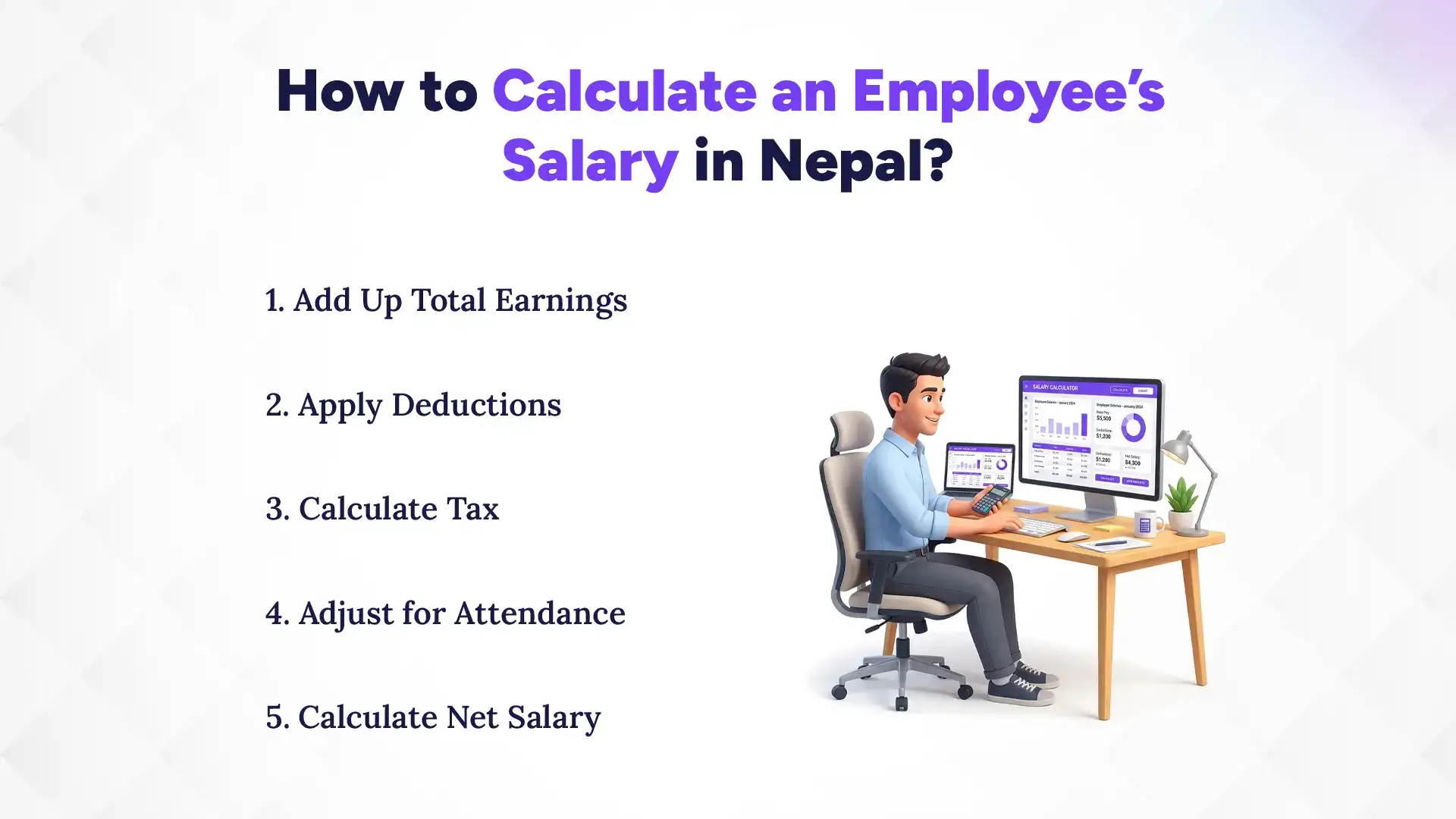
You can calculate an employee’s salary in Nepal by adding total earnings, applying deductions, calculating tax, adjusting for attendance, and finding the final net salary. This process brings together the employee’s salary structure and actual payroll information for the pay period. Here are the five steps HR teams can follow.
1. Add Up Total Earnings
Start with the employee’s basic salary and add applicable allowances, overtime, incentives, bonuses, and other earnings.
This gives you the employee’s gross salary for the pay period.
Identify the deductions that apply to the employee, such as employee-side contributions, unpaid leave, loan or advance repayments, and other authorized deductions. Keep employer contributions separate from amounts deducted from the employee’s salary.
3. Calculate Tax
Determine the employee’s taxable income and calculate the applicable income tax or TDS based on the relevant tax rules.
Tax should be calculated based on applicable salary components and eligible deductions rather than simply applying a fixed percentage to gross salary.
Adjust the salary based on the employee’s actual attendance and payroll period where applicable. This may include unpaid leave, overtime, late joining, or leaving before the end of the month.
The exact treatment depends on the company’s payroll policy and applicable requirements.
5. Calculate Net Salary
Subtract the applicable employee deductions and tax from gross salary to calculate the employee’s net salary.
Net Salary = Gross Salary − Total Deductions
The remaining amount is the employee’s take-home pay for that payroll period. Once the calculation is complete, HR can use these figures to prepare the employee’s payslip.
Example of Salary Calculation in Nepal:
A simple salary calculation example can show how basic salary, allowances, overtime, deductions, and tax come together to determine net pay. Suppose an employee earns a standard monthly basic salary of NPR 12,170 and dearnes allowance of NPR 7,380, and other allowances of NPR 17,000, and overtime earnings of NPR 3,000. The following example shows the calculation structure, while the actual deductions and TDS should be based on the employee’s applicable payroll details.
Salary Component
Amount
Basic Salary
NPR 12,170
Dearness Allowance
NPR 7,380
Lunch Allowance
NPR 4,000
Other Allowances
NPR 10,000
Overtime
NPR 3,000
SSF Contribution (Employer)
NPR 2,434.00
Gross Salary
NPR 38,984
SSF Deduction
NPR 3,772.70
TDS
NPR X,XXX
Other Deductions
NPR X,XXX
Net Salary
NPR 35,211.30
The calculation works as follows:
Add the basic salary, allowances, and overtime to get NPR 43,000 gross salary.
Calculate the employee’s applicable contributions and other deductions.
Determine taxable income and calculate the applicable TDS.
Subtract the applicable deductions and tax from gross salary.
The remaining amount is the employee’s net salary or take-home pay.
The actual net salary will vary depending on the employee’s contributions, tax liability, attendance, and other applicable deductions. For an accurate payroll calculation, HR should use the employee’s actual salary and payroll information for the relevant period.
Need to prepare the salary slip after calculation?
A payslip generator can organize the employee’s earnings, deductions, gross salary, and net pay into a clear salary slip.
An HRMS simplifies salary calculation in Nepal by connecting employee records, attendance, leave, overtime, salary components, deductions, and tax in one system. Pace HRMS brings these payroll inputs together, helping HR teams calculate salaries, apply applicable deductions, and generate payslips without repeatedly collecting data from separate records. It also makes monthly payroll more consistent, easier to review, and less dependent on manual calculations.
How to Calculate Salary in Common Payroll Situations?
Salary calculation can change when an employee joins or leaves mid-month, receives an increment, works overtime, or takes unpaid leave. In these situations, HR needs to adjust the regular salary calculation based on the employee’s actual payroll circumstances. Here are some common situations and what to consider in each one.
1. New Employee Joining Mid-Month
For a new employee who joins after the month has started, HR needs to calculate salary only for the applicable portion of the payroll period. Start with the employee’s agreed monthly salary, determine the applicable working days or proration method, and then calculate deductions and tax based on the resulting pay. The same approach should be applied consistently to employees joining at different points in the month.
2. Employee Leaving Mid-Month
When an employee leaves before month-end, HR must calculate pay for the period actually covered by the employee’s final payroll. The calculation may also need to include pending salary, overtime, applicable leave payments, advances, deductions, and other amounts due during final settlement. Review the employee’s last working date and outstanding payroll items before processing the final payment.
3. Salary After an Increment
After an increment, calculate payroll using the revised salary from its effective date rather than applying the new amount to the entire month automatically. Update the employee’s basic salary and related allowances, then recalculate applicable contributions and tax using the revised figures. If the increment takes effect partway through a month, calculate the old and revised salary portions separately.
4. Salary With Overtime
When an employee works overtime, add the applicable overtime earnings to their regular salary before completing the payroll calculation. First determine the eligible overtime hours and applicable rate, then add the resulting amount to other earnings and apply the relevant deductions and tax. Keep overtime records linked to attendance so HR can verify the additional payment.
5. Salary With Unpaid Leave
Unpaid leave can reduce an employee’s salary because the employee is not paid for the applicable unpaid days. HR should record the unpaid leave from attendance or leave records, apply the company’s approved salary-proration method, and reflect the resulting deduction in payroll. The deduction should also be reflected clearly on the employee’s payslip.
Salary Structure: Gross Salary vs Net Salary in Nepal
Gross salary is an employee’s total earnings before applicable deductions, while net salary is the amount they receive after those deductions. Gross salary can include basic salary, allowances, overtime, and other earnings, while net salary reflects deductions such as applicable contributions, tax, and other authorized amounts. Understanding the difference helps HR teams calculate payroll and communicate salary clearly to employees.
Gross Salary
Net Salary
Earnings before deductions
Amount received after deductions
Includes salary + applicable allowances/earnings
Gross salary minus applicable deductions
Starting point for payroll calculation
Final take-home amount
For example, an employee with NPR 50,000 in total earnings may receive less than NPR 50,000 as net salary after applicable deductions and tax.
Internal link: Gross Salary vs Net Salary in Nepal
How to Generate a Payslip After Calculating Salary?
After calculating an employee’s salary, HR can generate a payslip showing their earnings, deductions, gross salary, and net pay. A payslip gives employees a clear breakdown of how their final salary was calculated and provides HR with a record of the payment. Once the salary calculation is complete, the next step is to organize these details into a clear salary slip.
How Payroll Software Simplifies Salary Calculation for HRs?
Payroll software simplifies salary calculation by connecting employee data, attendance, leave, overtime, earnings, deductions, tax, and payslips in one workflow. Instead of calculating and transferring each component manually, HR teams can use payroll data to make salary processing faster and more consistent. This becomes especially useful when managing payroll for multiple employees or locations.
A salary calculation checklist helps HR teams verify each important payroll component before processing employee payments. It ensures that earnings, attendance, deductions, tax, and payslip details are reviewed in the right order. Use the following checklist before finalizing monthly payroll.
Confirm employee salary structure
Verify attendance and working days
Add allowances
Calculate overtime
Calculate gross salary
Apply employee contributions
Calculate taxable income
Calculate TDS
Apply other authorized deductions
Calculate net salary
Generate payslip
Review payroll before payment
Conclusion
Calculating salary in Nepal requires HR teams to combine basic salary, allowances, attendance, overtime, contributions, taxable income, tax, and other applicable deductions to determine an employee’s final net pay. Getting each component right helps businesses pay employees accurately, maintain reliable payroll records, and meet applicable payroll requirements.
Manual salary calculation may be manageable for a small team, but it becomes more time-consuming as the workforce and payroll requirements grow. An HR software can bring employee records, attendance, leave, overtime, salary components, deductions, and tax calculations into one system, making monthly payroll faster and more consistent.
With the right tools, HR teams can calculate salary accurately, calculate applicable tax, generate payslips, and automate payroll without handling every payroll task manually.
FAQs
What is the formula for calculating salary in Nepal?
+
The basic formula is Gross Salary = Basic Salary + Allowances + Overtime + Other Earnings, followed by applicable deductions and tax to determine net salary.
How is net salary calculated in Nepal?
+
Net salary is calculated by subtracting applicable employee deductions, income tax, and other authorized deductions from gross salary.
How is salary tax calculated in Nepal?
+
Salary tax is calculated based on an employee’s taxable income and the applicable income tax rules and slabs for the relevant fiscal year.
Are allowances included in salary calculation?
+
Yes, applicable allowances are included in salary calculation, such as dearness allowance, travel or transportation allowance, housing allowance, meal allowance, and communication allowance. However, their treatment for income tax and contributions can vary depending on the type of allowance and applicable Nepalese rules.
How is overtime calculated in Nepal?
+
Overtime in Nepal is generally paid at 1.5 times the employee’s basic remuneration for each hour of overtime, as provided by the Labour Act, 2074 and related labour rules. HR teams should calculate the eligible overtime hours, apply the 1.5× rate, and add the resulting amount to the employee’s earnings for the payroll period.
How is salary calculated for an employee joining mid-month?
+
For a mid-month joiner, salary is generally adjusted based on the applicable payroll proration method, joining date, and number of days covered by the payroll period.
How can HR calculate salary automatically?
+
HR can automate salary calculation using payroll software that connects employee records, attendance, leave, earnings, deductions, tax, and payslips.
How can I generate a payslip in Nepal?
+
You can generate a payslip in Nepal by entering an employee’s salary, earnings, deductions, and net pay into a payslip generator and creating the completed salary slip. For regular payroll, you can also use payroll software or a complete HRMS to calculate salaries, apply deductions, and generate payslips automatically.
Ready to get started?
Book a 30-minute consultation call, and let's talk about your goals.