The Government of Nepal introduced one of the most significant personal income tax reforms in years through the FY 2083/84 budget. Effective from Shrawan 1, 2083 (mid-July 2026), the Inland Revenue Department doubled the lowest tax threshold, cut the top marginal rate by 10 percentage points, and merged the separate slabs that used to apply to single and married taxpayers into one unified structure.
This matters directly to employees checking their payslip and to HR and payroll teams responsible for applying the new rates correctly from the first pay run of the fiscal year. This guide breaks down the new slabs, walks through exactly how to calculate salary tax under them, and includes worked examples across different income levels.
What Is the Salary Tax Slab System in Nepal?
Nepal uses a progressive salary tax slab system, where different portions of income are taxed at different rates as taxable income increases. This means a higher tax rate applies only to the portion of income that falls within the higher slab, rather than applying that rate to the employee's entire salary.
One important structural change for FY 2083/84 is the move to a unified progressive tax structure for resident individuals, replacing the separate single and married taxpayer tables used in previous fiscal years. This change is important for employees and payroll teams because the applicable tax calculation may differ from how salary tax was calculated in earlier fiscal years.
For FY 2083/84, resident individuals are subject to a progressive tax structure with rates of 1%, 10%, 20%, 27%, and 29%, depending on the applicable income band. The first 1% is treated as Social Security Tax, while the higher rates apply progressively to income falling within the corresponding bands.
Annual Taxable Income (NPR)
Tax Rate
Up to Rs 10,00,000
1%*
Rs 10,00,001 – Rs 15,00,000
10%
Rs 15,00,001 – Rs 25,00,000
20%
Rs 25,00,001 – Rs 40,00,000
27%
Above Rs 40,00,000
29%
If you're formally registered and actively contributing to the contribution-based Social Security Fund (SSF), the 1% Social Security Tax on your first Rs 10 lakh is waived entirely. Companies using software with SSF integration can automate this verification process and ensure proper tax treatment for eligible employees.
What Changed in Nepal's Salary Tax Slabs for FY 2083/84?
FY 2083/84 introduces several important changes to Nepal's individual income tax structure compared with FY 2082/83, including changes to the lower-income threshold, top marginal rate, and taxpayer structure. The new framework also uses a unified slab structure for resident individuals rather than separate tables based on marital status.
Feature
FY 2082/83 (Old)
FY 2083/84 (New)
Lowest Slab Threshold
Rs 500,000
Rs 1,000,000
Top Marginal Rate
39%
29%
Married vs. Single Split
Yes
No
Number of Slabs
6
5
The most significant changes are the higher threshold for the lowest tax band and the lower top marginal rate. These changes can reduce the tax burden for some employees, although the actual difference depends on taxable income, applicable deductions, contributions, and the taxpayer's circumstances.
Before comparing individual tax liabilities between the two fiscal years, make sure the calculation uses the correct taxable income and applicable exemptions for each year.
Insights
Did You Know?
Managing employee salaries involves more than calculating basic pay. Tax, SSF, and other deductions must also be handled accurately. Pace HRMS automates payroll calculations to help Nepali businesses simplify salary processing and reduce manual errors.
How to Calculate Salary Tax in Nepal for FY 2083/84
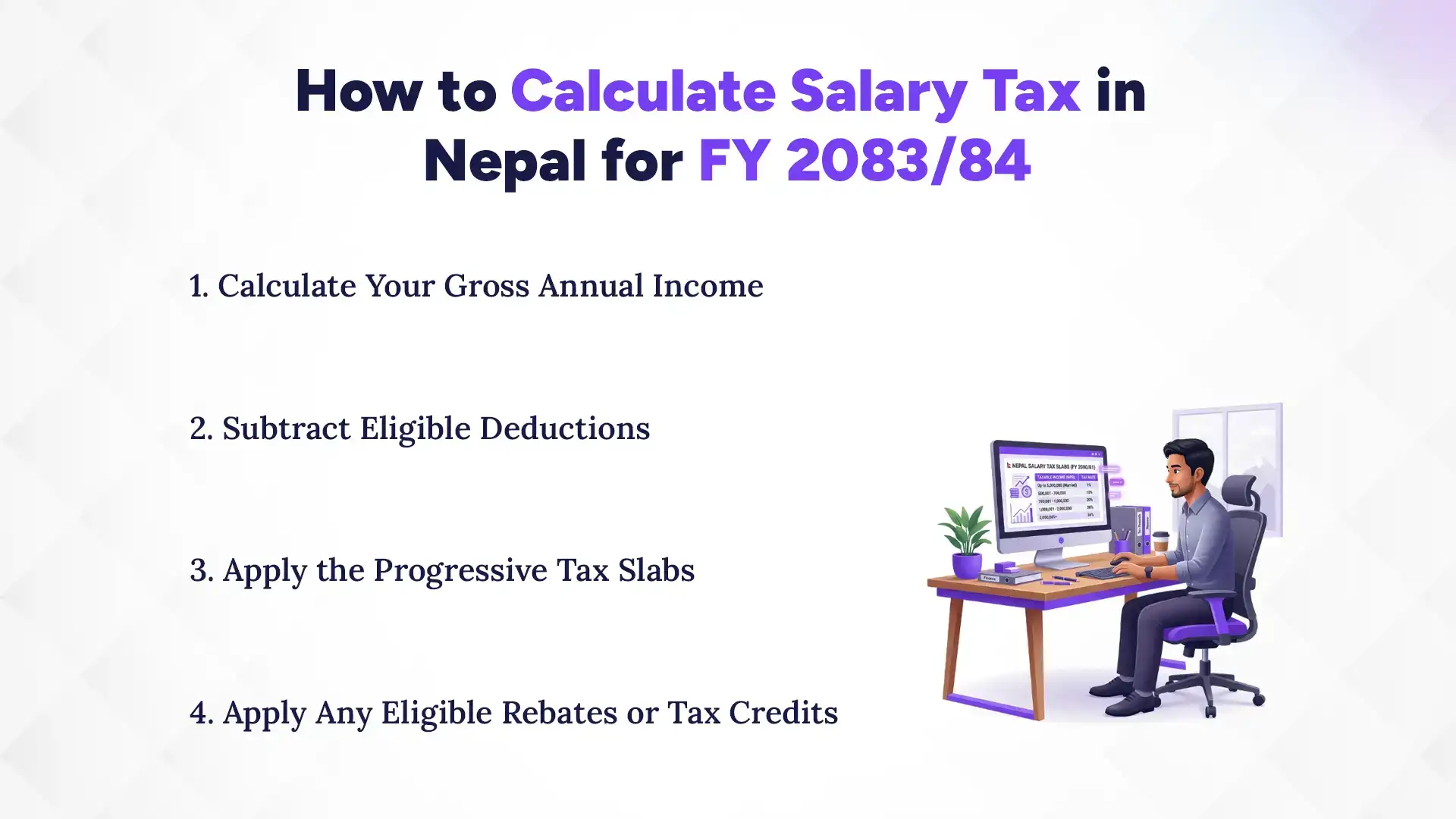
Calculating salary tax for FY 2083/84 involves determining your taxable income, applying the progressive tax slabs, and then applying any eligible rebates or tax credits. The basic process is to calculate annual taxable income, subtract eligible deductions, apply the applicable rates to each income band, and account for any qualifying rebates or credits.
1. Calculate Your Gross Annual Income
Add your taxable salary components for the year, including basic salary, allowances, bonuses, overtime, and applicable taxable benefits provided by your employer. Certain employer-provided benefits may also need to be included in taxable income according to the applicable tax rules.
2. Subtract Eligible Deductions
Nepal's income tax rules allow certain deductions or exclusions depending on the taxpayer and the nature of the income. Subtract the eligible amounts to determine your taxable income.
3. Apply the Progressive Tax Slabs
Apply the FY 2083/84 tax rates to each portion of taxable income that falls within the applicable slab. A higher rate applies only to the portion of income within that higher band, not to the entire salary.
4. Apply Any Eligible Rebates or Tax Credits
After calculating the tax under the applicable slabs, apply any rebates or tax credits for which you qualify. The final amount represents the applicable salary tax after those adjustments. Organizations that rely on payroll software in Nepal can handle these steps with less manual effort and reduce the chance of calculation errors during the process.
Make Salary Processing Easier
Automate salary calculations, tax deductions, SSF contributions, and payroll records with HR software built for Nepali businesses.
What Salary Tax Deductions Can You Claim in Nepal for FY 2083/84?
Eligible salary tax deductions can reduce your taxable income before the applicable tax slabs are applied. Depending on the taxpayer's circumstances, qualifying retirement contributions and insurance premiums may provide tax relief under Nepal's applicable FY 2083/84 rules.
Deduction
Applicable Limit / Treatment
EPF, SSF, or CIT contributions
Subject to the applicable percentage and annual deduction limits
Life insurance premium
Deductible up to the applicable annual limit
Health insurance premium
Deductible up to the applicable annual limit
Approved retirement funds
Subject to the applicable rules and limits
Employees should keep contribution statements, insurance receipts, and other supporting documents for deductions they claim. Providing the required documents to the employer or maintaining them for tax filing can help support the deduction if it needs to be verified.
Note: Deduction eligibility and limits can depend on the applicable provisions of the Income Tax Act and Finance Act 2083. Verify the current FY 2083/84 limits with the Inland Revenue Department or your payroll/HR team before using them in a tax calculation.
Tax Calculation Examples by Income Level
The examples below show the approximate annual and monthly salary tax at different taxable income levels under the FY 2083/84 tax structure. The comparison also shows how eligible SSF contributors may receive different treatment on income within the 1% Social Security Tax band.
Annual Taxable Income (NPR)
Taxpayer Status
Approx. Monthly Income (NPR)
Annual Tax (NPR)
Approx. Monthly Tax (NPR)
Rs. 6,00,000
Not contributing to SSF
Rs. 50,000
Rs. 6,000
Rs. 500
Rs. 6,00,000
Eligible SSF contributor
Rs. 50,000
Rs. 0*
Rs. 0
Rs. 10,00,000
Eligible SSF contributor
Rs. 83,333
Rs. 0*
Rs. 0
Rs. 12,00,000
Not contributing to SSF
Rs. 1,00,000
Rs. 30,000
Rs. 2,500
Rs. 30,00,000
Eligible SSF contributor
Rs. 2,50,000
Rs. 3,85,000
Rs. 32,083
The Rs 0 examples assume the employee meets the applicable conditions for the SSF-related 1% Social Security Tax treatment. Actual salary tax can differ after deductions, rebates, credits, and other applicable provisions. These examples are intended to explain the slab structure rather than replace an individual tax calculation.
What Happens If Salary Tax Is Calculated Incorrectly?
An incorrect salary tax calculation can result in underpayment, overpayment, compliance issues, and additional payroll work for both employees and employers. The impact depends on the nature and extent of the error, but correcting it can require changes to payroll records and tax reporting.
Underpayment: An employee may have too little tax withheld and face an additional tax liability later.
Overpayment: Too much tax may be withheld, reducing the employee's take-home pay until the amount is corrected or adjusted.
Compliance risk: Incorrect withholding across multiple employees can create tax compliance issues for the employer.
Administrative work: Correcting payroll calculations may require adjustments to payroll records, tax filings, and employee communications.
The risk of errors tends to be higher in companies that employ both full-time staff and external consultants under different tax classifications. Tech companies in particular face this challenge frequently, and some have started adopting HR software built for IT businesses to manage these distinct employment categories within a single system.
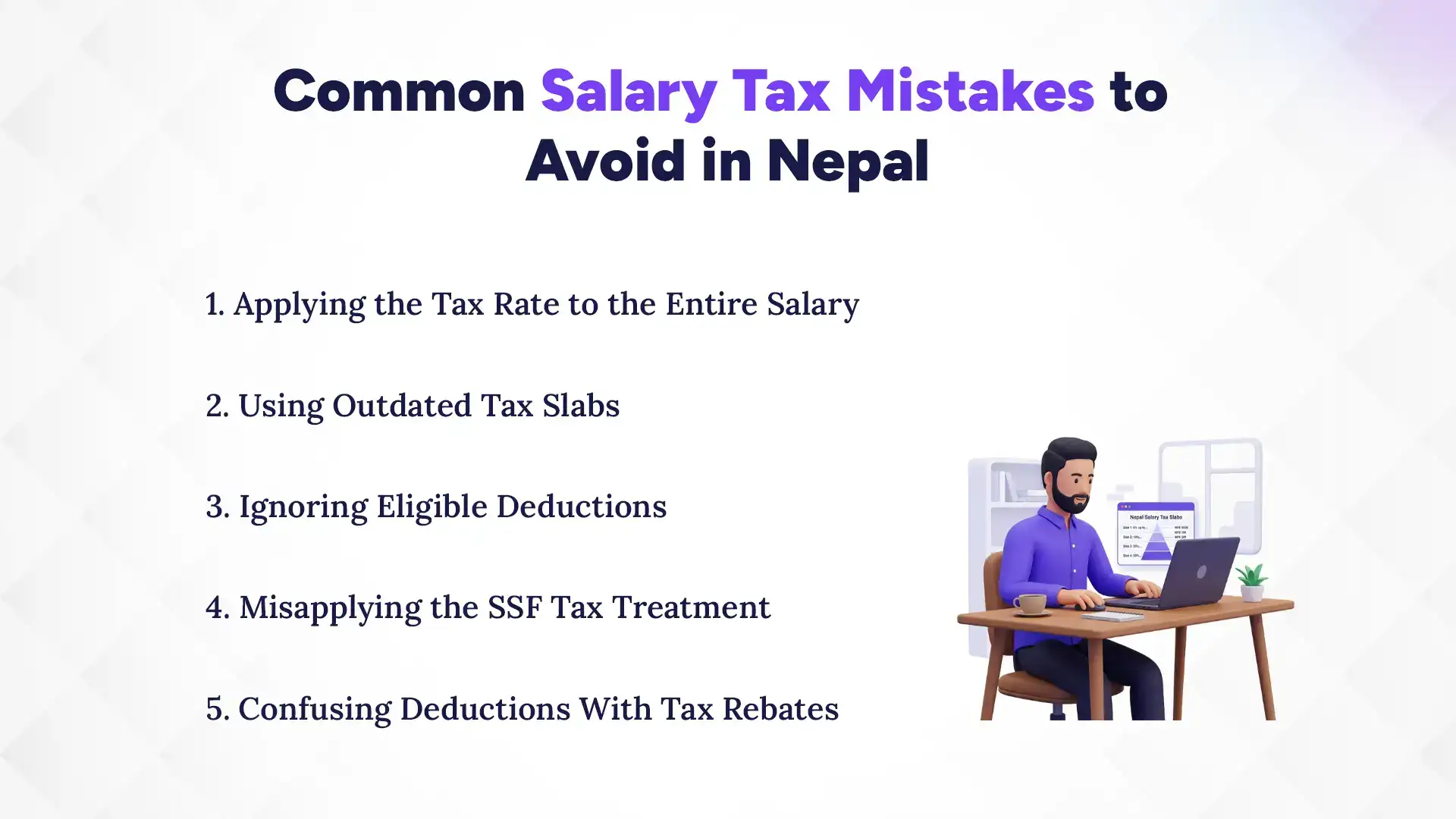
Salary tax mistakes can result in incorrect deductions, unexpected tax liabilities, or unnecessary payroll corrections. Understanding the most common errors can help employees and HR teams apply the FY 2083/84 tax rules more accurately.
1. Applying the Tax Rate to the Entire Salary
A progressive tax system does not apply one tax rate to the entire salary. Each rate applies only to the portion of taxable income that falls within the relevant slab.
2. Using Outdated Tax Slabs
Using tax rates or thresholds from a previous fiscal year can result in incorrect tax calculations. Always use the applicable FY 2083/84 rates when calculating current salary tax.
3. Ignoring Eligible Deductions
Failing to account for eligible retirement contributions, insurance premiums, or other allowable deductions can result in a higher taxable income than necessary.
4. Misapplying the SSF Tax Treatment
The SSF-related treatment of the 1% Social Security Tax should be applied only when the employee meets the applicable conditions. Do not assume that every employee contributing to SSF automatically receives the same tax treatment.
5. Confusing Deductions With Tax Rebates
Deductions reduce taxable income before the tax is calculated, while rebates or tax credits can reduce the calculated tax liability. Treating them as the same can lead to incorrect calculations.
FY 2083/84 Payroll Checklist for HR Teams
HR and payroll teams should update their payroll processes for the FY 2083/84 tax changes before processing salaries under the new structure. A short review of payroll settings, employee classifications, SSF status, and tax calculations can help prevent errors during the transition.
Update payroll software or spreadsheets to reflect the FY 2083/84 tax slabs.
Recalculate monthly TDS for employees from Shrawan 1, 2083, where applicable.
Verify which employees are eligible for the SSF-related 1% Social Security Tax treatment.
Review older payroll templates to ensure outdated married and single taxpayer logic is no longer being applied where the unified structure applies.
Communicate relevant tax changes to employees, particularly where take-home pay changes.
Keep the applicable Finance Act 2083 provisions and supporting payroll records available for future review or audit.
For organizations concerned about HR software pricing in Nepal, it's worth noting that modern solutions can automate these tax calculations and reduce manual errors. A final payroll review should confirm that the updated rules, employee information, deductions, and applicable rebates or credits are being applied correctly before the first payroll runs under the new fiscal year.
How Pace HRMS Keeps Payroll Aligned With Nepal's Current Tax Slabs
Getting this right depends on payroll being updated the moment a new fiscal year's rates take effect, not weeks later after someone notices a discrepancy. Pace HR Software applies Nepal's current fiscal-year tax rules to payroll automatically, including SSF-based waivers and eligible deduction handling, so a change as significant as the 2083/84 revision is reflected at the system level rather than requiring manual reconfiguration across every employee record.
This reduces the risk of misapplied rates significantly, but it's not a substitute for confirming the correct current figures directly, especially during a fiscal year with changes this substantial. HR and finance teams should still spot-check a sample of calculations after any major slab revision, the same review discipline that applies to payroll generally.
For businesses looking for cost-effective HR solutions in Nepal, it's important to balance budget considerations with the need for accurate tax calculations and compliance features.
Conclusion
The 1% tax band has doubled to cover income up to Rs 10,00,000, the top marginal rate has dropped from 39% to 29%, SSF contributors get the 1% band waived entirely, and the married/single distinction is gone; one slab structure now applies to everyone. HR and payroll teams should update systems and re-run TDS calculations as early in the fiscal year as possible, and employees should confirm their own payslip reflects these changes rather than assuming it already has.
If your business needs payroll that stays aligned with Nepal's current tax slabs, deductions, and rebates automatically, leave a message with Pace Infosys to explore how Pace HRMS handles fiscal year rule changes automatically.
FAQs
Is income up to Rs 10 lakh completely tax-free?
+
No. The first Rs 10 lakh is subject to the applicable 1% Social Security Tax treatment. Eligible contributors to the contribution-based Social Security Fund may qualify for the applicable waiver under the FY 2083/84 rules.
Does contributing to SSF remove the 1% tax?
+
Eligible employees contributing to the Social Security Fund can receive the applicable treatment for the 1% Social Security Tax on the first Rs 10 lakh, subject to the current rules.
Is there still a separate slab for married taxpayers?
+
FY 2083/84 uses a unified progressive structure for resident individuals rather than the separate single and married tables used in previous fiscal years.
When did the FY 2083/84 tax rates take effect?
+
The FY 2083/84 fiscal year began on Shrawan 1, 2083, corresponding to mid-July 2026. The Inland Revenue Department published the FY 2083/84 natural-person tax rates in Shrawan 2083.
What is the best HR software in Nepal?
+
Pace HRMS is the best HR software in Nepal, offering payroll, attendance, leave management, employee records, and other essential HR functions in one platform.
Do freelancers and consultants follow the same salary tax slabs?
+
Not necessarily. The tax treatment depends on how the income is classified and the applicable tax provisions. Freelancers, consultants, and business income may be subject to different rules from employment income.
Where can employees verify whether their payroll uses the correct tax slab?
+
Employees can check their payslip and confirm with their HR or payroll team. Businesses should also verify their payroll configuration against the current FY 2083/84 provisions published by the Inland Revenue Department.
Can deductions reduce my salary tax?
+
Qualifying deductions can reduce taxable income before the progressive tax rates are applied. The deduction depends on the type of contribution or expense and the applicable FY 2083/84 rules.
Do rebates work the same way as deductions?
+
No. Deductions generally reduce taxable income before tax is calculated, while rebates or tax credits reduce the calculated tax liability when the taxpayer qualifies.
Ready to get started?
Book a 30-minute consultation call, and let's talk about your goals.