IT companies move fast. One month you’re hiring new developers, the next you’re managing remote teams across different cities or even time zones. As teams grow, everyday HR tasks, like tracking attendance, running payroll, or monitoring performance can quickly become complicated.
Managing contract developers, onboarding new hires, and keeping employee records organized can easily turn into a time-consuming challenge. That’s where HR software for IT businesses makes a real difference.
With a smart HR management system, everything from recruitment to payroll lives in one place, making HR operations far simpler. In this guide, we’ll explore how HR software supports modern tech teams and how to choose the right HRMS for your IT and digital company.
What Is HR Software for IT Businesses?
HR software for IT businesses is a digital system that helps companies manage their people and everyday HR tasks in one place. It helps handle recruitment, employee records, payroll, attendance, and performance tracking for technology teams. Instead of relying on spreadsheets or scattered tools, HR teams can manage everything through a single platform.
For IT companies, this kind of software also supports modern work setups. For example, it keeps a centralized employee database, tracks attendance for remote or hybrid teams, and automates payroll and compensation. At the same time, it helps monitor performance and productivity while simplifying recruitment and onboarding for new developers and tech staff.
As tech companies grow, managing teams becomes more complex. Because of this, many businesses now rely on specialized HR software built for fast-moving workplaces. Let’s explore why IT companies increasingly depend on these systems today.
Why IT Companies Need Specialized HR Software in 2026
IT companies work in fast-moving environments. Teams often grow quickly, employees work from different locations, and the demand for skilled developers stays high. Because of this, managing people in a tech company is very different from managing teams in traditional industries.
For example, many IT companies have distributed or remote teams working across cities or time zones. At the same time, hiring is not always simple. Businesses often work with contract developers, freelancers, or project-based teams, which makes tracking performance, payroll, and productivity more complex. On top of that, high employee turnover and varied compensation structures can create extra work for HR teams.
This is where specialized HR software becomes important. The right system brings employee information into one place, automates everyday HR tasks, and helps managers stay organized while teams grow.
HR software supports IT companies since it:
Simplifies remote team management by tracking attendance and work activity across locations
Automates payroll and compensation for full-time employees, contractors, and freelancers
Improves productivity tracking with performance monitoring tools
Supports faster hiring through structured recruitment and onboarding processes
What Are the Key Features of HR Software for Tech Businesses?
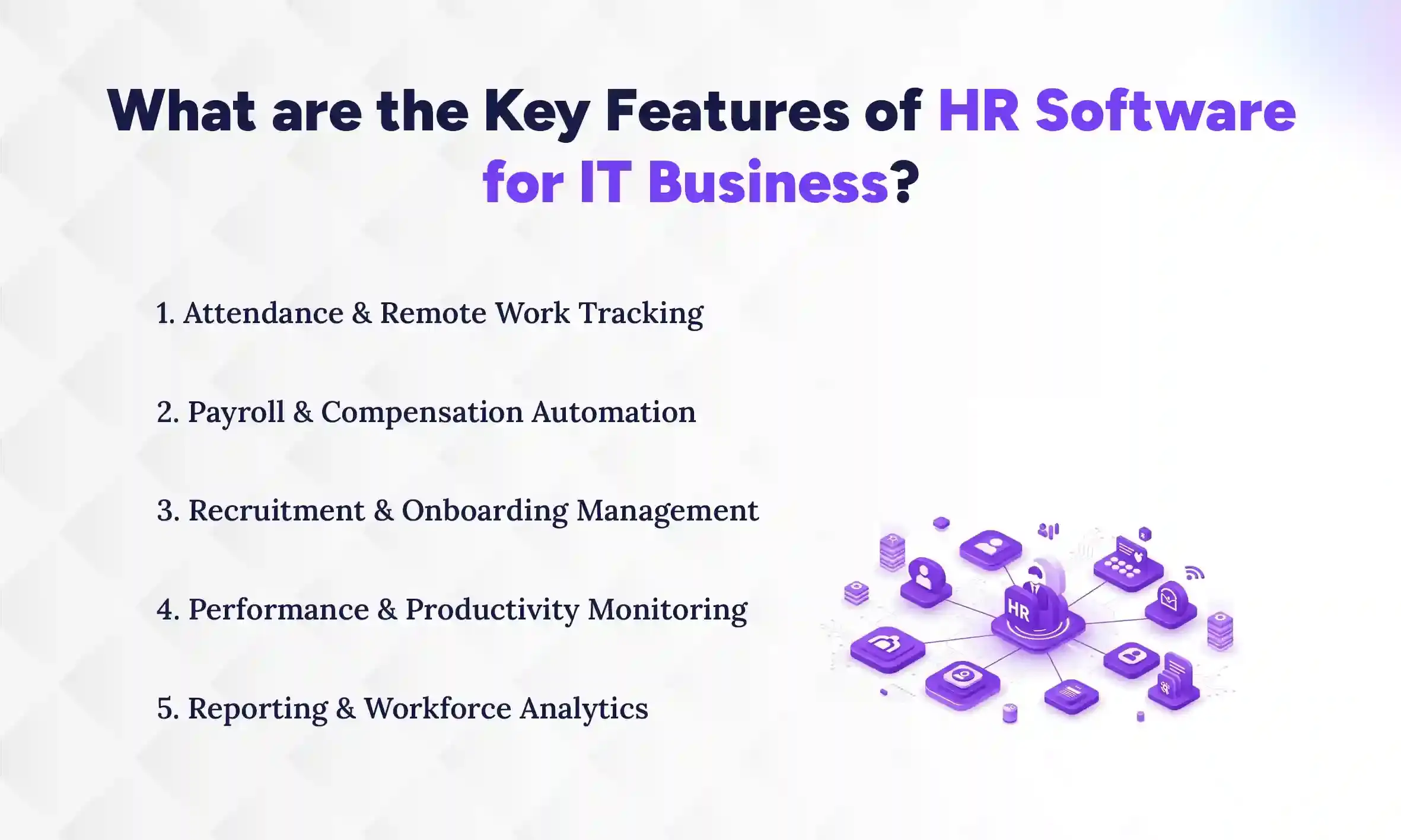
The key features of HR software for IT businesses include attendance and remote work tracking, payroll and compensation automation, recruitment and onboarding management, performance monitoring, and workforce analytics. These tools help HR teams manage distributed tech teams, automate routine processes, and keep employee information organized in one system. Let’s take a closer look at how each of these HRMS features supports IT companies in their day-to-day operations.
1. Attendance & Remote Work Tracking
IT teams often work from different locations, and many companies follow hybrid or fully remote models. Because of this, tracking attendance with manual methods becomes difficult. HR software, with its attendance management system, helps by recording work hours, login times, and leave requests in one place. Managers can easily see who is working, who is on leave, and how teams are performing across time zones. This helps maintain accountability while still supporting flexible work setups that many developers prefer.
2. Payroll & Compensation Automation
Payroll in IT companies can become complex very quickly. Some employees work full-time, while others may be freelancers, consultants, or contract developers. HR software automates salary calculations, tax deductions, bonuses, and overtime payments. This HR payroll system reduces manual errors and saves a lot of time for HR and finance teams. As a result, employees receive accurate and timely payments, which helps build trust and satisfaction within the company.
3. Recruitment & Onboarding Management
Hiring skilled developers and technical staff is often a top priority for IT companies. HR software simplifies this process by organizing job postings, candidate applications, interview stages, and hiring decisions in one system. Once a candidate is selected, the onboarding process can also be automated. New hires can complete documents, access company policies, and receive training materials online. This helps new employees settle in faster and start contributing to projects sooner.
4. Performance & Productivity Monitoring
Tracking performance in tech teams requires more than just annual reviews. HR software allows managers to set goals, track progress, and review employee performance regularly. For example, team leaders can monitor project contributions, productivity metrics, and feedback from peers or managers. This creates a clearer picture of how employees are performing and where support may be needed. Over time, this also helps companies reward strong performers and guide employees who want to improve their skills.
5. Reporting & Workforce Analytics
Data plays an important role in making better HR decisions. HR software provides reports and analytics that show trends in hiring, attendance, employee performance, and turnover. With these insights, HR teams can quickly identify problems and plan improvements. For example, they can spot departments with high turnover or measure how long it takes to fill technical roles. This kind of data-driven insight helps IT companies plan their workforce more effectively and grow in a more organized way.
Benefits of Using HR Software for IT Companies in Nepal
HR software helps IT companies save time, reduce errors, and manage remote teams, payroll, hiring, and performance efficiently. IT companies in Nepal are growing quickly, and many teams now work in hybrid or remote setups. As teams expand, handling HR tasks manually becomes harder and more time-consuming. With HR software, these processes are simplified, allowing HR teams to manage developers, support staff, and project teams in a more organized and productive way.
The following points must help you clarify how an HR software benefits tech companies in Nepal:
1. Better Management of Remote Teams
Many IT companies in Nepal work with developers who are spread across different cities or even countries. Because of this, keeping track of attendance, work hours, and team activity can be challenging. HR software provides a central dashboard where managers can see employee attendance, leave status, and work patterns. This makes it easier to manage distributed teams while still giving employees the flexibility they need. As a result, managers stay informed without constantly checking multiple tools.
2. Faster Hiring and Onboarding
Hiring skilled developers is often competitive and time-sensitive. HR software helps companies organize job postings, manage applications, and track candidates through each stage of the hiring process. This structured approach helps HR teams respond faster and avoid losing good candidates. Once a developer is hired, onboarding tools help new employees complete documents, access policies, and start their roles quickly. This smooth process helps new hires become productive much sooner.
3. Accurate Payroll for Diverse Roles
Payroll in IT companies can involve different types of workers. Some employees are full-time, while others may work as freelancers, consultants, or contract developers. HR software automatically calculates salaries, bonuses, taxes, and deductions based on each employee’s role and contract type. This reduces errors and saves a lot of time compared to manual payroll processing. At the same time, employees receive their payments accurately and on time, which builds trust in the company.
4. Improved Collaboration and Communication
When teams work on multiple projects, clear communication becomes very important. HR software often includes shared dashboards, announcements, and employee portals that keep everyone informed. Employees can check updates, request leave, or access company policies without sending multiple emails. Managers can also share important information with the entire team from one place. This helps teams stay connected and work more smoothly together.
5. Higher Employee Retention
Retaining skilled developers is a major challenge for many IT companies. HR software helps by giving managers better visibility into employee performance, feedback, and career growth. For example, managers can track achievements, provide recognition, and identify employees who may need support. When employees feel recognized and supported, they are more likely to stay with the company. Over time, this leads to stronger teams and a more stable workforce.
How to Choose the Best HR Software for Your IT Business in Nepal?
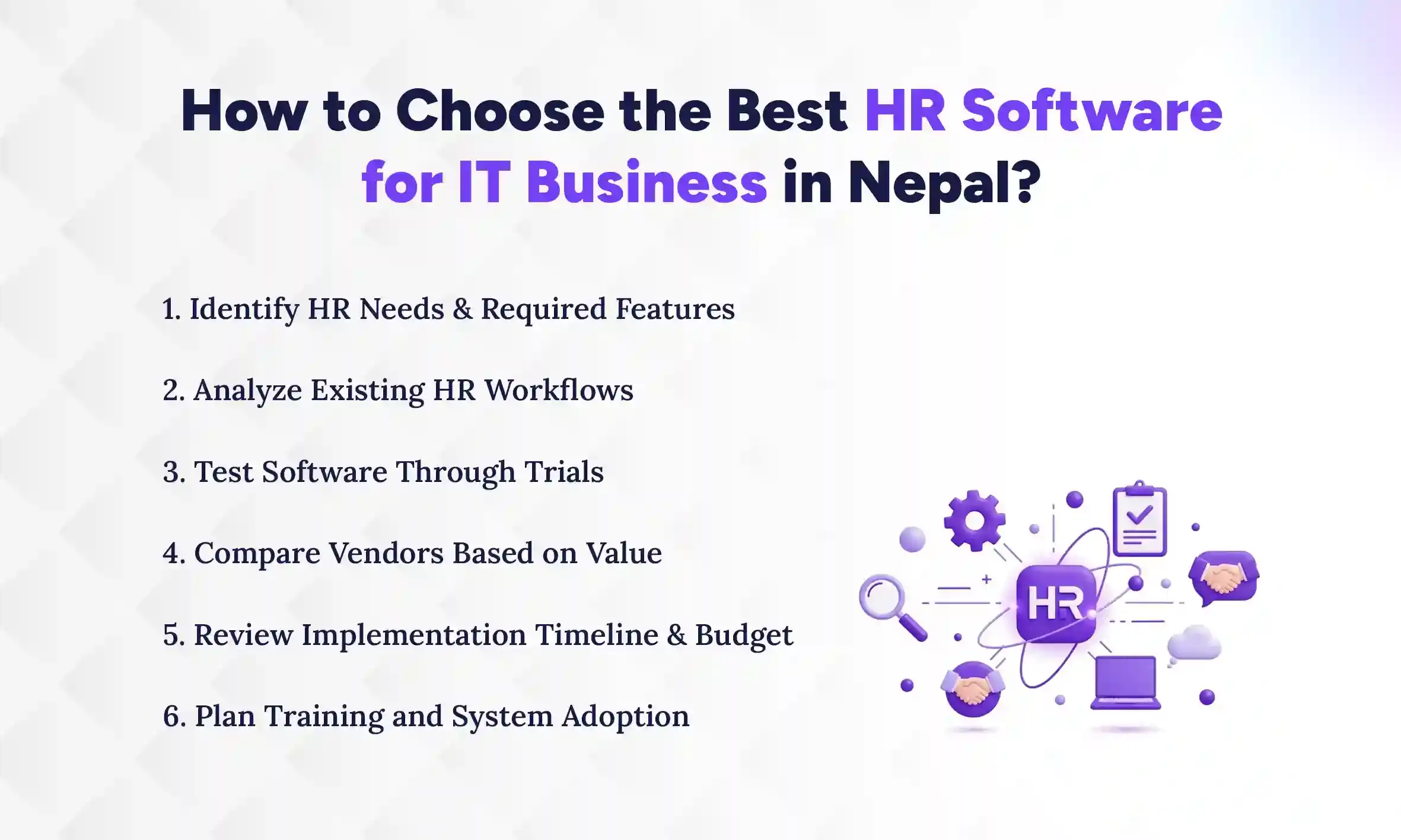
Choosing the right HR software starts with understanding your company’s needs, testing potential systems, and comparing vendors carefully. You want a solution that simplifies HR tasks, fits your workflows, and grows with your IT team. By following a clear process, you can avoid wasted time, unnecessary costs, and software that doesn’t actually help your team.
1. Identify HR Needs & Required Features
Start by listing the HR tasks that take the most time or cause the most confusion. Consider features like attendance tracking, payroll automation, recruitment tools, leave management system, or performance dashboards. Knowing what your company truly needs helps narrow down software options. This ensures you invest in a system that solves real problems rather than just looks impressive.
2. Analyze Existing HR Workflows
Next, look at how HR tasks are currently handled in your company. Identify gaps, bottlenecks, or manual processes that slow your team down. Understanding existing workflows helps you choose software that integrates smoothly with your current processes. This also makes the transition to a new system much easier for your team.
3. Test Software Through Trials
Most HR software offers trial versions or demos. Use these to explore the interface, check features, and see how the system works in real-life scenarios. Invite HR staff or managers to test the software with actual data. Trials help you spot potential issues before committing to a full purchase.
4. Compare Vendors Based on Value
Once you’ve tested multiple options, compare vendors on features, support, and overall value. Don’t just look at the price. Consider ease of use, flexibility, and customer service. A system that saves time and reduces errors can be far more valuable than the cheapest option.
5. Review Implementation Timeline & Budget
Plan how long it will take to set up and implement the software. Small startups may need 2–4 weeks, mid-sized companies 1–2 months, and large IT firms 3+ months. Also, factor in HR software costs like subscriptions, customization, integrations, and training. Clear expectations prevent surprises and keep the project on track.
6. Plan Training and System Adoption
Finally, ensure your team is ready to use the new system effectively. Provide training sessions, guides, and support materials for HR staff and managers. Encourage employees to explore the software early so adoption becomes smooth and natural. Proper training ensures you get the full benefits of the HR software from day one.
Which Is the Best HR Software for IT Businesses?
For IT companies in Nepal, Pace HRMS stands out as a flexible, user-friendly, and one of the best HR software solutions that fits different types of tech organizations. Whether you run a small startup, a mid-sized software company, a large enterprise, or a remote-first team, Pace HRMS adapts to your payroll, recruitment, and workforce management needs. Its scalable design ensures smooth HR operations while saving time, reducing errors, and keeping your tech teams productive across all projects and locations.
Why Choose Pace HRMS for Tech Companies?
Pace HRMS is the preferred choice for IT companies looking for centralized HR management, automated workflows, and real-time performance tracking. It simplifies everyday HR tasks while helping managers plan and support growing tech teams.
Pace HRMS helps IT teams by offering:
Remote attendance tracking for distributed developers and hybrid teams
Automated payroll management for full-time, freelance, and contract staff
Recruitment and onboarding tools to hire and integrate talent faster
Performance monitoring dashboards for productivity and goal tracking
Scalable HR management that grows with your tech company
Conclusion
In today’s fast-moving IT world, having the right HR software is essential. It helps manage remote developers, track attendance, automate payroll, and simplify recruitment. Tools like Pace HRMS keep HR tasks organized and make teams more productive. Whether you run a startup, a mid-sized company, or a large tech enterprise, the right HRMS can grow with your business.
Managing people can feel overwhelming, especially with distributed or growing teams. But HR software centralizes data, tracks performance, and automates everyday tasks. This allows HR teams to focus on supporting employees and building strong, motivated tech teams.
If you want to save time, reduce errors, and improve efficiency, now is the time to act. Compare the top 5 HR software options in Nepal, review features, and choose a system that fits your IT business.
FAQs
Which is the best HR software for startups in Nepal?
+
The best HR software for startups is lightweight, user-friendly, and handles payroll, attendance, and onboarding efficiently. Pace HRMS is ideal for small IT teams.
How can HR software help small IT teams with onboarding?
+
HR software automates new hire forms, policies, and training schedules, making onboarding faster and easier for small teams. Employees get up to speed quickly.
What HR tools help startups streamline recruitment and payroll?
+
Tools like Pace HRMS provide automated recruitment pipelines, candidate tracking, and payroll management, saving time and reducing errors for startups and small IT companies.
Which IT management software is best for new startups?
+
For new IT startups, choose software that combines HR, payroll, and workforce management. Cloud-based solutions like Pace HRMS allow teams to manage everything from one platform.
Can HR software track remote developers?
+
Yes, HR software tracks remote developers’ attendance, work hours, and productivity in real time, helping managers stay informed and teams stay accountable across locations.
How long does it take to implement HR software in IT companies?
+
Implementation depends on company size: small startups take 2–4 weeks, mid-sized firms 1–2 months, and large IT companies 3+ months for full setup and training.
How much does HR software cost for IT businesses in Nepal?
+
HR software pricing varies by features, team size, and support. Small IT teams may start with affordable subscriptions, while larger companies invest more for advanced modules and integrations.
Ready to get started?
Book a 30-minute consultation call, and let's talk about your goals.