When the cost of everyday essentials goes up, a salary that once felt comfortable can suddenly feel a little tight. For employees, this can affect everything from household expenses to savings. For employers, it raises an important question: how should rising living costs be reflected in employee pay?
This is where dearness allowance, or Mahangi Bhatta, comes in. In Nepal, you may come across it in government salary structures, minimum wage rules, employment contracts, and payroll calculations. But the term can be confusing, especially when it comes to understanding who gets it, how much it is, and how it should be handled in payroll.
In this guide, we’ll break down Mahangi Bhatta meaning, its role in Nepal, how it is calculated, and what HR teams need to know to manage it correctly.
What Is Dearness Allowance?
Dearness allowance is an additional amount paid with an employee’s salary to help cover the rising cost of living. In Nepal, it is commonly called Mahangi Bhatta (महँगी भत्ता). When the prices of everyday needs such as food, transportation, and housing go up, this allowance can give employees extra income alongside their basic salary.
Dearness Allowance (Mahangi Bhatta) Meaning in Nepali
महँगी भत्ता भनेको बढ्दो जीवनयापन खर्चलाई सम्बोधन गर्न तलबसँगै दिइने भत्ता हो।
यसले दैनिक आवश्यक वस्तु तथा सेवाको मूल्य बढ्दा कर्मचारीलाई थप आर्थिक सहयोग प्रदान गर्ने उद्देश्य राख्छ। त्यसैले, महँगी भत्तालाई धेरैजसो तलब संरचनामा आधारभूत तलबभन्दा छुट्टै देखाइन्छ।
Mahangi Bhatta is often shown separately from basic salary in a salary structure. This makes it easier for employers to identify the portion of pay intended to address living costs. The amount and eligibility can vary depending on the applicable rules, employment terms, or salary structure.
Why Do Employees Receive Mahangi Bhatta (Dearness Allowance)?
Employees receive Mahangi Bhatta to help maintain their purchasing power as living costs increase. It provides additional income without necessarily changing the employee’s basic salary.
To offset rising prices: Helps cover the higher cost of everyday essentials.
To adapt to changing living costs: Provides extra income as daily expenses increase.
To maintain purchasing power: Helps employees afford a similar level of goods and services.
To adjust compensation: Allows total pay to reflect changing economic conditions.
To keep basic salary separate: Adds to earnings without necessarily changing the basic salary.
How Does Mahangi Bhatta Work in Nepal?
Mahangi Bhatta is a separate salary component used to account for rising living costs. Its amount and treatment depend on the applicable salary structure, labour rules, employment terms, or employer policy.
1. Dearness Allowance vs Basic Salary: What’s the Difference?
Basic salary is the core part of pay, while Mahangi Bhatta is an additional salary component. They are usually shown separately in the salary structure.
Basic Salary
Mahangi Bhatta
Core pay
Additional pay
Forms the salary base
Added to basic salary
Set by salary structure
Depends on applicable rules or policy
Basic Salary + Mahangi Bhatta = Gross Earnings
Other salary components, such as Dashain or festival allowances, may also be provided separately depending on applicable rules or company policy.
2. Dearness Allowance for Government and Private-Sector Employees
Mahangi Bhatta rules can differ between government and private-sector employees.
For Government employees, monthly Mahangi Bhatta is Rs. 5,000 from FY 2082/83 and the same amount continues in FY 2083/84.
Private-sector employees: The official minimum monthly dearness allowance for private sector employees in Nepal is NPR 7,380, as part of the revised total minimum monthly remuneration of NPR 19,550 effective from July 17, 2025 (Shrawan 1, 2082 BS). Applicability for each individual depends on relevant labour rules, employment terms, and company policy.
3. Mahangi Bhatta and Nepal's Minimum Wage
For workers covered by Nepal’s current minimum remuneration notice, the minimum remuneration is made up of basic remuneration plus Mahangi Bhatta. The current rates below apply from 1 Shrawan 2082 (17 July 2025) for workers other than tea-estate workers.
Pay period
Basic
Dearness Allowance
Total
Monthly
Rs. 12,170
Rs. 7,380
Rs. 19,550
Daily
Rs. 470
Rs. 284
Rs. 754
Hourly
Rs. 63
Rs. 38
Rs. 101
These figures are a statutory minimum remuneration structure, so employers should not treat the Rs. 7,380 allowance as a standard allowance that every employee must receive regardless of their salary structure.
How Can HRs Manage Dearness Allowance in Payroll?
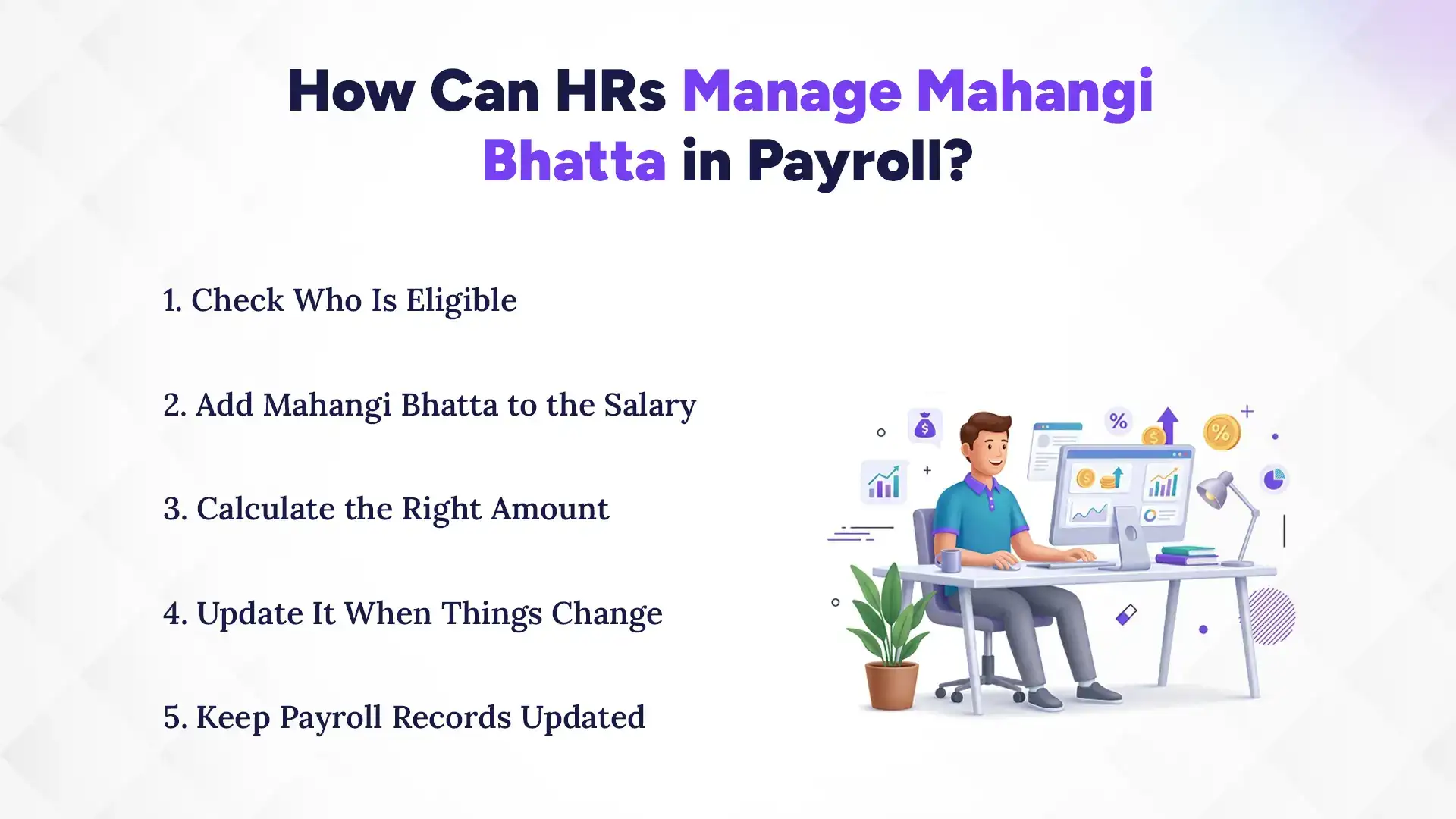
HRs can manage Mahangi Bhatta by checking eligibility, adding the correct amount, calculating it accurately, and keeping payroll records updated. The allowance should also be reviewed whenever salary rules, employee terms, or applicable rates change. Here’s how HR teams can handle each step smoothly.
1. Check Who Is Eligible
First, check the applicable labour rules of Nepal, salary structure of employees, employment contract, and company policy to confirm who should receive Mahangi Bhatta.
2. Add Mahangi Bhatta to the Salary
Once eligibility is confirmed, add the applicable allowance as a separate salary component so it is clearly shown in the employee’s pay structure.
3. Calculate the Right Amount
Apply the correct allowance rate and account for factors such as eligible months, partial months, and salary changes during the payroll period.
4. Update It When Things Change
Review Mahangi Bhatta when government rates, minimum remuneration, company and HR policies, or an employee’s salary terms change.
5. Keep Payroll Records Updated
Keep the allowance, effective dates, salary changes, and payroll calculations recorded so HR can prepare accurate payslips and review past payments when needed.
Make Payroll Easier for Your HR Team
Use Pace HR software to automate payroll, allowances, deductions, and employee records from one system.
Common Dearness Allowance Payroll Mistakes HR Should Avoid
HR teams can avoid Mahangi Bhatta payroll mistakes by using the correct rates, dates, calculations, and employee records. Even small errors can lead to incorrect pay, tax calculations, or outdated payslips. Here are the key mistakes to watch for.
Treating allowances as basic salary
Applying government rates to private employees
Using outdated allowance or minimum-wage rates
Hard-coding allowance amounts in Excel
Missing effective dates
Incorrectly prorating partial months
Not updating payslips
Excluding applicable employment income from tax calculations
Failing to record salary structure changes
Updating allowances manually, employee by employee
Is Mahangi Bhatta Taxable in Nepal?
Yes, Mahangi Bhatta is included in employment income for Nepal income-tax purposes, subject to applicable tax rules. The Inland Revenue Department includes Mahangi Bhatta among payments considered employment income, which can affect the employee’s tax slab. Here’s how it can affect an employee’s taxable income.
How Mahangi Bhatta Affects Taxable Income
For payroll, Mahangi Bhatta is considered along with other applicable employment income.
Annual salary + annual Mahangi Bhatta + other taxable employment benefits = Employment income
Manual Mahangi Bhatta calculation becomes harder as the number of employees, salary components, and payroll changes grows. What works for a small team can quickly become time-consuming with larger teams or multiple branches. Here’s what typically changes as payroll gets bigger.
With a few employees: Manual calculation is usually easy to manage.
With 50+ employees: More employees mean more calculations, updates, and checks.
With multiple branches or companies: Different salary structures and policies make payroll harder to manage.
HR and accounts teams may also need to manage basic salary, allowances, PF, SSF, TDS, overtime, and other payroll components for each employee.
How HR Software Simplifies Payroll - Sort Your Allowances!
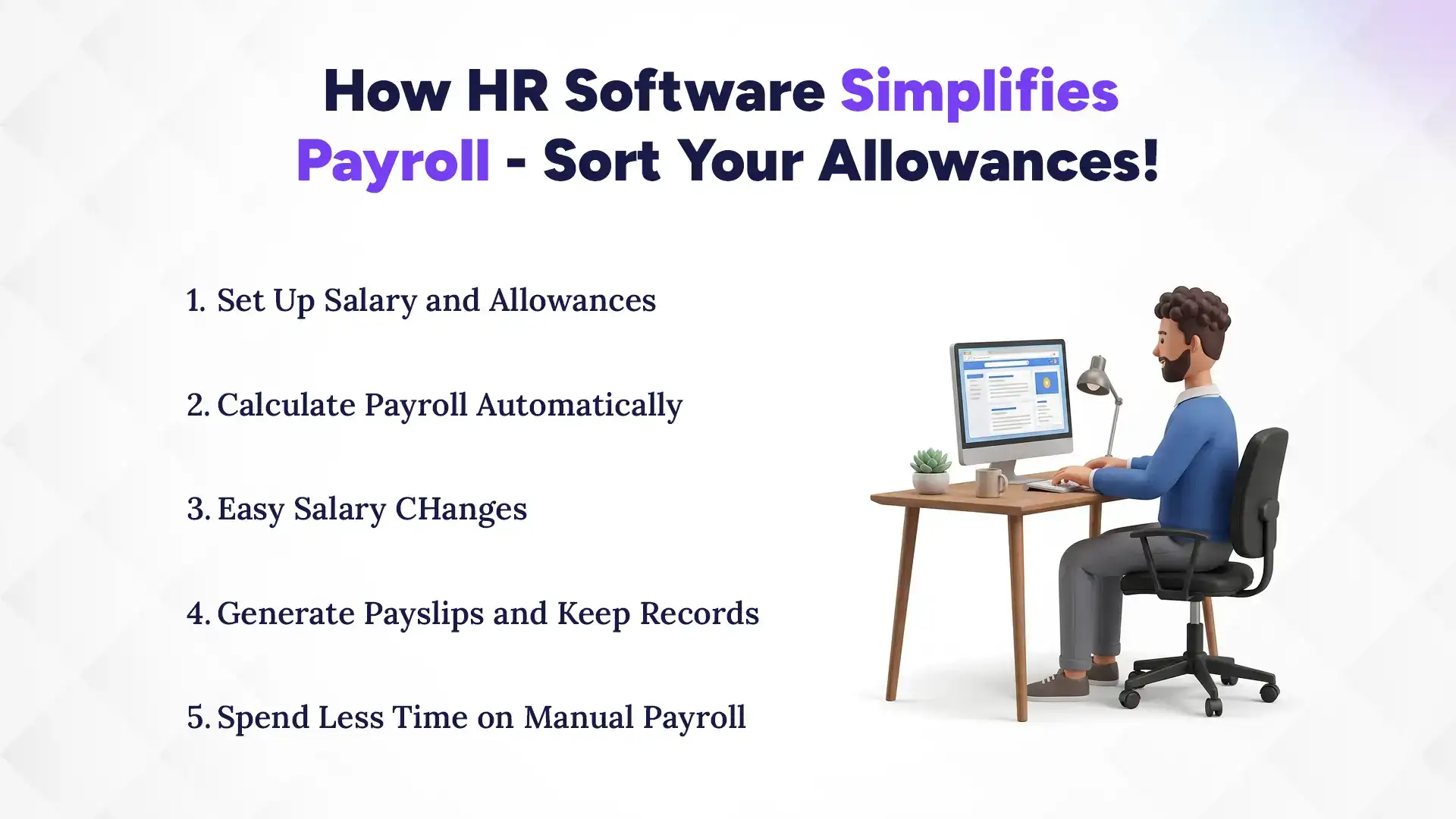
HR software simplifies payroll by organizing salary components, automating calculations, and keeping employee records updated. Instead of managing each allowance and payroll change manually, HR can handle them through one system. Here’s how it makes everyday payroll work easier.
1. Set Up Salary and Allowances
Set up basic salary, Mahangi Bhatta, and other allowances separately for each employee or salary structure.
2. Calculate Payroll Automatically
Once salary components are set, the system calculates payroll based on the assigned salary and applicable components.
3. Make Salary Changes Easily
Update salaries and allowances when there are increments, revisions, or other changes without editing every payroll record manually.
4. Generate Payslips and Keep Records
Create accurate payslips and keep salary, allowance, and payroll records organized in one place.
5. Spend Less Time on Manual Payroll
Automating repetitive payroll work reduces spreadsheets, repeated calculations, and manual checks, giving HR more time for other tasks.
For Nepal-based businesses, an HRMS can bring salary components, allowances, tax calculations, attendance, and payroll into one workflow.
Mahangi Bhatta is an important part of payroll in Nepal, helping employees manage rising living costs while giving employers a structured way to handle additional pay. From understanding its meaning and eligibility to calculating allowances, applying the right rates, and including applicable employment income for tax, getting each detail right matters.
For HR teams, payroll is not just about numbers on a spreadsheet. It directly affects how employees are paid, how clearly their earnings are understood, and how much time HR spends fixing avoidable errors. As your workforce grows, a simple and organized payroll process becomes even more valuable.
Take the manual work out of payroll. Use Pace HRMS to manage salaries, allowances, deductions, calculate taxes, payslips, and employee records from one place.
FAQs
What is the minimum salary in Nepal in 2026?
+
Nepal’s minimum monthly remuneration is Rs. 19,550, including Rs. 12,170 basic pay and Rs. 7,380 dearness allowance.
Is dearness allowance included in salary?
+
Yes. Dearness allowance is a salary component, but it is generally shown separately from the employee’s basic salary.
How to calculate Dearness allowance and basic salary?
+
For a fixed dearness allowance, add the applicable allowance to basic salary. Total salary = Basic salary + DA + other applicable components.
What is the government salary in Nepal for FY 2082/83?
+
Government employees received a Rs. 5,000 monthly dearness allowance in FY 2082/83, alongside their applicable basic salary and other allowances.
Who is eligible for Mahangi Bhatta in Nepal?
+
Eligibility depends on applicable labour rules, employment terms, salary structures, or employer policies.
Is Mahangi Bhatta taxable in Nepal?
+
Yes. Mahangi Bhatta is included in employment income for Nepal income-tax purposes, subject to applicable tax rules.
Can private companies provide Mahangi Bhatta to employees?
+
Yes. Private companies must provide Mahangi Bhatta based on applicable rules, employment terms, and company policy.
Ready to get started?
Book a 30-minute consultation call, and let's talk about your goals.