

Payroll records stay audit-ready in Nepal when every payslip, provident fund contribution, and filing confirmation is reconciled and filed the same month it's generated, not reconstructed from memory once an auditor asks for it. That distinction is the difference between an audit that takes an afternoon and one that swallows a week. In a typical Nepali payroll cycle, records pass through attendance systems, provident fund filings, tax withholding submissions, and branch-level approvals before they ever reach a finance team's desk.
If any one of those steps is left like an unreconciled deduction, a filing confirmation nobody saved, or a new hire whose contract didn't make it into the file, it surfaces at the worst possible time: during the audit itself. Building audit-readiness into the monthly routine, rather than treating it as a pre-audit scramble, is what keeps payroll defensible year-round.
What Does "Audit-Ready" Actually Mean for Payroll Records?
Audit-ready payroll records are records where every number can be traced back to its source, matches what was actually filed with authorities, and leaves nothing missing from an individual employee's file. In practice, this means the payroll register, the provident fund, and tax filings, and each employee's documentation all agree with one another. If any of these three checks fails, the records aren't audit-ready, regardless of how organized they look on the surface.
Every figure on a payslip, like gross salary, provident fund deduction, and tax withheld, should connect to a documented origin: an attendance log, a salary structure, or a statutory rate. When an auditor asks why a deduction is a specific amount, the answer needs to come from a record, not a recollection. That same figure also needs to match what was actually filed with the authorities: a payslip that shows one provident fund amount while the filing shows another is an immediate red flag, even if the mismatch is just a rounding error, so the internal payroll register and the amount submitted to the Employees Provident Fund or Social Security Fund need to be identical, month for month.
And beyond individual numbers, the employee's file as a whole needs to be complete with a signed offer letter, tax declaration, leave records, and every monthly payslip in place. A file with gaps, such as a missing month, an unsigned amendment, or a leave request with no corresponding approval, is exactly where an audit starts pulling threads.
| Trait | Audit-Ready | Not Audit-Ready |
|---|---|---|
| Traceability | Every figure links to a source document. | Figures exist with no backing calculation. |
| Filing Match | The payroll register matches submitted filings. | Internal records and filings diverge. |
| Employee File Completeness | All payslips, contracts, and declarations are present. | Gaps in months or missing signed documents. |
| Retrieval Time | Records pulled in minutes. | Records require searching across systems or paper files. |
| Reconciliation | Done monthly, as part of closing the pay run. | Attempted only when an audit is announced. |
This level of traceability is exactly what HRMS payroll software is designed to maintain automatically, ensuring every deduction has a documented origin and every filing has a matching internal record.
How Do You Reconcile Each Pay Run Before Closing It?
Reconciling each pay run means matching attendance and leave to the pay period, checking deductions against what was actually withheld, and confirming new hires and exits are reflected correctly before the run closes. This check should happen every cycle, not periodically, since it's the last point where an error can be corrected before it becomes a permanent part of the payroll record.
1. Matching Attendance and Leave to the Pay Period Before Running Payroll
Before a pay run closes, attendance and approved leave for that period need to be locked and matched against what payroll is about to calculate. Running payroll on stale attendance data where late approvals or corrections come in after the fact is one of the most common sources of discrepancies that surface later. A proper attendance management system locks attendance data once it's been matched to payroll, preventing these after-the-fact adjustments.
2. Checking Deductions Against What Was Actually Withheld
Provident fund, tax, and any loan or advance deductions should be checked line by line against the amount the system actually withheld, not just the amount the policy says should have been withheld. Manual overrides, rate changes mid-cycle, and one-off exceptions are exactly where errors creep in unnoticed.
3. Confirming New Hires and Exits Are Reflected Correctly
A new hire who joined mid-month needs a prorated salary calculation that matches their actual start date, and an exiting employee needs their final settlement, leave encashment, and provident fund closure documented correctly. Both scenarios are disproportionately likely to be flagged in an audit because they involve manual adjustments rather than the standard monthly calculation.
Which Payroll Documents Need to Stay Ready Year-Round?
Monthly payslips, provident fund contribution records, tax withholding and filing confirmations, and leave and attendance tied to each pay run are the documents that need to stay audit-ready year-round. These four document types cover almost everything an auditor will ask to see, and each one needs to be generated and filed as the related pay run closes rather than assembled later.
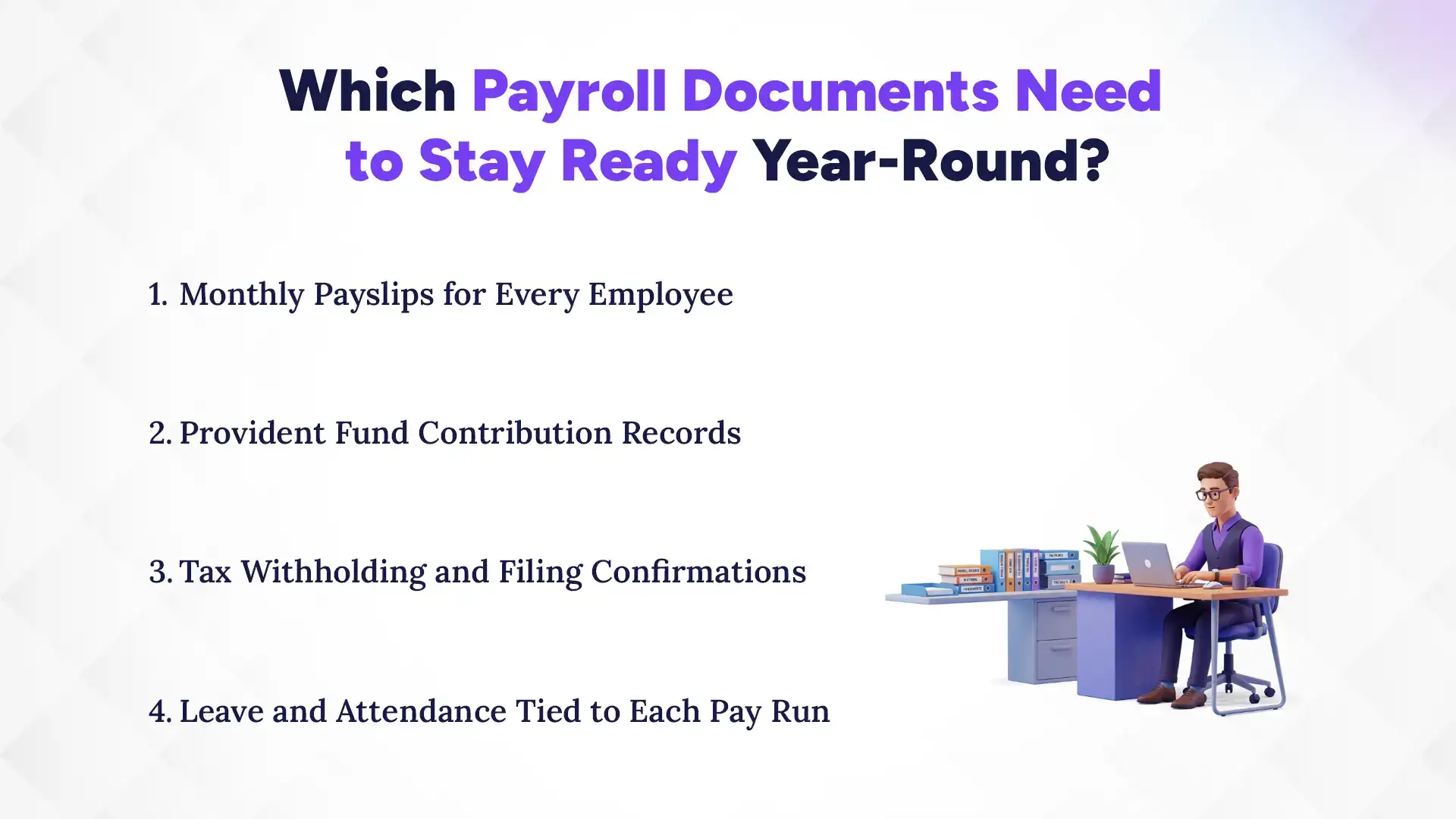
1. Monthly Payslips for Every Employee
Every employee needs an unbroken monthly record, not reconstructed at year-end, but generated and filed as each pay run closes. A missing payslip for even one month is one of the fastest ways to trigger follow-up questions.
2. Provident Fund Contribution Records
Both employer and employee contributions need to be documented separately, matched to the payroll register, and kept alongside the confirmation of what was actually submitted to the fund.
3. Tax Withholding and Filing Confirmations
Tax withheld from each employee needs a corresponding filing confirmation from the Inland Revenue Department. Without that confirmation on file, the withholding record alone doesn't prove the tax was actually remitted.
4. Leave and Attendance Tied to Each Pay Run
Leave balances and attendance records need to stay linked to the specific pay run they affected, not stored separately, where the connection has to be reconstructed later. An auditor reviewing leave encashment or unpaid leave deductions will expect to see the underlying attendance record, not just the final number. This is where leave management software proves valuable by maintaining the direct link between leave records and the pay periods they affect.
How Do You File Provident Fund and Tax Records So They Stay Audit-Ready?
Provident fund and tax records stay audit-ready when contributions are filed the same week they're due, every filing confirmation is kept on file, and filed amounts are reconciled against payroll records every month. This turns filing from a once-a-year concern into a routine check that catches errors while they're still small.
1. Filing Contributions the Same Week They're Due
Waiting until close to a deadline to file provident fund or tax contributions increases the odds of a rushed, unreviewed submission. Filing in the same week the payroll run closes keeps the gap between calculation and submission short enough that errors are caught while they're still easy to fix.
2. Keeping a Copy of Every Filing Confirmation
A filing isn't complete until the confirmation of the receipt, acknowledgment, or system-generated proof of submission is saved alongside the payroll records for that month. Without it, there's no proof the filing happened at all, regardless of what the internal register shows.
3. Reconciling Filed Amounts Against Payroll Records Monthly
Every month, the amount actually filed with the provident fund and tax authorities should be checked against what payroll calculated and deducted. Catching a mismatch in the same month it happens means a small correction; catching it a year later during an audit means explaining a discrepancy across every month in between.
What Happens When Payroll Records Aren't Ready at Audit Time?
When payroll records aren't ready at audit time, days get lost digging through old files, numbers stop matching across documents, auditor questions can't be answered on the spot, and a finding gets recorded that never needed to happen. Most of these findings trace back to poor documentation rather than actual noncompliance. That distinction doesn't matter to the audit report, which records the gap either way.
1. Days Lost Digging Through Old Files
Reconstructing a year of payroll history from scattered spreadsheets, paper files, or disconnected systems takes far longer than most teams expect, and it pulls staff away from their regular work for the duration of the audit.
2. Numbers That Don't Match Across Documents
When payroll registers, filing confirmations, and employee files were never reconciled month to month, small discrepancies compounded. By audit time, they show up as numbers that don't agree across three or four different documents, with no clear record of which one is correct.
3. Auditor Questions That Can't Be Answered on the Spot
An auditor asking why a specific deduction was applied or why a filing amount differs from the payroll register expects an answer backed by a document. Not having one on hand doesn't just slow the audit down; it signals that the underlying process isn't controlled.
4. A Finding That Didn't Need to Happen
Most payroll audit findings aren't the result of fraud or serious noncompliance; they're the result of poor documentation. A finding recorded for a paperwork gap still shows up in the audit report, still needs to be remediated, and still affects how the organization's controls are assessed going forward. The benefits of using HR software for Nepali businesses become clearer when you see how many of these avoidable findings never occur with automated documentation.
How Do You Prepare Payroll Records for Nepal's Fiscal Year-End Close?
Preparing payroll records for Nepal's fiscal year-end close means closing out Shrawan-to-Ashad reports cleanly, applying any mid-year tax changes retroactively where needed, and carrying balances forward correctly into the new fiscal year. Each of these steps depends on the pay runs throughout the year already being reconciled, since year-end close should summarize verified data, not generate it. A rushed close at year-end usually means the reconciliation work was skipped earlier.
1. Closing Out Shrawan-to-Ashad Reports Cleanly
Nepal's fiscal year runs Shrawan to Ashad, and payroll reports need to be closed against that calendar specifically, not against a calendar-year approximation. Every pay run within the fiscal year should be reconciled and finalized before the year-end close begins, so the close itself is a summary of already-verified data rather than a last-minute reconciliation exercise.
2. Applying Mid-Year Tax Changes Retroactively Where Needed
When tax slabs or rates change partway through the fiscal year, any retroactive adjustments need to be applied and documented for the affected pay periods before year-end close, with a clear record of which employees and which months were adjusted and why.
3. Carrying Balances Forward Correctly Into the New Fiscal Year
Leave balances, provident fund figures, and any outstanding advances need to carry forward into the new fiscal year with documentation showing exactly how the opening balance was calculated. An opening balance that can't be traced back to the prior year's closing figures is a gap an auditor will ask about immediately.
4. Using HRMS to Review Payroll Records Before Year-End Close
An HRMS can help verify employee-level payroll data before the fiscal year is closed by bringing together salary, attendance, leave, deductions, and other payroll records in one system. HR teams can use these records to identify discrepancies, check employee changes, and confirm that payroll figures are consistent before final reports are generated and balances are carried into the new fiscal year.
How Do You Keep Records Consistent Across Multiple Branches in Nepal?
Keeping records consistent across branches means standardizing how each branch files payroll, centralizing documents into one system, reconciling branch and head office records on a schedule, and assigning clear ownership at each location. Without this consistency, an audit that spans multiple branches effectively becomes several separate audits.
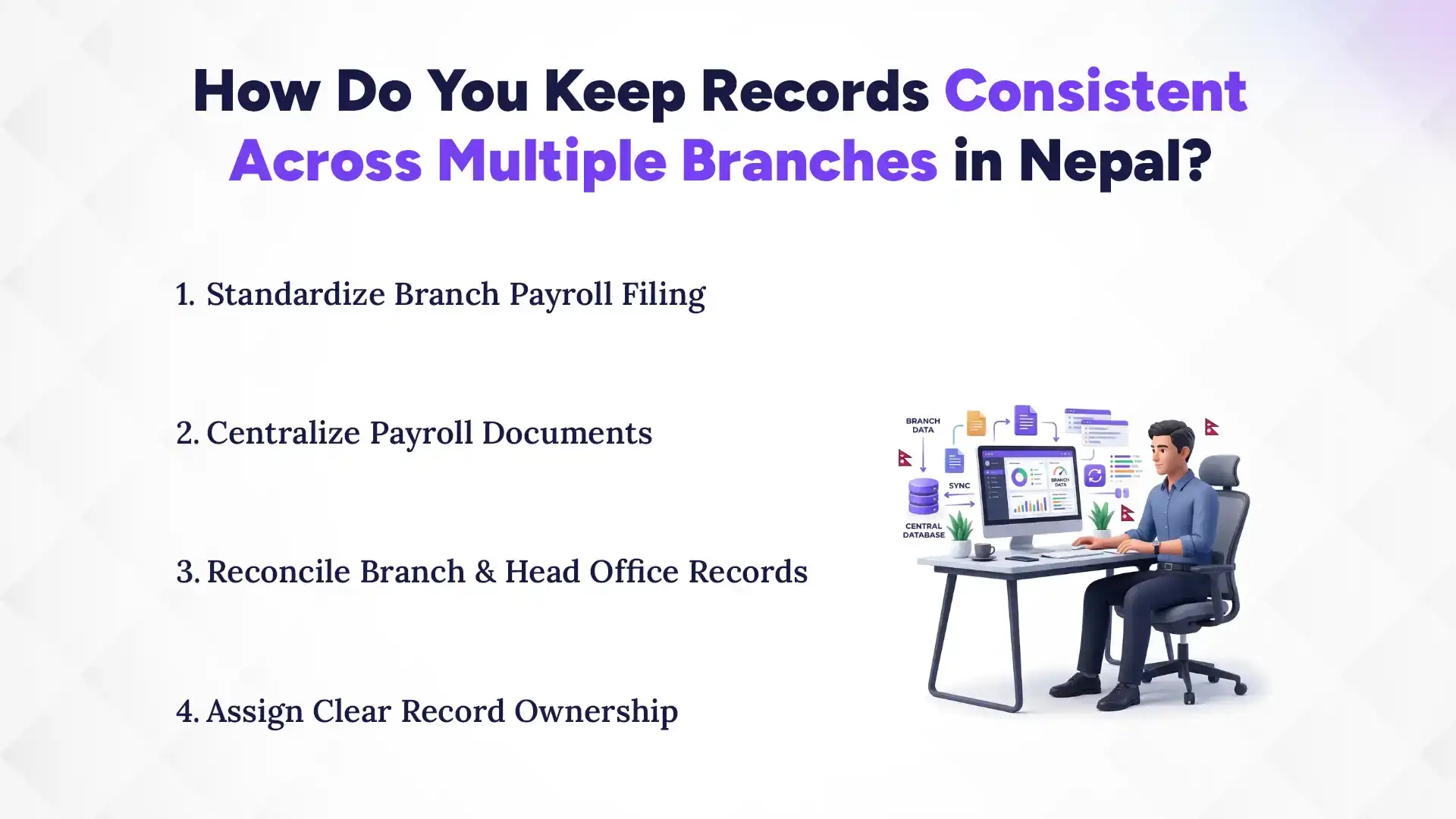
1. Standardize Branch Payroll Filing
Every branch should follow the same filing structure, naming convention, and document checklist, so records from one branch can be reviewed the same way as records from another without a translation step.
2. Centralize Payroll Documents
Branch-level payroll records should feed into a central system rather than staying siloed in local files, so the head office has a complete, current view without having to request documents from each branch individually when an audit begins. Understanding what is cloud-based HR software helps explain how centralized, accessible document storage works across multiple locations.
3. Reconcile Branch and Head Office Records
Branch payroll figures and head office consolidated records should be reconciled on a set schedule, not just when discrepancies are noticed. Differences that go unreconciled for months are far harder to explain than ones caught within the same pay cycle.
4. Assign Clear Record Ownership
Each branch should have a named person responsible for that branch's payroll documentation, so there's no ambiguity about who is accountable when a record is incomplete or a filing is late.
Which HRMS Keeps Payroll Records Audit-Ready Automatically in Nepal?
Pace HRMS keeps payroll records audit-ready automatically in Nepal, reconciling each pay run, filing provident fund contributions on schedule, and closing reports against Nepal's actual fiscal year without manual tracking.
Manually reconciling every pay run, chasing filing confirmations, and reconstructing employee files at audit time is a workload most payroll teams don't have the bandwidth for, especially across multiple branches. Pace HRMS is built around Nepal's actual payroll requirements, provident fund and tax filing schedules, the Shrawan-to-Ashad fiscal year, and multi-branch reconciliation so records stay reconciled and complete as each pay run closes, rather than needing to be pieced together later. Filing confirmations, payslips, and employee documentation are kept in one system, so when an audit does arrive, the records are already where they need to be.
Conclusion
Audit-ready payroll isn't something built in the week before an audit; it's the result of every pay run being reconciled and filed correctly the month it happens. Attendance matched before the run closes, deductions checked against what was actually withheld, provident fund and tax filings confirmed and reconciled monthly, and employee files kept complete as a matter of routine: none of it is complicated on its own, but doing it consistently across every pay cycle, every branch, and every fiscal year is where most manual processes break down.
An HRMS built for Nepal's payroll requirements is what makes that consistency realistic without someone manually chasing it down every month. If you want to make your payroll audit easier, contact Pace Infosys to see how it fits your team.