

Choosing the right HR software for performance reviews can be the difference between a motivated, high-performing workforce and a disengaged team struggling with outdated appraisal systems. In today’s fast-paced business environment in Nepal, companies are shifting toward digital solutions to manage employee performance more efficiently. Traditional review methods are no longer enough, as organizations now need real-time feedback, data-driven insights, and automated evaluation processes.
In this best HR software in Nepal for performance reviews, we will explore the top HR solutions available in Nepal, their key features, benefits, and how they can transform your performance management process. We’ll also help you understand what to look for when choosing the right software for your business. Whether you run a small company or a growing enterprise, this blog will guide you in making an informed decision.
What Is HR Software for Performance Reviews?
HR software for performance reviews is a digital tool used to manage, track, and evaluate employee performance efficiently. It helps organizations automate appraisal processes, set goals, and provide continuous feedback. This software improves transparency, reduces manual work, and enables data-driven performance management decisions. If you’re exploring solutions like HR software in Nepal, such tools are especially useful for modern businesses aiming to streamline their HR processes and improve workforce productivity.
Why Do Businesses Need HR Software for Performance Reviews?
Businesses need HR software for performance reviews to automate evaluations, improve feedback processes, and make smarter HR decisions. Modern organizations rely on digital tools to manage employee performance efficiently and consistently. It helps eliminate manual errors, saves time, and ensures fair assessments. Overall, it plays a key role in building a productive and engaged workforce. You can clearly understand the benefits of HR software when looking at how it streamlines processes, improves accuracy, and enhances overall employee management.
1. Streamlining Employee Performance Evaluation Processes
HR software simplifies the entire performance review process by automating evaluations. It replaces manual paperwork with structured digital workflows. Managers can easily schedule, conduct, and track reviews. This saves time and improves efficiency. It also ensures consistency across all departments. As a result, performance management becomes more organized and effective. It also allows easy access to historical performance data.
2. Improving Continuous Feedback and Communication
Modern HR tools enable real-time feedback rather than relying solely on annual reviews. Employees and managers can communicate regularly about performance. This helps identify issues early and make timely improvements. Continuous feedback builds transparency and trust. It also encourages open communication within teams. This leads to better employee development and performance. It also helps in creating a culture of continuous improvement.
3. Enhancing Employee Engagement and Productivity
When employees receive regular feedback, they feel more valued and motivated. HR software helps set clear goals and track progress. This keeps employees aligned with company objectives. Engaged employees tend to be more productive and committed. It also improves overall workplace satisfaction. This directly impacts business growth and performance. It also helps reduce employee turnover rates.
4. Reducing Manual Errors in Performance Tracking
Manual performance tracking often leads to errors and inconsistencies. HR software automates data collection and evaluation processes. This ensures accurate and reliable performance records. It minimizes human errors and bias in assessments. Automated systems also improve data security and accessibility. This leads to more trustworthy performance evaluations. It also ensures compliance with HR policies and standards.
5. Supporting Data-Driven HR Decisions
HR software provides detailed reports and analytics on employee performance. Managers can use this data to make informed decisions. It helps identify top performers and areas needing improvement. Data-driven insights support better planning and strategy. It also helps in promotions, training, and resource allocation. This makes HR decisions more effective and objective. It also improves long-term workforce planning and development.
What Are the Key Features of HR Software for Performance Reviews?
The HR software for performance reviews includes features like goal setting, continuous feedback, automated appraisals, and performance analytics to effectively manage employee evaluations. These tools help organizations track performance, improve communication, and align employee goals with business objectives. Modern HR systems also focus on automation, accuracy, and real-time insights. Overall, these features of HR software make performance management more efficient, transparent, and data-driven.
1. Goal Setting and OKR Management System
This feature allows organizations to set clear goals using frameworks like OKRs (Objectives and Key Results). Employees can align their individual goals with company objectives. It helps track progress and measure performance effectively. Managers can monitor achievements in real time. This improves accountability and focus across teams. It also ensures employees understand their contribution to business success. It helps create a goal-oriented work culture.
2. 360-Degree Feedback and Peer Reviews
360-degree feedback collects input from managers, peers, and subordinates for a complete evaluation. This reduces bias and provides a balanced view of employee performance. It improves self-awareness among employees. Peer reviews also encourage collaboration and teamwork. This feature enhances transparency in the review process. It helps organizations make fair and accurate assessments. It also strengthens team relationships and trust.
3. Real-Time Performance Tracking Dashboard
A real-time dashboard allows managers to track employee performance continuously. It provides insights into progress, goals, and productivity. This helps identify issues early and take corrective action. Employees can also view their own performance metrics. It promotes transparency and accountability. Real-time tracking ensures better decision-making and performance improvement. It also enables quick adjustments to goals and strategies.
4. Automated Appraisal and Review Cycles
Automation helps schedule and manage performance reviews efficiently. HR software sends reminders and ensures reviews are completed on time. It eliminates manual follow-ups and delays. Standardized workflows improve consistency across teams. This feature saves time and reduces administrative workload. It also ensures a smooth and organized review process. It helps maintain regular and timely performance evaluations.
5. Employee Self-Assessment Tools
Self-assessment tools allow employees to evaluate their own performance. This encourages reflection and personal growth. Employees can highlight achievements and challenges. It adds valuable insights to manager evaluations. This feature promotes engagement and accountability. It also supports a more balanced and inclusive review process. It helps employees take ownership of their development.
6. Integration with Payroll and HRMS Systems
Integration ensures seamless data flow between performance management and other HR functions. It connects employee data, attendance, and payroll systems. This reduces duplication and errors. Managers get a complete view of employee information. It improves efficiency and accuracy in HR processes. Integration also supports better decision-making. It helps streamline overall HR operations.
7. Cloud-Based Access and Mobile Compatibility
Cloud-based HR software allows access from anywhere at any time. Employees and managers can complete reviews remotely. Mobile compatibility makes it easy to provide feedback on the go. This is especially useful for remote and hybrid teams. It ensures flexibility and convenience. Cloud systems also enhance data security and scalability. It supports modern, distributed work environments.
What Are the Top HR Software for Performance Reviews in 2026?
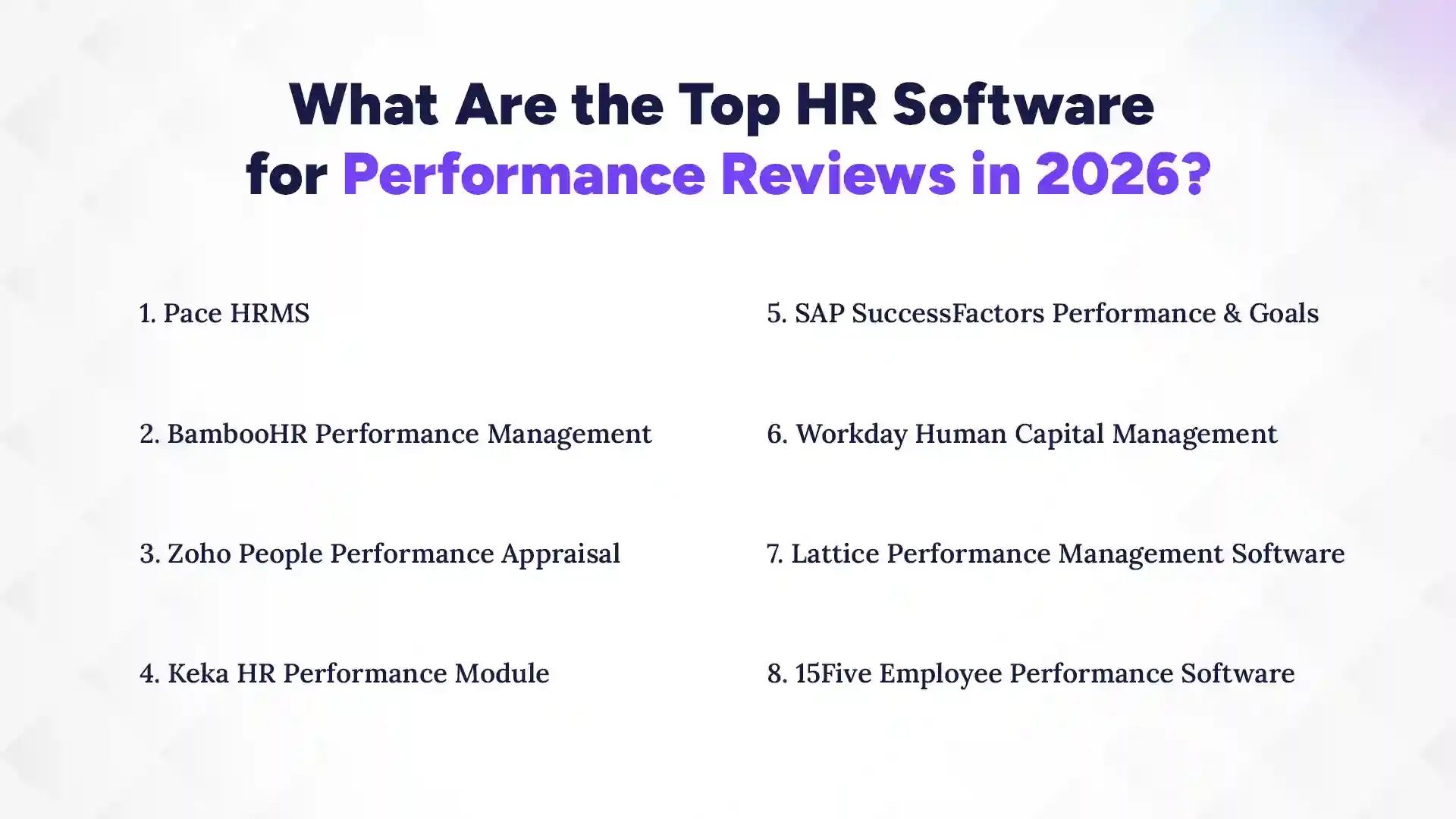
The top HR software for performance reviews in 2026 includes advanced platforms that offer goal tracking, continuous feedback, automation, and data-driven insights. These tools help businesses move from traditional annual reviews to modern, real-time performance management systems. They improve employee engagement, streamline HR processes, and support better decision-making. Below are some of the most popular and effective HR software solutions used by organizations today.
1. Pace HRMS
Pace HRMS is a comprehensive HR solution designed to simplify performance management and employee evaluations. It offers features like goal setting, automated appraisals, and real-time performance tracking. The platform helps organizations streamline HR operations and improve productivity. It is suitable for businesses of all sizes looking for scalable solutions. It also supports data-driven decision-making. Its user-friendly interface makes it easy for HR teams and employees. It helps create a more structured and transparent performance review system.
2. BambooHR Performance Management
BambooHR provides an easy-to-use performance management system designed for small and medium businesses. It offers 360-degree feedback, goal tracking, and customizable review cycles. The platform helps improve employee engagement and development. It also enables data-backed performance insights for better decisions. BambooHR simplifies HR processes through automation and integrations. It is known for its intuitive interface and ease of use. It helps organizations create a culture of continuous feedback.
3. Zoho People Performance Appraisal
Zoho People offers a flexible and customizable performance management system. It allows businesses to set goals, conduct appraisals, and gather 360-degree feedback. The platform supports continuous reviews and real-time feedback. It also provides detailed analytics and performance reports. Zoho People integrates well with other business tools. It is ideal for companies looking for affordable and scalable HR solutions. It helps improve employee performance and engagement.
4. Keka HR Performance Module
Keka HR is a modern HR software popular for its performance management features. It offers goal tracking, continuous feedback, and appraisal automation. The platform is user-friendly and suitable for growing businesses. It helps streamline HR operations and improve employee productivity. Keka also provides analytics for better decision-making. It integrates well with payroll and attendance systems. It supports a smooth and efficient performance review process.
5. SAP SuccessFactors Performance & Goals
SAP SuccessFactors is an enterprise-level HR solution designed for large organizations. It offers advanced performance management tools, including goal alignment and continuous feedback. The platform provides deep analytics and reporting capabilities. It supports global workforce management and scalability. It helps organizations align employee performance with business strategy. It is ideal for companies with complex HR needs. It also ensures consistency in performance evaluations across departments.
6. Workday Human Capital Management
Workday is a powerful HR platform widely used by large enterprises. It offers performance management, workforce planning, and analytics tools. The system provides real-time insights into employee performance. It supports continuous feedback and goal tracking. Workday is highly scalable and suitable for global organizations. It helps improve decision-making through data-driven insights. It also integrates with various enterprise systems.
7. Lattice Performance Management Software
Lattice focuses on employee engagement and performance development. It offers features like OKRs, continuous feedback, and performance reviews. The platform helps build a culture of transparency and growth. It is designed for modern, fast-growing companies. Lattice also provides analytics to track employee progress. It supports regular check-ins and feedback cycles. It helps improve team performance and alignment.
8. 15Five Employee Performance Software
15Five is designed to improve employee engagement and performance through continuous feedback. It offers weekly check-ins, goal tracking, and performance reviews. The platform focuses on employee development and well-being. It helps managers stay connected with their teams. It also provides insights into employee performance trends. 15Five is ideal for companies focusing on culture and growth. It supports a more human-centered approach to performance management.
How to Choose the Best HR Software for Performance Reviews?
To choose the best HR software for performance reviews, businesses should evaluate their needs, compare features, check integrations, and test usability before making a final decision. The right software should align with the company's size, budget, and performance management goals. It must also support automation, feedback systems, and data-driven insights. A careful evaluation ensures long-term efficiency and better employee performance management. You can follow a clear how to choose HR software approach to make a more informed and effective decision.
1. Identify Your Business Size and HR Needs
Every business has different HR requirements depending on its size and structure. Small businesses may need simple tools, while larger organizations require advanced features. Identifying needs helps avoid overpaying for unnecessary features. It also ensures the software supports current and future growth. Understanding HR challenges is the first step in selection. This leads to better software alignment with business goals. It also improves long-term scalability and usability.
2. Evaluate Performance Review Features and Flexibility
Check whether the software offers key features like goal setting, feedback, and appraisal automation. Flexibility is important for customizing performance review cycles. The system should adapt to different departments and roles. A feature-rich platform improves efficiency and accuracy. It also supports continuous performance management. This ensures better employee development and engagement. It also helps align performance with business objectives.
3. Check Integration with Existing HR Systems
The software should easily integrate with payroll, attendance, and other HR tools. Integration reduces manual work and data duplication. It ensures smooth information flow across systems. This improves accuracy and saves time for HR teams. A well-integrated system enhances overall efficiency. It also provides a complete view of employee performance. It supports better coordination between HR functions.
4. Compare Pricing and Subscription Plans
Different HR software solutions come with varying pricing models. Businesses should compare costs based on features and scalability. Affordable pricing should not compromise essential functionalities. Subscription plans should fit the company budget. Transparent pricing helps avoid hidden costs. This ensures a cost-effective long-term investment. It also helps maximize return on investment.
5. Review User Experience and Interface
A simple and intuitive interface improves user adoption. Employees and managers should easily navigate the system. A good user experience reduces training time. It also increases efficiency in daily HR tasks. Complex systems may reduce productivity and engagement. Therefore, usability is a key selection factor. It also ensures faster implementation across teams.
6. Request Demo or Free Trial Before Final Decision
A demo or free trial helps evaluate software performance in real conditions. It allows businesses to test features before purchase. Users can understand usability and functionality better. This reduces the risk of wrong investment. Feedback from HR teams can guide final decisions. It ensures the software meets actual business needs. It also builds confidence before full implementation.
Benefits of Using the Best HR Software for Performance Reviews
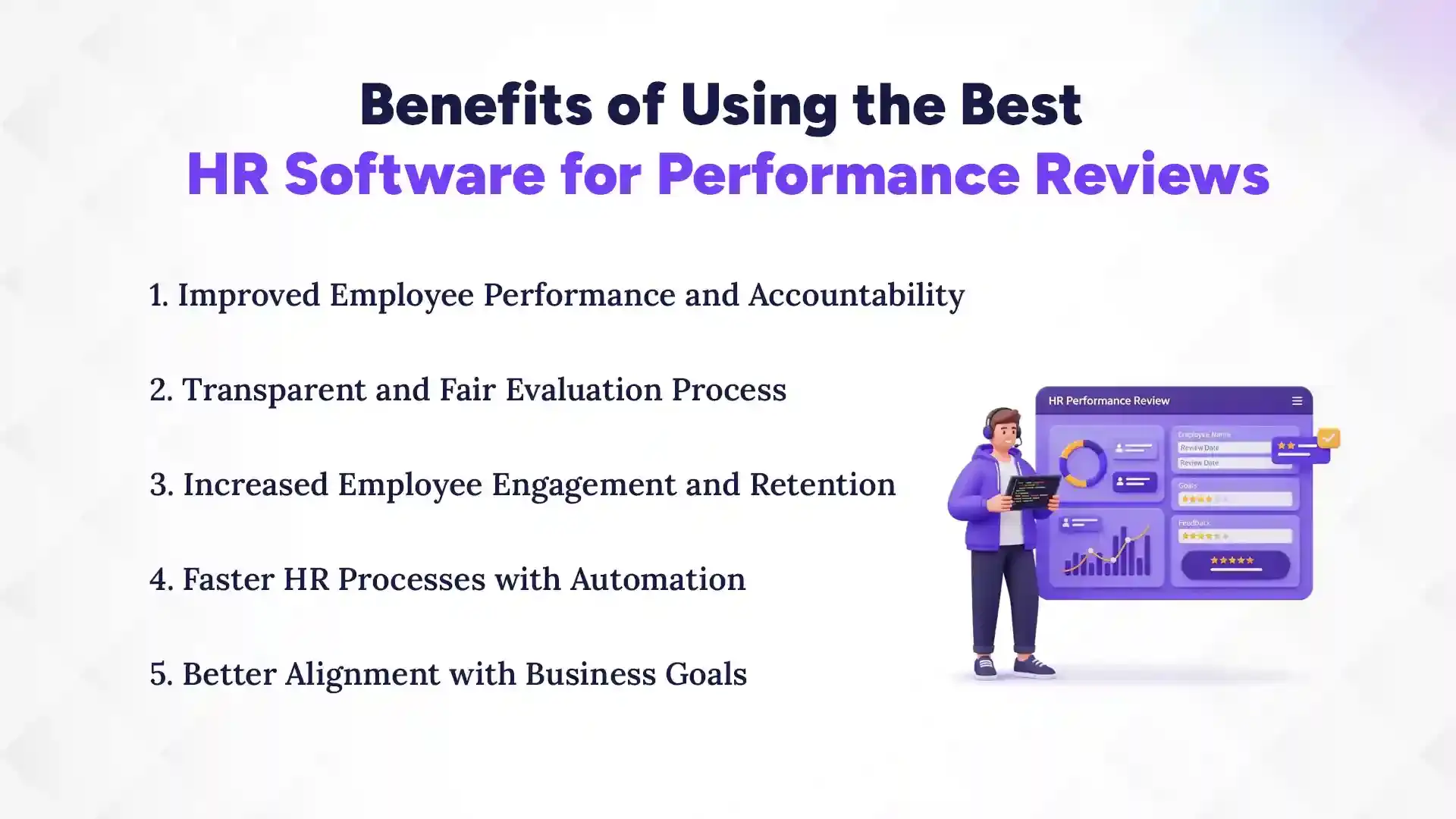
Using the best HR software for performance reviews helps organizations improve employee performance, streamline evaluation processes, and make data-driven HR decisions. It replaces manual appraisal methods with automated systems that are faster, more accurate, and transparent. Businesses can better track progress, set clear goals, and provide continuous feedback. Overall, it enhances workforce productivity and organizational efficiency when they implement HR software effectively.
1. Improved Employee Performance and Accountability
HR software helps employees understand their goals clearly and track their progress regularly. This increases accountability and encourages better performance. Managers can monitor individual contributions more effectively. It also helps identify strengths and areas for improvement. Regular tracking motivates employees to stay focused. As a result, overall productivity improves significantly. It builds a stronger performance-driven culture.
2. Transparent and Fair Evaluation Process
Performance review software ensures evaluations are based on data and structured feedback. This reduces bias and increases fairness in appraisals. Employees trust the system more when assessments are transparent. It also improves communication between managers and teams. A fair process boosts morale and confidence. This leads to a healthier work environment. It strengthens trust between employees and management.
3. Increased Employee Engagement and Retention
Regular feedback and recognition make employees feel valued. HR software enables continuous communication between employees and managers. This improves engagement and job satisfaction. Engaged employees are more likely to stay with the company. It also reduces turnover rates. Ultimately, it helps build a loyal and motivated workforce. It supports long-term organizational stability.
4. Faster HR Processes with Automation
Automation speeds up performance reviews and reduces manual workload. HR teams can schedule and manage appraisals easily. It eliminates repetitive administrative tasks. This saves time and reduces errors. Automated workflows ensure consistency across departments. It allows HR professionals to focus on strategic tasks. It improves overall operational efficiency.
5. Better Alignment with Business Goals
HR software helps align employee goals with organizational objectives. Managers can track progress toward key business targets. This ensures everyone is working in the same direction. It improves coordination between teams and departments. Better alignment leads to improved business performance. It also supports long-term strategic growth. It helps achieve organizational success more effectively.
Common Challenges Without HR Software for Performance Reviews
Without HR software for performance reviews, organizations often struggle with inconsistent evaluations, delayed feedback, and inefficient manual processes. Traditional methods make it difficult to track employee performance accurately and fairly. This leads to poor decision-making, reduced transparency, and lower employee satisfaction. Overall, it negatively impacts productivity and workplace culture.
1. Inconsistent and Biased Evaluations
Without structured HR software, performance reviews often depend on personal judgment. This can lead to bias and unfair evaluations. Different managers may use different standards for assessing employees. It creates inconsistency across teams and departments. Employees may feel undervalued or demotivated. This reduces trust in the appraisal system and affects morale. It also weakens organizational fairness.
2. Lack of Real-Time Feedback and Tracking
Traditional systems usually rely on annual or periodic reviews only. This limits timely feedback for employees. Issues are often identified too late to correct effectively. There is no continuous tracking of progress or goals. This slows down employee development. It also reduces opportunities for improvement and growth. It makes performance management less responsive.
3. Time-Consuming Manual Review Processes
Manual performance reviews require extensive paperwork and coordination. HR teams spend a lot of time collecting and organizing data. Managers also find the process repetitive and inefficient. It delays the overall evaluation cycle. This reduces productivity and increases administrative burden. It also increases the chances of human error. It wastes valuable organizational time.
4. Poor Documentation and Reporting
Without software, performance data is often stored in scattered files or spreadsheets. This makes it difficult to access historical records. Reporting becomes time-consuming and unreliable. Important insights may be lost or overlooked. It also creates challenges during audits or reviews. Poor documentation affects decision-making quality. It reduces overall HR efficiency.
5. Low Employee Engagement and Motivation
Lack of regular feedback makes employees feel disconnected. They may not clearly understand their performance expectations. This reduces motivation and engagement levels. Employees may feel their efforts are not recognized. It can lead to higher turnover rates. Ultimately, it affects overall organizational performance. It also weakens workplace morale and culture.
Future Trends in HR Software for Performance Reviews
The future of HR software for performance reviews is shifting toward smarter, faster, and more employee-focused systems. Businesses are increasingly adopting AI-driven insights, continuous feedback models, and mobile-friendly platforms. These advancements help organizations move beyond traditional appraisal methods. Overall, future HR software will make performance management more predictive, personalized, and efficient.
1. AI-Based Performance Analytics and Insights
AI is transforming how employee performance is analyzed and understood. It helps HR teams identify patterns, strengths, and improvement areas more accurately. Predictive analytics can forecast employee growth and risks. This reduces bias and improves decision-making quality. Managers get deeper insights into workforce performance. It also helps in smarter talent planning and management. It further supports proactive HR strategies.
2. Continuous Feedback and Pulse Surveys
Instead of annual reviews, companies are adopting continuous feedback systems. Pulse surveys help gather real-time employee opinions and performance updates. This improves communication between employees and managers. It allows quick action on performance issues. Employees feel more heard and supported. It also creates a more transparent work culture. It strengthens trust within the organization.
3. Integration with Learning and Development Platforms
Future HR software will closely connect performance reviews with learning systems. Employees can receive training based on their performance gaps. This creates a continuous improvement cycle. It helps align skill development with business needs. Managers can track learning progress easily. It also supports long-term employee growth and retention. It enhances workforce capability over time.
4. Mobile-First and Remote Workforce Solutions
Modern HR tools are being designed for mobile and remote access. Employees can complete reviews and give feedback from anywhere. This is especially important for hybrid and remote teams. It increases flexibility and engagement. Mobile platforms improve accessibility and response time. It ensures performance management is seamless across locations. It also supports real-time collaboration and updates.
Which Is the Best HR Software in Nepal for Performance Reviews?
Pace HR is the best HR software in Nepal for performance reviews because it offers a complete, automated, and data-driven performance management system designed for modern Nepali businesses. It simplifies employee evaluations, ensures fair appraisals, and provides real-time performance tracking for better HR decisions. With its user-friendly design and scalable features, it helps companies move from manual reviews to a structured digital system.
It is widely trusted by businesses in Nepal for its reliability, local compliance support, and all-in-one HR functionality. The software improves productivity by automating reviews, feedback, and reporting in one platform.
- Automates performance review cycles with structured workflows
- Supports goal setting, OKRs, and continuous employee feedback
- Provides real-time dashboards for performance tracking
- Ensures fair and transparent appraisal system with data insights
- Integrates seamlessly with payroll, attendance, and HRMS tools
Conclusion
Choosing the best HR software for performance reviews is essential for building a productive, transparent, and high-performing workforce. Modern businesses in Nepal are rapidly moving away from manual appraisal systems and adopting digital HR solutions that offer automation, real-time feedback, and data-driven insights. The right software not only improves employee evaluation processes but also enhances engagement, accountability, and overall organizational efficiency. It helps HR teams save time while ensuring fair and consistent performance management across all levels. You can explore the top 5 HR software in Nepal to find the most suitable solution for your business needs.
Among the available options, tools like Pace HRMS stand out for their simplicity, scalability, and performance-focused features. By implementing the right HR software, businesses can align employee goals with company objectives and create a more motivated work environment. Ultimately, investing in a strong performance review system leads to better decision-making, improved productivity, and long-term business growth.