Choosing the wrong app framework can waste months of work, burn your budget, and still give you a slow app. Many founders and teams start development feeling confident, then face crashes, poor speed, hard updates, and high costs. The problem is not your idea. The problem is the framework you picked at the start.
That is why understanding programming frameworks for app development matters more than ever. With so many options for Android, iOS, and cross-platform apps, one wrong choice can hold your product back.
In this blog, you will learn the top 10 programming frameworks for app development, how they work, and which one fits your goals. By the end, you will clearly know the best framework for mobile app development without confusion or tech stress.
What are Programming Frameworks for App Development?
Programming frameworks for app development are ready-made tools that help developers build apps faster and with fewer problems. Instead of writing everything from zero, developers use these frameworks as a strong base to create mobile apps for Android, iOS, or both.
Think of a framework like a starter kit. It already has common features such as screen layouts, buttons, navigation, and data handling. This saves time and keeps the app structure clean. It also reduces errors and makes updates easier later.
These frameworks guide how an app is built. They tell developers where to write code, how parts connect, and how the app talks to the device. This makes teamwork smoother and helps new developers understand the app quickly through mobile app development service.
Why are programming frameworks used?
Faster app development with less repeated work
Better app performance and smoother user experience
Easy support for Android, iOS, or both platforms
Strong community help and regular updates
Better security and fewer bugs
There are different types of app development frameworks. Native frameworks focus on one platform, like Android or iOS. Cross-platform frameworks let you build one app that works on both Android and iOS. Hybrid frameworks use web tools but still act like mobile apps.
In short, programming frameworks for app development help turn app ideas into real products faster, cheaper, and with better quality. Choosing the right one helps you avoid delays, extra costs, and future issues.
Types of Frameworks for Mobile App Development
Mobile app development frameworks come in different types because not every app has the same needs. Some apps need top speed, while others need fast launch with low cost. Each framework type follows a different way to build apps. Knowing these types helps you choose the right path from the start.
1. Native App Development Frameworks
Native frameworks are built for one platform only, like Android or iOS. Developers use platform tools such as Android Studio or Swift for iOS. These apps run very fast and feel smooth to users. They use full phone features like camera, GPS, and sensors easily. Native apps are more stable and secure. Updates and long-term support are strong. The downside is that you need separate apps for Android and iOS. This means more time and higher cost.
2. Cross-Platform App Development Frameworks
Cross-platform frameworks let you build one app for Android and iOS. Developers write one code and use it on both platforms. This saves time and lowers development costs. These apps give near native performance in most cases. Popular frameworks include Flutter and React Native. Cross-platform apps are good for startups and fast-growing businesses. Updates are easier because one change affects both platforms. Performance may not match native in heavy apps, but it works well for most needs.
3. Hybrid App Development Frameworks
Hybrid frameworks use web tools like HTML, CSS, and JavaScript. The app runs inside a web view but looks like a mobile app. These frameworks are quick to build and budget-friendly. They are good for simple apps and early ideas. Hybrid mobile apps work on both Android and iOS. Performance is lower compared to native apps. Access to device features is limited. These apps are best for content-based or basic business apps.
4. Progressive Web App Frameworks
Progressive web apps are websites that act like mobile apps. Users can open them in a browser and add them to the home screen. They do not need app store downloads. These apps are easy to update and very low-cost. They load fast and work even with weak internet. Features are limited compared to native apps. Device access is not full. PWAs are best for reach, speed, and simple user tasks.
Top 10 Mobile App Development Frameworks
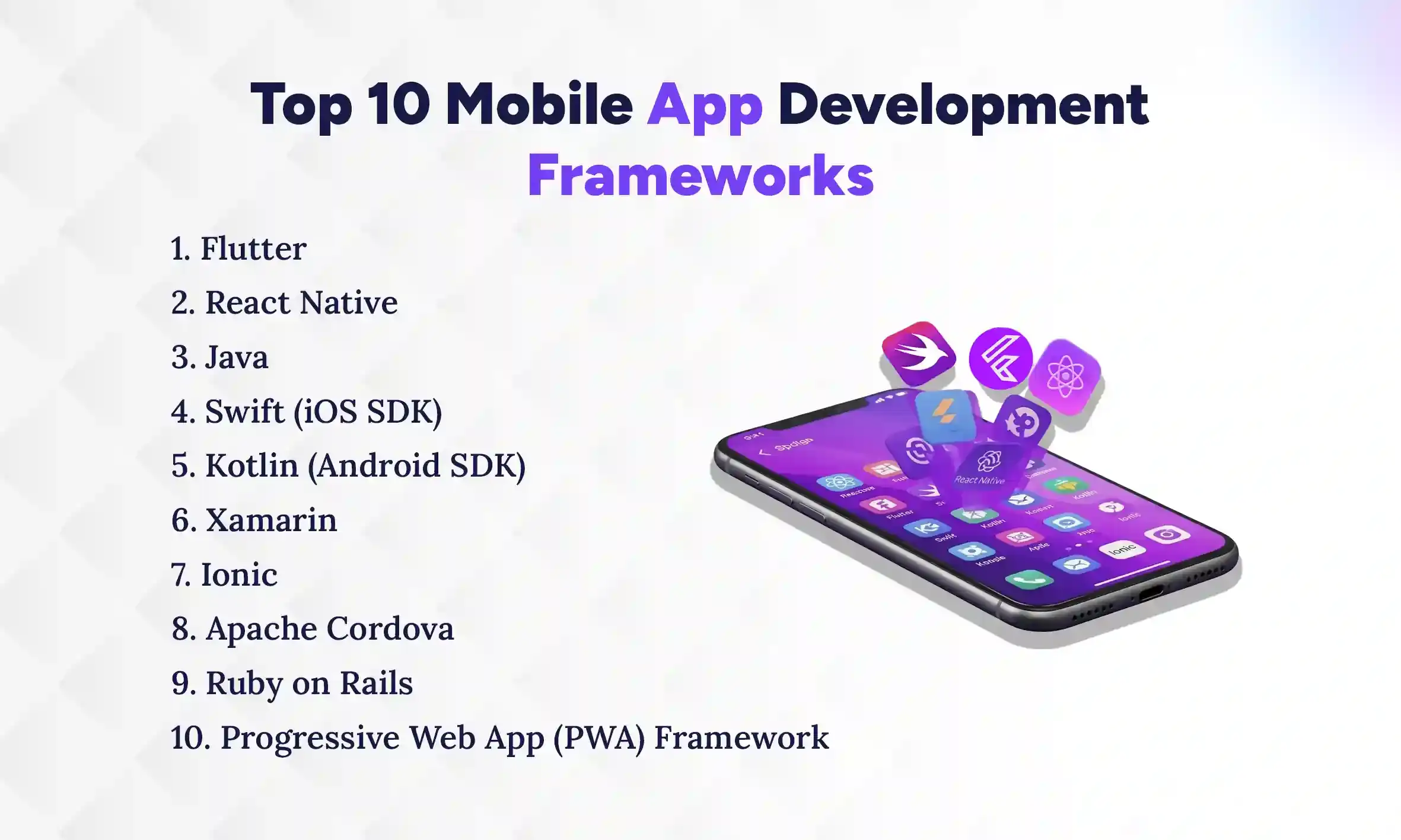
Mobile apps are growing fast, and choosing the right framework can make or break your app. Each framework has its own strength, use case, and learning level. Some are best for speed, some for cost, and some for deep performance. Below are the top 10 mobile app development frameworks that businesses and developers trust today.
1. Flutter
Flutter is a popular framework created by Google. It lets developers build apps for Android and iOS using one codebase. Apps built with Flutter are fast and smooth. The UI looks clean and modern on all devices. Flutter comes with many ready-made widgets that save time. It is great for startups and growing products. Updates are easy and quick. Flutter is a strong choice for cross-platform app development.
2. React Native
React Native is built by Meta and is widely used across the world. It allows developers to use JavaScript to build mobile apps. One codebase works for both Android and iOS. Apps feel close to native in look and performance. It has a large community and many plugins. This makes problem-solving easier. React Native is good for fast development. It is one of the best frameworks for mobile app development.
3. Java
Java is one of the oldest and most trusted languages for Android apps. It is used mainly with Android Studio. Java apps are stable and secure. It has strong support from Google. Many Android apps today still run on Java. Learning resources are widely available. It works well for large and complex apps. Java is a solid Android app development framework.
4. Swift (iOS SDK)
Swift is Apple’s main language for iOS app development. It is fast, safe, and easy to read. Swift works smoothly with Apple tools and devices. Apps built with Swift perform very well. It supports modern app features. Swift is best for apps that need a high-quality user experience. It is ideal for long-term iOS projects. Swift is the top choice for native iOS apps.
5. Kotlin (Android SDK)
Kotlin is now the preferred language for Android development. Google fully supports it. Kotlin code is shorter and cleaner than Java. It helps reduce errors and crashes. Kotlin works well with existing Java apps. Developers find it easier to maintain. Performance is strong and reliable. Kotlin is a modern Android app development framework.
6. Xamarin
Xamarin is a Microsoft-owned framework. It uses C# for app development. One codebase can build apps for Android and iOS. Xamarin apps have near native performance. It works well with Microsoft tools. This is useful for enterprise teams. Maintenance is easier with shared code. Xamarin fits businesses using the Microsoft ecosystem.
7. Ionic
Ionic is a hybrid app development framework. It uses web tools like HTML, CSS, and JavaScript. Apps are built once and run on multiple platforms. Ionic is fast to develop and budget-friendly. It works well for simple and medium apps. UI components are ready to use. Performance is lower than native apps. Ionic is good for early-stage products.
8. Apache Cordova
Apache Cordova is another hybrid framework. It wraps web apps into mobile apps. Developers can reuse web code easily. It supports Android and iOS. Cordova is simple to learn for web developers. It is useful for basic apps. Device feature access is limited. Cordova is best for content-focused apps.
9. Ruby on Rails
Ruby on Rails is mainly a backend framework. It is often used to power mobile apps with APIs. It helps build apps faster with a clean structure. Rails is easy to manage and update. It works well with mobile front ends. Many startups use it for speed. It supports scaling when done right. Rails is strong for app backend development.
10. Progressive Web App (PWA) Framework
PWA frameworks help build apps that run in browsers. These apps feel like mobile apps. Users can add them to the home screen. They do not need app store downloads. PWAs load fast and work offline. They are low-cost and easy to update. Features are limited compared to native apps. PWAs are great for reach and quick access.
Comparison Table Between App Development Frameworks
Choosing the right app development framework becomes easier when you compare them side by side. Each framework differs in performance, cost, learning effort, and best use case. The table below gives a clear and detailed comparison to help you decide without confusion.
Framework
App Type
Platform Support
Performance
Best Use Case
Flutter
Cross platform
Android, iOS
High and smooth
Best for modern apps needing one codebase and a strong UI
React Native
Cross platform
Android, iOS
Near native
Best for startups and apps that need a quick launch
Java
Native
Android only
Very high
Best for large and complex Android apps
Swift (iOS SDK)
Native
iOS only
Very high
Best for high-quality and long-term iOS apps
Kotlin (Android SDK)
Native
Android only
Very high
Best for modern Android apps with clean code
Xamarin
Cross platform
Android, iOS
Near native
Best for teams using C# and Microsoft tools
Ionic
Hybrid
Android, iOS, Web
Medium
Best for simple apps and fast MVP development
Apache Cordova
Hybrid
Android, iOS
Low to medium
Best for basic content-based mobile apps
Ruby on Rails
Backend
All platforms via API
High (backend)
Best for powering mobile apps with a strong backend
PWA Framework
Web-based app
All devices
Medium
Best for a wide reach and a low-cost app-like experience
How to Choose the Best Framework for Mobile App Development?
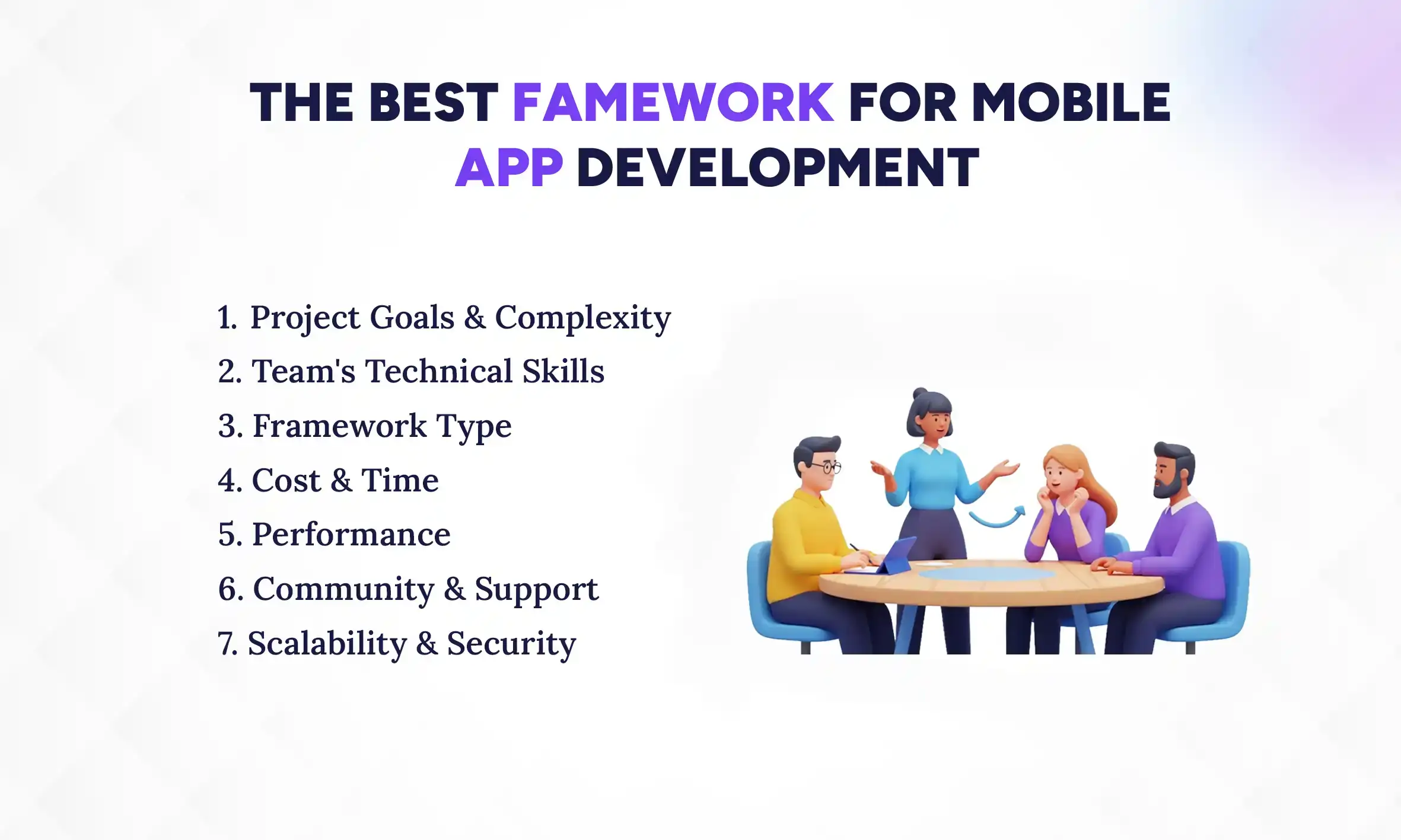
To choose the best framework for mobile app development, match your app goals, team skills, budget, and performance needs with the right framework type. This decision affects how fast you launch, how much you spend, and how well your app works. When you look at a few key factors clearly, choosing the right framework becomes much easier.
1. Project Goals & Complexity
Start by defining what your app needs to do. Simple apps need fewer features and lower effort. Complex apps need strong performance and deep device access. If your app uses heavy animations or real-time data, native frameworks work better. Cross-platform frameworks fit apps with shared features. Hybrid or PWA frameworks suit basic apps. Clear goals prevent wrong choices. Always plan for future updates.
2. Team’s Technical Skills
Your team’s skills matter a lot. Using a framework your team knows saves time. Learning a new framework slows development. Web-skilled teams do well with React Native or Ionic. Android-focused teams prefer Kotlin or Java. iOS teams work best with Swift. Familiar tools reduce errors. This keeps work smooth and fast.
3. Framework Type
Frameworks come as native, cross-platform, hybrid, or PWA. Native gives the best performance but higher cost. Cross-platform saves time with one codebase. Hybrid is quick but limited in power. PWA is low-cost and wide reach. Each type has strengths. Choose based on app needs. Do not follow trends blindly.
4. Cost & Time
Budget and deadline affect your choice. Native app development cost more and take longer. Cross-platform apps reduce cost and time. Hybrid and PWA are the fastest to build. Maintenance cost also matters. One codebase means easier updates. Always plan the full project cost. Cheap now can cost more later.
5. Performance
Performance affects user experience directly. Native frameworks give top speed and smooth use. Cross-platform offers near native performance. Hybrid and PWA are slower. Heavy apps need strong performance. Simple apps can compromise speed. Poor performance causes user drop. Choose wisely based on app load.
6. Community & Support
A strong community helps solve problems faster. Popular frameworks have more guides and tools. Updates and bug fixes come quicker. New developers find learning easier. Poor support slows progress. Community size shows framework trust. Always check long-term support. This saves time and stress.
7. Scalability & Security
Apps should grow without breaking. Scalable frameworks handle more users easily. Security protects user data and trust. Native and mature frameworks are more secure. Poor security risks data leaks. Growth planning is critical. Choose frameworks with strong updates. This keeps your app safe and future-ready.
Why Cross-Platform App Development Frameworks Are Gaining Popularity?
Cross-platform app development frameworks are popular because they let developers build one app for Android and iOS, saving time and cost. Businesses and startups want to launch faster without managing separate code for each platform. These frameworks also make updates easier and allow teams to reach more users quickly.
1. Faster Development
Cross-platform frameworks use a single codebase for multiple platforms. This means developers don’t need to write separate code for Android and iOS. Fewer lines of code speed up the development process. Updates can be applied to all platforms at once. It reduces testing time as well. Teams can launch apps much faster. This is ideal for startups and businesses with tight deadlines. It also allows rapid prototyping and iteration.
2. Cost Efficiency
Building one app instead of two saves money. Companies spend less on developers, tools, and maintenance. Cross-platform frameworks reduce long-term costs, too. Fewer resources are needed to manage updates and bug fixes. This is especially helpful for small businesses and startups. Even large companies benefit from shared code. Budget-friendly development allows investing in other features. It makes app development more predictable financially.
3. Wide Reach
Cross-platform apps work on both Android and iOS devices. This increases the potential audience. Businesses don’t have to choose one platform first. More users can download and use the app immediately. It also simplifies marketing and support. Teams can focus on a single app experience for everyone. Reaching a wider audience quickly is a major advantage. This is why many companies prefer cross-platform frameworks.
4. Easy Maintenance & Updates
Updating a single codebase is simpler than managing two separate apps. Bugs are fixed faster across platforms. New features can be rolled out to all users at once. Maintenance costs and effort are lower. Teams spend less time on repetitive tasks. This improves app quality and user satisfaction. Cross-platform frameworks streamline long-term app management. It keeps the app modern and reliable.
Which is the Best Company to Build Your Mobile App?
The Pace Infosys is the best company to build a mobile app because of its deep expertise in multiple programming frameworks, combined with proven development experience. Turning an app idea into a real product requires not only the right framework but also the right development partner. The Pace Infosys has mastery of major app development frameworks, including Flutter, React Native, Swift, Kotlin, and hybrid solutions. This ensures apps are built on frameworks that fit specific goals, budgets, and timelines perfectly.
Key strengths of The Pace Infosys include:
Expertise in Multiple Frameworks: Knowledge of the best frameworks for native, cross-platform, and hybrid apps.
Fast and Efficient Development: Framework selection reduces development time while maintaining quality.
Strong Support for Android and iOS: Seamless delivery for both platforms.
Performance and Scalability Focus: Apps optimized for speed, smooth user experience, and long-term growth.
Cost-Effective Solutions: Framework choices balance quality and resource efficiency.
Experienced Team: Skilled developers, designers, and testers ensure the app meets business goals.
Apps developed through The Pace Infosys perform well, remain secure, and are easy to maintain. Selecting the right framework ensures long-term success, whether the app requires high-performance native development, fast-to-market cross-platform solutions, or cost-effective hybrid approaches. Aligning framework expertise with project needs delivers apps that meet both user expectations and business objectives.
Conclusion
When it comes to building high-quality mobile apps, the framework you choose is as important as the company you hire. The best programming framework for app development depends on your goals, platform, budget, and team skills. For fast, cross-platform apps, Flutter and React Native are excellent choices, while Swift and Kotlin are ideal for native iOS and Android apps. Hybrid and PWA frameworks work well for simple or content-focused apps by exploring the top 10 mobile app development companies in Austin.
Ultimately, pairing the right framework with an experienced company like The Pace Infosys ensures your app is fast, reliable, and scalable. Choosing wisely from the start saves time, reduces cost, and results in a high-performing app that meets user expectations and business goals.
FAQs
Which is the best programming framework for app development?
+
The best programming framework depends on your app goals, budget, and platform needs. Flutter and React Native are great for cross-platform apps, while Swift and Kotlin are best for native performance.
What is the difference between native and cross-platform frameworks?
+
Native frameworks build apps for one platform only, such as Android or iOS. Cross-platform frameworks use one codebase to build apps for both platforms.
Are cross-platform apps as fast as native apps?
+
Cross-platform apps offer near native performance in most cases. However, native apps still provide the highest speed and smoothest experience for complex features.
How do I choose the right framework for my mobile app?
+
Choose a framework based on your app complexity, performance needs, team skills, and budget. Planning long-term scalability and maintenance is also important.
Which framework is best for startups?
+
Cross-platform frameworks like Flutter and React Native are best for startups. They reduce cost and development time while reaching both Android and iOS users.
Are hybrid frameworks good for mobile apps?
+
Hybrid frameworks are good for simple and content-based apps. They are budget-friendly but may not perform well for heavy or complex applications.
Do programming frameworks affect app security?
+
Yes, the framework can impact app security and data protection. Mature and well-supported frameworks provide better security updates and stability.
Can I change the framework after starting development?
+
Changing frameworks after development starts is possible, but costly and time-consuming. It is always better to choose the right framework at the beginning to avoid delays and extra expenses.
Ready to get started?
Book a 30-minute consultation call, and let's talk about your goals.