Mobile apps aren’t just a nice-to-have anymore. If you have a business looking to scale, build a strong brand, and connect deeply with customers, mobile applications can be a game-changer!
They are where your customers live, shop, and connect. An app can make your business feel faster, smarter, and more in tune with your audience with expanded reach and a more engaging experience. But, before you start dreaming about sleek designs and smooth animations, you need to ask the big question: how much will an app development cost exactly?
The mobile app development cost isn’t one-size-fits-all. Prices can swing wildly depending on platform, features, and who you hire. To help you understand the expenses, here, we’ll break down the numbers, explain what drives costs, and show you how to plan your budget without losing your mind, or your savings!
How Much Does It Cost to Build a Mobile App in 2026?
In 2026, the average mobile app development cost ranges from $30,000 to $150,000, depending on what you want your app to do and how polished it needs to be. Simple apps with just a few screens and basic functionality sit at the lower end, usually costing between $10,000 and $50,000. These apps focus on core functions with minimal bells and whistles.
Moving up, a medium-complexity app, like a fitness tracker or small e-commerce platform, typically falls in the $50,000 to $120,000 range because it requires more screens, integrations, and backend work. These apps often need multiple developers, designers, and testers, along with strong security and scalability considerations. The complex workflows, real-time updates, and integrations can push the cost much higher.
Understanding this range helps you set realistic expectations before you start building.
Mobile App Development Cost Breakdown (Stages + Features)
Mobile app development cost is made up of several clear stages, each with its own set of tasks that add up to the final price. These stages cover everything from planning and design to coding and quality checks, so you know exactly what you’re paying for. Let’s walk through what each of these stages really includes and why they matter.
1. Discovery and Planning
Discovery and planning is the very first step, where the idea starts taking shape. In this stage, teams do market research to understand users’ needs, define the features your app should have, and create a roadmap for how the project will move forward. It also includes discussions about technical requirements, timelines, and overall goals, making sure everyone is on the same page before development starts. This early work typically costs around $600 – $15,000, depending on how detailed the planning is. Getting this step right helps avoid delays and unexpected costs later in the project.
2. UI/UX Design and Prototyping
Once the plan is set, the design work begins. UI (user interface) and UX (user experience) design is all about how the app looks and feels. It starts with wireframes (simple sketches of screens) and user flows (how people move through the app). Then, designers create polished mockups that show what the app will look like on real screens.
Prototyping lets you click through a working model before any code is written, which helps catch design mistakes early. Design costs can range from $1,200 – $50,000 or more, depending on how complex the app’s visuals and interactions are.
3. Front-End and Back-End Development
This stage is where the app actually gets built with code. Front‑end development focuses on the parts users interact with, like buttons, menus, screens, and transitions. Back‑end development works behind the scenes, building the server, database, APIs, and logic that make the app work. Together, these parts turn design mockups into a working product. Front‑end and back‑end development usually make up the largest part of the budget, often costing tens of thousands of dollars depending on complexity, features, and integrations needed.
4. Third‑Party Integrations
Many apps need to connect to services outside the core app. These are called third‑party integrations. Examples include payment gateways (like Apple Pay or Stripe), map services (like Google Maps), analytics tools, and social login systems (like signing in with Facebook). Each integration adds development time because the team has to connect, test, and secure those services within your app. Costs for integrations vary depending on the number and types of services, but they are an important part of delivering a smooth, connected user experience.
5. Testing and Quality Assurance
Before your app can go live, it must be tested carefully to make sure everything works as expected. Quality assurance includes checking for bugs, testing performance on different devices, and making sure features behave reliably under real‑world conditions. This stage protects your reputation because users expect apps to be stable and smooth. Testing and QA typically cost several thousand dollars, and skipping or shortening this step often leads to bigger costs after launch when issues are harder to fix.
App Development Cost by Platform & Technology Choices
The platform and technology you choose for your app can make a big difference in cost, timeline, and user experience. Some approaches are more expensive but deliver better performance and features, while others save time and money but come with limitations. Understanding choices like native vs hybrid app development helps you plan your budget smartly and avoid surprises later. Let’s look at each option and what the costs really include.
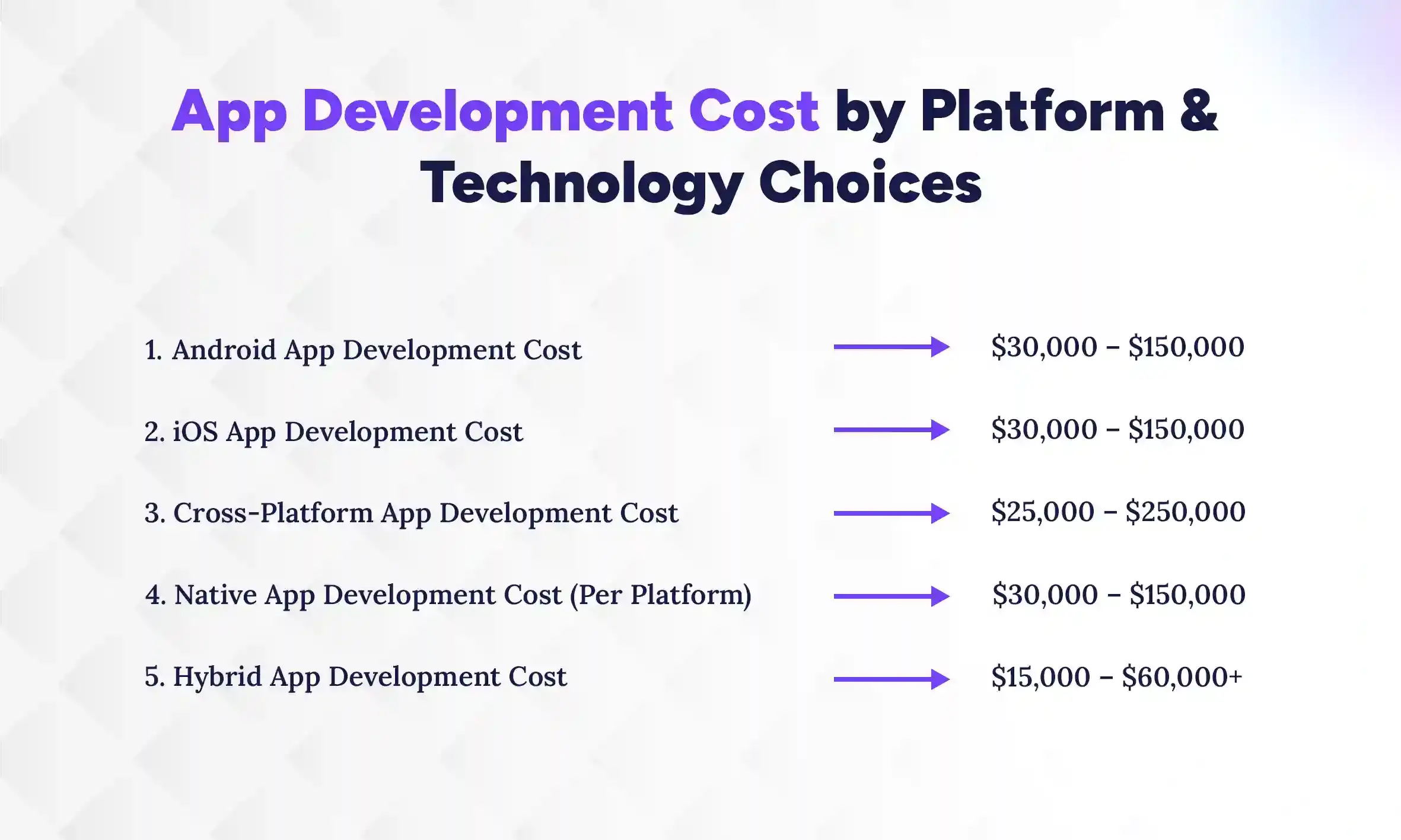
1. Android App Development Cost
Developing an app for Android devices usually costs between $30,000 and $150,000, depending on complexity. Android is popular worldwide, which means your app can reach a large audience, but you also need to test on many device models and screen sizes. This increases development and quality assurance time compared to a single-device ecosystem. The cost includes design, front-end and back-end coding, integrations, and testing to ensure your app works smoothly across all devices.
2. iOS App Development Cost
iOS app development is in the same price range as Android, roughly $30,000 to $150,000. Apple’s ecosystem is tightly controlled, so apps must meet strict design and performance standards, which can increase development time. A well-built iOS app delivers excellent performance and reliability across all iPhones and iPads. This range also includes UI/UX design, coding, backend setup, and testing to ensure your app is polished and stable.
3. Cross-Platform App Development Cost
Cross-platform frameworks like React Native and Flutter allow you to write one codebase that works on both Android and iOS. This approach is commonly used for building cross-platform mobile applications, helping businesses save time and money, especially when launching quickly. A cross-platform app can cost you around $25,000 – $250,000. The total expense can vary widely because adding complex features, APIs, or integrations increases development hours. A cross-platform app still requires design, coding, testing, and backend setup, but it usually delivers faster market reach than building two separate native apps.
4. Native App Development Cost (Per Platform)
Building a native app for each platform separately gives you the best performance and access to device features. Each platform, Android or iOS, is treated as a separate project, which means your total cost for both can double. Building a native app can cost around $30,000 – $150,000. Native apps handle complex features like AR, high-end graphics, and offline capabilities better than other approaches. This range covers full design, front-end and back-end development, integrations, testing, and optimization for smooth operation on each platform.
5. Hybrid App Development Cost
Hybrid apps use web technologies wrapped in a native container to work across Android and iOS. Because developers can use a single codebase, hybrid apps are cheaper and faster to build, often costing $15,000 to $60,000+. They work well for simpler business apps, internal tools, or MVPs but may struggle with heavy graphics or complex native features. Costs cover design, coding, integrations, and testing, but performance and deep device access are usually less than fully native apps.
How Does App Complexity Affect Development Cost?
App complexity is one of the biggest factors that change how much you’ll pay to build a mobile app. Simple apps can start around $10,000–$30,000, while complex, enterprise-grade applications can exceed $300,000–$500,000. By understanding what each complexity level includes, you’ll know what to expect in your budget and timeline. Let’s break it down in a way that’s easy to follow and useful for planning your project.
1. Basic App Development Cost
A basic app is the simplest version of a mobile application you can build. It usually has a few screens, a simple user flow, and basic functions like buttons, lists, and maybe a login screen. These apps do not require heavy backend work, advanced features, or complex integrations with other systems. Because of this simplicity, basic apps are usually much cheaper, with typical costs ranging from $9,000 to $19,500. This range can help small businesses test an idea or deliver essential services without a huge investment.
2. Medium-Complexity App Cost
When your app needs more than just a few screens, the cost starts to go up. Medium-complexity apps usually have features like user accounts, payment systems, push notifications, user analytics, and basic integration with other tools. They might also include custom UI elements and a more detailed backend setup to manage data and users. Because you are adding more functionality and requiring more development time, costs typically fall between $19,500 and $120,000. This is where most business apps land. Thoughtful design, useful features, and stable performance without being overly complex or enterprise‑level.
3. Enterprise or Feature-Rich App Cost
At the high end, enterprise or feature-rich apps are built for large operations or sophisticated services. These apps often need real‑time updates (like chat or live tracking), advanced security features, admin dashboards, AI tools, or deep integration with other systems like CRM, ERP, or payment processors. They also require thorough testing across many devices and heavy backend infrastructure to support large numbers of users. Because this type of project takes more people, more time, and higher expertise, the cost usually falls between $120,000 and $300,000+.
How Much Does It Cost to Hire an App Developer?
Hiring an app developer typically costs between $20 and $200+ per hour, heavily dependent on experience, location, and app complexity. Your choice between freelancers, agencies, or an in‑house team not only affects your budget, but also the speed, quality, and long‑term support for your app. Let’s break down what each option typically costs and what you get in return, so you can decide what fits your project best.
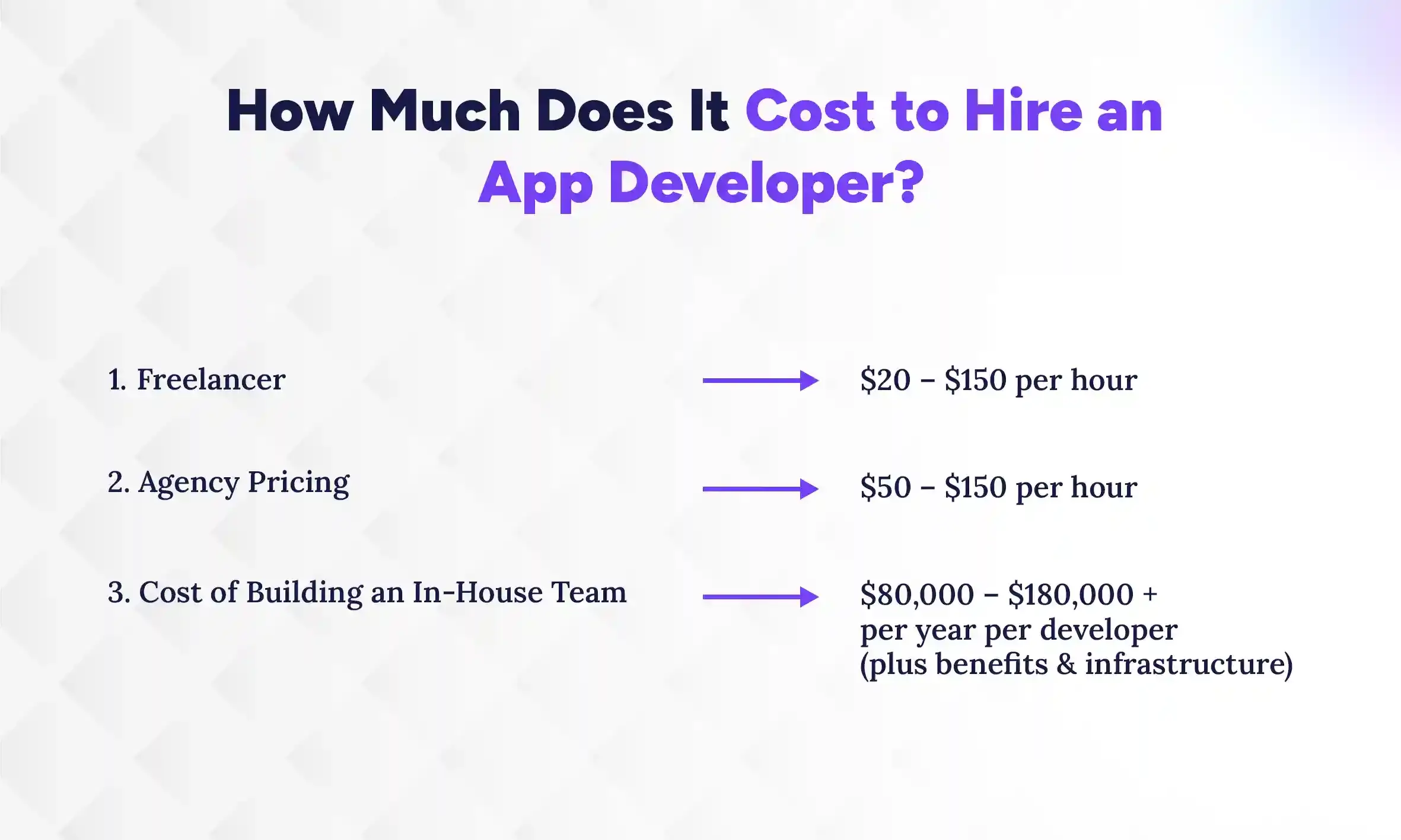
1. Freelancer
Hiring a freelancer can be a cost‑friendly way to get your app built, especially if you’re working with a tight budget. Freelancers charge by the hour, and rates can start as low as $20 per hour for less experienced developers, up to $150 per hour for highly skilled professionals. The final rate often depends on their experience, technical skills, and location. Freelancers are great for small to medium projects or for specific tasks like adding a feature, but you may need to spend extra time managing the project and ensuring consistent quality.
2. Agency Pricing
If you want a smoother, more managed process, working with an app development agency could be the right choice. Agencies usually have a full team of designers, developers, testers, and project managers. This takes away your stress of constant coordination and review on your side. Their hourly rates generally fall between $50 and $150 per hour depending on reputation and expertise. Many reputable agencies also offer monthly retainers, often ranging from about $5,000 to $15,000 per month for ongoing development and support. You’ll pay a bit more, but agencies tend to provide better structure, clearer timelines, and built-in quality checks that help reduce headaches during development.
3. Cost of Building an In‑House Team
Some businesses choose to build their own internal team, especially if they plan to develop multiple apps over time. Hiring an in‑house developer means you pay a yearly salary, and on average this can range from $80,000 to $180,000+ per year per developer, depending on their seniority and where they live. On top of salary, you’ll also need to budget for benefits, training, software tools, and office setup. While this option gives you full control and long‑term availability, it’s best for companies with ongoing development needs. Otherwise, it can be expensive for one‑off app projects.
How Long Does It Take to Develop an App?
Developing an app typically takes between 2 to 12+ months, depending on complexity. Simple apps take 2-3 months, medium-complexity apps take 3-7 months, and advanced, feature-rich apps often require 7-12+ months. Timelines depend heavily on the app’s complexity, the size of your development team, and the technologies you choose. Rushing can lead to mistakes, while over-planning can delay your launch unnecessarily. Let’s break down typical timelines for different types of apps so you have realistic expectations:
1. Timeline for Simple Apps
Simple apps usually have a handful of screens, basic features, and minimal backend requirements. For these apps, development typically takes 6 to 12 weeks from planning to launch. This includes discovery, design, coding, basic integrations, and testing. Simple apps are ideal for MVPs or small business solutions, allowing you to enter the market quickly and gather user feedback.
2. Timeline for Medium Apps
Medium-complexity apps include features like user accounts, push notifications, basic payments, and some integration with external services. Developing these apps usually takes 3 to 6 months, depending on team size and feature set. This timeline covers planning, detailed UI/UX design, coding for multiple features, testing, and a soft launch for feedback. Medium apps balance functionality and cost, making them the most common choice for businesses expanding into mobile.
3. Timeline for Complex Apps
Complex or enterprise-level apps have advanced features such as real-time chat, AR/VR, AI integration, high-end security, and scalable backends. These apps often take 6 months to over a year to fully develop and launch. The extended timeline accounts for multiple development cycles, thorough testing across devices, iterative feedback, and compliance with industry standards. Investing this time ensures your app is robust, secure, and capable of handling large user bases or sensitive data.
What Factors Influence Your App Development Costs?
The type of features you want, the platform you choose, the team building it, and even where your developers are located, all factors influence how much you’ll spend on a mobile app. Understanding these elements helps you plan your budget wisely and avoid unexpected costs. Let’s explore the main factors that shape app development pricing.
1. Platform and Technology Choices
The platform you choose, whether Android, iOS, or cross-platform, directly affects development time and cost. Native apps for a single platform usually cost more per platform but deliver better performance, while cross-platform apps save time with a single codebase. Choosing hybrid frameworks can reduce upfront costs but may limit advanced features. Additionally, the technology stack, programming languages, and third-party tools required for your app also influence the final price.
2. Development Team Structure
The composition of your development team impacts both cost and efficiency. A team may include project managers, UI/UX designers, front-end and back-end developers, and QA testers. Hiring freelancers can be cheaper but requires more oversight, whereas agencies provide full teams with better project management. In-house teams offer long-term control but come with salaries, benefits, and infrastructure expenses. The more complex your app, the larger or more specialized your team will need to be.
3. Geographic Location of Developers
Where your developers are located can make a big difference in hourly rates. Developers in North America or Western Europe usually charge higher rates due to cost of living and market demand, while Asia, Eastern Europe, or Latin America can offer lower rates for similar expertise. Remote hiring allows you to balance quality and budget by choosing the right mix of talent worldwide. Geographic factors also influence project timelines, as time zone differences can affect communication and workflow.
Hidden & Ongoing App Development Costs
Building your app is just the beginning. Maintenance, hosting, app store fees, and security all add to your ongoing budget, even after launch. Ignoring these can lead to surprises, slow updates, or unhappy users. Here’s a breakdown of the hidden and recurring costs you should plan for.
1. App Maintenance and Updates
Apps need regular maintenance to stay functional, secure, and compatible with new devices and OS versions. Maintenance can include bug fixes, performance improvements, and minor feature updates. On average, ongoing maintenance costs range from 10–20% of your initial development budget per year. Planning for this ensures your app remains reliable and your users stay happy over time.
2. Hosting and Infrastructure Costs
Most apps rely on servers, databases, cloud storage, and network services to function. Hosting and infrastructure costs depend on traffic volume, data storage needs, and whether you use cloud services like AWS, Google Cloud, or Azure. These costs can range from $50 to $500+ per month for small to medium apps, and significantly higher for enterprise-level solutions. Proper planning helps avoid unexpected downtime or performance issues.
3.App Store Fees and Compliance
Publishing an app isn’t free. Apple charges $99 per year for the App Store, while Google Play has a one-time $25 fee. You may also need additional fees for legal reviews, privacy compliance, or other certifications, which can vary from $500 to $5,000 depending on your industry. Compliance ensures your app meets regulations and avoids penalties, making it a vital part of your budget.
4. Security and Data Protection Costs
Protecting user data is crucial, especially for apps handling personal information, payments, or healthcare data. Security measures include encryption, secure APIs, authentication systems, and regular vulnerability testing. Costs for implementing strong security vary but can add $2,000–$10,000+ initially, with ongoing monitoring and updates. Prioritizing security protects your users and reduces the risk of costly breaches or reputation damage.
How Much Does App Development Cost by Industry?
In 2026, app development costs can vary a lot depending on industry and complexity, from around $10,000 for simple apps to over $500,000 for complex, specialized platforms. Typical industry ranges include E-commerce ($10k–$250k), Healthcare ($20k–$500k+), Fintech ($30k–$250k), and Social Media ($10k–$300k). Different industries have different requirements, which directly impacts app development costs. Let’s explore typical costs for popular app types:
1. E-Commerce App Cost
E-commerce apps usually include product catalogs, shopping carts, payment gateways, and order tracking. Depending on complexity, development can range from $20,000 to $120,000. Apps with advanced features like loyalty programs, real-time inventory updates, and personalized recommendations will be at the higher end. These apps also require secure payment integration and reliable backend support for smooth operations.
2. Healthcare App Cost
Healthcare apps often handle sensitive patient data and must comply with regulations like HIPAA or GDPR, which adds to cost. Simple appointment booking or teleconsultation apps start around $30,000, while complex apps with medical records, AI diagnostics, or wearable integrations can exceed $150,000. Security, encryption, and compliance are major cost drivers in this sector.
3. Fintech App Cost
Fintech apps require high levels of security, real-time transactions, and often integration with banking APIs. Costs can range from $50,000 to $200,000+ depending on complexity. Features like payment processing, digital wallets, user verification, and fraud detection increase development time. Fintech apps must also follow strict regulatory standards, adding to both development and ongoing maintenance costs.
4. On-Demand Service App Cost
On-demand apps, such as ride-sharing, food delivery, or service booking platforms, all combine geolocation, real-time updates, and payment processing. Development typically costs $40,000 to $150,000 depending on features. Apps with driver tracking, in-app chat, ratings, and dynamic pricing are more expensive. Efficient backend infrastructure is critical to handle real-time user requests and high traffic.
Is Building a Mobile App Worth the Investment?
Investing in a mobile app can feel like a big step, especially when budgets are tight. But a well-planned app can deliver strong returns, new revenue streams, and long-term business growth. Understanding how apps generate value helps you see why the cost is often worth it. Let’s explore the key benefits and ways to measure their impact.
1. ROI Potential of Mobile Apps
Mobile apps can boost customer engagement, retention, and loyalty, which directly affects revenue. Users who have your app installed are more likely to make repeat purchases or use your services regularly. Even a small increase in retention or conversion can cover the cost of development over time. When planned strategically, an app can pay for itself and continue generating value for years.
2. Revenue Models and Monetization
There are several ways to monetize an app depending on your industry and audience. Common models include in-app purchases, subscriptions, ads, premium features, and service fees. Choosing the right revenue strategy ensures your app is not just a cost center but a potential profit driver. Understanding these models early in development helps prioritize features and plan for scalability.
3. Long-Term Business Benefits
Beyond direct revenue, apps can improve brand visibility, streamline operations, and gather valuable user data. A mobile app gives your business a competitive edge by providing convenient access to your products or services. Over time, apps also allow you to implement advanced features like personalization, loyalty programs, and analytics to further strengthen customer relationships. Investing in an app is an investment in your brand’s future growth.
Simple Formula to Estimate App Development Cost
Estimating your app development cost doesn’t have to be complicated. By breaking it down into hours, design, testing, and infrastructure, you can get a realistic budget before you start. This approach helps you plan efficiently and avoid surprises along the way. Let’s go step by step to see how it works.
1. Calculating Cost by Developer Hours
The first step is estimating the total developer hours needed for your app. Simple apps may take 400–800 hours, medium apps 800–1,500 hours, and complex apps 1,500+ hours. Multiply the hours by the hourly rate of your developers (freelancer, agency, or in-house) to get a baseline cost. This gives you a solid starting point for your budget.
2. Adding Design, QA, and Infrastructure Costs
Next, factor in design, testing, and infrastructure. UI/UX design typically accounts for 10–20% of development costs, while quality assurance adds another 5–15% depending on complexity. Hosting, servers, and third-party integrations are ongoing costs that should also be included. Adding these ensures you have a full picture of what your app will really cost to launch successfully.
3. Sample Budget Calculation
For example, a medium-complexity app might need 1,000 developer hours at $35/hour, totaling $35,000. Add $5,000 for design, $3,000 for QA, and $2,000 for infrastructure, bringing the total to roughly $45,000. Adjust numbers based on your team, features, and location to create a realistic budget. This method helps you plan with confidence and avoid overspending.
How to Reduce Mobile App Development Costs?
Developing an app doesn’t have to break the bank if you plan wisely. By making smart choices around features, technology, and team structure, you can save money without sacrificing quality. Let’s explore practical ways to optimize your budget while still building a successful app.
1. Start with Core Features
Focus on the essential features your app needs to solve the main problem for users. Launching with a minimum viable product (MVP) helps you test your idea and gather feedback without spending on extras. Once users show interest, you can gradually add advanced features. This approach keeps costs manageable and reduces the risk of wasting money on unnecessary functionality.
2. Choose the Right Technology Stack
Picking the right tools and frameworks can save development time and money. For example, cross-platform frameworks like Flutter or React Native allow you to build for both Android and iOS with a single codebase. Native development is great for performance but costs more if you need multiple platforms. Match the technology to your app’s goals and budget to strike the best balance.
3. Outsource Strategically
Hiring freelancers or offshore teams can be significantly cheaper than local agencies, but it requires careful management. Outsourcing specific parts of development, like backend setup or QA, can reduce costs while keeping quality high. Make sure to vet developers, communicate clearly, and use project management tools to track progress. Strategic outsourcing gives you access to global talent without inflating your budget.
4. Use Agile Development
Agile development helps you build your app in small, iterative steps rather than all at once. This allows you to test features, get feedback, and make adjustments before spending too much. Agile also reduces the risk of overdeveloping features that users may not need. By keeping the process flexible, you save time, avoid wasted effort, and control costs effectively.
Conclusion
Investing in a mobile app is not just about dollars, it’s about creating a tool that connects you with your audience, grows your brand, and opens doors to new opportunities. From understanding development costs, platform choices, and team structures, to factoring in hidden expenses like maintenance and security, careful planning is key to getting the most value for your investment by exploring the top 10 app development companies in Austin.
It’s normal to feel overwhelmed by the numbers and options, but remember: every successful app started as an idea, just like yours. By focusing on the right features, smart budgeting, and a reliable development team, you can turn your vision into a tangible product that delights users.
So don’t delay your business idea! Take the first step today. Whether it’s sketching your MVP, reaching out to a freelancer, or exploring agencies like The Pace Infosys, your mobile app journey starts now, and the payoff can be transformative.
FAQs
How much does it cost to develop a mobile app?
+
App development costs range from $10,000 for simple apps to $500,000+ for complex, feature-rich platforms, depending on platform, features, and design quality.
What factors influence app development cost?
+
Costs depend on app complexity, platform choice, features, integrations, design quality, developer expertise, and regional rates. Every choice can significantly change your budget.
Is Android development cheaper than iOS?
+
Not necessarily. Android may require extra testing across devices, while iOS has stricter guidelines. Costs often balance out depending on app features.
Can I build an app under $10,000?
+
Yes, for basic MVP apps with minimal features. Complex apps or enterprise solutions usually exceed this range.
How long does app development usually take?
+
Simple apps can take 2–4 months, medium apps may take 4–8 months, and allocate at least 9+ months for complex apps, depending on features, team size, and platform.
How much does app maintenance cost after launch?
+
Expect 15–25% of the initial development cost annually for updates, bug fixes, security, and infrastructure maintenance.
What’s the most cost-effective way to build an app?
+
Use cross-platform frameworks, launch an MVP first, or outsource strategically to skilled developers in affordable regions.
Ready to get started?
Book a 30-minute consultation call, and let's talk about your goals.