Hiring the right people isn’t getting easier. Talent gaps are widening, great employees leave faster, and hiring often takes longer than it should. For many HR teams in Nepal, managing all this with spreadsheets or disconnected tools only adds to the stress.
That’s where talent management software comes handy. Simply put, it helps HR teams attract, develop, and retain the right people using smart, data-driven tools. Instead of reacting to problems, you start planning ahead.
And with Nepal’s workforce evolving with more competition, rising expectations, and growing businesses, having the right human resource system is no longer optional. In this guide, you’ll learn how talent management software works, what features matter, and how to choose the best solution for your organization.
What Is Talent Management Software in HR?
Talent management software is a type of HR software that helps businesses hire, develop, manage, and retain employees in one system. It covers the full employee journey, from recruitment and onboarding to performance management, learning, and even succession planning. Instead of handling each stage separately, everything stays connected and easy to track. This makes it simpler for HR teams to support employees at every step.
In practice, this means you can post jobs, track candidates, train employees, review performance, and plan future leaders, all from one place. As a result, HR teams don’t just fill roles; they build strong talent pipelines and prepare for long-term growth. It also helps managers make better decisions because they have clear data about skills, performance, and potential.
HRMS vs Talent Management Software
Now, it’s easy to confuse talent management software with a regular HRMS. An HRMS (Human Resource Management System) mainly focuses on administrative tasks like payroll, attendance, leave tracking, and storing employee records. It keeps day-to-day HR operations running smoothly and ensures that all employee data is organized and up to date.
Talent management software, on the other hand, is designed to help employees grow and succeed. It covers recruiting, onboarding, performance management, learning, and succession planning.
In short, an HRMS organizes your HR tasks, while talent management software helps your employees, and your business reach their full potential.
Some HRMS platforms include talent management features, but many do not. So, you can either look for an HR management software with an in-built talent management feature. Or, use an HRMS and a talent software separately, then ask your service providers to integrate the two software.
Why Is Talent Management Software Important for HR Managers in Nepal?
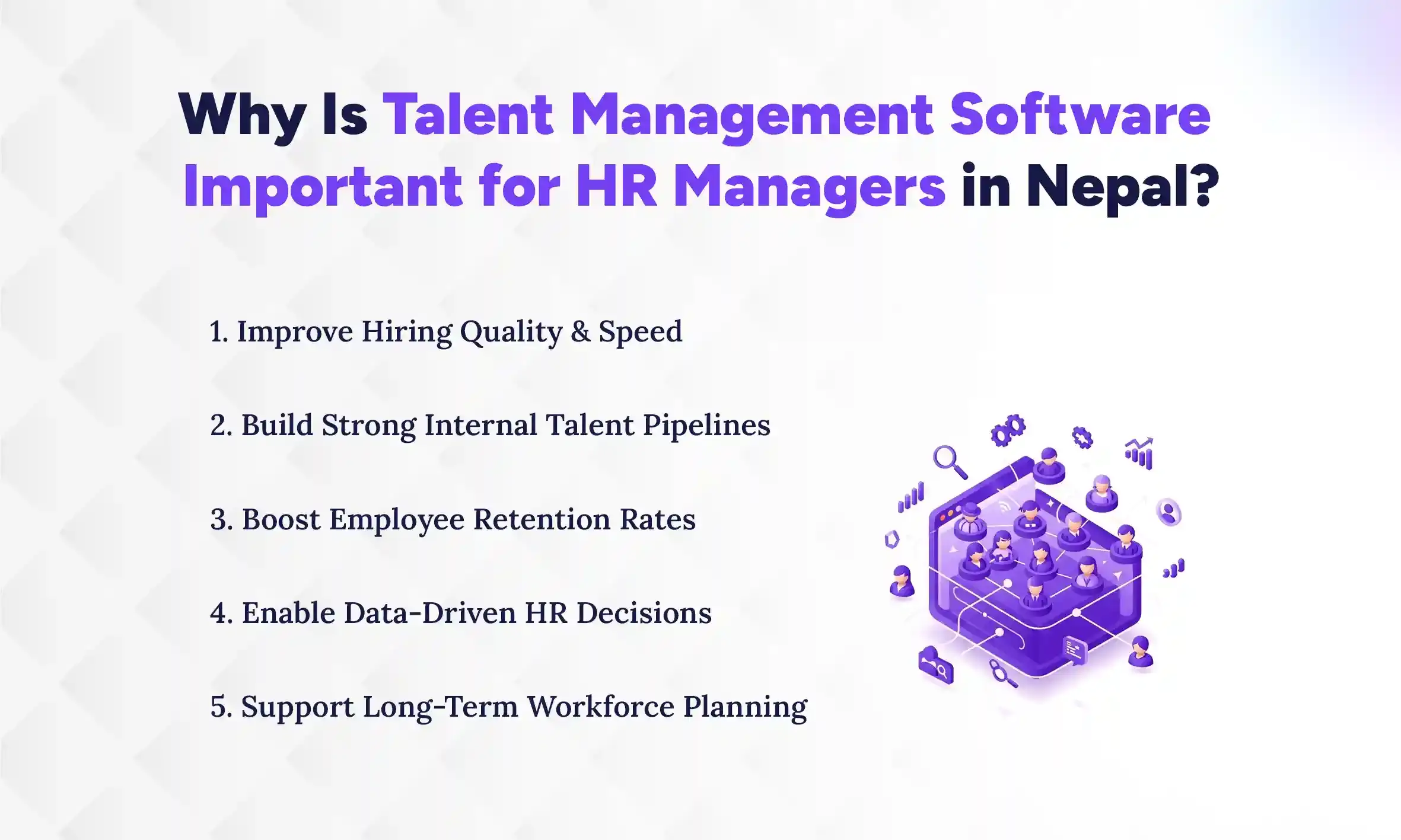
Talent management software is important because it helps HR managers hire faster, improve employee quality, reduce turnover, and make better decisions using clear data. In Nepal’s growing and competitive job market, relying on manual processes often leads to delays, missed talent, and poor planning. Let’s break down how it actually helps in day-to-day HR work.
1. Improve Hiring Quality & Speed
With talent management software, HR teams can track applicants, filter candidates, and shortlist faster without going through piles of CVs. You can set clear criteria for each role, which helps you focus only on the most suitable candidates. This reduces hiring mistakes and saves time for both HR and hiring managers. As a result, positions get filled quicker with better-fit employees.
2. Build Strong Internal Talent Pipelines
Instead of starting from zero every time, you can build a ready list of candidates for future roles. The system stores candidate data and lets you group them based on skills, experience, or interest. This way, when a role opens, you already know who to contact. Over time, this creates a strong and reliable talent pipeline.
3. Boost Employee Retention Rates
The software helps you track performance, growth, and employee feedback in one place. When employees feel seen and supported, they are more likely to stay longer. You can also identify early signs of dissatisfaction and take action before people leave. This reduces turnover and keeps your best talent within the company.
4. Enable Data-Driven HR Decisions
Instead of guessing, HR teams can use real data to make better decisions. You can track hiring trends, employee performance, and skill gaps easily. This helps you plan training, hiring, and promotions more effectively. In the long run, decisions become more accurate and less risky.
5. Support Long-Term Workforce Planning
Talent management software gives you a clear view of your current workforce and future needs. You can identify skill gaps and plan hiring or training ahead of time. It also helps in succession planning, so you’re prepared when key employees leave or move roles. This keeps your business stable and ready for growth.
Key Features of HR Software for Talent Management
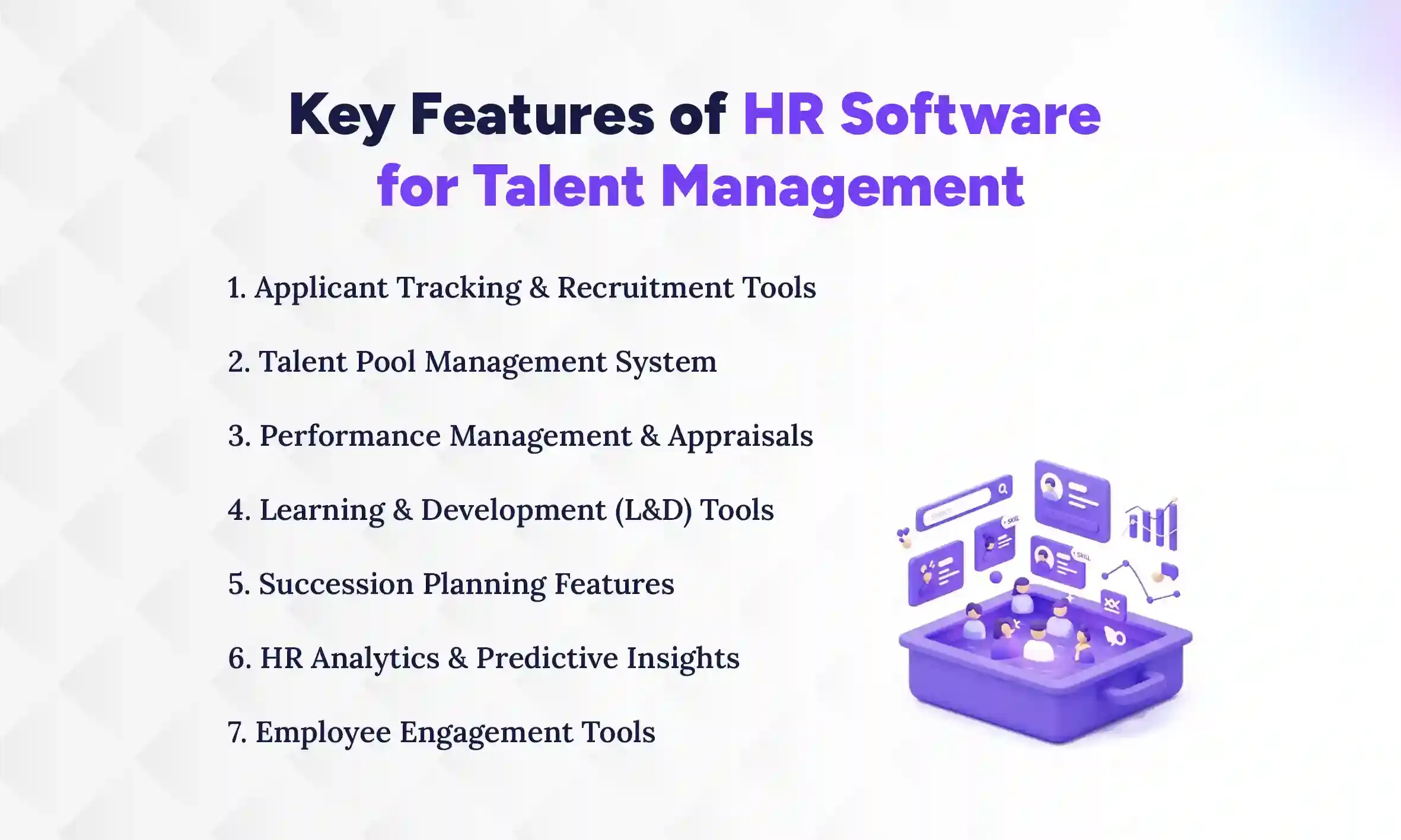
The right talent management software includes tools like applicant tracking, talent pool management, performance reviews, learning modules, and succession planning. These features help you hire better, develop employees, and plan for the future. Each tool addresses specific HR challenges, making your work faster, easier, and more organized. Let’s take a closer look at the key features you should focus on.
1. Applicant Tracking & Recruitment Tools
This feature helps you manage the entire hiring process from one place. You can post jobs, track applications, and move candidates through different stages easily. It also allows you to filter and shortlist based on skills and experience, saving time. As a result, your hiring becomes faster, more structured, and less stressful.
2. Talent Pool Management System
A talent pool system stores all candidate data in one central database for future use. You can group candidates based on roles, skills, or experience, making it easy to find the right fit later. It also helps you stay in touch with potential hires through simple updates or emails. This means you’re always ready when a new position opens.
3. Performance Management & Appraisals
This feature helps you track employee performance in a clear and consistent way. You can set goals, run appraisals, and give regular feedback without confusion. Managers get a better view of who is performing well and who needs support. Over time, this improves productivity and fairness across the team.
4. Learning & Development (L&D) Tools
L&D tools help you plan and manage employee training programs. You can assign courses, track progress, and identify skill gaps easily. This ensures employees keep learning and growing in their roles. In turn, your team becomes more capable and ready for new challenges.
5. Succession Planning Features
Succession planning helps you prepare for future leadership needs. You can identify high-potential employees and track their readiness for bigger roles. This reduces risk when key employees leave or get promoted. It also ensures your business keeps running smoothly without sudden gaps.
6. HR Analytics & Predictive Insights
This feature gives you data and reports to support better decisions. You can track hiring trends, employee performance, and turnover rates in one place. Some tools even predict future risks, like employees likely to leave. With these insights, HR teams can plan smarter and act early.
7. Employee Engagement Tools
Engagement tools help you understand how employees feel at work. You can run surveys, collect feedback, and track satisfaction levels regularly. This makes it easier to address issues before they grow bigger. When employees feel heard, they stay more motivated and committed.
Which Is the Best HR Software for Talent Management in Nepal?
Pace HRMS is one of the best HR software solutions for businesses in Nepal, with integration possibilities for talent management tools. The software combines powerful features, local compliance, payroll integration, and responsive support. It helps HR teams manage the entire employee journey, from hiring and onboarding to performance, learning, and succession planning, while keeping operations smooth and organized.
Why Pace HRMS Stands Out for Nepali Businesses
Pace HRMS is built for Nepali laws and business needs, making compliance easy and reducing HR stress. It also integrates payroll, attendance, and multi-location management for smooth operations. Pace HRMS is:
Fully compliant with Nepali labor laws
Handles local payroll and tax rules
Easy multi-location employee management
Reduces administrative workload
Key Advantages Over Other Solutions
Pace HRMS combines local adaptability with modern talent management features. Unlike international software, it fits Nepali businesses without workarounds and helps HR teams manage, develop, and retain talent efficiently.
Tailored for Nepalese businesses
Fast and smooth implementation
Talent pool management included
AI-assisted performance tracking
Learning and development modules
Succession planning made simple
How to Choose the Best Talent Management Software for Nepali Businesses?
Start by improving hiring, tracking employee performance, managing learning, and planning succession. Choosing the right talent management software isn’t just about features, it’s about finding a system that fits your team, your business processes, and the way you work in Nepal. The right software saves time, strengthens your workforce, and supports long-term growth. Here’s how to pick the best HR software solution:
1. Identify Your HR Goals & Challenges
Start by clearly understanding what problems you want to solve. Are you struggling with hiring delays, high turnover, or lack of employee growth? Once you know your priorities, it becomes easier to choose software that actually helps. This also prevents you from paying for HRMS features you don’t need.
2. Check Scalability & Flexibility
Your business will grow, and your HR system should grow with it. A good system should handle more employees, new roles, and changing workflows without needing a full replacement. It should also adapt to different work styles like remote or hybrid setups. This ensures you won’t outgrow the software too quickly.
3. Evaluate User Experience
If the system is hard to use, your team simply won’t use it. Look for clean dashboards, simple navigation, and mobile access if needed. An easy system reduces training time and improves adoption across the company. In short, the simpler it feels, the better it works.
4. Look for Integration Capabilities
Your HR software should connect smoothly with tools you already use, like payroll, accounting, or attendance systems. This avoids double work and reduces errors from manual data entry. When systems are connected, everything runs faster and more accurately. It also gives you a complete view of your workforce.
5. Compare Pricing & ROI
Don’t just look at the price, look at the value you get. A cheaper tool may cost more later if it lacks key features or support. Understand the pricing of HR software and the features that come with it. Compare what each system offers and how it improves efficiency. The goal is to save time, reduce errors, and get better results from your HR efforts.
6. Ensure Data Security & Compliance
HR systems handle sensitive employee data, so security is a must. Look for features like data encryption, access control, and regular backups. Also, make sure the software supports local labor laws and compliance needs. This protects your business and builds trust with your employees.
Common Challenges Without Talent Management Software
Without talent management software, HR teams in Nepal often struggle with slow hiring, unorganized employee data, and poor workforce planning. Manual processes create confusion, waste time, and make it hard to keep top talent engaged. These issues can affect productivity, morale, and ultimately the growth of your business.
1. Inefficient Hiring Processes
Without a centralized system, recruiting becomes slow and repetitive. HR teams spend hours sorting CVs, scheduling interviews, and tracking candidates manually. This not only delays hiring but also risks losing top candidates to competitors.
2. Poor Talent Visibility
When employee data is scattered across spreadsheets or different systems, it’s hard to know who has the right skills for upcoming roles. HR managers can miss opportunities to promote or develop existing talent, leaving potential untapped.
3. High Employee Turnover
Without tools to track performance, engagement, and satisfaction, employees may feel overlooked or unsupported. This increases the likelihood of resignations, forcing HR to constantly recruit and train new hires.
4. Lack of Data for Decision-Making
Decisions about promotions, training, or hiring are often based on guesswork instead of facts. Without clear insights from analytics, HR teams can make costly mistakes and fail to plan for the future effectively.
Latest Trends in Talent Management Software (2025–2026)
Talent management software isn’t just about tracking hires anymore. It’s becoming central to how HR teams solve bigger workforce challenges. According to Gartner’s 2025 research, four major trends will shape how organizations manage people in 2026, driven by AI, shifting labor patterns, and evolving workforce expectations.
1. Redesigning Early‑Career Roles & Development
A 2Q25 Gartner survey of 919 employees aged 22–27 found that many Gen Z workers value job mobility over security, leading to fewer entry‑level hires and more reliance on mid‑level talent. This puts pressure on HR to rethink early career programs and invest in faster skill development to keep pipelines healthy. Modern talent systems with learning modules and skill tracking help organizations build more efficient entry‑level talent strategies.
2. Internal Mobility Becomes a Priority
Gartner predicts that roughly one‑third of recruiting capacity will shift inward as HR focuses more on moving existing employees into new opportunities. Talent management tools that map skills, track performance, and support internal career paths make this shift easier. Instead of constantly hiring outside, companies can quickly find and promote internal talent where needed.
3. Turning Retention Into a Productivity Strategy
Research shows that about 25 % of the workforce is at least 20 % less productive than average, often due to disengagement or unclear goals. Talent management software makes it easier to spot productivity gaps early with dashboards and analytics. HR teams can then design specific growth plans rather than relying on guesswork.
4. Smarter Performance Management With AI + Human Insight
While AI tools are increasingly used in performance processes, many HR managers lack formal training on how to use them effectively. The trend is toward blending automation (for data gathering and routine tasks) with human judgment (for feedback, development, and fairness). Good talent systems balance both, offering AI‑assisted insights alongside human‑centric coaching tools.
These trends show that talent management software is becoming not just a tool for organizing HR work, but a strategic engine for hiring, development, retention, and performance in 2025–2026, especially as AI and shifting workforce dynamics reshape expectations.
Conclusion
Talent management software is now essential for HR teams in Nepal who want to hire the right people, keep them happy, and plan for the future. It helps you manage every step of the employee journey, from recruiting and training to performance and career growth, so HR can focus on strategy instead of just paperwork.
We know managing hiring, retention, and employee development can be stressful, especially in today’s fast-changing work environment. But with the right software, you can organize candidates, track performance, and give employees the support they need, all in one place. This makes your job easier and helps your people grow along with your business.
The best time to act is now. Explore your options, try a demo, and see how modern talent management software can make hiring smarter, employees stronger, and your business ready for growth.
Curious how a leave management system can simplify HR tasks and improve employee satisfaction? Explore our complete guide to see how modern HR tools can make managing leaves, attendance, and approvals effortless.
FAQs
What is the talent management system in HR?
+
A talent management system is software that helps HR teams hire, train, evaluate, and retain employees. It manages the full employee lifecycle, from recruitment to performance and career growth.
What is an ATS (Applicant Tracking System)?
+
An ATS is software that helps HR teams manage job applications and streamline hiring. It organizes resumes, tracks candidates through interviews, and keeps all recruitment data in one place, making hiring faster and more efficient.
What is the best HR management software?
+
The best HR management software depends on your business needs. In Nepal, solutions like Pace HRMS offer local compliance, payroll integration, talent management features, and employee engagement tools, all in one system.
Can talent management software integrate with payroll?
+
Yes, most modern HR systems connect with payroll to automatically update salaries, attendance, and deductions, reducing manual work and errors.
Is talent management software suitable for small businesses?
+
Absolutely. Scalable solutions like Pace HRMS offer features for small teams, helping manage recruitment, performance, and learning without extra complexity or cost.
Can talent management software improve employee retention?
+
Yes. By tracking performance, providing learning opportunities, and creating clear career paths, it keeps employees engaged and reduces turnover.
Is a talent management system useful for Nepali companies?
+
Of course, companies need a talent management system, regardless of location. Moreover, local solutions like Pace HRMS are designed for Nepali labor laws, payroll integration, and multi-location support, making them ideal for Nepalese businesses.
What features should HR look for in a talent management system?
+
Key features include applicant tracking, talent pool management, performance management, learning tools, succession planning, and employee engagement dashboards.
Ready to get started?
Book a 30-minute consultation call, and let's talk about your goals.