It's that time of year again. Colleagues whisper in the pantry, HR inboxes fill up, and one question keeps coming back: how much will my salary go up this year?
Salary increment in Nepal is more than a yearly ritual. For employees, it signals that their work is valued. For employers, it helps keep good people from walking out the door. Yet many people confuse what the law requires with what a company chooses to offer on top.
This guide clears that up. You will learn what the Labour Act, 2074 says, how to calculate an increment step by step, what factors shape extra raises, and how HR teams can run the whole process smoothly. Let's start with the basics.
What Is Salary Increment?
Salary increment is a rise in an employee's existing salary, usually given every year or after a period of strong performance. It recognizes experience, contribution, and growing responsibility. Still, not every raise happens for the same reason, so it helps to know the main types.
Annual increment: A yearly raise given after an employee completes a year of service.
Performance-based increment: An extra raise linked to appraisal results, targets, or exceptional work.
Promotion-based increase: A pay rise that comes with a higher position and bigger responsibilities.
Two more terms often get mixed up with these. A salary revision is a wider update to pay levels, such as changing the salary scale for a job grade because market rates have moved. A bonus is a one-time payment that does not change the monthly salary.
Here is a quick example. Sita, an accountant, completes one year and receives her annual increment. Her manager also gives her a performance raise for a smooth audit season. Later, the company revises pay scales for all accountants, and when she becomes a senior accountant, her pay rises again. Meanwhile, the one-time bonus for finishing the audit early disappears from the next payslip. Five changes, five different reasons.
What Are the Salary Increment Rules in Nepal?
Nepal's Labour Act, 2074 entitles an employee who has completed one year of service to an annual increment every year. As stated in Section 36, employees must receive a minimum increment of half a day’s basic salary. That is a legal floor, not a ceiling, so let's see what it covers and what it leaves to employers.
What Section 36 requires
Eligibility starts after one full year of service.
The increment must be at least half a day's remuneration based on monthly basic remuneration.
The Act's definition of basic remuneration includes the increment given after one year of service, so the amount builds on itself over time.
What employers must do
Give the annual increment every year once an employee is eligible.
Calculate it on basic salary, not gross salary.
Record it in payroll and the employee's salary records.
Withhold it only under the Act's disciplinary provisions. For example, Section 131 allows withholding the annual increment or promotion for one year for certain serious misconduct, such as embezzlement.
Statutory vs additional increments
The annual increment is what the law guarantees. Anything beyond it, such as a performance raise or market adjustment, is the employer's decision under company policy. The Labour Act does not mandate a fixed 5%, 10%, or any other percentage. Keep the two clearly separate in letters and payroll files.
How Is Salary Increment Calculated in Nepal?
In Nepal, the Labour Act requires an annual increment equivalent to at least half a day's basic salary for employees who complete one year of service. This is different from the percentage-based increments that companies may offer based on performance or company policy. Let's understand how both work with a simple example.
1. Calculating the Mandatory Annual Increment
Under Section 36 of the Labour Act, 2074, an employee is entitled to an annual increment of at least half a day's remuneration based on their monthly basic salary.
For a simple calculation, divide the monthly basic salary by 30 to find the daily salary. Then, divide that amount by two to get the annual increment.
Example:
Suppose Hari earns NPR 30,000 as his monthly basic salary.
Monthly basic salary = NPR 30,000
Daily basic salary = 30,000 ÷ 30 = NPR 1,000
Half a day's salary = 1,000 ÷ 2 = NPR 500
Therefore, Hari’s annual increment is NPR 500, making his new basic salary NPR 30,500.
2. Calculating a Percentage-Based Salary Increment
Apart from the mandatory annual increment, companies may offer additional salary increases based on employee performance, experience, or company policy.
The calculation is simple:
Increment Amount = Current Salary × Increment Percentage ÷ 100
For example, if Ramesh receives an additional 8% increment on his NPR 30,000 basic salary:
An employee can receive the mandatory annual increment along with an additional performance-based increment. In such cases, both amounts contribute to the revised salary.
For example, if Hari receives NPR 500 as his mandatory annual increment and NPR 1,500 as an additional performance-based increment, his revised basic salary becomes:
NPR 30,000 + NPR 500 + NPR 1,500 = NPR 32,000.
This way, businesses can meet their legal obligations while also rewarding employees for their performance.
What Factors Determine Employee Salary Increment?
Employee performance, experience, skills, company finances, market pay, inflation, and role changes all influence how much extra increment a person receives. These factors apply to additional raises only, and they never replace the statutory annual increment. Here is how each one plays out in practice.
Performance and productivity: Strong results and met targets justify bigger raises. A sales executive who beats targets two years in a row is a natural candidate.
Experience and years of service: Longer service brings deeper know-how, and many companies reward that loyalty.
Skills, qualifications, and responsibilities: A new certification or added team duties increase an employee's value, and pay should reflect it.
Company profitability and budget: Every raise must fit the budget. A tough year may shrink additional raises, though the statutory increment still applies.
Market salary benchmarks: If competitors pay more for the same role, retention suffers. Checking pay for similar jobs helps you avoid losing people.
Inflation and cost of living: Rising rent, food, and transport costs eat into real pay, so many employers weigh them during salary revision in Nepal.
Promotions and role changes: A bigger role with more accountability usually calls for higher pay.
What Is the Standard Salary Increment Percentage in Nepal?
Nepal does not have a legally fixed annual salary increment percentage. The Labour Act sets the minimum as half a day's remuneration, not as a percentage, and anything above that is left to the employer. That is why the salary increment percentage in Nepal differs so widely, and it helps to see how organizations decide.
The statutory increment is a legal duty. A percentage-based revision is a business decision made under company policy. You may see blogs or social posts quoting a "standard" 5% or 10%. Treat those as examples, not rules, because no official nationwide figure exists.
Most HR teams start with an increment budget for the year, often as a share of total payroll, and then divide it across employees. When setting that budget, they usually look at:
Company profit and cash flow
Salary levels in the market for similar roles
Inflation and cost of living
Appraisal results across the team
Where each employee sits within the salary range for their role
Percentages vary because every company has different finances, and every employee has a different performance record, role, and pay position. Two people in the same office can reasonably get different percentages.
How to Develop an Effective Salary Increment Policy?
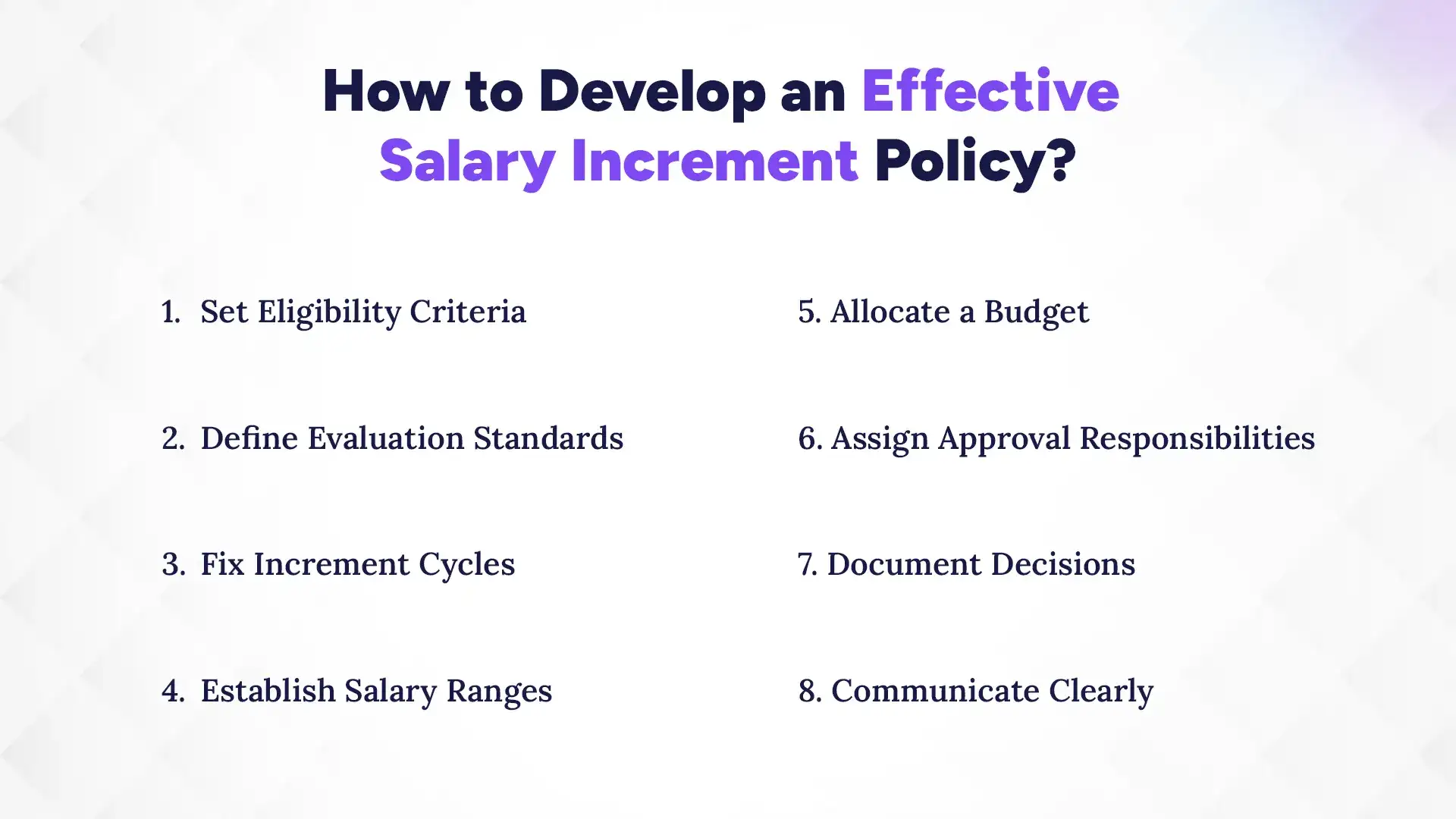
An effective salary increment policy is a written set of rules that explains who gets an increment, how much, when, and who approves it. It keeps decisions fair, consistent, and legally compliant. The steps below work for large firms and for small and medium businesses alike.
Set eligibility criteria: Define who qualifies, such as employees who have completed one year of service, and how probation and leave are treated.
Define evaluation standards: Decide how performance is rated, using clear goals instead of gut feeling.
Fix increment cycles: Choose a review period, such as each work anniversary or a common date, and make sure no one waits beyond the legal one year.
Establish salary ranges: Set a minimum and maximum for each position so raises stay fair across the team.
Allocate a budget: Decide the total amount available before individual decisions begin.
Assign approval responsibilities: Name who recommends, reviews, and approves, so nothing stalls.
Document decisions: Record the reason behind every revision for future reference and audits.
Communicate clearly: Tell employees the outcome, the new salary, and the effective date. Silence breeds rumours.
Small businesses can keep this simple. A one-page policy and a basic rating sheet are far better than no policy at all.
How Should HR Manage the Salary Increment Process?
HR should manage the salary increment process as a clear sequence, from checking records to updating payroll. Each stage has an owner, and skipping one is how errors and complaints begin. Here is the execution flow, assuming your policy is already in place.
Review salary records: HR confirms joining dates, current basic salary, allowances, and past increments. Wrong records lead to wrong increments.
Conduct performance appraisals: Managers rate employees against agreed goals, while HR keeps the process consistent.
Evaluate eligibility: HR checks who has completed one year of service and who qualifies for an additional increment.
Calculate increments: HR works out the statutory increment and any additional amount separately, as shown earlier.
Obtain management approval: Management reviews the proposals against the budget and approves the final figures.
Prepare revised salary structures: HR updates basic salary, allowances, and totals for each employee.
Issue increment letters: Each letter should state the new salary, the effective date, and which part is statutory and which is additional.
Update payroll records: Payroll applies the new figures from the effective date, so employees see the change in their next payslip.
Throughout, accurate records, clear communication, and proper documentation protect both the employee and the company. Timely payroll updates matter too, since a delayed increment means back pay and unhappy staff.
How Can HR Software Simplify Salary Increment Management?
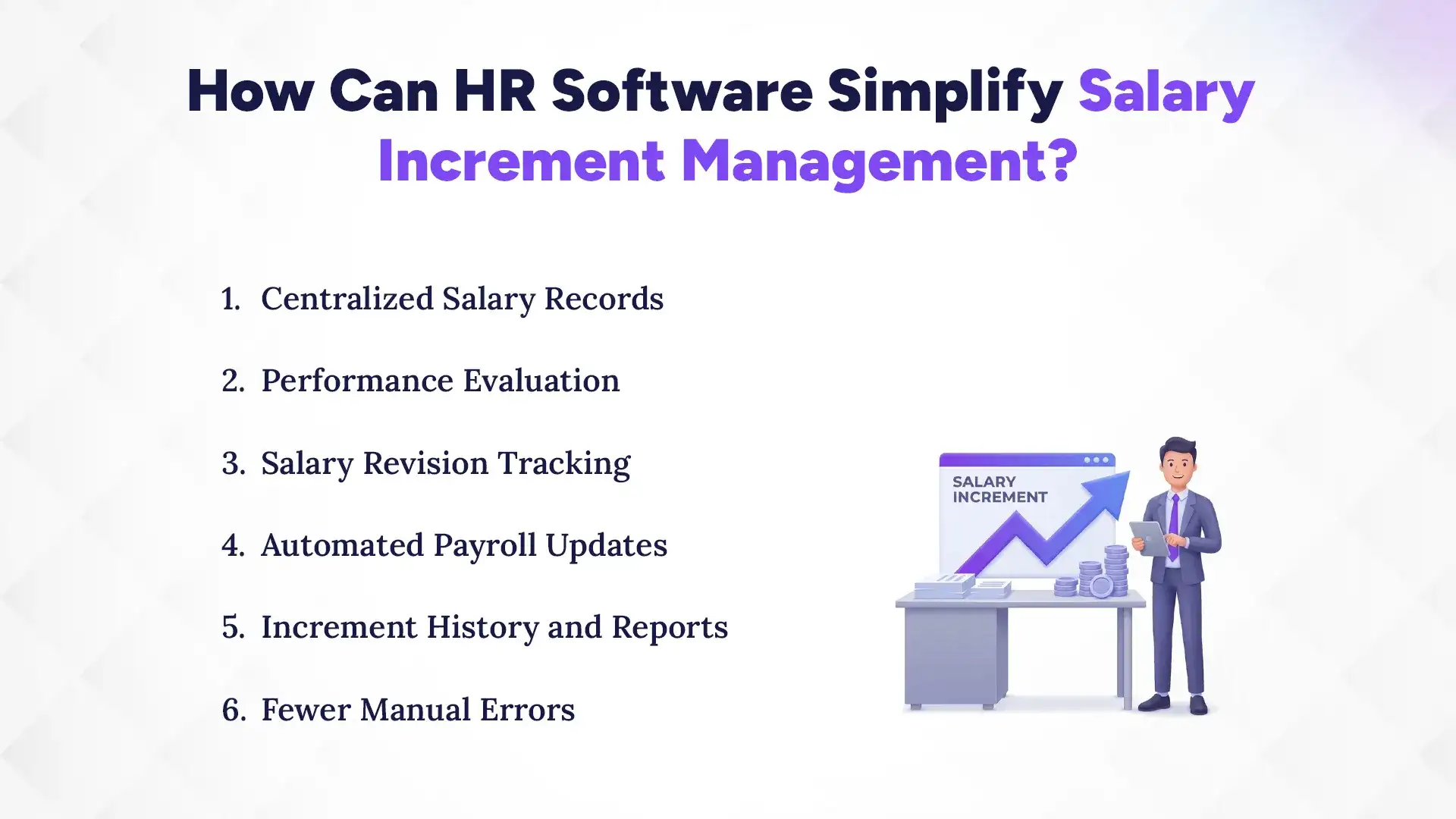
HR software helps businesses in Nepal manage salary increments by keeping employee records, performance appraisals, salary revisions, and payroll in one system. Instead of updating multiple spreadsheets, HR teams can manage the entire process more easily and reduce manual errors. Here is how HR software makes salary increment management simpler.
Centralized salary records: Store employee salaries, joining dates, and previous increments in one place.
Performance evaluation: Review employee performance before making increment decisions.
Salary revision tracking: Maintain records of approved increments and salary changes.
Automated payroll updates: Reflect revised salaries in payroll without repeated manual entries.
Increment history and reports: Track salary changes for budgeting and future reviews.
Fewer manual errors: Reduce data entry mistakes during salary revisions and payroll processing.
For Nepalese businesses looking to simplify these processes, Pace HRMS offers an integrated HR and payroll management solution. It helps businesses manage employee information, performance, attendance, and payroll from a centralized platform. With support for Nepal-specific payroll requirements, including SSF, CIT, and TDS calculations, it helps HR teams handle salary updates alongside their regular payroll responsibilities.
Why Choose Pace HRMS for Employee Records and Performance Management?
Pace HRMS is a customizable HR software in Nepal that helps businesses manage the entire employee lifecycle, from daily activities and employee records to appraisals and performance reviews. It also provides workforce analytics and predictive reports to help HR teams understand employee performance and make informed decisions.
What makes Pace HRMS a preferred choice for businesses in Nepal?
Trusted by leading organizations across Nepal.
Backed by over a decade of software development experience.
Highly customizable with flexible pricing options.
Mobile-friendly experience for employees and HR teams.
Whether you manage a growing team or multiple branches, Pace HRMS makes it easier to keep employee records organized and payroll updated. Explore Pace HRMS to see how your business can simplify HR and salary management.
Conclusion
Understanding salary increment rules in Nepal helps employees know their rights and helps employers stay compliant. The Labour Act, 2074 guarantees a minimum annual increment of half a day's remuneration on basic salary, and everything beyond that depends on company policy. A clear, written process turns that difference into something everyone can trust.
Fair appraisals, transparent HR policies, and accurate payroll keep increments free of confusion and complaints. When employees see how decisions are made, they stay motivated, and when employers follow a structured process, they avoid legal and administrative headaches. Tools like Pace HRMS can simplify employee and payroll management along the way.
So before your next increment cycle begins, review your policy, check your records, and make sure your statutory and additional increments are clearly separated. Your team will notice the difference.
FAQs
Is annual salary increment mandatory in Nepal?
+
Yes. Under Section 36 of the Labour Act, 2074, an employee who has completed one year of service is entitled to an annual increment. It does not depend on appraisal ratings, though the Act allows withholding it for serious misconduct through proper disciplinary action.
How much is the minimum annual salary increment in Nepal?
+
The minimum is half a day's remuneration, based on the employee's monthly basic remuneration. On a basic salary of NPR 30,000, that works out to NPR 500 when the daily rate is calculated by dividing by 30. Employers can always offer more.
Is salary increment based on basic or gross salary?
+
The statutory increment is usually based on basic salary, so allowances are excluded. Employers may use gross salary for additional percentage-based raises, but that is a company policy choice, not a legal requirement.
Can an employer deny an annual salary increment?
+
Generally no. Once an employee completes a year of service, the increment is a legal entitlement. The Act does allow withholding it for one year as a penalty for specified serious misconduct, but only through the proper disciplinary process.
When should companies provide annual salary increments?
+
Most companies give increments once a year, either on each employee's work anniversary or on a common date. Whichever cycle you choose, make sure no employee waits longer than the legal one-year mark, and write the cycle into your policy.
Are salary increments and promotions the same?
+
No. An increment raises pay within the same role, while a promotion moves an employee into a higher position. A promotion may include a pay rise, but the two are decided separately and should be documented separately.
Can an employee receive both annual and performance-based increments?
+
Yes. The statutory annual increment is the minimum, and employers can add a performance-based increment on top. State clearly in the increment letter which part is statutory and which is additional, so the final figure is easy to understand.
Ready to get started?
Book a 30-minute consultation call, and let's talk about your goals.