When should an employee receive a bonus? Who qualifies for it? And how should an employer calculate the amount?
For HR professionals and business owners in Nepal, these are more than payroll questions. Employee bonuses involve profit, eligibility, payroll records, tax, and legal compliance. That makes it important to understand what the Bonus Act 2030 actually requires before processing annual bonus payments.
The Bonus Act 2030 provides the legal framework for distributing bonuses to employees of covered establishments in Nepal. It covers matters such as eligibility, bonus calculation, distribution, and the responsibilities of employers.
In this guide, we’ll break down the Bonus Act Nepal in simple terms, including who is eligible, how the bonus works, what HR teams need to record, and where payroll processes can go wrong.
What Is the Bonus Act 2030 in Nepal?
The Bonus Act 2030 is Nepal's legislation governing employee bonus distribution in covered establishments. It connects employee bonuses with the establishment's profit and sets rules for determining eligibility, calculating and distributing bonuses, and maintaining the required process.
In simple terms, the Bonus Act 2030 answers an important question for employers: when an establishment makes the applicable profit, what portion is allocated toward employee bonuses and how should that bonus be distributed?
1. Why Was the Bonus Act Introduced?
The Bonus Act provides a legal framework for sharing a portion of an eligible establishment's profit with its employees.
This gives employers a defined process for handling bonuses instead of leaving the payment entirely to individual company policies. For HR teams, that means bonus management needs to consider both the company's financial position and the employee's eligibility under the applicable rules.
The Act also sets out requirements around the form and timing of bonus payments. For example, bonuses under the Act are paid in cash, and the Act requires distribution within eight months after the end of the financial year, subject to provisions allowing an extension in certain circumstances.
2. Is a Statutory Bonus the Same as an Employee Incentive?
No. A bonus provided under the Bonus Act should not automatically be treated as the same thing as a performance incentive or discretionary reward.
A company may have its own incentive schemes, annual performance bonuses, commissions, or other employee benefits. These can operate separately from the statutory bonus requirements under the Act.
For HR teams, keeping these payments clearly categorized helps avoid confusion during payroll processing, tax calculation, and employee record keeping.
Who Is Covered Under the Bonus Act Nepal?
Employee eligibility depends on factors such as the employee's working period and employment status. The Act also specifies certain employees and situations that are excluded from bonus entitlement.
1. Employees Who Work at Least Half the Fiscal Year
An employee generally becomes eligible for bonus when they have worked for at least half of the period they are required to work during the financial year, subject to the Act's provisions. This makes the employee's service period an important part of the bonus process.
2. Employees on Paid Leave or Recognized Work-Related Absence
The Act recognizes certain periods as part of the employee's working period, including applicable paid leave and specified periods relating to reserve duty or disability resulting from an accident connected with the establishment's work. For HR, this means eligibility should be checked against the applicable provisions rather than calculated simply from attendance days.
3. Temporary and Fixed-Term Employees
Temporary or fixed-term employment does not necessarily mean an employee is automatically excluded from bonus consideration. The applicable Bonus Rules provide provisions for temporary employees, while contractual employment can depend on the terms of the employment agreement and the applicable legal requirements.
4. Employees Excluded From Bonus Eligibility
The Act excludes certain categories of workers from bonus entitlement. This includes casual and replacement employees under the relevant provision.
The Act also contains provisions under which an employee can lose bonus entitlement in specified disciplinary circumstances, such as certain acts involving the establishment's property, illegal strikes, or serious disciplinary misconduct.
5. Employees Who Leave During the Fiscal Year
Leaving an organization during the financial year does not automatically answer the bonus question. The employee's period of service and the applicable provisions of the Act need to be considered when determining eligibility and the amount payable. This is why HR teams should keep joining dates, separation dates, payroll history, and other relevant employee records up to date.
For employers, the key takeaway is simple: don't calculate bonuses from a single salary sheet. Employee eligibility needs to be established first, using the applicable provisions of the Bonus Act and Rules.
How Is Bonus Calculated and Distributed Under the Bonus Act?
Bonus under the Bonus Act 2030 is calculated based on the establishment’s profit and the applicable bonus distribution rules, not simply an employee’s basic salary. For covered profit-making establishments, the Act provides for a portion of net profit to be allocated toward employee bonuses, subject to its provisions. Here’s how the bonus calculation, distribution, and payment process works in practice.
1. Bonus Calculation Based on Enterprise Profit
For a profit-making establishment covered by the Act, 10% of the net profit is allocated for employee bonuses, subject to the Act's provisions.
The resulting bonus pool is then distributed among eligible employees according to the applicable calculation rules. This means HR teams need to consider the establishment's applicable profit, the bonus pool, employee eligibility, and the relevant salary or wage figures.
For example, if an eligible establishment has NPR 10 million in net profit, 10% would create a NPR 1 million total bonus pool for eligible employees. This NPR 1 million is then distributed among eligible employees according to the applicable calculation rules, rather than giving each employee 10% of their basic salary.
2. Bonus Distribution and Payment
Once the applicable bonus amount has been determined, it is distributed among eligible employees according to the Act.
The Act requires bonuses to be paid in cash and generally distributed within eight months after the end of the financial year. It also provides a mechanism for an extension in certain circumstances when the bonus cannot be distributed within that period.
3. Records Employers Need to Maintain
Bonus processing depends on accurate information. HR and finance teams should maintain relevant employee, salary, financial, calculation, and payment records.
Keeping these records organized helps employers verify eligibility, calculate payments, answer employee questions, and maintain a clear payroll trail.
And this is where the bonus process starts becoming an HR technology issue, not just a legal one.
Bonus, Salary and Tax: What HR Teams Should Know
Bonus affects more than an employee’s annual payout because it also needs to be considered alongside salary, payroll, deductions, tax, and employee records. HR teams should therefore process bonus payments as part of an organized payroll process, with the right records and applicable tax requirements in place.
1. Is Bonus Part of Salary?
A bonus is different from an employee's regular salary or allowance. Basic salary is the fixed amount paid for an employee's work, while a bonus is an additional payment made according to applicable statutory or company rules.
This distinction matters when HR teams prepare payroll. Bonus calculations should follow the applicable provisions rather than simply adding a fixed percentage to an employee's basic salary.
Keeping salary, allowances, and bonus amounts clearly separated also makes payroll records easier to review.
2. Is Bonus Taxable in Nepal?
Bonus can have tax implications in Nepal. Employers should account for applicable tax requirements when processing employee bonus payments and ensure the relevant deductions and reporting are handled correctly.
For HR teams, this means the bonus process should connect with payroll and tax calculations, rather than being handled as a completely separate payment.
If your organization calculates salary tax manually, it is also important to use the applicable tax rules for the relevant financial year.
3. Why Payroll Records Matter
A bonus payment creates another important payroll record. HR teams should be able to trace the process from employee eligibility and salary data to bonus calculation, applicable deductions, payment, and payslip.
Keeping these details organized makes it easier to answer employee queries and maintain consistent payroll records.
How HR Software Helps Manage Bonus Payments
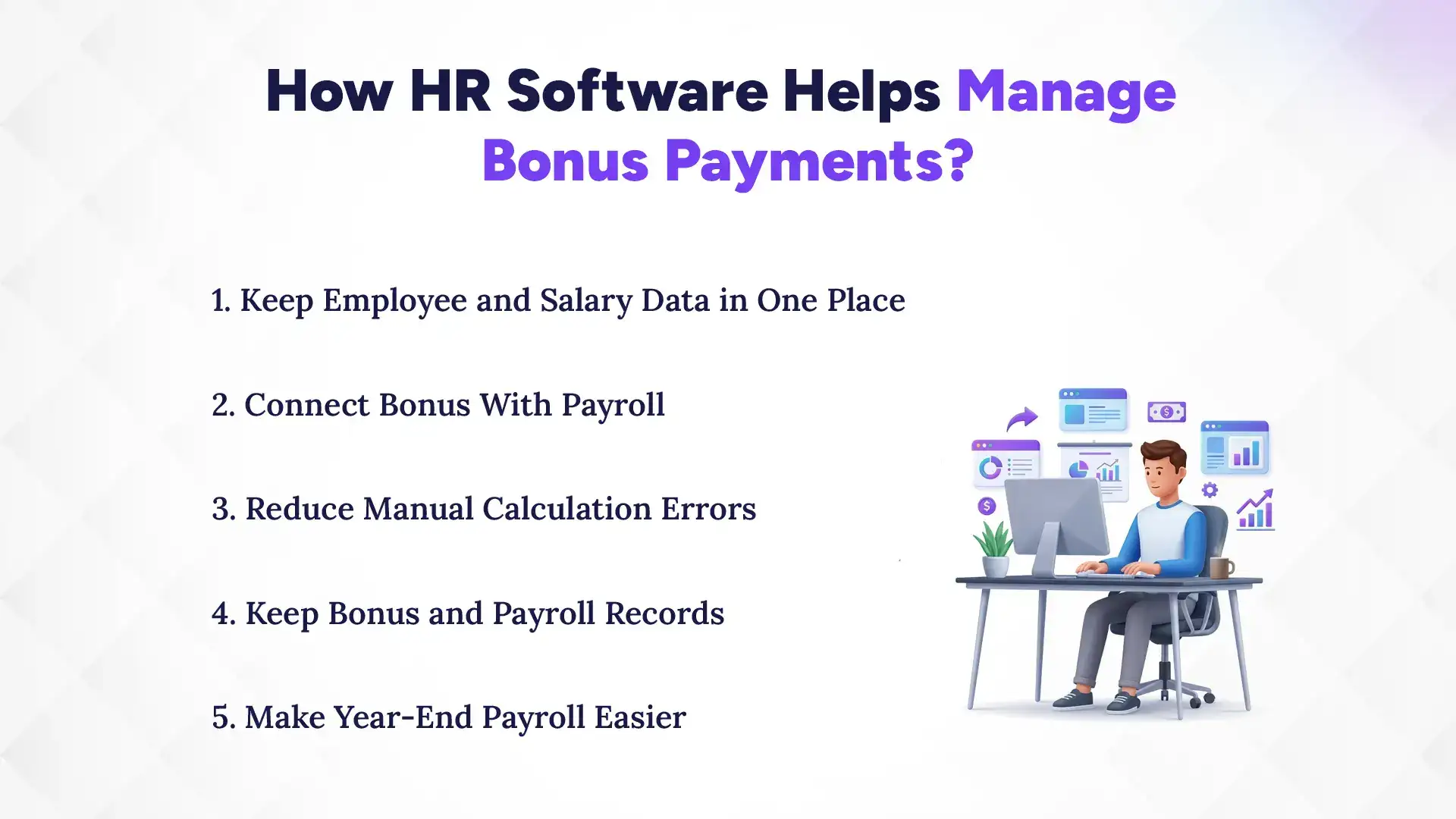
HR software can help businesses manage bonus payments by connecting employee records, salary data, payroll, tax calculations, and payment records in one system. This reduces repetitive manual work and gives HR teams a clearer process for handling bonuses. Here are some practical ways HR software can support bonus management.
1. Keep Employee and Salary Data in One Place
An HRMS can centralize employee profiles, joining dates, salary information, employment history, and payroll records. This gives HR teams the data they need when checking bonus eligibility and preparing payments.
2. Connect Bonus With Payroll
Instead of calculating bonus amounts separately and manually transferring them into payroll, HR teams can manage bonus-related payments as part of their broader payroll process.
3. Reduce Manual Calculation Errors
Spreadsheets can work for smaller teams, but repeated manual calculations become harder to manage as the workforce grows. HR software can automate configured payroll calculations and reduce repetitive data entry.
4. Keep Bonus and Payroll Records
A centralized payroll system can maintain payroll history, payslips, employee records, and payment information. This gives HR teams a clearer record of what was calculated and paid.
5. Make Year-End Payroll Easier
When bonus processing comes around, HR should not have to search through spreadsheets, employee files, and separate payroll records.
For example, Pace HRMS combines employee records, payroll, tax calculations, salary components, and payroll reporting in one system, helping HR teams manage these processes from a centralized platform.
Explore Pace HRMS for payroll and employee management.
Common Bonus Management Mistakes Employers Should Avoid
Employers can avoid bonus-related payroll and compliance problems by using accurate profit, employee, salary, and payment records throughout the process. Common mistakes include using outdated legal information, overlooking employee eligibility, and treating statutory bonus as a simple salary percentage. Here are the key mistakes HR and payroll teams should watch for.
1. Treating Bonus as a Fixed Salary Percentage
The statutory bonus process is not simply a matter of multiplying every employee's basic salary by the same percentage. Employers need to follow the applicable calculation method.
2. Using Outdated Legal Information
The Bonus Act and related rules should be checked against the latest applicable requirements. Using an old blog, spreadsheet, or internal policy as the only reference can lead to incorrect calculations.
3. Using Incorrect Profit Figures
The bonus calculation starts with the applicable profit figure. HR and finance teams should therefore work with accurate and properly documented financial information.
4. Overlooking Employee Eligibility
Not every employee necessarily falls into the same eligibility category. Employment period, employment type, and other applicable conditions should be checked before calculating individual bonuses.
5. Separating Bonus From Payroll
Managing bonus calculations separately from payroll can create mismatched figures, duplicate data entry, and reconciliation problems.
6. Poor Documentation
HR teams should retain the records supporting eligibility, calculations, deductions, and payments. Good documentation makes the process easier to verify later.
Bonus Act Nepal: HR Compliance Checklist
Before processing employee bonuses, HR and payroll teams should:
Confirm whether the establishment falls under the Bonus Act.
Verify the applicable financial information.
Review employee eligibility.
Calculate the applicable bonus amount.
Determine individual employee payments.
Account for applicable tax and deductions.
Process payments within the required timeline.
Maintain calculation and payment records.
Check the latest applicable legal requirements.
A simple checklist like this can help HR teams catch missing information before bonus payments are finalized.
Conclusion
The Bonus Act 2030 gives employers and HR teams a legal framework for managing employee bonuses in Nepal. Understanding who qualifies, how the bonus is calculated, and how payments and records should be handled can make the process much easier to manage.
For businesses, the work does not end with calculating the bonus. Accurate employee records, payroll data, tax calculations, and payment history are all part of a reliable bonus process.
A centralized HRMS can reduce the manual work involved by bringing these processes together.
Managing payroll and employee records manually? Explore Pace HRMS to bring your HR and payroll processes into one centralized system.
Ready to get started?
Book a 30-minute consultation call, and let's talk about your goals.