A payroll error rarely stays contained to the paycheck it affects. Beyond correcting the payment itself, a single mistake can damage employee trust, create compliance issues, and add unnecessary administrative work. Many payroll errors result not from negligence, but from manual or disconnected processes that make mistakes easier to miss. In Nepal, payroll management involves several areas that require careful attention, including salary and tax calculations, Provident Fund (PF) and Social Security Fund (SSF) contributions, attendance and leave records, and fiscal-year reporting. Even a small oversight can lead to incorrect payments, employee concerns, or compliance problems.
In this guide, we'll cover 10 common payroll errors in Nepal, explain how to prevent them, show how to identify mistakes before payroll is processed, and outline what to do if an error has already reached an employee.
What Counts as a Payroll Error?
A payroll error is a mistake in calculating, processing, paying, or recording an employee’s compensation, deductions, taxes, or applicable statutory contributions. These errors can occur at different stages of the payroll process, from entering employee data to calculating salaries and maintaining payroll records. A payroll error is any mistake that causes an employee’s pay, deductions, taxes, contributions, or payroll records to be inaccurate. Understanding HR software uses helps clarify where these errors typically occur within broader HR management. Payroll errors generally fall into four categories:
Calculation errors: Mistakes in calculating pay, such as applying the wrong tax rate or miscalculating overtime.
Data errors: Mistakes caused by inaccurate or outdated information, such as incorrect attendance records, leave balances, or salary figures.
Processing errors: Mistakes during the payroll or payment process, such as duplicate payments, missed employees, or incorrect payment amounts.
Recordkeeping errors: Mistakes in maintaining payroll records, such as incomplete documentation or inaccurate historical records that make payroll difficult to review or audit.
Most of the payroll mistakes covered in this guide fall into one or more of these categories. Understanding them helps employers identify where an error occurred and take steps to prevent similar mistakes in future payroll cycles.
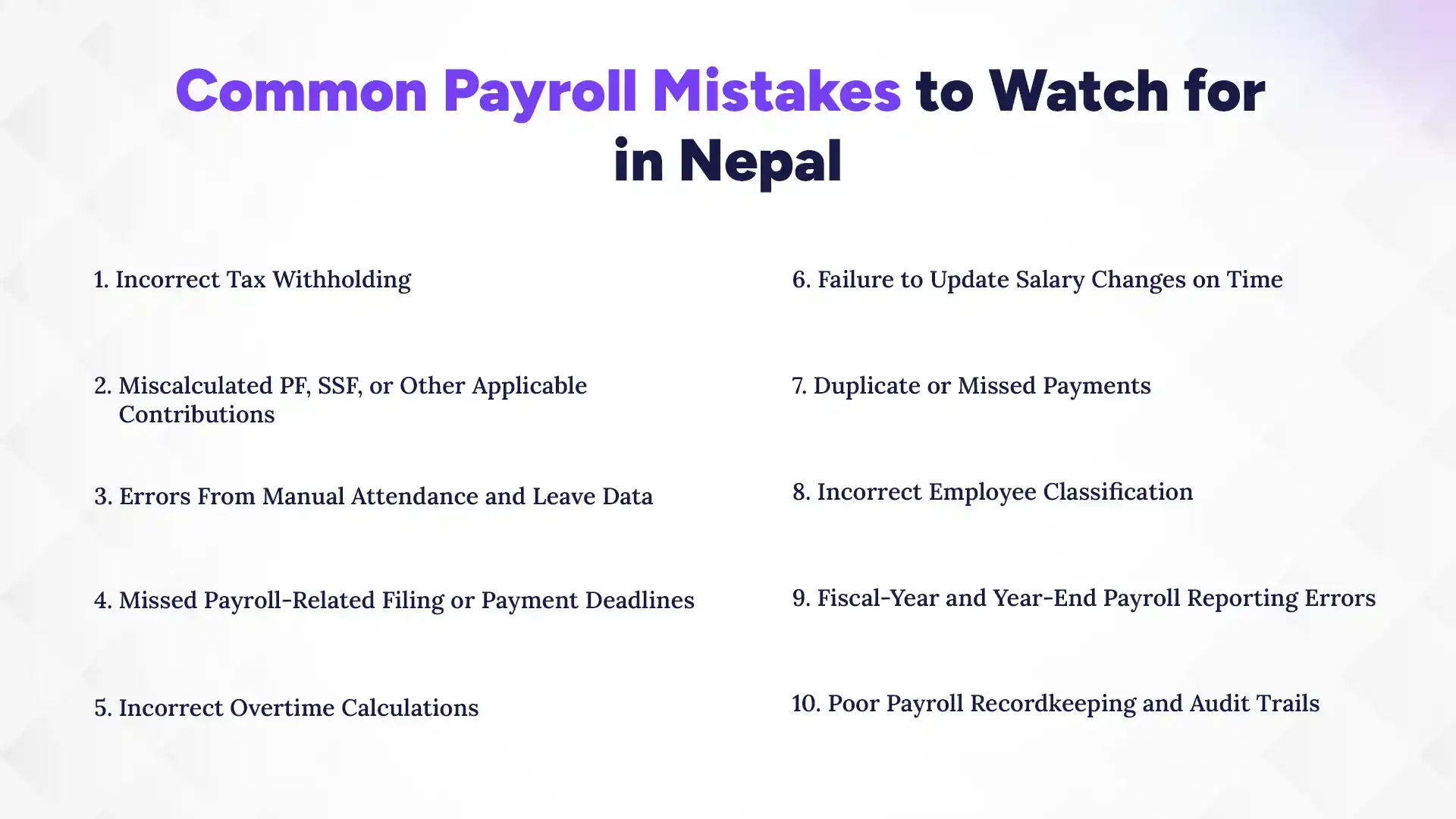
Common Payroll Mistakes to Watch for in Nepal
The 10 common payroll mistakes to watch for in Nepal are incorrect tax calculations, PF and SSF contribution errors, inaccurate attendance and leave data, missed payroll-related deadlines, incorrect overtime calculations, delayed salary updates, duplicate or missed payments, incorrect employee classifications, fiscal-year reporting errors, and poor payroll recordkeeping. These mistakes can result in inaccurate employee payments, compliance issues, additional administrative work, and difficulties when reviewing or auditing payroll records.
1. Incorrect Tax Calculation or Deduction
Incorrect tax calculations can occur when businesses use outdated tax rates or apply the wrong rules to an employee's salary and circumstances. This can result in inaccurate deductions and potential compliance issues. Keeping payroll tax rules updated and reviewing them whenever applicable requirements change can help prevent these errors. The key HRMS software features that support automated tax calculations can reduce the risk of applying wrong rates.
2. Miscalculated PF, SSF, or Other Applicable Contributions
Errors in PF, SSF, or other applicable contributions can occur when businesses manually calculate deductions or apply the wrong contribution rules. These mistakes can affect both employee deductions and employer contributions. Using accurate, up-to-date payroll rules and automated calculations can reduce the risk of contribution errors.
Errors in PF, SSF, or other applicable contributions can occur when businesses manually calculate deductions or apply the wrong contribution rules. These mistakes can affect both employee deductions and employer contributions. HRMS payroll software in Nepal is specifically designed to handle these statutory calculations accurately, reducing the risk of contribution errors that lead to compliance problems.
3. Errors From Manual Attendance and Leave Data
Manual attendance and leave tracking can introduce errors into payroll calculations, particularly when data must be transferred between separate systems. Incorrect working hours, absences, or leave balances can result in inaccurate pay. Connecting an attendance management system and leave management software directly with payroll can reduce repeated data entry and improve accuracy.
4. Missed Payroll-Related Filing or Payment Deadlines
Businesses can miss important payroll-related filing or payment deadlines when dates are tracked manually or without a clear compliance calendar. Late filings or payments may create additional administrative work and potential compliance concerns. Understanding HR software implementation helps build the structured processes that keep filing deadlines on track.
5. Incorrect Overtime Calculations
Overtime errors can occur when additional working hours are recorded incorrectly or the applicable overtime calculation is applied inconsistently. Even small mistakes can cause employees to be underpaid or overpaid. Linking approved attendance data with payroll calculations can help ensure overtime is calculated consistently.
6. Failure to Update Salary Changes on Time
Salary increases, promotions, allowances, and other compensation changes need to be reflected in payroll at the correct time. When an approved change is missed before the payroll cutoff, an employee may receive an incorrect payment. A clear approval and payroll-update process can help ensure compensation changes are reflected in the appropriate payroll cycle.
7. Duplicate or Missed Payments
Duplicate or missed payments can happen during off-cycle payroll, corrections, new-hire processing, or other situations that require manual intervention. These errors can create payment discrepancies and require additional reconciliation. Reviewing the payroll register and using validation checks before payment can help identify unusual or duplicate entries.
8. Incorrect Employee Classification
Incorrectly classifying an employee can result in the wrong pay, tax, deduction, or contribution rules being applied. This can happen when employee information is outdated or classifications are not clearly maintained. Keeping employee records accurate and applying payroll rules according to the appropriate classification can reduce this risk.
9. Fiscal-Year and Year-End Payroll Reporting Errors
Payroll reporting errors can occur when businesses use the wrong reporting period, fail to reconcile payroll data, or leave year-end adjustments until the last minute. In Nepal, payroll teams need to account for the applicable fiscal-year requirements when preparing reports and records. Regular reconciliation throughout the year can make year-end reporting more accurate and easier to manage.
10. Poor Payroll Recordkeeping and Audit Trails
Poor recordkeeping can make it difficult to verify payroll calculations, track changes, or reconstruct previous payroll decisions. Payroll information spread across spreadsheets, emails, paper documents, and separate systems can increase this risk. Keeping payroll records centralized, organized, and supported by a clear audit trail makes payroll easier to review and verify.
How Do You Catch a Payroll Error Before It Reaches Employees?
You can catch a payroll error before it reaches employees by reviewing the payroll summary, reconciling employee data, checking for unusual changes, and completing a final approval before payments are released. A structured pre-payroll review helps identify calculation mistakes, missing employees, duplicate payments, and incorrect employee information while there is still time to correct them. The business benefits of HR software become clearest when this kind of structured review replaces last-minute manual checks.
Review the payroll summary: Check the total payroll amount, deductions, contributions, and other key figures before approving the run.
Reconcile employee data: Compare attendance, leave, overtime, new hires, resignations, and salary changes against the payroll figures.
Compare with the previous payroll: Look for unusual increases or decreases in total payroll or individual employee payments that may indicate an error.
Check for duplicate or missing employees: Confirm that every eligible employee appears once and that no employee has been accidentally omitted or added twice.
Spot-check individual calculations: Review a sample of employee payslips or salary calculations rather than relying only on the overall payroll total.
Separate preparation from approval: Have a second person review and approve the payroll whenever possible, rather than having the same person prepare and approve the entire payroll run.
Automation can make these checks faster and more consistent, but it should support rather than completely replace human review. Payroll software can flag unusual amounts, missing information, or duplicate entries, while a designated reviewer can investigate the alerts and confirm that the payroll is accurate before payment is finalized.
What Should You Do If You Discover a Payroll Error?
You should correct a payroll error by identifying everyone and every pay period affected, fixing the underlying payroll data, reviewing any related tax or contribution impact, communicating with affected employees, and documenting the correction. Acting quickly can help limit the impact on employees and reduce the risk of the same error affecting future payroll cycles. If you discover a payroll error, follow these steps:
Identify everyone affected: Determine which employees and pay periods are affected rather than correcting only the case that initially revealed the problem.
Fix the underlying data: Correct the employee information, salary details, attendance records, or other source data that caused the error before adjusting the resulting payment.
Review tax and contribution impacts: Check whether the correction affects tax deductions, PF, SSF, or other applicable contributions. Correcting the salary amount alone may not resolve the full payroll issue.
Communicate with affected employees: Explain the error and the planned correction clearly so employees understand what happened and when they can expect the adjustment.
Process the correction appropriately: Depending on the situation, the correction may be included in a subsequent payroll run or handled through a separate adjustment or payment process.
Document the correction: Record what went wrong, which employees were affected, what was corrected, and why. This creates a useful audit trail and can help prevent the same error from recurring.
After the correction is completed, review the process that caused the error and add an appropriate check or control to reduce the chance of it happening again.
Payroll Accuracy Checklist Before Every Pay Run
A payroll checklist helps businesses verify employee data, salary calculations, deductions, contributions, and approvals before payments are released. Running through these checks before every payroll cycle can help catch common errors early and improve payroll accuracy.
Employee records and salary details are up to date
Attendance and leave data have been reviewed
Approved salary changes and allowances are reflected
Overtime calculations have been checked
Tax calculations and deductions have been reviewed
PF, SSF, and other applicable contributions have been verified
Employee classifications are correct
Duplicate or missing employees and payments have been checked
The payroll summary has been reviewed and approved
Payroll records and supporting documents are properly stored
Completing these checks before each pay run creates a consistent review process and gives payroll teams a final opportunity to identify and correct errors before employees are paid.
How HRMS Can Help Reduce Payroll Errors
HRMS can help reduce payroll errors by centralizing employee data, connecting attendance and leave with payroll, automating calculations, and providing payroll reports for review. By reducing manual data entry and keeping payroll information in one system, an HRMS can minimize the opportunities for errors caused by disconnected processes and inconsistent calculations.
An HRMS can help reduce payroll errors in several ways:
Centralized employee data: Employee information, salary details, attendance, leave, and other payroll-related records can be maintained in one place instead of across multiple spreadsheets and files.
Connected attendance and leave: Attendance and approved leave data can flow directly into payroll, reducing the need to manually transfer figures between systems.
Automated calculations: Configured payroll rules can automatically calculate items such as taxes, overtime, deductions, and applicable contributions, helping apply the same rules consistently.
Payroll reports: Payroll summaries and reports can be generated for review without requiring manual compilation, making it easier to identify unusual figures or discrepancies.
Centralized records: Payroll records remain organized and searchable, making it easier to review previous payroll runs and maintain an audit trail.
However, HRMS does not eliminate the need for payroll review. A well-configured system still depends on accurate employee data, properly configured rules, and human review before payroll is approved. Automation reduces manual work and the opportunity for errors, but a final review remains an important part of an accurate payroll process.
How Pace HRMS Helps Nepali Businesses Improve Payroll Accuracy
Pace HR software centralizes employee data and automates key payroll processes. Attendance and leave data can connect with payroll, while configured payroll rules help reduce manual errors in tax, overtime, and applicable contribution calculations.
By reducing repetitive data entry and keeping payroll records centralized, Pace HRMS helps businesses process payroll more consistently. However, regular payroll review and accurate employee data remain essential even with automation.
Conclusion
Most payroll errors are preventable when businesses combine accurate employee data, consistent processes, proper review, and appropriate automation. For Nepali businesses, paying close attention to applicable tax, contribution, and fiscal-year requirements is equally important. The goal isn't simply to process payroll faster but to make every payroll run accurate, reviewable, and properly documented.
HRMS can reduce repetitive manual work and provide better control over payroll, while human review remains an important part of the process.
Want every branch working from the same employee record? Leave a message with Pace Infosys to explore how Pace HRMS centralizes payroll data across your business.
FAQs
What's the most common payroll error businesses in Nepal make?
+
Incorrect tax withholding and PF/SSF contribution errors are among the most common payroll mistakes, often caused by manual calculation or outdated rate assumptions.
Can payroll errors lead to legal or compliance penalties in Nepal?
+
Yes. Errors in tax withholding, statutory contributions, or filing deadlines can lead to compliance penalties, regardless of whether the mistake was intentional.
How often should payroll calculations be double-checked?
+
Payroll calculations should be reviewed every pay run, not just periodically, since errors can occur in any individual cycle.
Can HRMS catch payroll errors before they happen, not just after?
+
Yes, to an extent. HRMS can flag anomalies like duplicate entries or unusual amounts before a payroll run is finalized, though human review remains part of the process.
What should a business do if it discovers a past payroll error?
+
A business should identify the affected employees and periods, correct the underlying data, determine any tax or contribution impact, and communicate clearly with those affected.
Does automating payroll eliminate errors completely?
+
No. Automation significantly reduces the opportunity for manual errors, but it doesn't eliminate the need for review before each payroll run is finalized.
Ready to get started?
Book a 30-minute consultation call, and let's talk about your goals.