The way people search for information is changing faster than ever, with AI tools now delivering direct answers instead of just links. Traditional SEO is no longer the only strategy businesses rely on to gain visibility online. As search engines evolve into answer engines, content must adapt to stay relevant. This shift is pushing marketers to rethink how they create and optimize content for better reach and engagement.
In this blog, Is Generative Engine Optimization the Future of Digital Marketing?, we will explore what GEO is and how it works in modern search environments. You will learn about its importance, key strategies, benefits, and potential risks. We will also compare GEO with traditional SEO and discuss how businesses can implement it effectively. By the end, you will clearly understand whether GEO is shaping the future of digital marketing.
What Is Generative Engine Optimization (GEO)?
Generative Engine Optimization (GEO) is the process of optimizing content to appear in AI-generated answers provided by search engines and AI tools. It focuses on creating clear, structured, and context-rich content that directly answers user queries. Unlike traditional SEO (what is SEO), GEO prioritizes visibility in answer engines rather than just ranking in search results. It helps businesses adapt to AI-driven search trends and improve their presence in modern digital marketing.
Is Generative Engine Optimization the Future of Digital Marketing?
Yes, Generative Engine Optimization is the future of digital marketing as search engines shift toward AI-driven, answer-based results. It helps businesses stay visible in evolving search environments. While traditional SEO still matters, GEO is rapidly gaining importance alongside it.
AI search engines prioritize direct, conversational answers over traditional rankings
Growing use of voice search and AI assistants increases demand for GEO
Higher chances of appearing in featured snippets and AI-generated results
Focus on user intent and context to improve content relevance
Helps build authority and trust in AI-driven search ecosystems
Complements traditional SEO for long-term digital marketing success
Why Is Generative Engine Optimization Important Today?
Generative Engine Optimization is important today because it helps businesses stay visible in AI-driven search results and answer engines. As users rely more on AI tools for quick and direct answers, traditional SEO alone is not enough. GEO ensures your content is structured and optimized for these new search formats, along with concepts like AEO (Answer Engine Optimization). It plays a key role in improving reach, relevance, and user engagement in modern digital marketing.
1. Growth of AI Search Engines and Chatbots
AI-powered search engines and chatbots are rapidly changing how users find information online. Tools like AI assistants provide instant, conversational answers instead of showing multiple links. This shift reduces dependency on traditional search result pages. Businesses need to adapt their content for these platforms. GEO helps align content with AI-driven systems. It ensures your content remains discoverable in evolving search environments.
2. Better Visibility in AI-Generated Responses
GEO increases the chances of your content appearing in AI-generated answers. Instead of competing only for rankings, content is selected for direct responses. This improves visibility even without users clicking on websites. Being featured in AI answers builds credibility and trust. It also increases brand awareness among users. Higher visibility leads to stronger digital presence.
3. Improved User Experience with Direct Answers
Users prefer quick and accurate answers without browsing multiple pages. GEO focuses on providing clear and concise information. This improves user satisfaction and engagement. Content becomes easier to understand and more relevant. It aligns with modern search behavior and expectations. Better user experience increases retention and trust.
4. Competitive Advantage in Modern SEO Landscape
Businesses adopting GEO early gain a competitive edge over others. Many companies still rely only on traditional SEO strategies. GEO allows brands to stand out in AI-powered search results. It helps capture new traffic sources and audiences. Staying ahead of trends improves long-term growth. Early adoption ensures better positioning in future search ecosystems.
How Does Generative Engine Optimization Work?
Generative Engine Optimization works by aligning content with how AI systems understand, process, and deliver answers to user queries. It focuses on intent-based content, structured formatting, and contextual relevance so that AI models can easily extract and present information. Instead of just ranking pages, GEO helps content become part of direct answers. This improves visibility across AI-powered search platforms and assistants.
1. Understanding User Intent and Context
GEO begins with understanding what users are actually searching for and why. It focuses on the intent behind queries rather than just keywords, similar to how on-page SEO is used to structure and optimize content for relevance. Content is created to match informational, navigational, or transactional intent. Context also plays a major role in how AI interprets queries. This helps deliver accurate and relevant answers. Better intent matching improves chances of being selected by AI systems. It also ensures content stays aligned with evolving user behavior.
2. Creating Conversational and Answer-Focused Content
Content in GEO is written in a natural, conversational tone. It directly answers user questions clearly and concisely. This makes it easier for AI tools to extract useful information. Short paragraphs and clear explanations improve readability. It also aligns with voice search and AI assistant queries. Answer-focused content increases the chances of appearing in AI responses. It also improves engagement and user satisfaction.
3. Optimizing for AI Models and Search Algorithms
GEO involves optimizing content for both AI models and traditional search algorithms. This includes using relevant keywords, semantic variations, and structured content. AI systems analyze patterns, context, and relevance before selecting answers. Proper optimization improves content discoverability. It also ensures content meets modern search standards. Balanced optimization enhances overall visibility across platforms. It also helps content perform consistently across different search environments.
4. Role of Structured Data and Content Formatting
Structured data helps search engines and AI systems understand content better. Proper formatting, such as headings, bullet points, and schema markup, improves clarity, which is a key part of technical SEO. It makes content easier to scan and extract. Organized content performs better in search and AI-generated answers. This also supports featured snippets and rich results. Well-structured content increases accuracy and visibility. It also improves overall content accessibility.
Key Strategies for Generative Engine Optimization
Key strategies for Generative Engine Optimization focus on creating content that aligns with how AI systems understand and deliver answers. It requires a shift from traditional keyword stuffing to intent-driven, structured, and user-focused content. GEO emphasizes clarity, relevance, and trustworthiness to improve visibility in AI-generated responses. By following the right strategies, businesses can improve their chances of being featured in answer engines. These strategies also support long-term digital marketing success.
1. Focus on Question-Based and Conversational Keywords
GEO relies heavily on question-based and conversational keywords. These reflect how users naturally search using voice and AI tools. Content should be optimized around real user queries and long-tail keywords. This helps match search intent more accurately. It increases chances of appearing in direct answers. It also improves visibility in voice and conversational search queries.
2. Provide Clear and Direct Answers First
Content should begin with a clear and direct answer to the user’s query. This makes it easier for AI systems to extract relevant information. Short and precise answers improve readability and engagement. It also supports featured snippets and zero-click searches. Direct answers improve visibility in AI responses. It also increases the chances of being selected as a primary answer source.
3. Use Structured Data and Schema Markup
Structured data helps AI and search engines understand content better. Schema markup provides additional context about the page. It improves chances of appearing in rich results and AI-generated answers. Proper tagging enhances content clarity. This leads to better indexing and discoverability. It also supports enhanced search features like rich snippets and knowledge panels.
4. Improve Content Readability and Formatting
Well-formatted content performs better in GEO. Using headings, bullet points, and short paragraphs improves readability. It makes content easier for both users and AI systems to scan. Clear structure enhances user experience. This increases engagement and retention. It also reduces bounce rates by making content easy to consume.
5. Build Authority and Trust Signals (E-E-A-T)
Building authority and trust is essential for GEO success. Content should demonstrate expertise, experience, authority, and trustworthiness. High-quality content backed by credible sources performs better. Consistency in publishing valuable content improves brand authority. This increases the chances of being selected by AI systems. It also strengthens long-term credibility in digital search ecosystems.
Benefits of Generative Engine Optimization in Digital Marketing
Generative Engine Optimization offers several advantages for businesses adapting to AI-driven search environments. It helps improve visibility in answer engines, enhances content relevance, and aligns with modern user behavior. GEO focuses on delivering clear and valuable information, which improves both reach and engagement. As digital marketing evolves, GEO plays a key role in building long-term online presence and performance.
1. Increased Visibility in AI and Voice Search
GEO improves visibility in AI-powered search engines and voice assistants. Content optimized for conversational queries has a higher chance of appearing in direct answers. Voice search continues to grow with users relying on smart devices. This increases opportunities for businesses to reach wider audiences. It also reduces dependency on traditional search rankings. Greater visibility leads to improved brand awareness and reach.
2. Higher Chances of Featured Snippets and AI Answers
GEO increases the likelihood of content being selected for featured snippets and AI-generated responses. Clear and structured answers are preferred by search engines. This helps content appear at the top of search results. It improves credibility and trust among users. Being featured also increases brand recognition. It provides more exposure without relying solely on rankings.
3. Improved User Engagement and Experience
GEO focuses on delivering concise and relevant answers to users. This improves user satisfaction and engagement. Easy-to-read content encourages users to stay longer on the page. It also reduces confusion and enhances understanding. Better engagement signals improve overall SEO performance. Satisfied users are more likely to trust and return to your content.
4. Stronger Brand Authority and Trust
Consistently providing accurate and valuable content builds brand authority. GEO emphasizes expertise and trustworthiness in content creation. This helps businesses establish credibility in their niche. Users are more likely to trust brands that appear in AI answers. Authority also improves long-term search performance. Strong trust signals increase brand reputation and reliability.
5. Long-Term SEO and Content Performance Growth
GEO supports sustainable growth in digital marketing strategies. Content optimized for AI search remains relevant for a longer time. It adapts to evolving search trends and user behavior. This ensures consistent traffic and engagement over time. Businesses can maintain a strong online presence. Long-term optimization leads to stable and scalable growth.
Are There Risks to Using Generative Engine Optimization?
Yes, there are certain risks associated with using Generative Engine Optimization if it is not implemented carefully. While GEO improves visibility in AI-driven search, it also depends heavily on accuracy, structure, and content quality. Poor execution can lead to misinformation or reduced traffic. Businesses must balance GEO with traditional SEO strategies to avoid potential drawbacks.
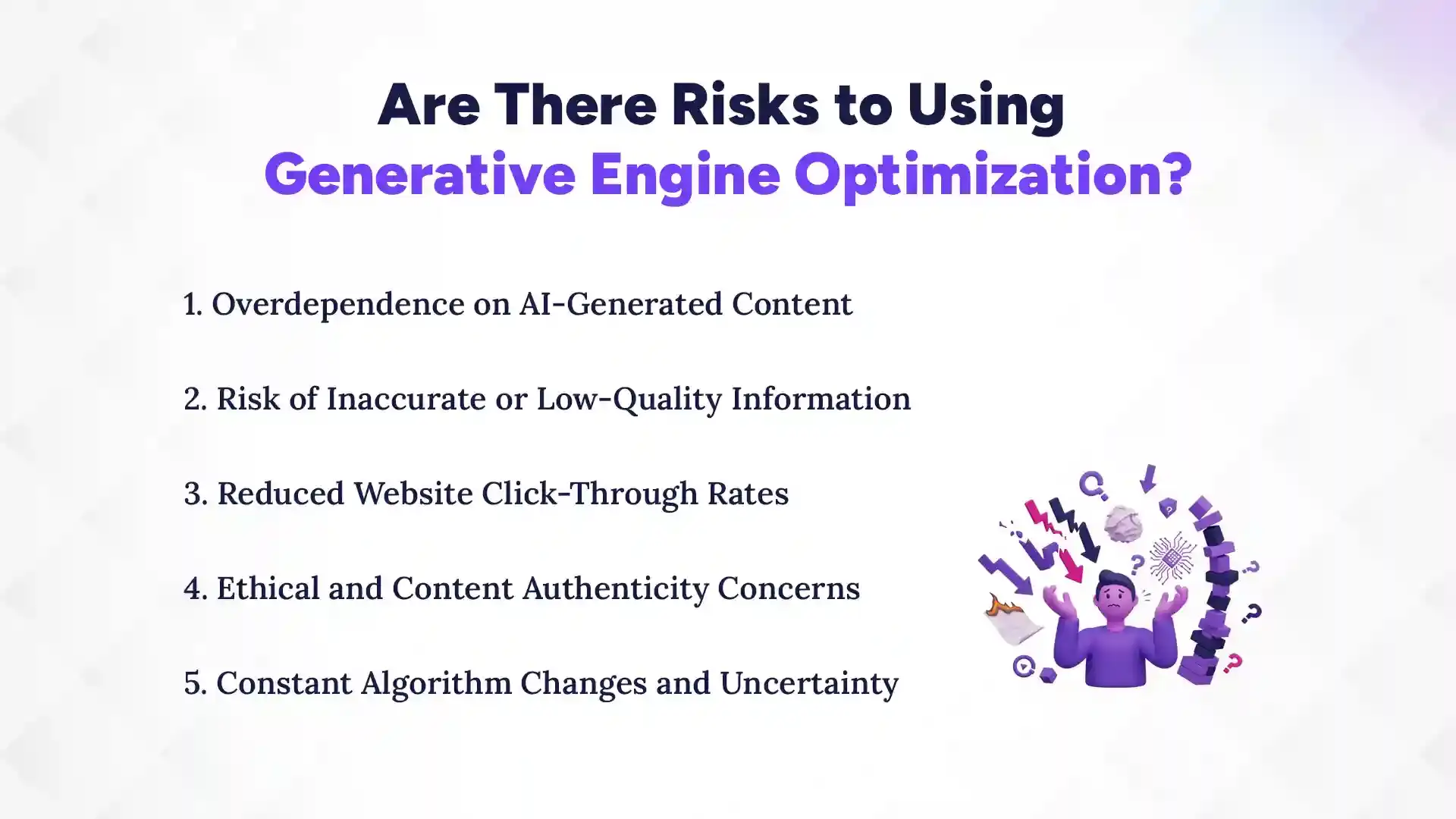
1. Overdependence on AI-Generated Content
Relying too much on AI-generated content can reduce originality and creativity. It may lead to repetitive or generic information that lacks depth. Search engines and users prefer unique, high-value content. Overuse of AI tools can also weaken brand voice. Human oversight is necessary for quality control. Balanced usage ensures better content authenticity and engagement. It also helps maintain a strong brand identity.
2. Risk of Inaccurate or Low-Quality Information
AI systems can sometimes generate or prioritize inaccurate information. If content is not properly reviewed, it may mislead users. This can negatively impact brand trust and credibility. High-quality content requires fact-checking and expert validation. Poor accuracy reduces overall SEO performance. Reliable content is essential for long-term success in GEO. It also protects brand reputation.
3. Reduced Website Click-Through Rates
GEO focuses on providing direct answers within search results. This can reduce the need for users to visit websites. As a result, click-through rates may decline. While visibility increases, traffic may not always follow. Businesses must optimize for both visibility and engagement. Balancing answers with website value is important. It helps sustain organic traffic.
4. Ethical and Content Authenticity Concerns
Using AI-driven optimization raises concerns about originality and authenticity. Over-optimized or automated content may feel less human. This can affect user trust and brand perception. Ethical content creation requires transparency and originality. Maintaining authenticity is crucial for long-term credibility. Trust is a key factor in digital marketing success. It also influences audience loyalty.
5. Constant Algorithm Changes and Uncertainty
AI and search engine algorithms are constantly evolving. This creates uncertainty in how content is ranked or selected. Strategies that work today may change in the future. Businesses need to continuously adapt their GEO approach. Regular updates and monitoring are essential. Flexibility helps maintain consistent performance in changing environments. It also reduces long-term risk.
Is Generative Engine Optimization the Same as Traditional SEO?
No, Generative Engine Optimization is not the same as traditional SEO, although both aim to improve online visibility. GEO focuses on optimizing content for AI-generated answers, while SEO focuses on ranking webpages in search engine results. Both strategies overlap in areas like keywords and content quality, but differ in execution and purpose. Together, they form a more complete digital marketing approach.
1. Key Differences Between GEO and SEO
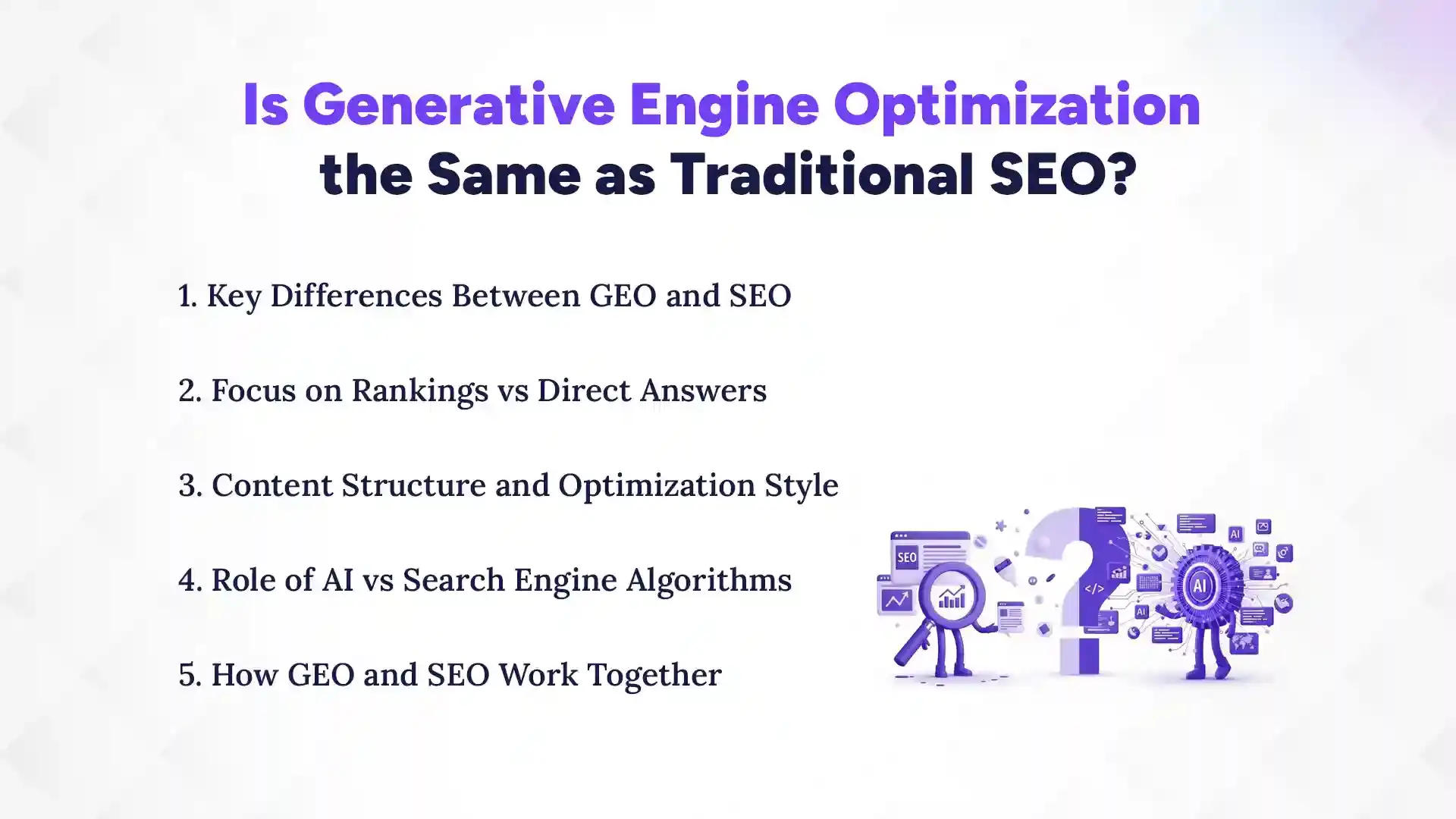
GEO and SEO differ mainly in how content is optimized and delivered to users. SEO focuses on ranking websites on search engine results pages, while GEO focuses on appearing in AI-generated responses. SEO relies heavily on keywords and backlinks, whereas GEO emphasizes context and user intent. GEO also prioritizes conversational and structured answers. SEO is more traditional, while GEO is AI-driven. Both aim for visibility but use different optimization methods. It also reflects the shift toward AI-based search behavior.
2. Focus on Rankings vs Direct Answers
SEO is designed to improve rankings in search engine result pages. GEO, on the other hand, focuses on providing direct answers to user queries. This reduces the need for users to click on multiple websites. GEO content is often selected for featured snippets or AI responses. SEO drives traffic, while GEO drives visibility in answers. Both approaches serve different stages of the user journey. It helps users get faster and more accurate information.
3. Content Structure and Optimization Style
SEO content is often structured around keywords and backlinks. GEO content is structured around questions, intent, and clarity. Short, direct answers are preferred in GEO strategies. SEO allows longer-form content for ranking purposes. GEO requires better formatting like bullet points and schema markup. Structure plays a key role in how content is interpreted. It improves both readability and AI extraction.
4. Role of AI vs Search Engine Algorithms
Traditional SEO relies on search engine algorithms like Google ranking systems. GEO is driven by AI models that generate answers directly. These AI systems analyze context, meaning, and user intent. SEO focuses more on indexing and ranking signals. GEO focuses on understanding and response generation. AI plays a central role in modern search experiences. It changes how content is discovered and delivered.
5. How GEO and SEO Work Together
GEO and SEO are not competitors but complementary strategies. SEO ensures visibility in traditional search results. GEO ensures presence in AI-generated answers and voice search. Combining both improves overall digital reach. Businesses benefit from using both strategies together. A hybrid approach strengthens long-term online performance. It ensures visibility across all search platforms.
Tools for Generative Engine Optimization
Tools for Generative Engine Optimization play a crucial role in creating, optimizing, and analyzing content for AI-driven search systems. These tools help marketers understand user intent, generate high-quality content, and improve visibility in AI-generated answers. They also support keyword research, content structuring, and technical optimization. Using the right tools ensures better performance in both traditional SEO and GEO strategies.
1. AI Content Tools (ChatGPT, Jasper, etc.)
AI content tools help create high-quality and conversational content quickly. Platforms like ChatGPT and Jasper assist in generating ideas, drafts, and optimized text. These tools are useful for aligning content with user intent and GEO requirements. They improve efficiency and reduce content creation time. However, human editing is still important for accuracy and tone. They help scale content production while maintaining relevance and quality. They also support idea generation for complex topics.
2. Keyword and Question Research Tools
Keyword and question research tools help identify what users are searching for online. They provide insights into long-tail and conversational queries. Tools like AnswerThePublic and AlsoAsked are especially useful for GEO. These tools help structure content around real user intent. They also improve chances of appearing in AI-generated answers. Understanding user questions is key to effective GEO optimization. It ensures content directly matches search behavior.
3. SEO Platforms (Ahrefs, SEMrush)
SEO platforms like Ahrefs and SEMrush provide detailed insights into keywords, competitors, and content performance. They help track rankings and identify optimization opportunities. These tools are useful for both SEO and GEO strategies. They allow businesses to analyze search trends and content gaps. This improves overall content strategy and visibility. They support data-driven decision-making for better optimization. They also help monitor long-term performance.
4. Schema Markup and Technical SEO Tools
Schema markup tools help structure content for better understanding by search engines and AI systems. They improve how content is displayed in rich results and AI answers. Technical SEO tools ensure websites are properly optimized for crawling and indexing. They also help fix errors and improve site performance. These tools are essential for GEO success. Proper technical setup enhances content visibility and accuracy. It also supports better indexing in AI-driven search systems.
How to Implement Generative Engine Optimization Strategy?
Implementing a Generative Engine Optimization strategy involves a structured approach to creating content that aligns with AI-driven search systems. It starts with understanding user intent and ends with continuous performance tracking and updates. The goal is to make content easily discoverable and usable by AI models for generating direct answers. A well-planned GEO strategy improves visibility, engagement, and long-term digital growth.
Step 1: Identify User Questions and Search Intent
The first step in GEO implementation is identifying what users are actually searching for. This includes analyzing real questions, conversational queries, and search intent. Understanding intent helps create more relevant and useful content. It ensures your content matches informational, navigational, or transactional needs. This step forms the foundation of an effective GEO strategy. Accurate intent mapping improves content relevance and AI selection chances.
Content should be designed to directly answer user questions clearly and concisely. It must be informative, structured, and easy to understand. High-quality content increases trust and engagement. AI systems prefer content that provides immediate value. Short and precise answers work best for GEO. Answer-focused content improves visibility in AI-generated responses.
Step 3: Optimize Content Structure and Formatting
Proper structure makes content easier for AI systems to process. Using headings, bullet points, and short paragraphs improves readability. Well-formatted content enhances user experience as well. It also helps search engines extract key information quickly. Structured formatting increases the chances of appearing in featured snippets. Clear organization supports better content performance in GEO.
Step 4: Add Structured Data and Improve Technical SEO
Structured data helps search engines and AI models understand content context. Schema markup improves how information is displayed in search results. Technical SEO ensures proper crawling, indexing, and site performance. Fixing technical issues enhances overall visibility. This step strengthens content accessibility for AI systems. Technical optimization is essential for GEO success.
Step 5: Monitor Performance and Update Content Regularly
Regular monitoring helps track how content performs in AI-driven search. Analytics tools provide insights into traffic and engagement. Updating content ensures it remains relevant and accurate. AI algorithms prefer fresh and updated information. Continuous improvement strengthens long-term GEO results. Ongoing optimization ensures sustained visibility and performance.
Future Trends of Generative Engine Optimization
Future trends of Generative Engine Optimization show a strong shift toward AI-driven search experiences and smarter content delivery systems. As search engines evolve into answer engines, GEO will become a core part of digital marketing strategies. Businesses will need to focus more on intent-based, structured, and conversational content. These trends highlight how AI will continue reshaping how users discover and consume information online.
1. Growth of AI-Powered Search Engines
AI-powered search engines are rapidly changing how users find information online. Instead of showing only links, they now provide direct and summarized answers. This reduces dependency on traditional search results pages. GEO helps content become part of these AI-generated responses. Businesses will need to optimize for AI systems to stay visible. This trend is expected to dominate the future of search.
2. Increased Importance of Voice and Conversational Search
Voice search is becoming more popular with smart devices and AI assistants. Users now prefer natural, conversational queries instead of typed keywords. GEO focuses on optimizing content for these types of searches. This improves chances of appearing in voice-generated answers. Content must be clear, direct, and question-based. Voice search will continue to grow in importance.
3. Integration of AI in Digital Marketing Strategies
AI is becoming a key part of modern digital marketing strategies. Businesses are using AI tools for content creation, optimization, and analytics. GEO fits naturally into this AI-driven ecosystem. It helps marketers understand user intent and behavior better. This leads to more effective and targeted campaigns. AI integration improves efficiency and decision-making.
4. Evolving Content Optimization Techniques
Content optimization techniques are continuously evolving with AI advancements. Traditional keyword-focused strategies are shifting toward intent and context-based optimization. GEO emphasizes structured, conversational, and high-quality content. Marketers must adapt to changing algorithms and user behavior. Continuous updates and improvements are essential for success. Future SEO will be more intelligent and user-focused.
Is Generative Engine Optimization Worth It for Businesses?
Yes, Generative Engine Optimization is worth it for businesses as it helps improve visibility in AI-driven search results and enhances long-term digital presence. It allows brands to stay relevant in evolving search ecosystems where AI-generated answers are becoming more common. GEO also supports better user engagement and competitive positioning. Overall, it is a valuable investment for future-ready digital marketing.
Strong ROI potential as AI search adoption continues to grow
Improves long-term visibility in answer engines and AI platforms
Helps businesses build stronger brand authority and trust online
Increases chances of appearing in featured snippets and AI responses
Provides a competitive edge in highly competitive industries
Supports sustainable growth in modern digital marketing strategies
Conclusion
Generative Engine Optimization is rapidly transforming the way digital marketing works by shifting focus from traditional rankings to AI-driven, answer-based visibility. As search engines become more intelligent, businesses like The Pace Infosys must adapt to GEO strategies to stay relevant. It improves how content is discovered, interpreted, and presented in modern search environments. While it does not replace SEO, it significantly enhances how brands appear in AI-generated results.
Overall, GEO is becoming an essential part of future digital marketing strategies. It helps businesses improve visibility, engagement, and authority across AI-powered platforms. By combining SEO with GEO, brands can achieve a stronger online presence and long-term growth. Companies that adopt this approach early will have a clear advantage in the evolving digital landscape.
FAQs
What is Generative Engine Optimization (GEO)?
+
GEO is optimizing content for AI-generated answers in search engines. It helps content appear in conversational AI and answer-based search results.
Is GEO replacing traditional SEO?
+
No, GEO is not replacing SEO but working alongside it effectively. Both strategies together improve visibility in search and AI platforms.
How does GEO improve digital marketing?
+
GEO improves visibility in AI search results and enhances user engagement. It also helps brands reach audiences through direct AI answers.
Why is GEO important for businesses?
+
GEO helps businesses appear in AI-driven search and voice results. It increases brand visibility and long-term online authority.
What type of content works best for GEO?
+
Conversational, structured, and question-based content works best for GEO. Clear answers improve chances of AI selection.
Does GEO affect website traffic?
+
Yes, GEO can increase visibility but may reduce click-through rates. Users often get answers directly from AI results.
Can small businesses use GEO?
+
Yes, small businesses can easily implement GEO strategies effectively. It helps them compete with larger brands in AI search.
Is GEO important for the future of SEO?
+
Yes, GEO is becoming essential in the future of digital marketing. It aligns with AI-powered search and evolving user behavior.
Ready to get started?
Book a 30-minute consultation call, and let's talk about your goals.