Running a transport or logistics company sounds simple from the outside, but HR is where things quietly get messy. Drivers are always on the move, shifts keep changing, and attendance is often tracked on paper, or worse, in someone’s memory. One missed record or payroll mistake can quickly turn into confusion and frustration for everyone. In Nepal’s fast-moving logistics industry, these small gaps add up fast.
That’s why more companies are now shifting toward digital HR systems that bring order, speed, and clarity. In this guide, we’ll break down the real HR challenges logistics businesses face and show how the right HR software can make daily operations much easier to manage.
What is HR Software for Transport and Logistics Companies?
HR management software for transport and logistics companies is a digital system that helps manage employee data, attendance, payroll, and work schedules in one place. Its main purpose is to reduce manual work and make HR tasks faster and more accurate. Instead of using registers or spreadsheets, everything is handled through a single platform that updates in real time.
Now, the logistics industry has very different needs compared to regular office setups. Drivers, helpers, and field staff are always on the move, so tracking their attendance and shifts becomes difficult without a proper system. That’s why specialized HR software is needed. It can handle GPS tracking, shift-based work, and trip-based payments more smoothly.
A good HR software comes with customisation features, which lets you build a system suitable for logistics management, manpower mobility and complex schedules. They support features like attendance, overtime for trips, and mobile access for workers in the field. Because of this, they fit much better with how transport businesses actually operate day to day.
Key HR Challenges in Transport and Logistics Companies
Transport and logistics companies face several HR challenges such as tracking drivers, managing rotating shifts, handling complex payroll, and monitoring employees who are always on the move. These issues often come from manual systems that are not built for field-based work. As operations grow, these problems become even harder to control. Let’s break down each challenge in HR management to understand it better.
1. Managing Drivers and Field Staff Attendance
Managing attendance for drivers and field staff is one of the biggest challenges in logistics companies. Since employees are rarely in the office, manual attendance often leads to missing or incorrect records. In many cases, supervisors rely on phone calls or handwritten notes, which creates errors. This directly affects payroll accuracy and daily workforce planning. As a result, companies struggle to maintain trust and consistency in attendance tracking.
2. Handling Shift-Based and 24/7 Operations
Logistics businesses often run day and night, which makes shift planning very complex. Employees rotate between early, late, and night shifts, and this needs constant updates. Without a proper system, shift clashes and confusion are common. Managers also find it hard to balance workload fairly across teams. Because of this, smooth 24/7 operations become difficult to maintain.
3. Payroll Complexity with Overtime and Trips
Payroll in logistics is not just about fixed salaries, it includes overtime, trip allowances, and extra working hours. Calculating all these manually increases the chance of mistakes. Even a small error in trip records can lead to salary disputes. This creates frustration among employees and extra pressure on HR teams. So, payroll becomes one of the most time-consuming HR tasks in the industry.
4. Tracking Remote and On-Road Employees
Most logistics employees are always on the road, which makes real-time tracking very challenging. HR teams often do not know exact working hours or locations. This lack of visibility affects performance monitoring and accountability. In some cases, communication gaps also delay important updates. That’s why tracking remote staff remains a major operational hurdle.
Benefits of HR Management Software for Logistics Businesses
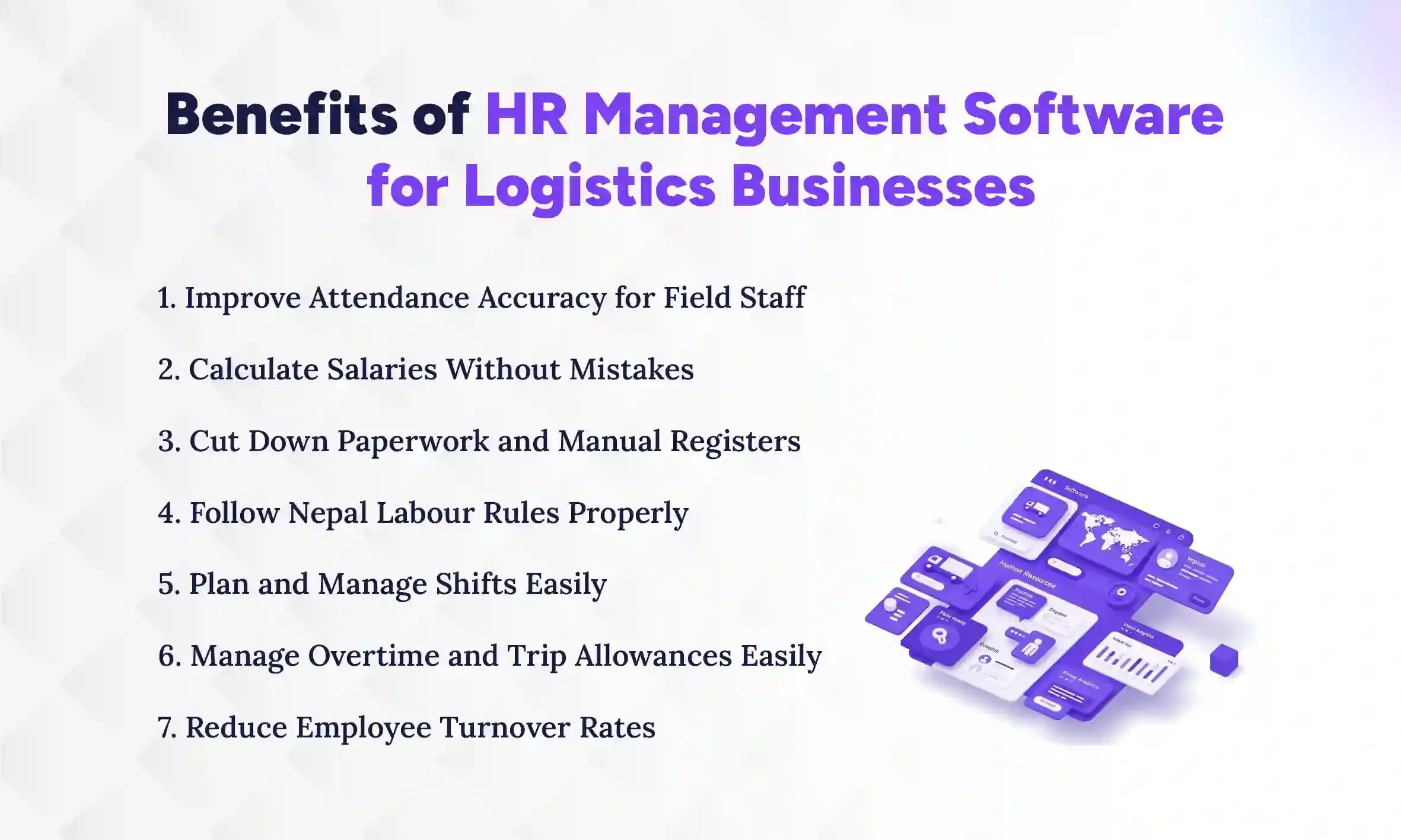
HR management software brings many clear benefits to logistics businesses, such as better attendance tracking, accurate payroll, reduced paperwork, and easier shift management. It helps companies handle daily HR tasks in a more organized and reliable way. Because of this, operations become smoother and less stressful for both HR teams and employees. Let’s look at each HRMS benefit in detail.
1. Improve Attendance Accuracy for Field Staff
HR software improves attendance accuracy by using digital tools like mobile check-ins or GPS tracking for field staff. This removes the need for manual registers, which often have errors or missing entries. Drivers and field workers can mark attendance directly from their phones. As a result, HR teams get real-time and reliable attendance data. This also helps avoid confusion during salary calculations.
2. Calculate Salaries Without Mistakes
Salary calculation becomes much easier because the system automatically includes attendance, overtime, and trip data. This reduces human errors that often happen in manual payroll processing. HR teams do not need to cross-check multiple registers or sheets. Everything is calculated in one place with clear records. This ensures employees get paid correctly and on time.
3. Cut Down Paperwork and Manual Registers
HR software reduces the need for paper files, registers, and spreadsheets. Instead of storing everything physically, all records are saved digitally in one system. This makes it easier to find and update employee information quickly. It also saves a lot of time for HR teams. Over time, it creates a more organized and efficient workflow.
4. Follow Nepal Labour Rules Properly
With built-in compliance features, HR software helps companies follow Nepal’s labour rules more easily. It can track working hours, overtime limits, and leave policies in a structured way. This reduces the risk of legal issues or penalties. HR teams can also generate reports when needed for audits. So, compliance becomes less stressful and more accurate.
5. Plan and Manage Shifts Easily
Shift planning becomes simple because managers can assign and adjust shifts digitally. They can easily see who is available and who is already assigned. This helps avoid confusion and overlapping schedules. Changes can also be updated instantly for all employees. As a result, daily operations run more smoothly.
6. Manage Overtime and Trip Allowances Easily
The system automatically tracks overtime hours and trip-based work for employees. This ensures that extra work is recorded correctly without manual effort. HR teams can set rules for allowances and payments in advance. Because of this, salary disputes are reduced. Employees also feel more confident about fair compensation.
7. Reduce Employee Turnover Rates
When HR processes are clear and payments are accurate, employees feel more satisfied. This reduces frustration caused by delays or mistakes in salary and attendance. Better communication and transparency also improve trust within the company. Over time, employees are more likely to stay longer. This helps reduce turnover and hiring costs.
Ready to Accelerate Your Digital Growth?
Partner with The Pace Infosys to build scalable web and mobile solutions tailored to your business goals.
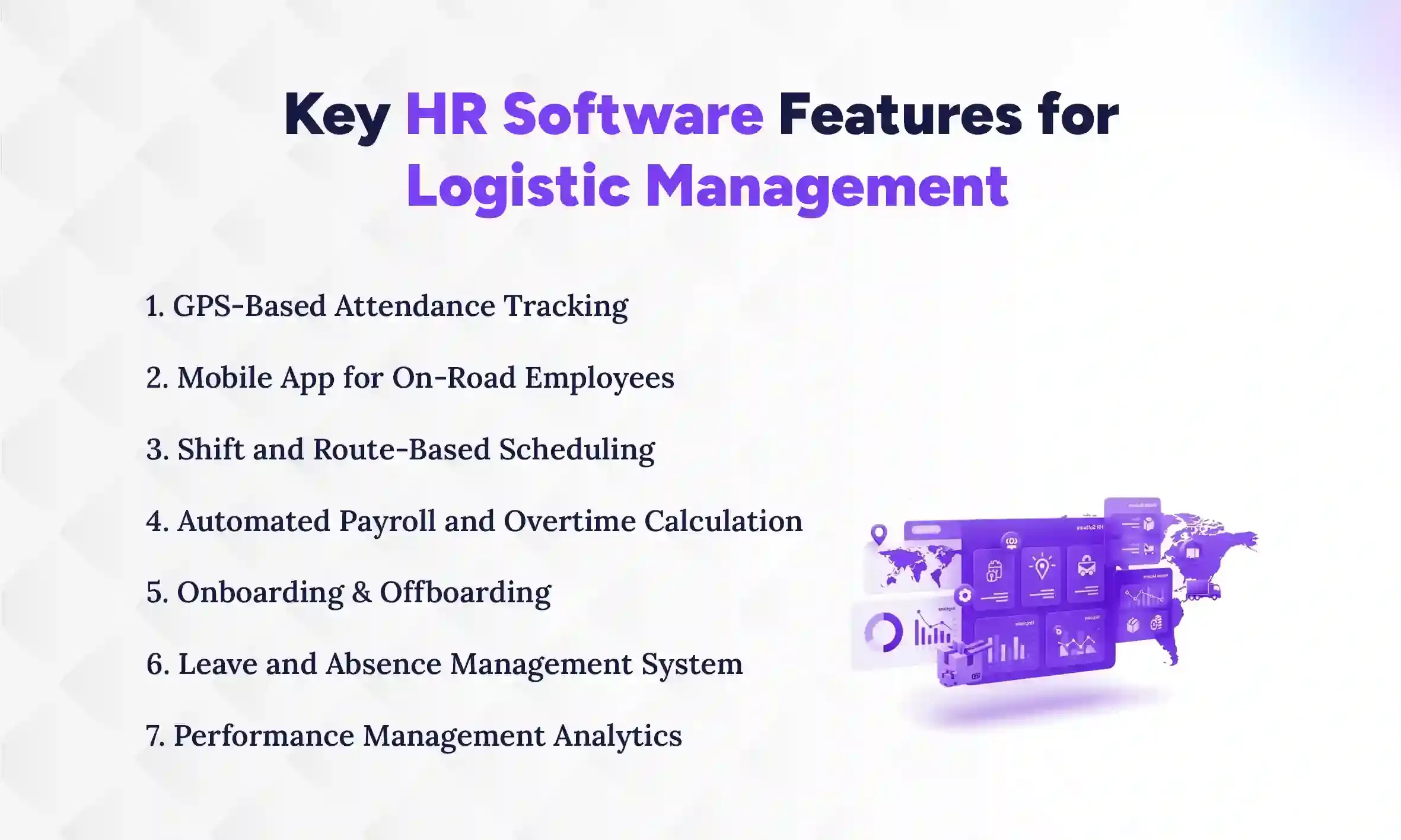
HR software for logistics comes with powerful features designed to handle field staff, drivers, and complex operations in a simple way. These features are built to reduce manual work and improve accuracy across attendance, payroll, and workforce planning. Because logistics work is always on the move, these tools help managers stay in control even outside the office. Let’s look at the most important features one by one.
1. GPS-Based Attendance Tracking
A GPS-based attendance tracking system helps companies confirm where employees are when they start or end work. This is especially useful for drivers and field staff who do not work from a fixed location. It removes fake entries and reduces manual errors in attendance logs. Managers can see real-time location updates for better control. This builds trust and improves attendance accuracy.
2. Mobile App for On-Road Employees
A mobile app allows drivers and field workers to manage HR tasks directly from their phones. They can mark attendance, check schedules, and view updates without visiting the office. This is very helpful for teams who are always on the road. It also improves communication between HR and field staff. As a result, work becomes faster and more flexible.
3. Shift and Route-Based Scheduling
This feature helps managers assign shifts based on routes, trips, and availability. It reduces confusion when multiple vehicles and drivers are involved in daily operations. Schedules can be updated quickly when plans change. It also ensures fair workload distribution among employees. This keeps operations smooth and well-organized.
4. Automated Payroll and Overtime Calculation
An automated payroll system ensures salaries are calculated based on real attendance, overtime, and trip records. This removes the need for manual calculations, which often lead to errors. The system applies rules consistently for every employee. It also speeds up salary processing at the end of each month. This reduces disputes and improves payment accuracy.
5. Onboarding & Offboarding
Onboarding in HR software helps new employees join the system quickly with all required details in one place. Offboarding ensures that exit formalities are handled smoothly without missing records. Both processes are stored digitally for future reference. This saves time for HR teams and reduces paperwork. It also improves the overall employee experience.
6. Leave and Absence Management System
A leave management system allows employees to apply for leave directly through the app, while managers can approve or reject requests easily. It keeps a clear record of all absences in real time. This helps avoid confusion during payroll processing. It also ensures that staffing levels are always balanced. Overall, it makes leave management more transparent and organized.
7. Performance Management Analytics
Performance analytics helps companies track how efficiently employees are working over time. It can show data like trip completion, attendance patterns, and punctuality. Managers can use this information to identify top performers and areas that need improvement. It also supports better decision-making for promotions or training. This makes workforce management more data-driven and fair.
How to Choose the Right HR Software for Logistics Companies?
Choosing the right HR software for logistics companies means focusing on your operations, workforce type, and daily challenges. It is not just about features, it is about how well the system fits your drivers, field staff, and HR workflow. When the software matches your real needs, it becomes easier to manage people, payroll, and operations smoothly. Let’s break this down into key areas you should focus on.
1. Assess Company Size and Fleet Operations
Start by understanding the size of your team and how your fleet operates daily. A small transport company may need basic attendance and payroll, while larger fleets require shift planning, route tracking, and detailed reporting. You should also look at how many drivers, helpers, and office staff you manage. Also, understand what HR software does and how it works. This helps you choose software that fits your current setup. At the same time, make sure it can handle future growth without needing a system change.
2. Check Mobile and Field Usability
In logistics, most employees are not sitting in an office; they are on the road. So, your HR software must work smoothly on mobile devices. Drivers should be able to mark attendance, check shifts, or request leave without confusion. If the system is too complex, field staff may avoid using it. That is why simple design and easy access matter. When mobile usage is smooth, adoption becomes much easier.
3. Evaluate Payroll and Compliance Features
Payroll in logistics is rarely simple, as it often includes overtime, trip-based pay, and allowances. Your software should handle all these calculations accurately without manual effort. It should also follow Nepal’s labor rules, including working hours and deductions. This reduces the risk of payroll mistakes and compliance issues. A strong payroll system saves time and builds trust with employees.
4. Look for Integration with Existing Systems
Your HR software should work well with the systems you already use, like accounting or payroll tools. Without integration, HR teams may end up entering the same data multiple times. This increases the chances of errors and slows down processes. When systems are connected, data flows automatically and stays consistent. In the long run, this makes your entire operation faster and more efficient.
Which is the Best HR Management Software for Transport & Logistics Companies?
When it comes to logistics businesses, Pace HRMS stands out as one of the best HR management software in Nepal. It is built to handle real challenges like managing drivers, field staff, shifts, and complex payroll, all in one simple system. Instead of juggling multiple tools, businesses get a smooth, connected HR workflow that saves time and reduces errors.
What makes Pace HRMS even more reliable is its proven track record. With over 99% customer satisfaction and usage across some of the most reputed companies in Nepal, including Kumari Job, which is one of the country’s leading job portals, Pace HRMS has already earned strong trust in the market. This shows that it is not just a new solution but one that businesses actively rely on every day.
Why Choose Pace HRMS for Logistics Businesses in Nepal?
Pace HRMS is designed to support the unique needs of logistics companies where teams are always on the move. It works well for both office staff and field employees, making workforce management simple and consistent across locations.
Built for managing distributed and on-road teams
Reliable attendance tracking with payroll automation
Strong data security with scalable system design
Trusted by growing and established companies in Nepal
Overall, Pace HRMS helps logistics businesses move from scattered, manual HR processes to a more organized, accurate, and stress-free system.
Conclusion
HR management in transport and logistics is no longer something you can handle with registers and guesswork. With drivers on the road, shifts running all day, and payroll getting complex, a proper HR system becomes essential. The right software helps you track attendance, manage payroll, and stay organized without daily stress.
When HR runs smoothly in the background, everything else becomes easier to control and scale. That’s where digital HR makes a real difference.
So, if you’re ready to simplify your operations and reduce manual work, it’s time to take the next step. Explore Pace HRMS and see how it can make your HR processes faster, clearer, and much more reliable.
FAQs
Is Pace HRMS suitable for small transport businesses?
+
Yes, Pace HRMS is scalable and affordable, making it suitable for small transport companies while also supporting growth as operations expand.
How does an HR software help in payroll management?
+
It automates salary calculations, overtime, and deductions, ensuring accurate and timely payroll processing without manual errors.
Does HR software support workforce management via mobile?
+
Yes, Pace HRMS offers a PWA mobile app that lets employees mark attendance, check shifts, and manage requests from anywhere.
How does HR software reduce payroll errors?
+
It links attendance directly with payroll, automatically calculating salaries, overtime, and deductions to reduce manual mistakes.
Is HR software useful for managing shift-based logistics work?
+
Yes, it helps plan, assign, and manage shifts easily, ensuring smooth 24/7 operations without scheduling conflicts.
Can HR software manage multiple branches or depots?
+
Yes, it centralizes data from multiple locations, making it easy to manage employees across different branches or depots.
How quickly can HR software be implemented?
+
Most HR systems can be set up within a few days, depending on business size and data migration needs.
Is HR software secure for employee data?
+
Yes, reputed HR software offers secure cloud storage, access control, and data protection to keep employee information safe.
Ready to get started?
Book a 30-minute consultation call, and let's talk about your goals.