On a busy Monday, a Kathmandu agency receives a trekking enquiry on Facebook, a family tour request by phone, and an international holiday request through its website. One sits in a staff member's inbox, one in a notebook, and one in a spreadsheet nobody updated last week. By Wednesday, no one is sure who has replied to whom.
Receiving enquiries is only the first step. Agencies need a consistent way to record each lead, understand what the traveler wants, assign responsibility, schedule follow-ups, and track progress toward a booking decision. A travel agency CRM is one way to organize that sales process, although it does not run every stage of a confirmed trip.
This article explains where agencies lose track of enquiries, shares a seven-step process that works with or without software, and shows how to tell CRM and booking tools apart before you choose one.
Why Do Nepalese Travel Agencies Struggle to Manage Leads and Bookings?
Agencies struggle because enquiries arrive through many channels and rarely end up in one shared record with a clear owner and next step. Nepal recorded 529,090 international visitor arrivals in the first five months of 2026, about 5.6 percent more than the same period in 2025, according to Nepal Tourism Board data reported by Himal Press. More visitor interest only helps if enquiries are handled well.
The same problems tend to repeat:
Scattered sources: Website forms, social media, calls, email, referrals, and walk-ins each create separate records.
Missed follow-ups: A traveler asked for prices and said they would decide later, and nobody called back.
Lost preferences: Travel dates, group size, budget, and accommodation needs are noted differently by each person.
Unclear ownership: Two employees contact the same traveler, or nobody does.
No pipeline view: Managers cannot see which enquiries are new, stalled, or close to a decision.
Mixed-up tracking: A spreadsheet shows a traveler's name but not their actual next step.
Consider a traveler who messages about an Annapurna trek for six people in March. The consultant promises a proposal tomorrow and keeps that promise only in her head. Two days later, the traveler hears back from another agency within an hour.
A repeatable lead-management process can fix most of this before an agency spends money on more software.
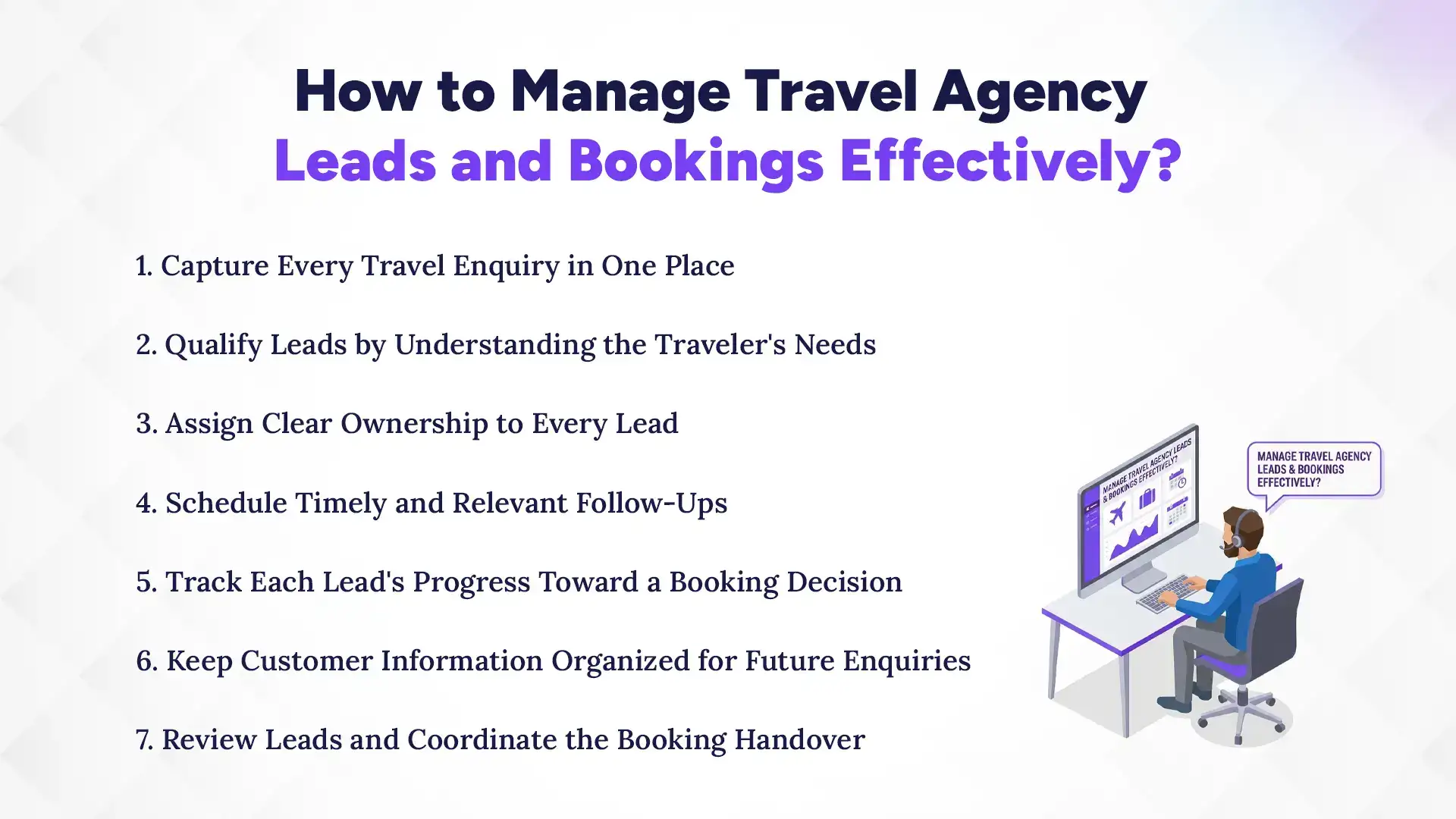
How to Manage Travel Agency Leads and Bookings Effectively?
Managing travel agency leads and bookings effectively means capturing every enquiry in one place, qualifying it, assigning an owner, scheduling follow-ups, tracking its pipeline stage, keeping customer records organized, and handing confirmed travelers to your booking team.
This works because each step removes a common cause of lost enquiries, such as scattered records, unclear ownership, and forgotten follow-ups, and it works whether you use a shared spreadsheet or CRM software. Here is how to put each of these seven steps into practice.
1. Capture Every Travel Enquiry in One Place
Every enquiry, from every channel, should end up in one shared record. At a minimum, note:
Customer name and contact details
Enquiry source
Destination or package of interest
Preferred travel dates
Number of travelers
Approximate budget, if shared
Important preferences or questions
Date of the next follow-up
A shared spreadsheet is a fair starting point for a small agency. As enquiry volume grows, a CRM adds structure through consistent fields, search, and filters. Be realistic about how enquiries get in. Some sources can be connected to software, while others, such as a phone call, still need someone to type the details. Do not assume any tool captures every social platform automatically.
2. Qualify Leads by Understanding the Traveler's Needs
Not every enquiry is ready for a decision. Ask about the destination and type of trip, travel dates and flexibility, group size, budget range, and accommodation or activity preferences. Also find out whether the traveler is still exploring or ready to proceed, and what information they need before deciding.
Compare two enquiries. One traveler is weighing Pokhara and Mustang for next year. Another wants a proposal for a Chitwan family trip next month. The second needs a reply today, while the first still deserves a friendly check-in later. Qualification helps staff set priorities without dismissing early-stage prospects.
3. Assign Clear Ownership to Every Lead
Every active enquiry needs one responsible employee. Assign by team responsibility or specialty. Trekking enquiries might go to a consultant who knows the routes and permits, while international holiday requests go to a colleague who handles outbound packages. Each record should show the next action and who owns it.
Plan for absence as well. Record handovers when someone is on leave, and check enquiries over weekends and holidays so none sit unattended. One owner per lead also prevents two employees from calling the same traveler.
4. Schedule Timely and Relevant Follow-Ups
Travel decisions involve questions, comparisons, and waiting. Follow up after sending a quotation or package details, check whether the traveler needs clarification, and contact people who asked for more information. Agree on the next contact time before ending a conversation, and record every completed and pending follow-up.
Keep messages personal. For example: "Hello Sita, I shared the Pokhara package on Tuesday. Would you like me to adjust the hotel options or dates? I can call tomorrow afternoon if that suits you."
Also keep two things separate. A reminder prompts an employee to follow up. An automated message goes straight to the customer. Both can be useful, but generic repeated messages can frustrate a traveler who is still deciding.
5. Track Each Lead's Progress Toward a Booking Decision
A defined pipeline shows where every enquiry stands. A simple set of stages might be:
New enquiry
Contacted
Requirements understood
Proposal or quotation shared
Follow-up pending
Decision pending
Won or lost
These are suggested stages, not Pace CRM's default settings. Each record needs an accurate status and a clear next action, so managers can spot stalled enquiries and see where travelers need help.
A lead marked "won" means the traveler agreed to proceed. It does not mean the reservation, ticketing, payment, or supplier confirmation is complete.
6. Keep Customer Information Organized for Future Enquiries
Relationships continue after one enquiry. Keep relevant interaction history and record preferences with care. A traveler who asked about a domestic tour last year may now ask about a different destination. If the record shows their group size, budget, and preferred travel season, the consultant starts with context instead of repeating basic questions.
Contact past customers about future trips only when it is relevant, and avoid intrusive messaging. Handle personal information responsibly. Limit access to staff who need it and use it only for legitimate business purposes.
7. Review Leads and Coordinate the Booking Handover
Hold a short weekly review. Check enquiries that have not received a response, quotations awaiting a decision, and upcoming follow-up tasks. Record each final outcome, won or lost, so the team can learn from it.
When a traveler confirms, hand them to the booking or operations team and pass on their requirements accurately: names, dates, group size, and special requests. Sales tracking and booking execution are different jobs. Reservations, payments, tickets, accommodation, and supplier confirmations may need a dedicated booking system or a clear operational process.
The aim is simple: every enquiry is traceable and every next step is clear.
A travel agency CRM is customer relationship management software that helps agencies organize prospect and customer information, track sales opportunities, record interactions, and manage follow-ups. Think of it as the agency's shared memory for every traveler's conversation.
The main functions to look for are:
Centralized customer and lead records: one place for contact details, requirements, and notes.
Lead and opportunity tracking: a view of each enquiry from first contact to decision.
Sales pipeline visibility: a clear picture of how many enquiries sit at each stage.
Follow-up reminders and activity records: prompts for staff and a log of what was done.
Customer interaction history: context for returning travelers.
Reporting and analytics: summaries of lead status and team activity.
Lead capture or integrations: support for the channels the agency actually uses.
Together, these reduce scattered records and give managers better visibility into potential business. A CRM is not necessarily a travel reservation platform, though. Confirm whether a product supports operational booking functions or whether you need separate booking software.
Travel Agency CRM vs. Travel Booking Software: What's the Difference?
A travel agency CRM manages the sales side of the business, tracking each enquiry, its follow-ups, and its progress to a decision, while travel booking software manages the operational side, such as reservations, availability, tickets, and payments, once a traveler decides to go. The two solve different problems, so a tool that is strong at one may offer little or nothing for the other, and some platforms combine both.
The table below compares them side by side so you can see where each one fits.
Area
Travel Agency CRM
Travel Booking Software
Main purpose
Manage customer relationships and sales opportunities
Manage travel reservations and booking operations
Customer enquiries
Records and tracks enquiries
May receive enquiries related to bookable services
Follow-ups
Helps organize contact history and next actions
Depends on the system's communication features
Sales pipeline
Tracks progress toward a sales decision
May not provide a full sales pipeline
Reservations and availability
Not inherently included
May support reservations and availability
Tickets, payments, and confirmations
Require separately verified capabilities
May be supported, depending on the product
Products vary widely within each category. Some travel technology platforms combine CRM and booking functions, so check the exact capabilities before you buy.
Choose your CRM software based on your real bottleneck. If the main problem is missed enquiries and inconsistent follow-ups, a CRM may be the priority. If the main problem is reservations, inventory, ticketing, or supplier coordination, booking-focused software may be necessary.
What Should Nepalese Agencies Look for in a Travel CRM?
Look for a travel CRM that keeps lead and customer records in one place, shows each enquiry’s pipeline stage, supports follow-ups and activity tracking, works with the channels you actually use, offers useful reporting, fits your workflow, and comes with clear pricing and support. The questions below show how to test each option against those needs.
Centralized records: Can the team keep organized records and find information quickly?
Clear pipeline stages: Can employees see where each enquiry stands and what happens next?
Follow-up and activity management: Can staff log interactions and track pending actions? Check whether the tool offers reminders for staff, automated customer messages, or both.
Lead sources and integrations: Does it support the channels you use? Verify each integration before committing.
Useful reporting: Can managers review lead status, overdue follow-ups, and open opportunities?
Flexibility and ease of use: Can it match your workflow without creating extra admin work?
Pricing, support, and implementation: What is the total cost, and what do onboarding, training, and support involve?
Not every agency needs an expensive or specialized platform. A very small agency may manage well with a disciplined spreadsheet and the process above, while a growing team handling many enquiries will likely benefit from a dedicated CRM.
How Can Pace CRM Help Travel Agencies Manage Leads?
Pace CRM helps travel agencies manage leads by bringing enquiries from sources such as a website, Facebook, and referrals into one system, where each traveler’s details, conversations, follow-ups, and pipeline stage sit in a single record. That matters because most lost enquiries come from a forgotten follow-up or an unclear handover, and a shared system with reminders, pipeline stages, and dashboards lets consultants stay on top of their leads while managers see what is waiting. The key CRM features below show how this works in an agency’s daily routine.
One record for every traveler: Pace CRM stores contact details, communication history, and requirements in a single customer profile, so any consultant can pick up a conversation without asking the traveler to repeat themselves.
Enquiries from multiple sources in one place: It is designed to bring in leads from a website, Facebook, referrals, and other sources, so no enquiry stays hidden in a personal inbox or notebook.
Automatic lead assignment: Leads can be assigned to team members automatically, which gives every enquiry a clear owner and avoids two consultants contacting the same traveler.
Visual drag-and-drop pipeline: Teams move each lead through stages such as proposal shared or decision pending, so managers can spot stalled enquiries quickly. Pipelines and workflows can be customized to match how your agency sells.
Follow-up reminders and task assignment: Scheduled reminders prompt staff to follow up after a quotation or enquiry, which reduces missed callbacks.
Dashboards and performance reports: Custom dashboards and reports show enquiries, follow-ups, and team activity, so managers can review the pipeline without chasing updates.
Role-based access: Customizable user roles and permission-based sharing keep customer data visible only to the staff who need it.
Built for Nepali businesses: Pace CRM is made by The Pace Infosys, a Nepal-based company that offers local support, guided setup, and a free trial, and it is available as cloud, on-premise, and mobile access.
In practice, a consultant could open a trekking enquiry, see the traveler's earlier conversations, record the next follow-up, and move the opportunity to "proposal shared" after sending a quotation. A manager can see which enquiries are waiting.
If your team loses track of enquiries, you can request a demo to see whether Pace CRM's lead-management features fit your workflow.
Conclusion
Managing travel agency leads and bookings in Nepal does not have to be a messy, stressful task. Success comes down to using a simple process to capture every enquiry, assign a clear owner, and follow up on time. Whether you use a basic spreadsheet or dedicated CRM software, keeping your sales process organized ensures no traveler falls through the cracks.
Every missed follow-up is a missed chance to show a traveler the beauty of Nepal. Your agency works hard to bring in enquiries, so your team deserves a system that makes turning those leads into unforgettable journeys easy. When you take control of your pipeline, you build trust with your customers and give your business room to grow.
Stop Losing Leads & Start Closing More Bookings!
Set up Pace's Travel CRM to keep your team organized and moving forward.
It depends on lead volume, sales workflow, integrations, reporting needs, budget, and whether you also need booking management. Pace CRM is an option to evaluate for its lead and customer management features, not a proven best choice.
How can travel agencies track customer enquiries?
+
Record each enquiry in a shared system, capture the traveler's requirements, assign an owner, update the lead status, and schedule the next follow-up. Review pending enquiries regularly.
Is travel agency CRM software different from booking software?
+
Yes. A CRM generally handles customer records, sales opportunities, and follow-ups, while booking software handles reservations and related operations. Some platforms combine both, so check each product's capabilities.
Can a CRM help travel agencies get more bookings?
+
It can support better lead organization, consistent follow-ups, and clearer sales visibility. Actual bookings still depend on package suitability, pricing, service quality, customer demand, and your sales process.
Can small travel agencies use CRM software?
+
Yes, especially if enquiries are scattered or follow-ups are missed. The right solution should fit the agency's workload, budget, and operational needs.
Does Pace CRM manage travel bookings?
+
Pace CRM focuses on lead, customer, and sales-pipeline management. Do not assume it handles reservations, tickets, or payments. Confirm any booking-related needs with the Pace team during a demo.
Ready to get started?
Book a 30-minute consultation call, and let's talk about your goals.