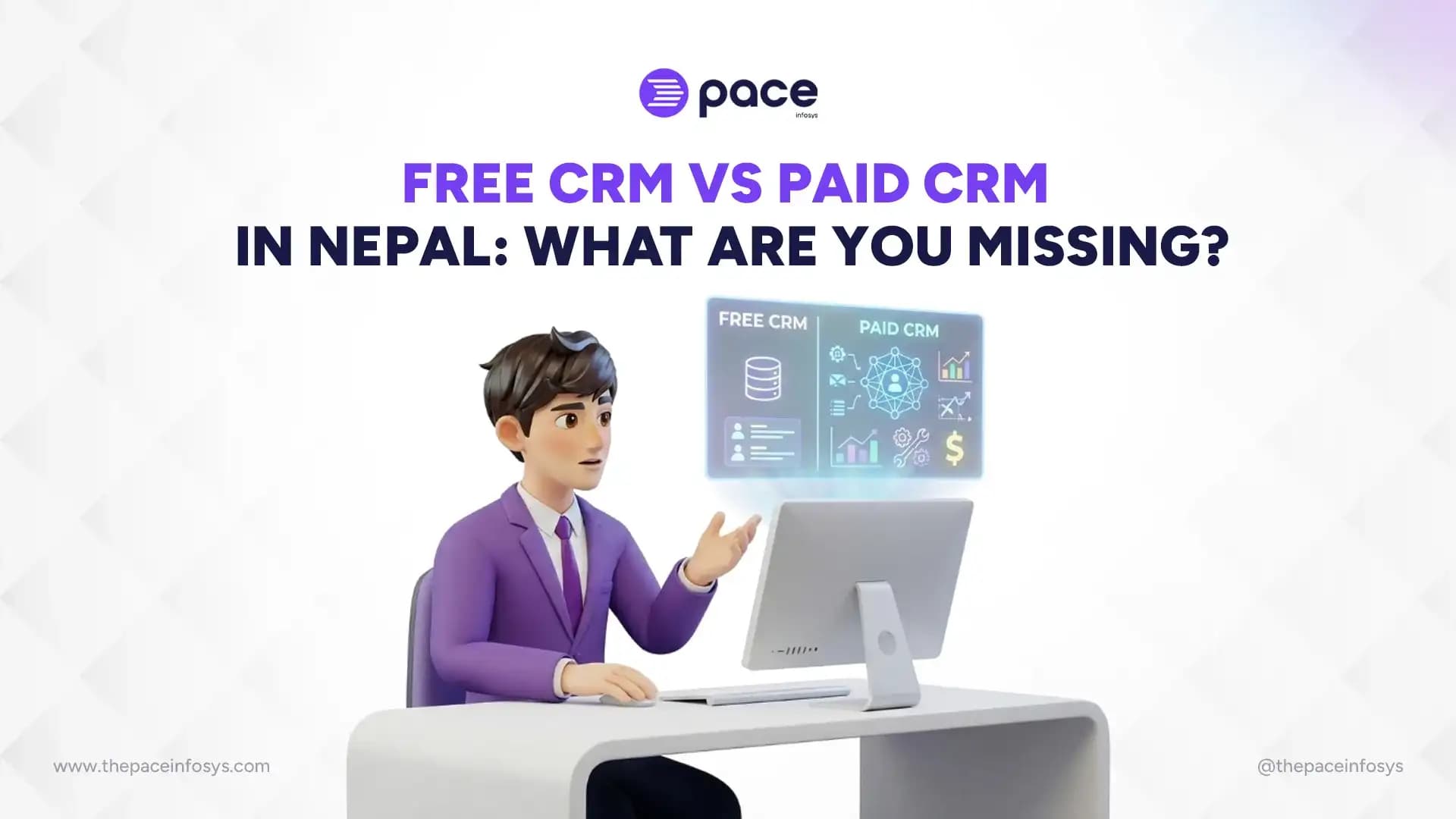
Free CRM in Nepal typically leaves out deeper automation, real reporting, and dedicated support gaps that don't show up until a sales team is already relying on the system for deals that actually matter. It works fine right up until a missed follow-up or a lost contact record turns "free" into an expensive lesson, especially when businesses realize what a proper customer relationship management system is actually supposed to deliver.
This guide covers what free CRM typically includes, why businesses in Nepal start there, what's actually missing compared to a paid CRM, how free tools handle security and support, what happens when a business outgrows them, what to compare before deciding, and what Nepali businesses specifically need to weigh closing with which paid CRM fills the gaps free tools leave.
What Does Free CRM Typically Include?
Free CRM typically includes basic contact management, simple deal tracking, and a limited number of user seats, covering just the essentials for a very small sales team.
Most free plans give you a place to store contact details and log basic deal information, moving a business off spreadsheets and into something that at least resembles a system of record. That covers the bare minimum a small sales team needs to stop losing track of leads entirely. Where free plans consistently draw the line is user seats, capping how many reps can actually use the system before you're pushed toward a paid tier.
Factor
Free CRM
Paid CRM
Feature Depth
Basic contacts and deal tracking only
Full sales pipeline and automation
Automation
Minimal or none
Workflow automation and triggers
Scalability
Capped user seats and records
Scales with team size and deal volume
Support Access
Limited or community-based
Dedicated, responsive support
Why Do Businesses in Nepal Start With Free CRM?
Businesses in Nepal start with free CRM because of tight initial budgets, a small sales team that doesn't yet justify a paid system, and uncertainty about what their CRM needs will look like as they grow.
1. Tight Initial Budget Constraints
Early-stage businesses often have very little room in the budget for software that isn't tied directly to revenue, making free CRM an easy first choice. Working within tight initial budget constraints is a reasonable starting point, as long as the trade-offs are understood from the beginning.
2. Small Sales Team at the Start
With just one or two reps, the gaps in a free plan simply aren't visible yet, since there's little complexity for the software to fall short on. A small sales team at the start means most of what's missing in free CRM hasn't become relevant yet.
3. Uncertainty About Future CRM Needs
New businesses often don't yet know what their sales process will look like in a year or two, which makes committing to a paid system feel premature. This uncertainty about future CRM needs is understandable, but it also means the switch to paid software often happens reactively rather than by plan.
What Are You Missing Compared to a Paid CRM?
Compared to a paid CRM, free CRM is missing deeper customization, real reporting and analytics, higher contact or deal limits, and meaningful support when something actually goes wrong.
1. Limited Customization Options
Free plans generally offer fixed pipeline stages and settings, with little room to adjust the system to match how your specific sales process actually works. Limited customization options mean the software shapes how your team sells, rather than offering the advanced CRM features that adapt to fit your existing process.
2. Reduced Reporting and Analytics
Free tiers typically provide only basic summaries, if any reporting at all, leaving sales leaders without real insight into pipeline health or rep performance. Reduced reporting and analytics makes it harder to make informed sales decisions as the team grows past a couple of reps.
3. Capped Contacts or Deals
Most free plans cap the number of contacts or deals the system can support, forcing a forced upgrade or migration the moment you cross that threshold. Capped contacts or deals turn growth itself into the trigger that ends the free option, often without much warning.
4. Minimal or No Customer Support
When something goes wrong on a free plan, support is often limited to community forums or slow email queues, if it exists at all. Minimal or no customer support becomes a real problem the first time an issue affects an active deal and needs to be resolved quickly.
How Does Free CRM Handle Data Security and Support?
Free CRM generally handles data security and support with limited or no security certifications, basic access controls, and minimal response times when issues actually come up.
1. Limited or No Security Certifications
Free platforms rarely carry independent security certifications, since the cost of maintaining them typically isn't justified by a free tier's revenue. Limited or no security certifications means there's no independent proof that customer data is actually being protected the way you'd expect from a secure cloud-based CRM.
2. Basic Access Controls
Free plans often provide only simple, all-or-nothing permission settings, without the granular role-based access larger teams eventually need. Basic access controls can leave sensitive deal and contact data more exposed than a growing sales team should be comfortable with.
3. Minimal Support Response Times
When a security or access issue does come up, free plans generally offer little in the way of guaranteed response times. Minimal support response times mean a real problem could sit unresolved far longer than it should.
What Happens When a Business Outgrows Free CRM?
When a business outgrows free CRM, data migration becomes a real challenge, sales workflows get disrupted during the switch, deal history can be temporarily lost, and access to features that are suddenly needed gets delayed.
1. Data Migration Challenges
Moving contacts, deals, and activity history out of a free platform isn't always straightforward, especially if the tool wasn't built with easy export in mind. Data migration challenges often turn what should be a quick switch into a drawn-out, error-prone process that jeopardizes your established lead management in CRM.
2. Disrupted Sales Workflows During Switching
While migrating to a new system, active deals can stall or require manual tracking until the new platform is fully set up and reps are trained on it. Disrupted sales workflows during switching are one of the most immediate, visible costs of outgrowing free CRM.
3. Temporary Loss of Deal History
If data doesn't transfer cleanly, some deal history, past notes, and previous communication can be lost or become inaccessible during the transition. Temporary loss of deal history creates real problems if that context is ever needed later to close a deal or resolve a dispute.
4. Delayed Access to Needed Features
The features a growing sales team suddenly needs are better automation, deeper reporting, and higher record limits, which aren't available until the migration to paid software is actually complete. Delayed access to needed features means the capability gap shows up exactly when it's least convenient, right as the team is scaling.
What Should You Compare Before Choosing Free or Paid?
Before choosing free or paid, businesses should compare the true total cost over time, where the feature ceiling sits as the team grows, and how much support and automation coverage each option actually provides.
1. True Total Cost Over Time
Free CRM isn't actually free once the cost of lost deals, manual workarounds, and an eventual migration are factored in. Calculating the true total cost over time, not just the sticker price, gives a far more honest comparison when evaluating the actual cost of CRM software in Nepal.
2. Feature Ceiling as You Grow
Every free plan has a point where its features simply stop being enough, and it's worth knowing in advance roughly where that ceiling sits. Understanding the feature ceiling as you grow helps you plan the switch to paid CRM proactively instead of reactively.
3. Support and Automation Coverage
The level of support and automation included with each option often matters more in practice than the feature list on a pricing page. Weighing support and automation coverage carefully avoids discovering the gap only after it's already cost the team a deal.
What Should Nepali Businesses Weigh Specifically Before Choosing Free?
Nepali businesses should specifically weigh the long-term cost of switching later, local support availability in free plans, data ownership and portability, and realistic growth plans over the next few years before choosing free CRM.
1. Long-Term Cost of Switching Later
Switching from free CRM to a paid system later almost always costs more in time and disruption than starting with the right tool from the beginning would have. Weighing the long-term cost of switching later helps put the appeal of "free" in a more honest context.
2. Local Support Availability in Free Plans
Most free CRM plans offer little to no local support tailored to how Nepali sales teams actually operate, leaving businesses to troubleshoot on their own. Considering local support availability in free plans matters more once an active deal depends on the system working correctly.
3. Data Ownership and Portability
It's worth confirming upfront how easily contact and deal data can be exported from a free platform, since some tools make this deliberately difficult to discourage switching. Prioritizing data ownership and portability protects a business from being effectively locked into a tool it's already outgrown.
4. Growth Plans Over the Next Few Years
A business that expects meaningful sales team growth in the next few years should factor that trajectory into the decision now, rather than waiting until free CRM's limits are actively costing deals. Considering growth plans over the next few years turns this into a proactive decision instead of a reactive scramble.
Which Paid CRM Fills the Gaps Free CRM Leaves in Nepal?
Pace CRM fills the gaps free CRM leaves in Nepal, with deeper automation, stronger security, and room to scale that free tools simply aren't built to provide.
For Nepali sales teams ready to move beyond what free CRM can offer, Pace CRM builds in the automation, reporting, and reliable support that free platforms consistently leave out. It scales with the team instead of capping growth at an arbitrary contact or deal count.
What sets Pace CRM apart is that it was built around how Nepali sales teams actually sell, not adapted as an afterthought once a free plan's limits became a problem. Between deeper automation, real customer support, and room to grow, it gives businesses the depth free CRM was never designed to provide.
Conclusion
A free CRM may not cost you a monthly subscription, but it can still come with hidden costs, missed opportunities, limited sales visibility, and the challenges of switching platforms as your business grows. A paid CRM designed for businesses in Nepal can address these limitations from the beginning, helping your sales team stay organized and avoid costly disruptions when deals matter most.
If your business is starting to outgrow a free CRM, explore Pace CRM through a demo or contact Pace Infosys to find out whether it’s the right fit for your sales team.
FAQs
At what team size does a business typically outgrow free CRM?
+
Businesses often outgrow free CRM at around 3–10 sales reps, depending on the plan's limitations.
Can deal and contact data be exported easily from free CRM if you switch later?
+
It depends on the provider. Some free CRMs offer easy data export, while others have more limited options.
Does free CRM put a Nepali sales team at a competitive disadvantage?
+
Yes. Free CRM can limit automation, reporting, and follow-up capabilities, putting growing sales teams at a disadvantage.
Is it cheaper long-term to start with paid CRM instead of free tools?
+
Yes. Paid CRM can be more cost-effective long-term by reducing migration costs and improving sales efficiency.
What's the biggest hidden cost of using free CRM in Nepal?
+
The biggest hidden cost is lost sales from missed follow-ups and limited sales visibility.
Can free CRM and a paid CRM be used together during a transition?
+
Yes. Both can be used temporarily during migration, but maintaining two systems long-term is usually inefficient.
Ready to get started?
Book a 30-minute consultation call, and let's talk about your goals.