Thinking about implementing CRM software for your business, but not sure how much it will cost? Many companies in Nepal, from startups to large enterprises, are now adopting CRM systems to manage customer relationships, track sales pipelines, and improve customer service. However, one of the most common questions business owners ask before adopting a CRM system is: how much does CRM software actually cost in Nepal?
In this blog, we will explore the cost of CRM software in Nepal, including the common pricing models, average CRM pricing ranges, and factors that influence the total cost. We will also discuss key CRM features that impact pricing and provide tips on how businesses can choose the right CRM software based on their budget and operational needs.
CRM Software Pricing in Nepal: What Businesses Should Expect
CRM software pricing in Nepal can vary widely depending on the type of system, features included, and the size of the business using it. Small businesses may choose basic CRM tools with limited features, while larger companies often invest in more advanced systems that support sales automation, customer support, and marketing integration. Because of these differences, Customer Relationship Management software pricing can range from affordable subscription plans to fully customized enterprise solutions.
In general, businesses in Nepal can expect CRM software to be offered through subscription-based models, one-time licenses, or per-user pricing plans. Cloud-based CRM solutions are becoming more popular because they require lower upfront investment and are easier to maintain. On the other hand, customized CRM systems with advanced integrations and automation features may cost significantly more depending on the business requirements.
What Are the Common Pricing Models for CRM Software in Nepal?
The cost of CRM software in Nepal is usually structured through different pricing models depending on how the software is deployed and used. Businesses can choose between one-time license payments, subscription-based cloud CRM systems, or per-user pricing models. The right pricing model often depends on company size, budget, and the level of CRM features required. Understanding these models helps businesses select a CRM system that fits both their operational needs and financial plans.
1. One-Time License + Annual Maintenance
The one-time license model requires businesses to purchase the CRM software with a single upfront payment. After purchasing the license, companies usually pay an annual maintenance fee for system updates, support, and technical services. This model is commonly used for on-premise CRM systems where the software is installed on the company’s own servers. While the initial investment may be higher, long-term costs may be lower than with subscription models. Larger businesses sometimes prefer this option for better control over their software infrastructure.
2. Subscription-Based (Cloud CRM Software)
Subscription-based CRM software is one of the most popular models used by businesses in Nepal today. Instead of paying a high upfront cost, companies pay a monthly or yearly subscription fee to access the CRM system. These CRM platforms are usually cloud-based, meaning the software is hosted online and accessible from anywhere. This model also includes regular updates, security maintenance, and customer support from the provider. It is especially suitable for startups and growing businesses because it requires lower initial investment.
3. Per-User, Per-Month Pricing Model
In the per-user pricing model, businesses pay a fixed fee for each user who accesses the CRM system. The total cost increases as more employees are added to the platform. Many global CRM providers commonly use this model because it allows companies to scale their usage gradually. Small teams can start with a few users and expand later as the business grows. However, companies with large teams may see costs increase over time with this model.
4. Startup or Small Business CRM Plans
Many CRM providers offer special pricing plans designed specifically for startups and small businesses. These plans typically include basic CRM features such as contact management, lead tracking, and simple sales pipeline tools. Pricing is usually lower than that of enterprise-level CRM solutions. Some providers even offer freemium versions with limited functionality. These plans are ideal for businesses that want to start using CRM software without making a large financial commitment.
5. Custom Enterprise CRM Solutions
Large companies often require custom-built CRM solutions that are tailored to their specific business processes. In such cases, CRM software is developed or heavily customized to integrate with existing systems, including ERP, accounting software, and marketing automation platforms. Because of their advanced features and customization, enterprise CRM solutions can be significantly more expensive. The pricing usually depends on development time, system complexity, and integration requirements. These solutions are best suited for large organizations with complex operational needs.
INSIGHTS
Did You Know?
CRM systems can improve customer retention by up to 27%. Pace CRM helps businesses build stronger relationships through better tracking and follow-ups.
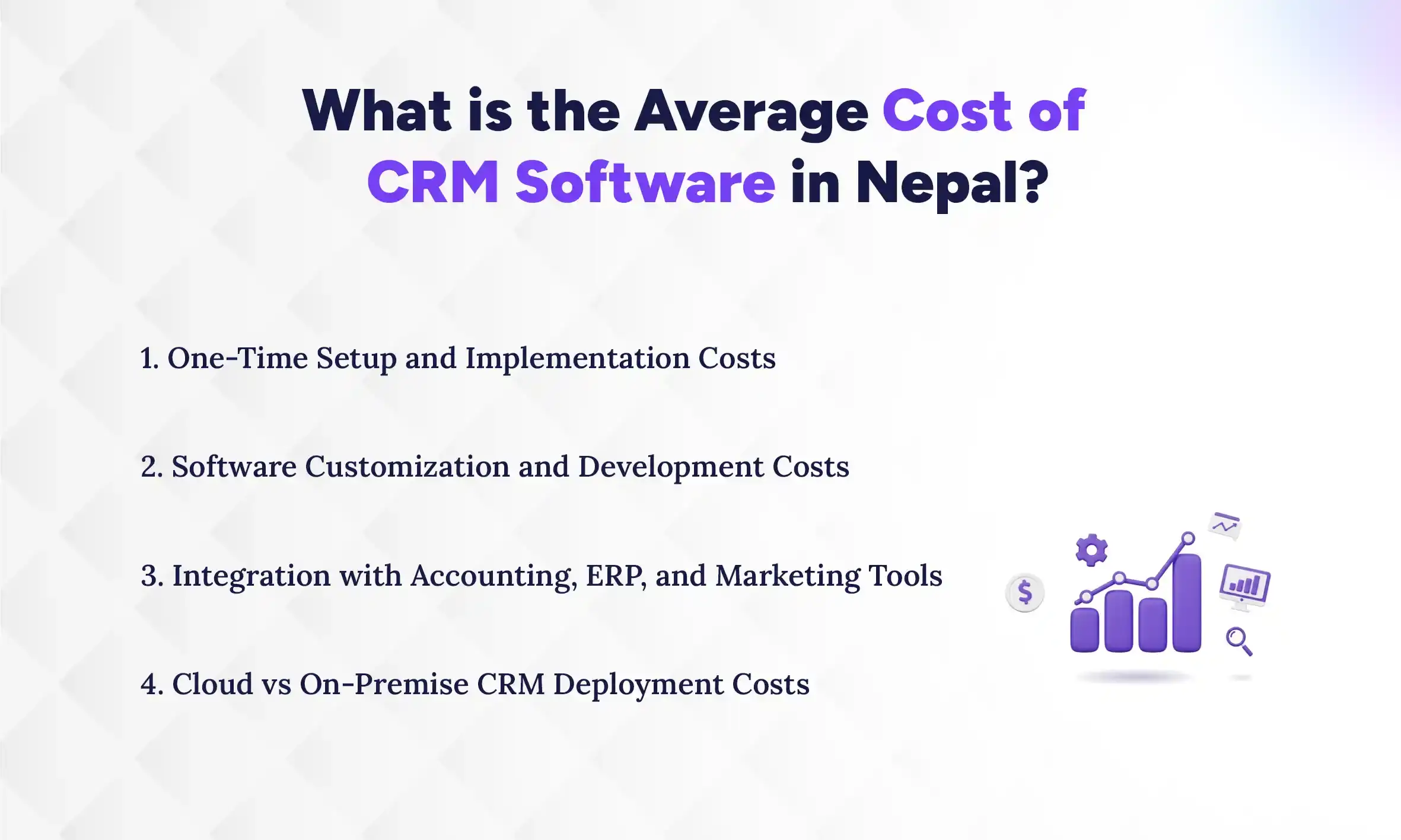
What Is the Average Cost of CRM Software in Nepal?
The cost of CRM software in Nepal typically starts at around NPR 3,000 and can range up to several hundred thousand rupees, depending on the features, customization, and business requirements. Small businesses may only need basic CRM tools with limited users, while larger companies often require advanced CRM systems with automation, integrations, and custom modules. Because of these differences, CRM pricing varies widely. Businesses should evaluate their needs carefully before selecting a CRM solution.
1. One-Time Setup and Implementation Costs
When a company installs CRM software for the first time, there is usually a one-time setup or implementation cost. This may include system installation, configuration, and onboarding support from the CRM provider. Businesses may also need training sessions to help employees learn to use the system effectively. For small CRM deployments, setup costs may be minimal, but for larger organizations, implementation can be more complex. As a result, setup costs can increase depending on system size and requirements.
2. Software Customization and Development Costs
Many businesses in Nepal require CRM systems customized to their workflows and sales processes. Customization may involve adding new modules, modifying dashboards, or creating automation features tailored to the company’s operations. These development tasks increase the overall CRM cost. The more complex the customization requirements, the higher the development expenses will be. Companies with specialized processes often invest more in CRM customization to improve efficiency.
3. Integration with Accounting, ERP, and Marketing Tools
Modern CRM software often needs to integrate with other business systems such as accounting software, ERP platforms, email marketing tools, and customer support systems. These integrations help businesses manage data centrally. However, integrating CRM with multiple external platforms may require additional configuration or development. Some integrations may require third-party licenses or API access. As a result, integration requirements can significantly affect the final CRM cost.
4. Cloud vs On-Premise CRM Deployment Costs
The deployment model also plays a major role in determining CRM software pricing. Cloud-based CRM systems usually operate on monthly or yearly subscription plans and require lower upfront investment. Businesses simply access the system through the internet without needing their own servers. On the other hand, on-premise CRM systems require purchasing software licenses, servers, and IT infrastructure. While on-premises systems may provide greater control over data, they often require a higher initial investment than cloud CRM solutions.
Ready to Manage Leads Better?
Use Pace CRM to track leads, automate follow-ups, and close deals faster. Simple, powerful, and built for your growth.
What Determines the Cost of CRM Software in Nepal?
The cost of CRM software in Nepal is determined by several factors, including the number of users, required features, customization needs, deployment type, and system integrations. Understanding the types of CRM available can help businesses choose the right system based on their operational needs. Different businesses have different operational requirements, which means CRM pricing can vary significantly. A small startup may only need basic contact management tools, while a large company may require advanced automation and integrations. Understanding these factors helps businesses estimate the overall CRM investment more accurately.
1. Company Size (Number of CRM Users)
The number of employees using the CRM system directly affects the total cost. Many CRM platforms charge based on the number of users or licenses required. For small businesses with only a few sales representatives, the cost remains relatively low. However, as more users are added to the system, subscription or licensing costs increase. Larger organizations with multiple departments that use CRM usually require more licenses, which increases the overall software cost.
2. Number of CRM Modules and Features
CRM software can include many modules such as lead management, sales pipeline tracking, marketing automation, customer support, and reporting tools. Businesses that require more advanced features will typically pay a higher price. Basic CRM plans usually include limited functionality, while premium plans offer more automation and analytics capabilities. The number of modules selected directly impacts the final CRM cost. Companies should choose only the features they truly need.
3. Customization and Development Requirements
Some businesses require CRM software tailored to their workflows and operational processes. Customization may involve modifying dashboards, creating new modules, or automating specific tasks. These development activities increase the total cost of CRM implementation. The more unique the business requirements are, the more customization work is needed. Custom CRM development is usually more expensive than using a standard CRM platform.
4. Implementation, Training, and Support
Implementing CRM software often involves system setup, configuration, and employee training. Businesses may also require technical support and maintenance services from the CRM provider. These services may come with additional costs depending on the complexity of the system. Proper training ensures that employees can use the CRM effectively. Ongoing support is also important for maintaining system performance and resolving technical issues.
5. Cloud vs On-Premise CRM Deployment
The deployment method significantly affects CRM pricing. Cloud-based CRM systems usually operate on a subscription model and require less upfront investment. Businesses can access the software online without installing infrastructure. In contrast, on-premise CRM systems require companies to purchase licenses, servers, and IT infrastructure. Although on-premise solutions provide more control over data, they often involve higher setup and maintenance costs.
Learn More About Cloud vs On-Premise CRM in detail!
6. Integration with Sales, Marketing, and Customer Support Systems
Many businesses want their CRM to integrate with other tools such as sales platforms, email marketing systems, accounting software, and customer support applications. These integrations help create a unified workflow and improve business efficiency. However, integrating multiple systems may require additional development work or third-party services. The complexity of these integrations can increase the overall cost of the CRM. Businesses should plan integrations carefully to avoid unnecessary expenses.
Key CRM Software Features and How They Impact Pricing
The features included in a CRM system play a major role in determining the cost of CRM software in Nepal. Basic CRM systems usually include simple contact management and sales tracking, while advanced systems offer automation, analytics, and integration capabilities. Understanding the benefits of CRM helps businesses determine which features are truly necessary. The more advanced features a business requires, the higher the CRM pricing will typically be. Companies should carefully evaluate which features are essential for their operations before choosing a CRM solution, helping them balance functionality and cost effectively.
1. Customer Contact and Lead Management
Customer contact and lead management are among the most fundamental features of any CRM system. This feature allows businesses to store and organize customer information such as contact details, communication history, and lead sources. It helps sales teams track potential customers and manage relationships more efficiently. Basic CRM systems usually include this feature in their standard package. However, advanced lead scoring, segmentation, and automation capabilities may increase CRM costs.
2. Sales Pipeline and Opportunity Tracking
Sales pipeline management allows businesses to track potential deals through different stages of the sales process. This feature helps sales teams monitor leads, manage opportunities, and predict revenue more accurately. CRM systems with advanced pipeline tracking may include visual dashboards, deal forecasting tools, and automated reminders. These features improve sales productivity but may come with higher pricing tiers. Businesses with active sales teams often prioritize this functionality.
3. Marketing Automation Tools
Marketing automation tools help businesses automate marketing campaigns, email communication, and customer engagement activities. These features allow companies to create targeted campaigns based on customer behavior and preferences. Advanced marketing automation may include email marketing, campaign analytics, and customer segmentation. Because these tools require more system capabilities, they often increase CRM software pricing. Companies focused on digital marketing usually benefit from these advanced features.
4. Customer Support and Ticket Management
Customer support and ticket management features help businesses handle customer service requests efficiently. When a customer submits an inquiry or issue, the system creates a support ticket that can be tracked until it is resolved. This improves response time and ensures that no customer request is missed. CRM platforms with advanced support features may include live chat integration and automated responses. These additional capabilities can increase the overall cost of the CRM system.
INSIGHTs
Did You Know?
Businesses using CRM systems can improve sales by up to 29%. With Pace CRM, you can track leads, automate tasks, and close deals faster in one simple platform.
5. Reporting and CRM Analytics
Reporting and analytics features allow businesses to analyze customer data, sales performance, and marketing results. Managers can generate reports that provide insights into business performance and customer behavior. Advanced analytics tools may include customizable dashboards, predictive analytics, and performance tracking. These features help businesses make data-driven decisions. However, CRM systems with powerful analytics tools usually come with higher pricing plans.
6. Workflow Automation and Task Management
Workflow automation helps businesses automate repetitive tasks such as sending follow-up emails, assigning leads to sales representatives, or updating customer records. This feature improves efficiency and reduces employees' manual workload. CRM systems with advanced automation capabilities allow businesses to create custom workflows and triggers. While automation improves productivity, it may increase the cost of the CRM software. Companies that rely heavily on automation often invest in premium CRM plans.
7. Mobile CRM Access
Mobile CRM access allows employees to use the CRM system through smartphones or tablets. This is particularly useful for sales representatives who frequently work outside the office or meet clients in different locations. With mobile CRM, employees can update customer information, track deals, and communicate with teams in real time. Some CRM providers include mobile access in basic plans, while others offer it as a premium feature. The availability of mobile features may influence CRM pricing.
8. Third-Party Integrations
Third-party integrations allow CRM software to connect with other business tools such as accounting systems, marketing platforms, payment gateways, and email services. These integrations help businesses manage operations through a centralized system. However, integrating multiple external tools may require additional configuration, development work, or licensing fees. The complexity of these integrations can increase the overall cost of the CRM. Businesses should carefully plan integrations based on their operational needs.
Is CRM Software Worth the Cost for Businesses in Nepal?
Yes, CRM software is worth the cost for businesses in Nepal because it helps companies manage customer relationships, improve sales performance, and streamline business operations. Instead of managing customer data manually, cloud based crm systems centralize all information on a single platform. This improves communication between teams and allows businesses to provide better customer service. Over time, CRM software can also increase productivity and revenue, making it a valuable long-term investment for growing businesses.
1. Improves Customer Relationship Management
CRM software helps businesses build stronger relationships with their customers by organizing all customer information in one system. Sales teams can easily track communication history, customer preferences, and previous interactions. This allows businesses to provide more personalized service to their clients. When customers feel understood and valued, they are more likely to stay loyal to the company. As a result, businesses can improve customer satisfaction and long-term relationships.
2. Increases Sales Efficiency and Conversion Rates
CRM systems help sales teams manage leads and opportunities more efficiently. Sales representatives can track potential customers through different stages of the sales pipeline and follow up at the right time. Automated reminders and notifications ensure that no opportunity is missed. This structured approach helps sales teams close deals faster. Over time, this can significantly improve sales conversion rates and overall business growth.
Grow Faster With Pace CRM!
Manage leads, automate sales, and track every deal in one place. Pace CRM helps you close more deals with less effort.
One of the biggest advantages of CRM software is that it centralizes all customer data in a single platform. Businesses no longer need to rely on spreadsheets or scattered documents to manage customer information. Employees from different departments can access the same data in real time. This improves collaboration between sales, marketing, and customer support teams. Having centralized data also reduces errors and improves operational efficiency.
4. Enhances Marketing and Customer Support
CRM software also supports marketing and customer service activities. Businesses can use CRM systems to track marketing campaigns, manage customer inquiries, and monitor support tickets. Marketing teams can analyze customer behavior and run targeted campaigns more effectively. At the same time, customer support teams can respond to issues faster. This combination improves both marketing performance and customer satisfaction.
5. Enables Better Business Decision-Making
CRM platforms provide valuable insights through reports and analytics. Business owners and managers can monitor sales performance, customer trends, and marketing results through dashboards and data reports. These insights help leaders make better strategic decisions. Instead of relying on guesswork, businesses can use real data to guide their growth strategies. This makes CRM software a powerful tool for data-driven decision-making.
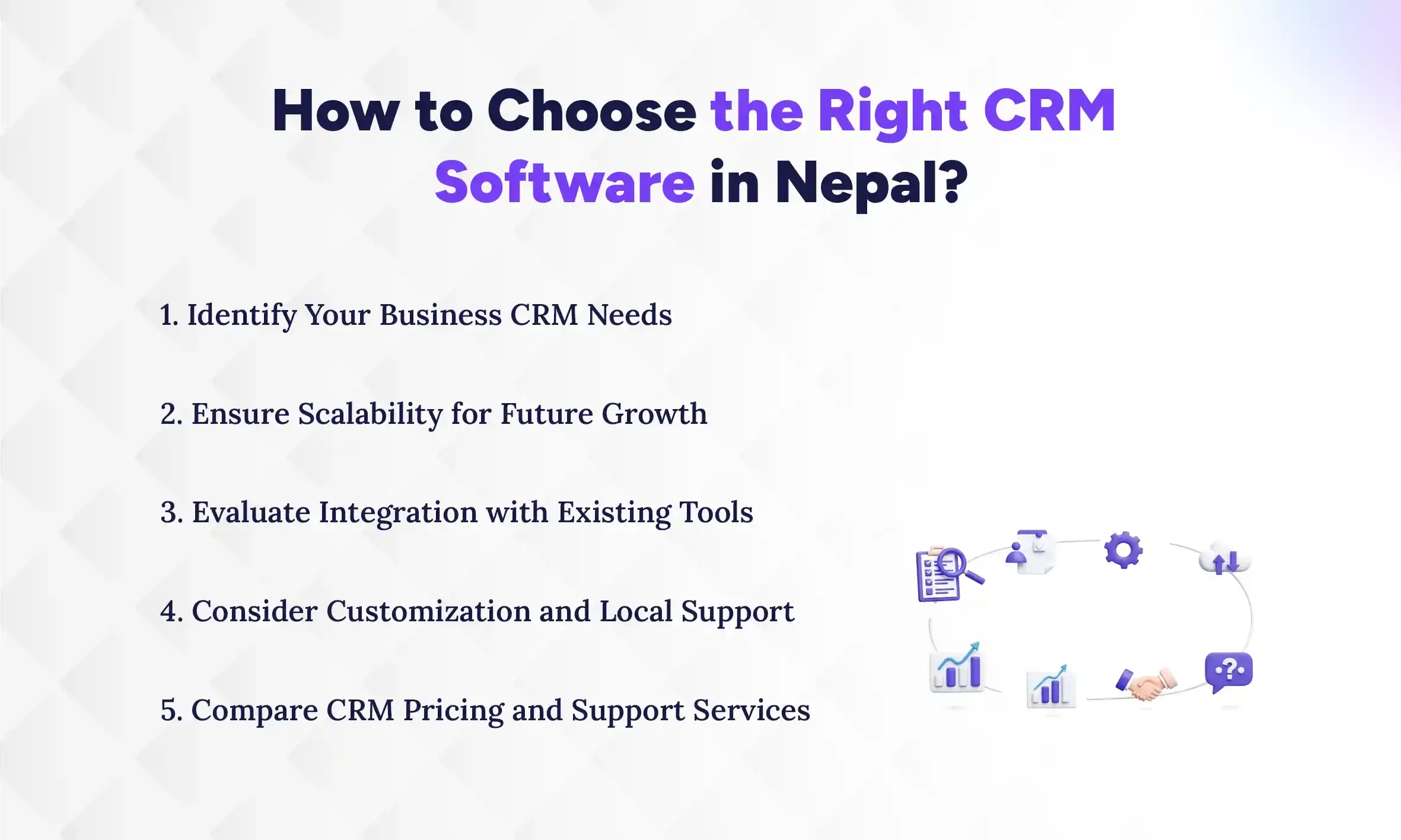
How to Choose the Right CRM Software in Nepal?
Choosing the right CRM software in Nepal requires businesses to evaluate their operational needs, budget, scalability, and integration requirements. A CRM system should support the company’s sales process, customer management, and long-term growth strategy. Businesses should not only focus on the cost of CRM software in Nepal but also consider features, flexibility, and technical support. Taking time to compare different CRM solutions helps companies select the best crm for small businesses in Nepal that delivers the best value.
1. Identify Your Business CRM Needs
The first step in selecting CRM software is to understand your business's specific needs. Companies should identify the challenges they want the CRM system to solve, such as managing leads, tracking sales, or improving customer service. Different industries may require different CRM features depending on their operations. For example, sales-driven companies may prioritize pipeline management, while service-oriented businesses may need strong support tools. Clearly defining business needs helps narrow down the right CRM options.
2. Ensure Scalability for Future Growth
Businesses should choose CRM software that can grow along with their operations. As a company expands, the number of users, customers, and data will also increase. A scalable CRM system allows businesses to add more users, features, or modules without replacing the entire system. This flexibility helps companies avoid costly software changes in the future. Scalable CRM platforms are especially important for startups and growing businesses.
3. Evaluate Integration with Existing Tools
Before choosing a CRM system, businesses should evaluate how well it integrates with existing tools such as accounting software, marketing platforms, and customer support systems. Integration helps create a seamless workflow where different systems can share data automatically. This reduces manual data entry and improves operational efficiency. CRM platforms with strong integration capabilities enable businesses to manage all processes in a single, connected environment.
4. Consider Customization and Local Support
Every business has unique workflows and operational requirements, so customization options are important when selecting CRM software. A CRM system should allow businesses to modify dashboards, workflows, and modules according to their needs. In addition, local technical support can be very valuable for troubleshooting and training. Providers that offer local implementation and support services can help businesses adopt the system more smoothly.
5. Compare CRM Pricing and Support Services
Businesses should compare pricing plans and support services before choosing a CRM provider. Some CRM systems offer basic packages with limited features, while others provide advanced tools and premium support. It is important to review what is included in the pricing plan, such as updates, maintenance, and customer support. Comparing multiple providers helps businesses find a CRM solution that offers the best balance between cost and functionality.
Which is the Best CRM Software for Businesses in Nepal?
Pace CRM is one of the best CRM solutions for businesses in Nepal because it helps companies manage leads, organize customer data, and improve sales processes on a single, centralized platform. It is designed to simplify customer relationship management while supporting business growth. With features such as lead tracking, sales pipeline management, and workflow automation, businesses can handle customer interactions more efficiently.
Pace CRM also allows companies to centralize customer information, monitor sales activities, and gain real-time insights that help improve decision-making. These capabilities help businesses stay organized, improve follow-ups, and increase conversion rates.
Conclusion
The cost of CRM software in Nepal can vary widely depending on the type of CRM system, features, customization requirements, and the size of the business. Basic CRM solutions may start from around NPR 3,000, while advanced enterprise systems with integrations and automation can cost significantly more. Businesses should carefully evaluate their operational needs, user count, and required features before selecting a CRM platform. Understanding pricing models and cost factors helps companies make smarter investment decisions.
Overall, CRM software can be a valuable tool for businesses looking to improve customer relationships, streamline sales processes, and increase operational efficiency. With the right CRM system, companies can centralize customer data, improve communication, and make data-driven decisions. Choosing a scalable, well-supported CRM solution such as The Pace Infosys helps ensure long-term business growth and better customer management.
FAQs
What is the average cost of CRM software in Nepal?
+
The cost of CRM software in Nepal usually starts around NPR 3,000 and can increase depending on features and customization.
Why do businesses in Nepal need CRM software?
+
CRM software helps businesses manage customer relationships, track sales leads, and improve communication with customers.
Is cloud CRM cheaper than on-premise CRM in Nepal?
+
Yes, cloud CRM is usually cheaper because it requires lower upfront investment and no server infrastructure.
Can small businesses afford CRM software in Nepal?
+
Yes, many CRM providers offer affordable plans and basic packages designed specifically for small businesses.
What features affect the cost of CRM software in Nepal?
+
Features like automation, analytics, integrations, and customization can significantly increase the CRM software price.
How long does it take to implement CRM software in a company?
+
CRM implementation usually takes a few days to several weeks, depending on complexity and customization needs.
Can CRM software integrate with other business systems?
+
Yes, most CRM systems can integrate with accounting software, ERP systems, marketing tools, and support platforms.
Which CRM software is recommended for businesses in Nepal?
+
Pace CRM is often recommended for Nepali businesses due to its customization, scalability, and strong customer management features.
Ready to get started?
Book a 30-minute consultation call, and let's talk about your goals.