Running a security company in Nepal is no easy task!
If you are still using dusty logbooks or messy WhatsApp groups to manage your team, you probably feel like you are fighting a losing battle. Manual scheduling and missed messages lead to unhappy clients and stressed staff.
But what if you could see everything, from guard locations to contract renewals, on one single screen? That is the most basic advantage a CRM software offers you and your security company.
This guide is here to show you how a specialized CRM can fix these headaches, understand what a CRM is for security companies in Nepal, its benefits and how to choose the right CRM system. It is time to move away from the chaos and start running a modern, professional security business that grows without the constant stress.
What is CRM for Security Companies?
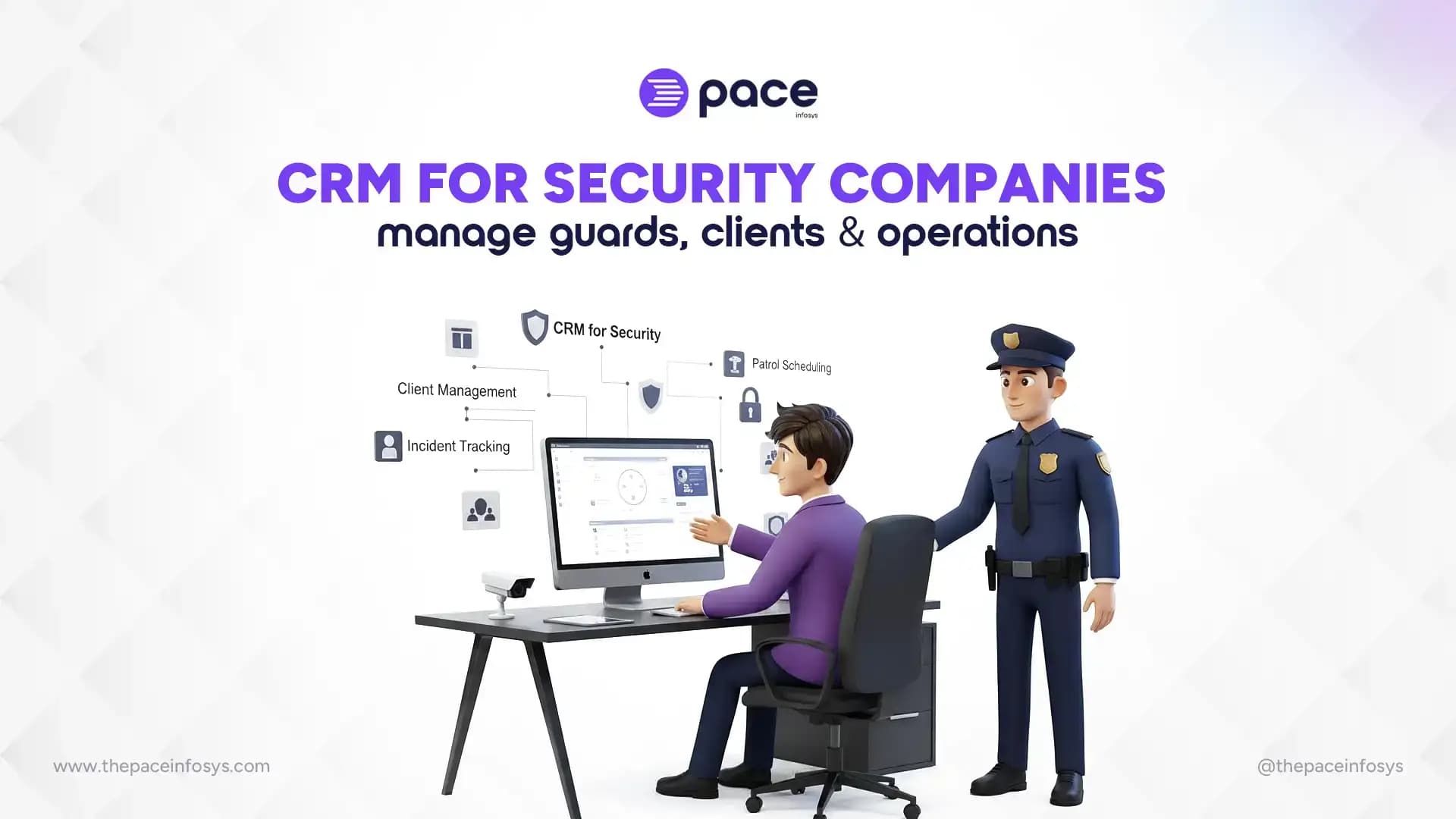
A CRM for security companies is a central software system that organizes your entire business operation in one digital space. It functions as a specialized database where you store guard profiles, client contracts, and site schedules instead of using paper files. This tool connects your office staff directly to guards working in the field through a single, shared platform. By using a CRM system, you ensure that every piece of information, from patrol logs to billing details, is accurate and easy to find.
While a general CRM usually focuses only on sales, a security-specific CRM manages the daily movement of your workforce. It tracks active guard shifts, records live incident reports, and monitors contract deadlines automatically. This software acts as a real-time link between the person guarding a gate and the manager sitting in the office. Using it allows you to see exactly what is happening at every client site without needing to make dozens of phone calls.
Security guard companies need CRM software to replace slow, manual processes with fast, digital automation. Without this tool, managing dozens of guards across different sites leads to missed shifts and angry clients. A CRM gives you total control over your workforce so you can prevent mistakes before they happen. It turns a chaotic office into a professional operation by keeping every guard, schedule, and contract in order.
Efficiently managing multiple guards and various shifts
Handling client contracts and service level agreements
Real-time communication and reporting
Reducing operational errors and paperwork
As operations grow, manual systems quickly become unmanageable. That’s where CRM becomes essential.
Key Features of CRM Software for Security Companies
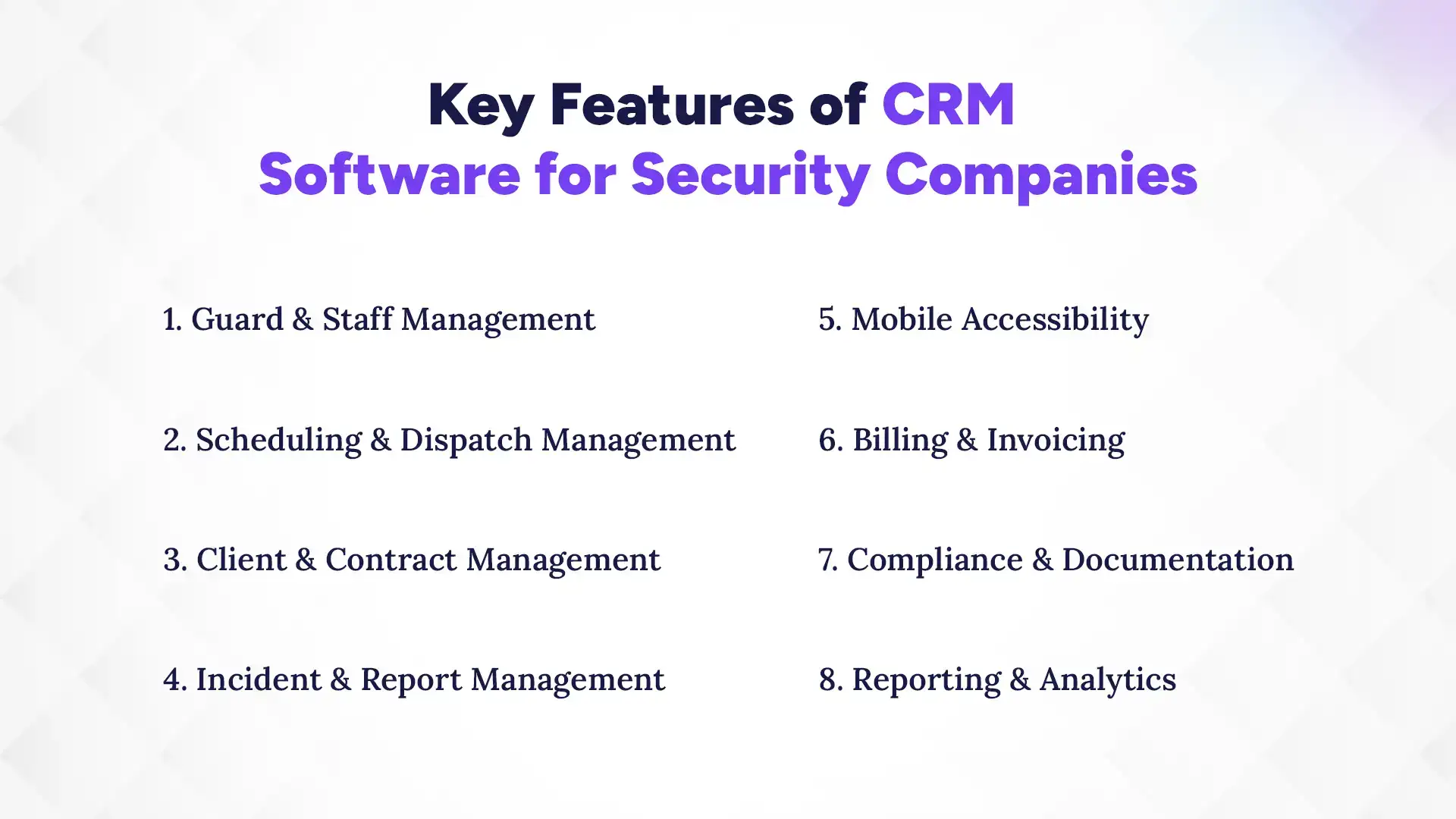
The best CRM for the security industry includes guard scheduling, incident reporting, and contract management tools to keep everything running smoothly. These features allow you to track performance and ensure every site is covered by the right person at the right time. Let's look at the specific CRM tools & features that make this possible.
1. Guard & Staff Management
Keeping track of your staff’s profiles, training, and certifications is much easier with a digital database. You can store copies of their citizenship documents and training records directly in the system for quick access. This helps you assign the right guard to the right post based on their specific skills. It also makes it simple to track who is doing a great job and who needs more training.
2. Scheduling & Dispatch Management
Say goodbye to the headache of overlapping shifts or empty posts with automated scheduling tools. You can create weekly rosters in minutes and send them directly to your guards' phones. If someone is sick, the system helps you find a backup who is nearby and available immediately. This ensures that your clients never have to worry about an unmanned gate or a late arrival.
3. Client & Contract Management
Your clients expect professional service, and a CRM helps you deliver by keeping all contract details organized. You can set alerts for contract renewals so you never miss a chance to keep a good client. It also stores specific instructions for each site, ensuring your team knows exactly what the client expects. This builds a strong relationship because the client sees you are always on top of things.
4. Incident & Report Management
When something happens on-site, you need to know about it right away through digital incident reports. Guards can upload photos and notes directly from their location, which then creates a professional report for the client. This transparency proves your value and keeps everyone informed without the need for long phone calls. It turns a scary situation into a well-managed professional response that clients will appreciate.
Insights
Did You Know?
Businesses using CRM systems can improve customer retention by 25–40% and increase sales by 15–30%, making CRM a powerful tool for long-term client relationships.
5. Mobile Accessibility
Since your guards are always on the move, having a mobile-friendly system is a total game-changer for daily operations. Guards can clock in, view their schedules, and submit reports right from their smartphones while standing at their posts. This removes the need for them to travel to the office just to submit paperwork. Managers can also check the status of any site from anywhere using their own mobile devices.
6. Billing & Invoicing
Connecting your operations to your billing system ensures that you get paid accurately and on time for every hour worked. The CRM can track the exact hours a guard spent on-site and automatically generate an invoice for the client. This reduces the time spent on math and prevents arguments over billing discrepancies. It makes your financial department's life much easier and keeps your cash flow steady and predictable.
7. Compliance & Documentation
Staying compliant with local labor laws and security regulations is much simpler when your documents are organized digitally. The system can remind you when a guard’s license is about to expire or when a site safety audit is due. Having all this proof ready at the click of a button is helpful during inspections or audits. It protects your company from legal trouble and maintains your reputation as a professional firm.
8. Reporting & Analytics
You can’t improve what you don’t measure, which is why built-in reporting tools are so important for growth. These reports show you which sites are most profitable and which guards are the most reliable over time. You can use this data to make smart business decisions rather than just guessing. It helps you show your clients exactly how much value you are providing with hard numbers and clear charts.
CRM for Security Companies vs Traditional Management Methods
A CRM offers real-time data and automation that traditional methods like paper logs or spreadsheets simply cannot provide. While old methods are slow and prone to human error, a digital system keeps everything fast, accurate, and safe. Transitioning to a CRM is the best way to move from "surviving" to "thriving."
Feature
Traditional Methods (Paper/Excel)
CRM Software Solution
Data Storage
Messy files and lost notebooks
Secure, searchable cloud storage
Scheduling
Manual calls and confusing texts
One-click rosters and mobile alerts
Reporting
Delayed and often unreadable
Instant, professional digital reports
Tracking
Based on trust and verbal word
Real-time GPS and digital check-ins
Invoicing
Slow manual calculations
Automated and highly accurate
Which is the Best CRM Software for Security Companies?
Pace CRM is the top option for security companies in Nepal because it is built to handle the real-world chaos of guard management. It combines all the features we discussed into one easy-to-use platform that actually works for our local context. Using Pace CRM helps you stand out as a modern leader in the security industry.
Why Choose Pace CRM?
Locally Optimized: Built with the needs of Nepalese business owners and staff in mind.
Simple Interface: Your guards won't need a computer degree to send an incident report.
All-in-One Power: Handles everything from the first sales lead to the final guard shift.
Excellent Support: Get help from a local team that understands your business environment.
While you could try to adapt a general CRM, it often feels like putting a square peg in a round hole. Specialized tools like Pace CRM are designed specifically for the security industry's unique hurdles. It is the most reliable way to professionalize your operations and impress your clients from day one.
Ready to Manage Leads Better?
Use Pace CRM to track leads, automate follow-ups, and close deals faster. Simple, powerful, and built for your growth.
How to Choose the Right CRM for Your Security Business in Nepal?
To choose the best security CRM, you should look for a system that is easy to use, fits your budget, and can handle the specific challenges of the Nepalese market. It is important to find a partner that understands our local business culture and provides great local support. Choosing the right tool will set the foundation for your company's success for the next decade.
Whether you have ten guards or one thousand, the CRM needs to be able to scale with your growth. You don't want to buy a system that you will outgrow in just six months as you win more contracts. Look for a solution that offers different tiers so you only pay for what you actually need right now. A flexible system ensures that your technology is an asset rather than a weight holding you back.
2. Customization Needs
Every security company has its own way of doing things, so your CRM should be able to adapt to your specific workflow. You might need special fields for unique site requirements or custom report templates that match your branding. Avoid one-size-fits-all software that forces you to change your successful business habits just to fit the code. The software should work for you, not the other way around, to ensure everyone actually uses it.
3. Integration with Existing Tools
Your new CRM should play nicely with the tools you are already using, like your accounting software or email system. This prevents you from having to type the same information into two different places, which saves a lot of time. Good integration makes the transition much smoother and ensures that data flows correctly across all your departments. It connects your whole business into one single, high-performing machine that works perfectly together.
If the software is too complicated, your guards and supervisors will simply stop using it, which wastes your investment. Choose a CRM with a clean, simple interface that feels as easy to use as Facebook or WhatsApp. Make sure the provider offers good training sessions to get your team up to speed quickly and confidently. When the staff finds the tool helpful instead of annoying, they will embrace it and help the business grow.
5. Budget vs ROI
While price is always important, you should look at the Return on Investment (ROI) rather than just the monthly cost. A slightly more expensive CRM that saves you twenty hours of manual work a week is actually much cheaper in the long run. Calculate how much money you lose from billing errors or lost contracts and see how the CRM prevents those losses. Investing in quality software is an investment in the future profit of your company.
Benefits of Using CRM for Security Guard Companies in Nepal
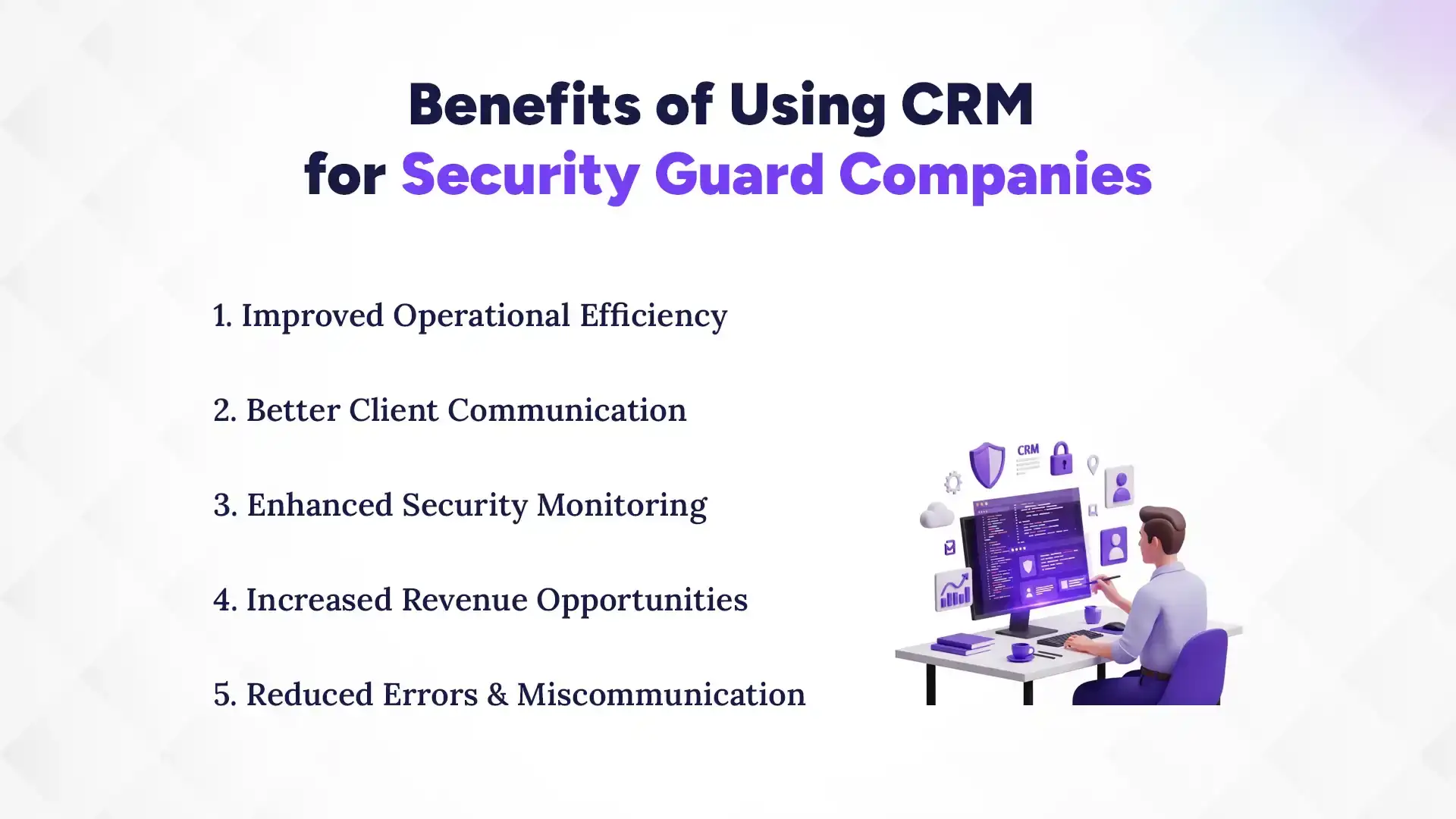
Using a CRM leads to better efficiency, happier clients, and much higher profits for your security company because with a system, you waste less time on chores. It creates a professional image that helps you win bigger contracts and beat out competitors who are still using paper. Here is how these prime benefits of CRM change your day-to-day business.
1. Improved Operational Efficiency
Automation takes over the boring, repetitive tasks so your office staff can focus on more important things. You will spend less time fixing schedule mistakes and more time looking for new business opportunities. Information moves faster through the company, meaning decisions are made in seconds instead of hours. This shift makes your entire organization feel more energetic and much more capable of handling large-scale projects.
2. Better Client Communication
Clients love being kept in the loop, and a CRM allows you to share updates with them effortlessly. You can give them access to their own portal where they can see daily logs or monthly reports whenever they want. This level of honesty builds a huge amount of trust and makes them feel very secure. When a client feels heard and informed, they are much more likely to stay with your company for years.
3. Enhanced Security Monitoring
With GPS tracking and real-time alerts, you always know exactly where your guards are during their shifts. This extra layer of oversight ensures that patrols are actually happening and that guards are staying alert. If a guard misses a check-in, the system alerts you immediately so you can investigate the situation. This proactive approach prevents small issues from turning into major security breaches that could hurt your reputation.
Insights
Did You Know?
Around 57–58% of businesses report increased sales after adopting CRM, with many achieving up to 30% revenue growth through better customer and operations management.
4. Increased Revenue Opportunities
A CRM helps you spot opportunities to sell more services by analyzing your current client data and site history. For example, if a client has many incidents, you can suggest adding more guards or better technology to their site. It also makes the sales process faster because you have all the information needed to create a quote ready. By looking professional and organized, you can justify charging higher rates than the messy budget companies.
5. Reduced Errors & Miscommunication
When everyone is looking at the same digital source of truth, there is much less room for unwanted arguments. Instructions are written clearly in the app, so guards don't have to rely on fuzzy verbal orders. This reduces the chance of a guard showing up at the wrong place or performing the wrong task. Fewer mistakes mean fewer complaints, which ultimately leads to a much smoother and more peaceful work environment for everyone.
Implementation Tips for Security CRM in Nepal
To get the most out of your CRM, you should start small, train your team well, and focus on moving your data accurately. A successful rollout requires a bit of planning, but the rewards are worth the effort for your whole team. Follow these simple steps to make sure your transition to digital is a total success.
1. Train Staff and Guards
Take the time to show every team member how the new system makes their specific job easier and less stressful. Run small workshops where they can practice clocking in or writing a report on their phones in a safe environment. When they see that the CRM reduces their paperwork, they will be much more excited to use it every day. Good training is the secret ingredient to making any new technology stick within a large team.
2. Start with Core Features
Don't try to use every single feature on the very first day, or you might overwhelm your staff and cause confusion. Start by moving your guard roster and client list into the system first to get the basics running smoothly. Once everyone is comfortable with scheduling, you can start introducing more advanced features like digital invoicing or analytics. This step-by-step approach builds confidence and ensures that the transition doesn't disrupt your daily security operations.
When moving your information from paper or Excel to the CRM, double-check everything to make sure it is accurate and up to date. This is a great time to clean up your records and remove old contacts or expired guard certifications that are no longer needed. Starting with clean, organized data ensures that your reports and schedules are correct from the very first minute. It prevents garbage in, garbage out scenarios that can frustrate your office staff during the first week.
4. Monitor and Optimize Usage
After the system is live, keep an eye on how people are using it and ask for their honest feedback. You might find that some guards need a bit more help with the mobile app, or that a report template needs a small tweak. Regularly reviewing your data will help you find ways to make your business even more efficient over time. Technology is not a set it and forget it thing; it's a tool that grows and improves alongside your company.
Conclusion
Switching to a CRM is no longer just an option for security companies in Nepal, it is a necessity if you want to stay competitive. By moving your operations to a digital platform, you gain the efficiency, scalability, and professional edge needed to win the best clients.
No more lost logbooks, no more scheduling nightmares, and no more guessing about where your guards are. Instead, you get a clear view of your entire business, allowing you to lead with confidence and grow your revenue.
Ready to see how technology can transform your security firm? Explore the top 5 CRM software for Nepalese businesses. Start your journey toward a more organized future today and watch your business reach new heights.
FAQs
What is CRM for security companies?
+
A CRM helps security companies manage clients, guards, schedules, and operations in one system, improving efficiency and communication.
How does CRM help security guard companies?
+
It automates scheduling, tracks guards, manages client data, and improves reporting, reducing manual work and operational errors.
What features should a security CRM have?
+
Key features include guard scheduling, incident reporting, mobile access, billing, compliance tracking, and real-time communication tools.
Is CRM useful for small security companies?
+
Yes, CRM helps small companies streamline operations, manage clients efficiently, and scale without increasing administrative workload.
Can CRM track security guard attendance?
+
Yes, most security CRMs include attendance tracking with GPS or mobile check-ins for accurate monitoring.
How much does CRM for security companies cost?
+
Costs vary based on features and users, typically ranging from affordable monthly subscriptions to customized enterprise solutions.
Ready to get started?
Book a 30-minute consultation call, and let's talk about your goals.