Are you losing leads because you forget to follow up? Are customer details scattered in notebooks, Excel sheets, or WhatsApp chats? Many businesses in Nepal face this problem. Sales teams miss calls, forget meetings, and lose track of important clients. This leads to lost sales and slow growth.
As competition grows in Nepal, managing customers properly is no longer optional. A good CRM system helps you store data, track leads, follow up on time, and improve customer relationships. It keeps everything organized in one place.
In this blog, we will explore the top 5 CRM in Nepal, compare their features and pricing, and help you choose the right CRM for your business. By the end, you will know which CRM fits your needs best.
What is CRM (Customer Relationship Management)?
CRM (Customer Relationship Management) is a software system that helps businesses manage their customers and leads in one place. Instead of using notebooks, Excel sheets, or different apps, a CRM keeps everything organized and easy to find.
In simple words, CRM helps you track who your customers are, what they need, and when you should follow up with them. It stores contact details, call history, emails, meetings, and sales information. This helps your team stay organized and avoid missing important opportunities.
CRM is not only for big companies. Small and medium businesses in Nepal also use CRM to grow faster and improve customer service.
What Does a CRM System Do?
A CRM system helps you:
Store customer contact details safely
Track leads and sales pipeline
Set reminders for follow-ups
Record calls, emails, and meetings
Manage sales team activities
Generate sales reports and performance reports
Improve customer support
With a CRM, your team can see the full history of a customer in seconds. This makes communication better and more professional. In today’s competitive market, using CRM software in Nepal is becoming very important. It saves time, reduces mistakes, and helps businesses build strong and long-term relationships with customers.
Why Do Businesses in Nepal Need a CRM System?
Businesses in Nepal need a CRM system to manage leads properly, improve customer relationships, and increase sales. As competition is growing in almost every industry, managing customers manually is no longer effective. Understanding the benefits of CRM helps businesses see why a CRM helps them stay organized, follow up on time, and close more deals.
Better Lead Management: Many businesses in Nepal receive leads from Facebook, websites, referrals, and phone calls. Without a proper system, these leads can easily get lost. A CRM stores all leads in one place and shows their status clearly. This helps the sales team know who to call and when to follow up.
Improved Customer Service: Customers expect quick replies and professional service. If your team cannot find customer details quickly, it creates a bad impression. A CRM keeps all customer history in one system, including past calls and purchases. This helps your team respond faster and build trust.
Increased Sales and Revenue: When follow-ups are done on time, the chances of closing deals increase. A CRM sends reminders and tracks the sales pipeline. Managers can also see sales performance reports. This helps businesses find gaps and improve their sales process.
Better Team Coordination: In many companies, sales teams work separately without clear tracking. A CRM allows managers to see daily activities and performance. It improves communication and keeps everyone accountable. This leads to better teamwork and business growth.
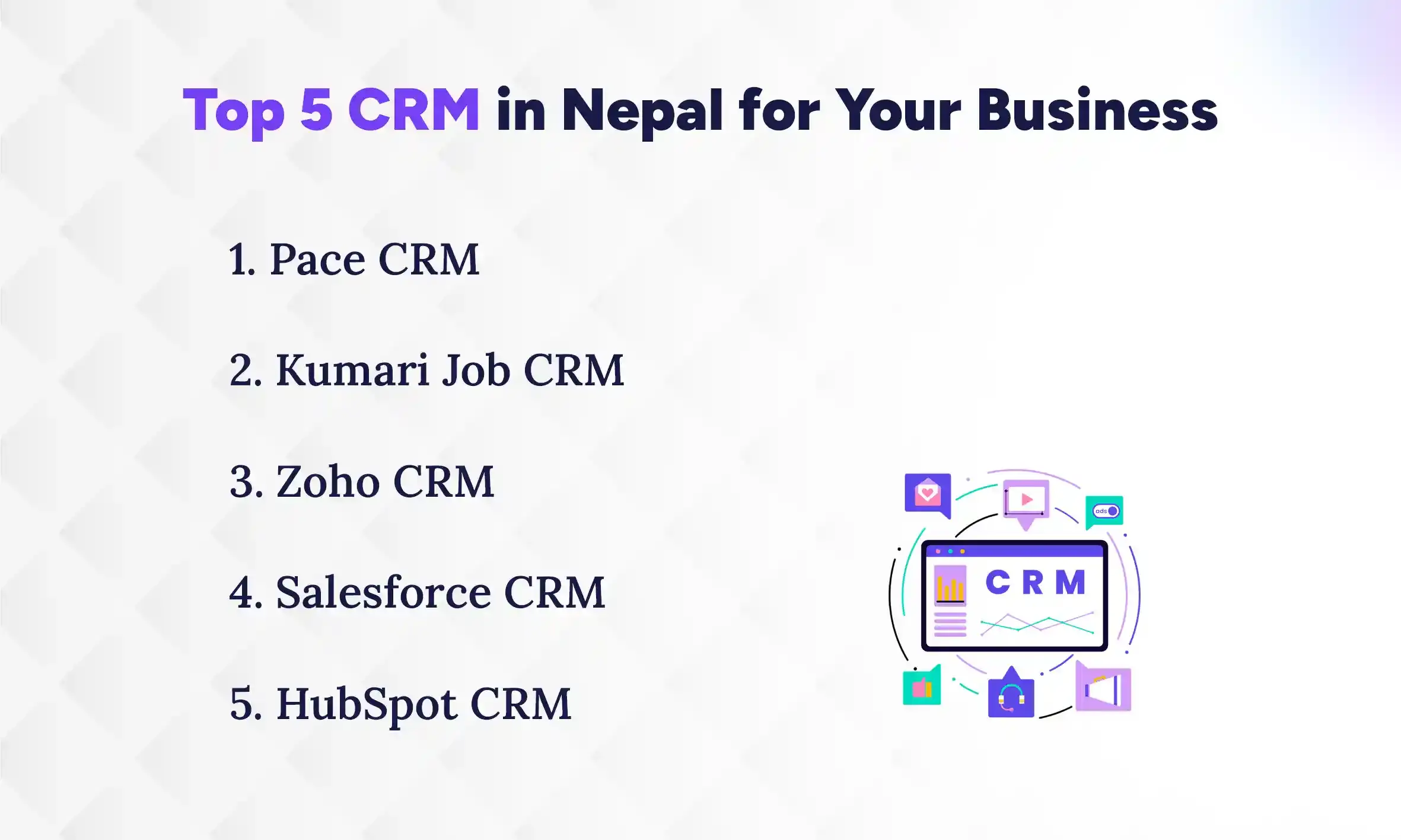
Top 5 CRM in Nepal for Your Business
Finding the right CRM can change how you do business in Nepal. It helps you stop using messy paper notes and move to a system that grows your sales. Here are the top 5 CRM tools that are best for businesses in Nepal today.
1. Pace CRM
Pace CRM is a local software built to help companies in Nepal handle their customer service better. It is designed to be very simple, so your team can start using it right away without any hard training. The system focuses on making sure every customer's question or problem is tracked and solved on time. Since the support team is based in Nepal, you can get help quickly whenever you have an issue.
Features
Contact & Lead Management: Keep all customer names, numbers, and history in one safe place so you never lose a lead.
Sales & Pipeline Management: Track every deal and support ticket from start to finish to ensure nothing gets forgotten.
Marketing Automation: Send automatic SMS and Email updates to your customers and staff to save time.
Reporting & Analytics: Get clear data and simple reports on how your team is performing and which tasks are finished.
Pros
Local Support: You get direct help from a team in Nepal that understands your business.
Easy to Use: The interface is simple, so staff don't need a lot of technical skills.
Affordable: Pricing is built for the local market, making it budget-friendly.
Better Tracking: You can see exactly how many customer issues are solved or pending.
Multi-Device: Works smoothly on both computers and mobile phones.
Cons
Focus Area: It is mostly for customer support and might lack some deep marketing tools.
Integration: It may not connect with as many international apps as global CRMs do.
2. Kumari Job CRM
Kumari Job CRM is a modern tool that helps businesses in Nepal manage their sales and new leads in one place. It comes from a well-known local HR brand, so it is built specifically to fit the way offices work in our country. This CRM makes it easy for your staff to remember follow-ups and keep track of every potential client. It is a great choice for growing companies that want a clean and organized way to increase their sales.
Features
Client & Prospect Organization: Keep all your contact details and potential customer info in one tidy list for fast access.
Deal Flow Tracking: Monitor your sales through every stage so you know exactly when a deal is ready to close.
Smart Follow-ups: Set up automatic alerts and reminders to stay in touch with your customers regularly.
Performance Insights: Use the visual dashboard to check your daily sales numbers and team progress at a glance.
Pros
Sales Focused: Built to help you close more deals by tracking leads from start to finish.
User-friendly: The design is clean and modern, so it feels like using a simple mobile app.
Recruitment Ready: Excellent for businesses that also need to manage hiring and candidates.
Quick Setup: You can move your existing data from Excel very quickly.
Local Expertise: Designed by a company that knows the Nepalese sales environment well.
Cons
Advanced Features: Might miss some very high-end automation found in expensive global tools.
Newer Platform: Some new features are still being updated and added regularly.
3. Zoho CRM
Zoho is a popular choice worldwide because it gives many features for a low price. It is good for teams that want to do more than just store names. It can handle emails and chats all in one place.
Features
All-in-one Inbox: Connect your email and social media to the CRM.
Workflow Rules: Automatically assign leads to your sales staff.
Mobile App: Update your sales notes while you are away from the office.
Pros
Good Value: You get a lot of powerful tools for a relatively small monthly cost.
Mobile Ready: Their app is very strong, allowing you to work from anywhere.
Connects Well: It easily plugs into other apps like Google Workspace or Mailchimp.
Cons
Setup Time: It can take a while to set up all the features exactly how you want.
Customer Support: Getting help can be slow because they don't have a local office in Nepal.
Overwhelming: There are so many buttons and options that it might confuse beginners.
4. Salesforce CRM
Salesforce is the biggest CRM in the world. It is very powerful and can be changed to fit any kind of large business. It is best for big companies in Nepal that have a lot of data and many departments.
Features
High Customization: Change the system to look exactly how you want.
Deep Analytics: Create detailed charts and graphs of your sales.
App Store: Add thousands of extra tools from their marketplace.
Pros
Highly Powerful: There is almost nothing this CRM cannot do if you have the budget.
Very Secure: Top-level security to keep your customer data safe from hackers.
Scalable: It can grow with your company from 10 employees to 10,000.
Cons
Very Expensive: The price is much higher than local or other global options.
Hard to Learn: Your team will likely need professional training to use it correctly.
Requires Experts: You usually need to hire a specialist to set it up and maintain it.
5. HubSpot CRM
HubSpot is famous because it has a free version that never ends. It is perfect for startups in Nepal that are just starting to track their customers. It focuses on making everything look simple and modern.
Features
Free Tools: Use basic CRM features without paying anything.
Meeting Link: Let clients book a time on your calendar automatically.
Email Tracking: See exactly when a client opens your email.
Pros
Free Start: You can use the basic features for free for as long as you want.
Great Interface: It is widely considered the easiest CRM to navigate.
Educational Content: They offer free videos to teach you how to improve your sales.
Cons
Price Jumps: If you need the pro features, the cost becomes very high very fast.
Limited Customization: It is harder to change the system to fit unique business needs.
Rigid Reports: The free version has very limited options for looking at your data.
Comparison Table of the Top 5 CRM in Nepal
Choosing between a local and an international CRM depends on your budget and how much support you need. While global brands are famous, they often come with high monthly costs in Dollars and complicated features that most local businesses never use. Pace CRM and Kumari Job CRM offer a better alternative by providing all the essential tools you need at a much lower price, with the added benefit of local support and payment in Nepalese Rupees.
The table below compares these top 5 options based on features, ease of use, and value for money.
Feature/Detail
Pace CRM
Kumari Job CRM
Zoho CRM
Salesforce
HubSpot
Best For
Best Price for Features
Sales & Lead Tracking
Growing Teams
Large Enterprises
Startups & Marketing
Pricing
Affordable (NPR)
Affordable (NPR)
Starts at $15+/user
Very High Cost
Free to Very High
User Experience
Simple & Fast to learn
Clean & Modern UI
Can be confusing
Very Complex
User-friendly
Scalability
Grows with your team
Easy to add users
Modular Upgrades
Infinite but Costly
High cost to scale
Integration
Local SMS/Email ready
SMS/Email
Wide Global Apps
Huge App Market
Good Marketing Sync
Payment Currency
Nepalese Rupees
Nepalese Rupees
US Dollars
US Dollars
US Dollars
Support
Direct Local Team
Direct Local Team
Online/Chat Only
Partner Only
Online/Community
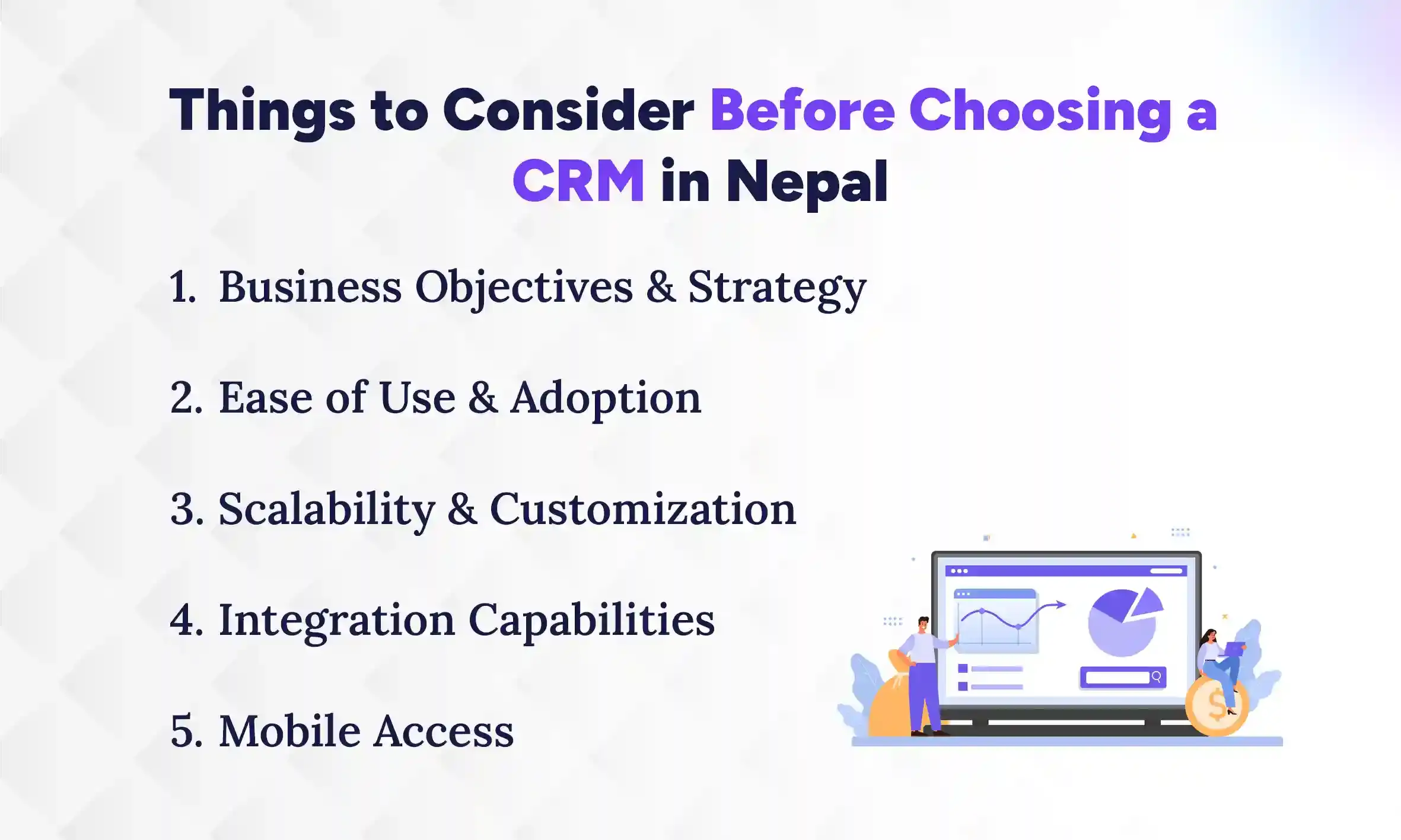
Things to Consider Before Choosing a CRM in Nepal
Picking a CRM is a big step, so you need to be careful before spending your money. Not every system will fit the way your specific team works in Nepal. You should look for a tool that makes your daily life easier, not more complicated. Here are the main things you should check before you make your final choice.
1. Business Objectives & Strategy
First, think about what you actually want to achieve with the software. Do you want to find more new customers, or just keep better track of the ones you already have? A CRM should help you reach your goals, like increasing your monthly sales or answering customers faster. Make sure the tool you pick matches your plan for the next few years.
2. Ease of Use & Adoption
The best CRM is the one that your team actually uses every day. If the software is too hard or has too many confusing buttons, your staff will just go back to using notebooks. Look for a clean design that anyone can understand in just a few minutes. It should save you time, not give you a headache.
3. Scalability & Customization
Your business will not stay the same size forever, so your CRM shouldn't either. It needs to be easy to add more staff members or more customer data as you grow. You should also be able to change some settings to fit your specific type of business. A good system grows with you instead of making you buy new software later.
4. Integration Capabilities
Your CRM needs to work well with the other tools you already use. This means it should connect easily with your email, your website, and your SMS service. When all your tools talk to each other, you don't have to type the same info in two different places. This keeps all your data clean and updated automatically.
5. Mobile Access
In Nepal, sales teams are often out of the office meeting clients or traveling. You need a CRM that works perfectly on a smartphone so you can check details on the go. Being able to update a deal right after a meeting is much better than waiting until you get back to your desk. It keeps your information fresh and accurate.
6. Budget & Total Cost of Ownership (TCO)
Don't just look at the starting price; think about the total cost for the whole year. Some global tools charge extra for every little feature, which can make your bill very high. Local tools often have a flat price in Nepalese Rupees, which is easier to plan for. Always check if there are hidden fees for training or adding more data.
7. Security & Compliance
Your customer details are the most important part of your business, so they must be kept safe. The CRM should have strong passwords and protection so that hackers cannot steal your info. It is also good to know where your data is stored and who can see it. Keeping your customers' trust is much easier when their data is secure.
8. Vendor Support & Training
Even with easy software, you might have a question or a problem at some point. It is much better to have a local team you can call for help immediately. Check if the company offers training to show your staff how to use the system properly. Good support means you won't get stuck and stop working.
How to Successfully Implement a CRM in Your Business in Nepal?
To successfully implement a CRM in Nepal, you must pick a simple tool, train your team well, and move your data slowly to avoid confusion. Getting this right means your staff will actually use the system instead of going back to paper notes. If you follow a clear plan, your business will become much more organized and professional in a very short time.
Set Clear Goals: Decide exactly what you want the CRM to do, like tracking sales calls or managing customer complaints. When you have a clear goal, it is much easier to set up the software the right way. This helps your team understand why they are using a new system.
Choose the Right Tool for Nepal: Pick a CRM like Pace or Kumari Job that fits the way local businesses work and allows you to pay in Rupees. It should be easy enough for your staff to learn without needing a tech expert. Avoid tools that are too complicated or expensive for your current needs.
Clean and Move Your Data: Before putting your customer list into the new CRM, delete any old or duplicate entries from your Excel sheets. This ensures that the new system starts with fresh and correct information. Moving clean data makes it much easier for your sales team to start working immediately.
Train Your Team Thoroughly: Hold a small workshop to show every staff member how to add leads and update their tasks. People are often afraid of new technology, so you need to show them how it makes their job easier. If the team feels confident, they will use the CRM every day.
Start Small and Grow: Don’t try to use every single feature on the first day; just start with the basics like saving phone numbers and notes. Once everyone is comfortable, you can start using more advanced things like automated reports. Starting slowly prevents your team from feeling overwhelmed.
Check Progress Regularly: Meet with your team every week to see if they are facing any problems with the software. Use this time to fix mistakes and see if the CRM is actually helping you close more deals. Constant checking ensures the system stays useful and doesn't get ignored.
Which is the Best CRM for Small Businesses in Nepal?
Pace CRM is the best CRM for small businesses in Nepal because it offers the perfect mix of essential features and local pricing that fits any budget. Unlike global tools that can be confusing and expensive, Pace CRM is built to be simple and easy for your team to use from day one. It helps you stay organized and professional without the high costs of international software.
Small businesses in Nepal often struggle with scattered data and missed follow-ups. Pace CRM solves this by bringing everything into one clear dashboard. Since the company is based here, you don't have to worry about paying in dollars or dealing with time-zone differences for support. When exploring different types of CRM, Pace CRM stands out as a solution designed to grow with you, meaning you can start small and add more features as your sales increase.
Why Pace CRM Wins for Small Businesses:
Budget-Friendly: You pay in Nepalese Rupees, so your bill doesn't change when the dollar rate goes up.
Direct Local Help: You can call or meet the support team in Kathmandu if you ever have a question.
Simple Interface: Your staff won't need weeks of training; they can learn the system in a single afternoon.
All-in-One Tracking: It manages your leads, sales, and customer service in one tidy place.
Quick Setup: You can move your current customer lists from Excel to Pace CRM in minutes.
By choosing Pace CRM, you are investing in a partner that understands the Nepalese market. It removes the stress of managing customers so you can focus on what matters most: growing your business.
Conclusion
In conclusion, choosing the right CRM for your business in Nepal comes down to finding a balance between cost and features. For most local companies, Pace CRM is the best choice because it provides all the essential tools you need at an affordable price. While international options like Salesforce or HubSpot are powerful, they are often too expensive and difficult to set up for a small or medium-sized office. Solutions developed by The Pace Infosys are designed to better suit the needs of growing businesses.
By picking a local solution like Pace CRM or Kumari Job CRM, you get the benefit of paying in Rupees and receiving direct support when you need it. Start with a system that is easy to use, and you will quickly see your sales and customer relationships improve.
FAQs
Which CRM is used in Nepal?
+
The CRMs used in Nepal include local options like Pace CRM and Kumari Job CRM, as well as global brands like Zoho and HubSpot. Many local businesses prefer Pace CRM because it offers support in Kathmandu and accepts payment in Rupees.
Is CRM software expensive for small businesses in Nepal?
+
The cost of CRM software in Nepal depends on the provider, but local CRMs are very affordable for small shops. You can find basic plans that fit a small budget without the high monthly fees of international brands.
Can I pay for a CRM in Nepalese Rupees (NPR)?
+
Yes, you can pay in Nepalese Rupees if you choose a local provider like Pace CRM or Kumari Job CRM. This is much easier than global tools that require a dollar card and charge extra for currency conversion.
Do I need a fast internet connection to use a CRM?
+
You do not need a very fast internet connection, but a stable one is necessary since most CRMs store data in the cloud. As long as you can browse basic websites, you can update your sales and customer details smoothly.
Will my customer data be safe and private in a CRM?
+
Your customer data is very safe because professional CRMs use strong encryption and passwords to protect your files. Only people you give permission to can see the sensitive information inside the system.
Can I move my existing Excel data into a CRM easily?
+
Yes, you can move your Excel data into a CRM by using a simple "Import" feature. This allows you to upload all your old contacts and phone numbers in just a few clicks.
Does a CRM provide local SMS and Email integration in Nepal?
+
Local CRMs like Pace CRM provide SMS and Email integration that works perfectly with Nepalese service providers. This allows you to send automatic alerts to your customers' phones without any extra hassle.
Is it better to choose a local CRM or a global one?
+
It is usually better to choose a local CRM because you get help from a team in your own city and avoid the high cost of international travel. Local tools are also easier for your staff to learn because they are built for the way we work in Nepal.
Ready to get started?
Book a 30-minute consultation call, and let's talk about your goals.