


CIT (Citizen Investment Trust) is one of the most trusted saving options for employees in Nepal. It helps people set aside a portion of their income every month while also giving tax benefits and long-term financial security.
Sounds simple, right? But when you’re the one managing it for a growing team, things can get a bit messy.
As businesses expand, tracking monthly deductions, updating employee details, and keeping records accurate becomes harder. Even small mistakes can lead to wrong contributions, unhappy employees, or extra work for HR.
That’s why many companies are now moving toward HR and payroll software in Nepal. Instead of juggling spreadsheets, they’re choosing smarter systems that handle CIT smoothly, with less stress and more control.
What Is CIT (Citizen Investment Trust) in Nepal?
CIT (Citizen Investment Trust) is a savings and investment scheme in Nepal that helps employees build a secure financial future. Every month, employees contribute a fixed portion of their salary into CIT. Over time, this amount grows with returns, making it useful for long-term goals like retirement or financial stability.
In most cases, the contribution is made by the employee, although some organizations may also support or facilitate the process. The amount is usually deducted directly from salary, which makes saving consistent and disciplined. Because of this setup, employees can save without needing to manage it separately.
CIT is open to individuals who want to invest for the future, especially those working in formal jobs. One of its biggest benefits is tax saving, as contributions can reduce taxable income. At the same time, it gives employees a safe and structured way to grow their money over time.
Common Challenges in CIT Management for HR Teams
HR teams often face challenges like calculation errors, managing employee enrollment, delayed deposits, and manual tracking issues while handling CIT. These problems usually come from handling data across spreadsheets and disconnected systems. Because of this, CIT management becomes time-consuming and error-prone, which we’ll break down further below.
- Errors in monthly CIT contribution calculations
- Difficulty managing employee enrollment and updates
- Delays in CIT deposits and reporting deadlines
- Manual tracking and reconciliation across spreadsheets
- Lack of real-time visibility on contributions
- Mismatch between payroll and CIT records
- High dependency on manual data entry
- Errors during employee exit and adjustments
What Is CIT Management Software?
CIT management software is a tool that helps businesses handle Citizen Investment Trust deductions in a simple and organized way. Instead of managing everything manually, it brings all CIT-related tasks into one system. This makes it easier for HR teams to track contributions, manage records, and stay accurate every month.
The HR software with CIT integration connects payroll, salary data, and employee records in one place. So, when salaries are processed, CIT deductions are calculated automatically based on updated data. This removes the need for separate calculations and reduces the chances of mistakes. As a result, everything stays aligned without extra effort.
The main difference between manual handling and automated systems is control and reliability. Manual methods depend on spreadsheets and human input, which can lead to errors and delays. On the other hand, CIT software works in real time, making the process faster, more accurate, and much easier to manage.
Who Needs CIT Management Software in Nepal?
CIT management software is essential for all businesses that handle employee deductions, structured payroll, and growing workforce complexity. As teams expand and benefits like CIT become more common, manual tracking quickly becomes difficult to manage. Because of this, many organizations turn to software to simplify processes and reduce errors.
If you’re one of the following, you must explore such software for HR efficiency:
- SMEs needing simple and reliable CIT tracking
- Growing businesses managing increasing employee data
- Corporates with structured payroll systems
- Companies offering CIT as an employee benefit
- HR teams handling multiple salary deductions
- Businesses struggling with manual CIT processes
- Organizations aiming for accurate monthly compliance
- Teams looking to reduce payroll-related errors
Top CIT Management Features in HR Payroll Software
CIT management features in HR payroll software include automatic deductions, payroll integration, employee record tracking, and compliance tools. Together, they make CIT handling faster, easier, and more accurate for HR teams. Let’s break down how each of these HR management features actually helps in day-to-day work.
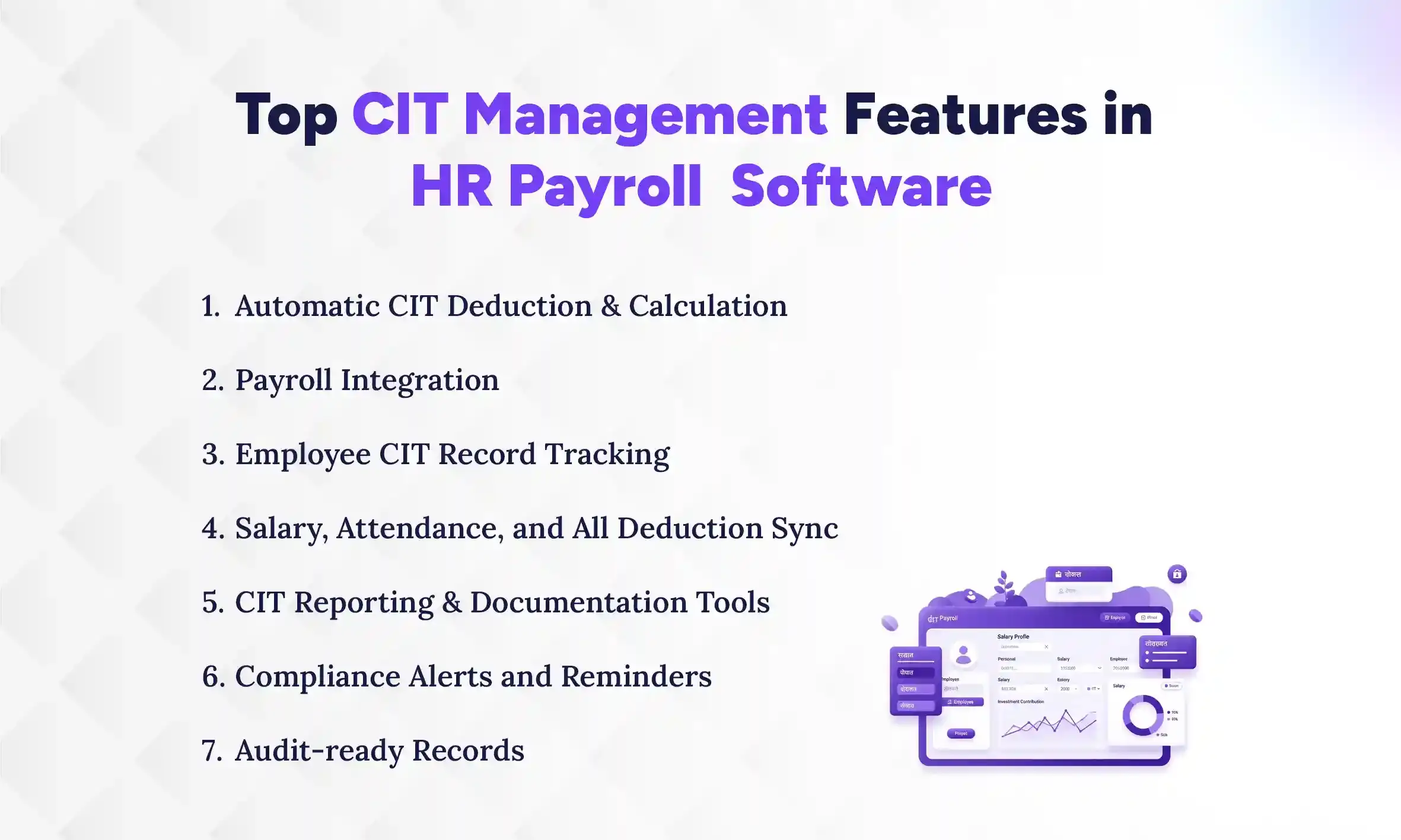
1. Automatic CIT Deduction & Calculation
This feature calculates CIT deductions automatically from employee salaries. So, HR teams don’t have to worry about formulas or manual errors. If there’s any change in salary, the system updates the amount instantly. This keeps contributions accurate every month. In short, it saves time and reduces stress during payroll.
2. Payroll Integration
CIT software works directly with payroll, so everything stays connected. When salaries are processed, deductions are applied automatically without extra steps. This avoids double work and keeps records clean. It also reduces confusion between payroll and CIT data. As a result, payroll becomes smoother and more reliable.
3. Employee CIT Record Tracking
All CIT details for each employee are stored in one place. This includes contribution history, updates, and changes over time. HR teams can quickly check records without digging through files. It also helps answer employee questions faster. Because of this, tracking becomes simple and clear.
4. Salary, Attendance, and All Deduction Sync
This feature connects salary, attendance, and deductions in one system. If attendance or leave changes, salary updates automatically. That means CIT deductions are always based on the rightly managed leave and attendance data. It also prevents mismatched data. So, everything stays accurate without extra effort.
5. Reporting & Documentation Tools
The software creates ready-to-use CIT reports in just a few clicks. HR teams don’t have to prepare documents manually every month. Reports are clear, organized, and easy to share. This saves time during compliance checks. It also keeps records safe for future use.
6. Compliance Alerts and Reminders
The system sends reminders for important CIT deadlines. This helps HR teams avoid late deposits or missed reports. It also reduces last-minute panic during busy payroll days. Everything stays on track with simple alerts. As a result, compliance feels much easier to manage.
7. Audit-ready Records
All CIT data is stored in a clean and structured way. This makes it easy to handle audits or inspections anytime. HR teams don’t need to rush or prepare documents at the last minute. Everything is already organized and ready. That means less stress and more confidence during audits.
What Are the Benefits of Using CIT Management Software?
CIT management software helps businesses handle deductions faster, more accurately, and with far less effort. It brings payroll, records, and compliance into one smooth system, so HR teams don’t have to juggle multiple tools. As a result, daily work becomes easier and more reliable. Let’s look at the key benefits of HR software with CIT integration.
1. Saves Time and Reduces Manual Work
This software removes the need for manual calculations and spreadsheet tracking. HR teams no longer have to process CIT for each employee one by one. Everything runs automatically in the background. This saves hours during payroll cycles. So, teams can focus on more important tasks instead of repetitive work.
2. Ensures Accurate CIT Contributions
Accuracy improves when calculations are handled by the payroll system. It uses real-time salary data to apply the correct deduction every month. Even small changes are updated instantly. This reduces mistakes and avoids rework. As a result, businesses can trust their CIT records without second-guessing.
3. Simplifies Tax and Compliance Management
CIT is closely linked with tax benefits, so accuracy is very important. The software keeps all records organized and ready for reporting. It also helps ensure deductions are applied correctly for tax purposes. This reduces compliance risks and confusion. Because of this, managing CIT feels much more straightforward.
4. Improves Transparency for Employees
Employees can clearly see their CIT contributions through the system. This builds trust because everything is visible and updated regularly. They don’t need to rely only on HR for information. It also reduces repeated questions and confusion. Over time, this creates a more transparent workplace.
5. Supports Business Growth and Scalability
As businesses grow, managing CIT manually becomes harder. This software handles more employees without increasing workload. It keeps processes smooth even as teams expand. HR teams don’t need to change systems later. So, businesses can grow without worrying about HR complexity.
How CIT Management Software Works for HR Teams?
CIT management software makes the entire contribution process simple by connecting employee data, payroll, and deductions in one system. Instead of handling each step manually, HR teams get an automated flow that reduces effort and mistakes. This helps ensure smooth monthly operations. Here’s how it works step by step.
1. Employee Enrollment and CIT Setup
The process starts when employee details are added to the system. HR teams set up CIT rules based on company policies and employee eligibility. Once this is done, the system stores everything in one place. It removes the need for repeated manual entries. So, onboarding becomes quick and organized.
2. Monthly Salary and Deduction Tracking
Each month, the system tracks employee salary data and updates any changes automatically. It also keeps a record of attendance and other salary inputs. This ensures CIT calculations are always based on correct information. HR teams don’t have to cross-check multiple files. As a result, tracking becomes much easier.
3. Automatic CIT Calculation
Once salary data is ready, the software calculates CIT deductions automatically. It uses predefined rules to apply the correct percentage or amount. This removes manual errors and saves time. Even if salaries change, the system adjusts instantly. So, accuracy stays consistent every month.
4.Payroll Processing with CIT Deductions
During payroll, CIT deductions are included in automated salary processing. HR teams don’t need to calculate or enter them separately. This keeps payroll clean and error-free. It also ensures employees receive correct salary slips. Because of this, payroll runs become faster and smoother.
5. CIT Reporting and Submission
At the end of the cycle, the software generates ready-to-use CIT reports. These reports can be used for submission or internal records without extra formatting. HR teams can download them in just a few clicks. This reduces last-minute workload and stress. So, compliance becomes simple and well-managed.
CIT Management Software vs Manual CIT Tracking
CIT management software is a more accurate and efficient way to handle employee contributions compared to manual tracking. It reduces errors, saves time, and ensures compliance is always up to date. This makes it a more reliable option for growing HR teams.
| Feature / Aspect | Manual CIT Tracking | CIT Management Software |
|---|---|---|
| Accuracy | Uses spreadsheets and manual entry, which often causes calculation mistakes and missing records | Automatically calculates CIT using updated salary data with very low error risk |
| Efficiency | Requires HR teams to calculate and update data every month, which takes a lot of time | Processes CIT instantly as part of payroll, reducing repetitive HR work |
| Compliance | Compliance reports are prepared manually, increasing risk of delays or incorrect filing | Generates ready reports and reminders for timely and accurate compliance |
| Scalability | Hard to manage as employee numbers grow, leading to more workload and confusion | Easily handles growing teams with consistent performance and no extra complexity |
How to Choose the Best Payroll Software for CIT Management in Nepal?
To choose the best HR software for CIT management in Nepal, focus on compliance, ease of use, and strong payroll integration. A good system should handle CIT calculations correctly while also supporting smooth monthly payroll work. This helps HR teams reduce errors and save time. Here’s how you can choose the right one step by step.
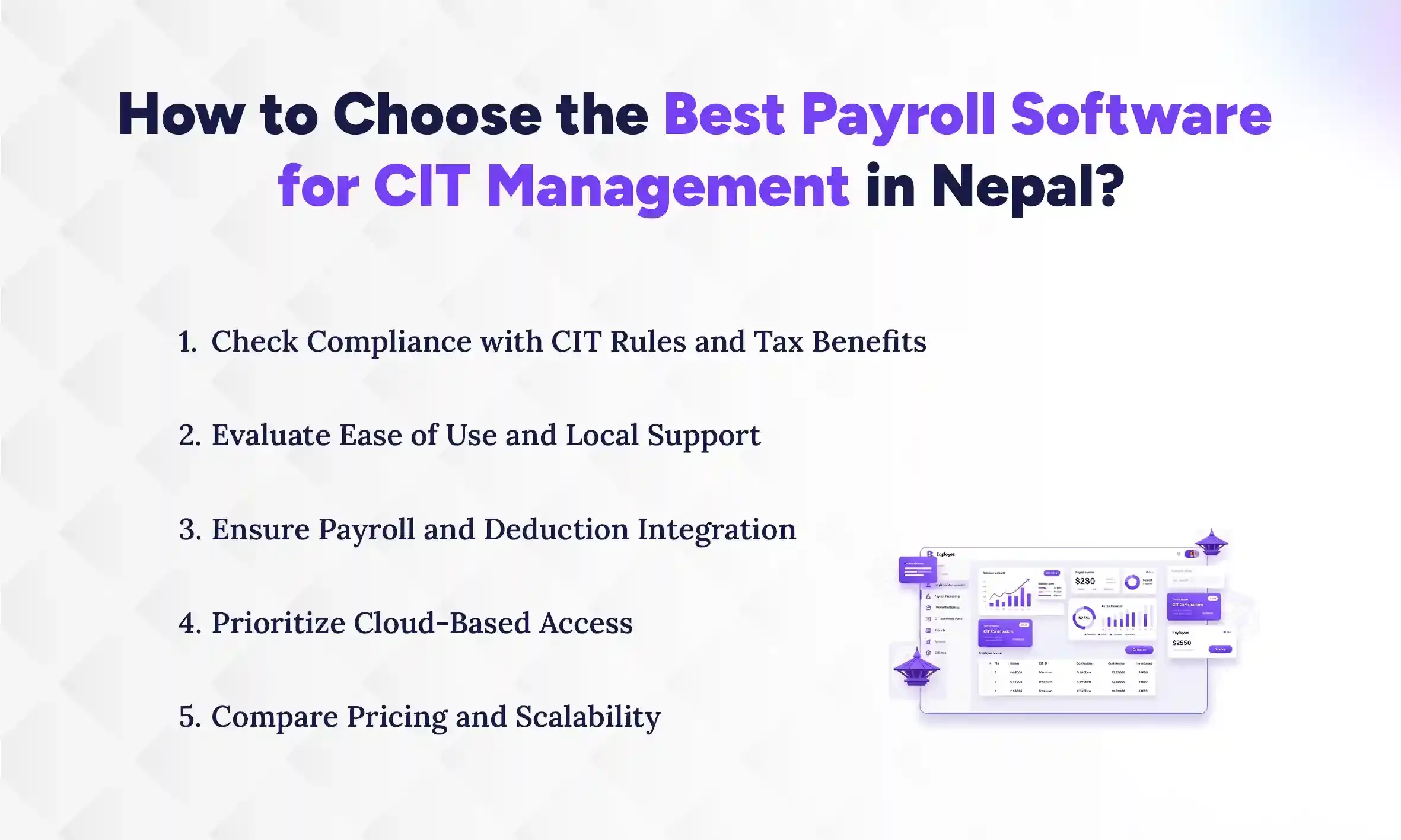
1. Check Compliance with CIT Rules and Tax Benefits
The software must follow Nepal’s CIT rules and tax guidelines without gaps. This ensures all deductions are calculated and reported correctly. It should also support proper tax benefit tracking for employees. If compliance is weak, it can lead to penalties and confusion. So, always confirm rule updates are handled automatically.
2. Evaluate Ease of Use and Local Support
The system should be simple enough for HR teams to use without long training. A clear dashboard helps users find CIT details quickly. Local support is also important for faster issue resolution. This becomes helpful during payroll deadlines. So, choose software that feels easy and responsive.
3. Ensure Payroll and Deduction Integration
Payroll and CIT must work together in one system. This avoids double work and reduces manual errors. When salaries are processed, deductions should apply automatically. It also keeps all records consistent and updated. As a result, payroll becomes smoother and more reliable.
4. Prioritize Cloud-Based Access
Cloud-based HRMS allows HR teams to manage CIT from anywhere. It is useful for remote work or multi-branch companies. Data stays updated in real time across the system. It also reduces the risk of data loss. So, cloud-based systems offer better flexibility and safety.
5. Compare Pricing and Scalability
Pricing should match the value and features offered by the software. It should not become expensive as the company grows. Scalable systems can handle more employees without extra complexity. This saves long-term costs and effort. So, always think about future growth before choosing.
Best Practices for CIT Management Using HR Software
Using HR software for CIT management becomes more effective when companies follow a few simple but consistent practices. These steps help keep data accurate, reduce errors, and ensure smooth compliance every month. Let’s look at the key practices HR teams should follow.
1. Regular Employee Data Updates
Employee details like salary, role, and benefits should be updated as soon as changes happen. If data is outdated, CIT calculations can become incorrect. HR software works best when it has fresh and accurate information. So, updating records regularly keeps everything aligned. This also avoids confusion during payroll processing.
2. Monthly Deduction Checks
Even though the system calculates CIT automatically, monthly checks are still important. HR teams should quickly review deductions before payroll is finalized. This helps catch any unexpected changes early. It also builds confidence that everything is correct. So, a simple review step can prevent bigger issues later.
3. Employee Awareness on CIT Benefits
Employees should understand how CIT deductions work and why they matter. HR teams can share simple explanations or monthly summaries through the system. This reduces confusion and builds trust. When employees are informed, they ask fewer questions and feel more secure. So, awareness helps improve overall transparency.
4. Internal Audits and Record Verification
Regular internal audits help ensure all CIT records are correct and complete. HR software makes this easier by keeping all data in one place. Teams can quickly verify past records without manual searching. It also helps identify small errors before they become bigger problems. So, audits keep the system clean and reliable.
Which Is the Best CIT Management Software in Nepal?
Pace HRMS is one of the best CIT management software solutions in Nepal for simplifying payroll, improving accuracy, and ensuring smooth compliance in one system. It is widely preferred because it brings payroll, attendance, and statutory deductions together in a single platform. This reduces manual work and gives HR teams better control over daily operations.
Pace HRMS connects CIT with payroll and employee records so everything updates automatically in real time. It removes the need for spreadsheets and repeated manual calculations that often lead to errors. With this automation, HR teams can manage salary processing, deductions, and reporting more smoothly and without delays. As a result, every process stays accurate and well-organized.
Businesses choose Pace HRMS because it saves time, reduces compliance stress, and improves overall efficiency. It also scales easily as the company grows, so HR teams don’t need to change systems later. Overall, it provides a simple and reliable way to manage CIT, payroll, and compliance together.
Conclusion
Managing CIT manually is no longer practical for growing businesses in Nepal. From calculations to compliance, every step needs speed, accuracy, and constant attention, which quickly becomes overwhelming for HR teams. CIT management software solves this by automating the entire process and keeping everything organized in one place. It brings clarity, reduces errors, and makes payroll handling much more stable.
When work becomes easier, HR teams can finally focus on people instead of repetitive calculations. It also removes the stress of missing deadlines or handling last-minute corrections. Over time, this builds more trust, better accuracy, and smoother financial planning for both employees and employers.
If you are still managing CIT through spreadsheets and manual effort, it may be time to rethink your approach. A CIT-integrated HR solution can simplify your daily work and improve long-term efficiency. Explore the top 5 HR software in Nepal and make your HR process lighter, faster, and more reliable.