Attendance seems simple…until payroll comes around with wrong numbers, employees argue about working hours, and your HR team spends days fixing attendance registers. It is a head-scratching situation many of us know all too well!
If this sounds familiar, you are definitely not alone. In this guide, we will explore the biggest attendance management challenges Nepali businesses face and practical ways to overcome them.
Why Attendance Management Matters
Tracking daily attendance forms the backbone of your daily business operations and sets the tone for workplace culture. When attendance records are smooth and reliable, everything else in your company runs much better.
Proper attendance tracking ensures that employees are paid fairly for their hard work. At the same time, it helps leaders see how time is spent so they can plan projects and schedules with confidence. Good attendance habits build trust between employees and management, creating a positive work environment for everyone.
Key reasons attendance management is essential for your business:
Payroll accuracy: Ensures correct salaries, overtime pay, and deductions.
Employee accountability: Encourages punctuality and honest work hours.
Legal compliance: Helps satisfy labor laws regarding working hours and leave.
Productivity: Keeps projects moving on schedule without unexpected delays.
HR efficiency: Saves admin teams hours of repetitive paperwork.
Better workforce planning: Shows clear staffing trends for better scheduling.
Unfortunately, achieving these isn't always easy.
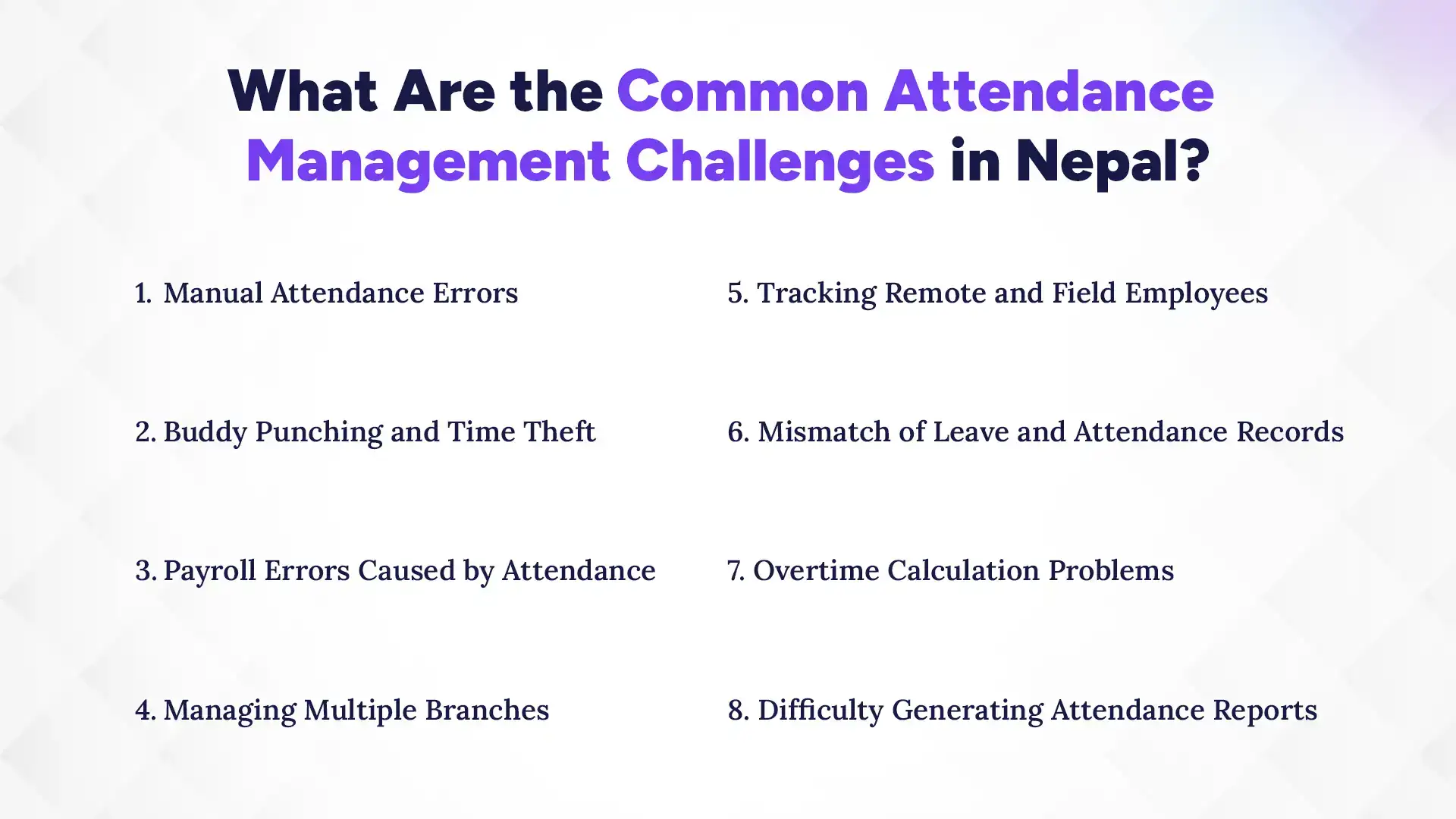
What Are the Common Attendance Management Challenges in Nepal?
The most common attendance management challenges in Nepal include manual record errors, time theft like buddy punching, misplaced leave files, and complex overtime calculations. These problems usually happen when growing companies rely on paper logs, spreadsheets, or disconnected biometric devices that force HR teams to enter data by hand.
Let us look at each of these major attendance challenges in detail and see how they impact daily business operations.
1. Manual Attendance Errors
Manual errors are one of the most common attendance problems businesses face. Whether you're using paper registers or a digital system, missed check-ins, incorrect entries, and forgotten updates can leave HR with inaccurate records. Over time, these errors can affect leave balances, overtime, and payroll.
A mitigating solution for this is to automate attendance tracking. An attendance management system can capture attendance data automatically, reduce manual corrections, and help HR maintain more accurate records.
2. Buddy Punching and Time Theft
Buddy punching happens when one employee clocks in for a coworker who is running late or absent. While it might seem harmless to the employees involved, it leads to paid hours that were never actually worked.
Traditional card swipers and paper logs make time theft very easy to pull off. Over a few months, these stolen minutes add up to significant financial losses for your business.
Using a modern HR software Nepal solution with built-in biometric attendance features stops buddy punching completely. Advanced methods like face recognition, mobile attendance, and GPS verification ensure that the right person is actually at work when they check in.
3. Payroll Errors Caused by Attendance
If attendance data is messy, your monthly payroll will suffer too. Mistakes in counting worked days mean staff might receive incorrect salaries, wrong overtime payouts, or mistaken leave deductions.
When payroll mistakes happen, HR teams spend days answering complaints and re-calculating pay slips. Even worse, pay errors hurt employee morale and damage trust in management.
Integrating your time and attendance software directly with payroll eliminates these manual steps. Systems like Pace HRMS automatically sync attendance data into payroll calculations, ensuring error-free pay slips every month.
4. Managing Multiple Branches
Managing attendance across different branches in cities like Kathmandu, Pokhara, or Biratnagar can quickly turn chaotic. Each office often keeps its own paper log or separate machine, leaving central management in the dark.
Without a central system, central HR must wait until the end of the month to gather attendance files from each branch manager. This delay makes it hard to track overall attendance, spot absenteeism early, or handle company-wide shifts.
A cloud-based HR management system brings all branch data together on a single dashboard. Managers can easily check branch-wise attendance from anywhere at any time.
5. Tracking Remote and Field Employees
Not all employees work at a desk inside an office building. Sales teams, delivery staff, field technicians, and construction supervisors spend most of their workday on the move.
Paper registers and stationary biometric devices simply do not work for field staff. HR managers are often left guessing whether field employees started their duties on time or reached their assigned locations.
Mobile attendance features solve this by allowing field staff to check in directly from their smartphones. Using GPS check-ins and geo-fencing, management gets live attendance updates along with location confirmation.
6. Leave and Attendance Don't Match
It is frustrating when an employee on approved leave is accidentally marked absent on the attendance register. This usually happens when leave approvals live in email threads or paper slips that do not link to daily attendance records.
These mismatches cause confusion during festival holidays, weekend shifts, and monthly payroll reviews. HR teams then have to spend hours checking old messages to fix attendance marks manually.
An integrated HRMS keeps leave approvals and attendance logs on the same system. When a leave request is approved, the system updates the attendance record automatically to prevent any confusion.
7. Overtime Calculation Problems
Overtime rules can get tricky, especially during busy seasons or night shifts. Calculating extra hours manually based on different company policies often leads to mistakes and payroll disputes.
If overtime rules are applied inconsistently, employees feel cheated, while the company risks overpaying for unworked extra time. Paper logs make it almost impossible to verify if overtime was actually authorized.
Automating overtime calculations with modern employee attendance tracking software removes the guesswork. The system calculates exact overtime pay based on pre-set company rules and verified check-out times.
8. Difficulty Generating Attendance Reports
When company directors ask for attendance trends, HR managers often have to spend days creating reports from scratch. Gathering data from paper logs or multiple spreadsheets is slow and exhausting.
Without quick reports, leaders cannot easily track late arrivals, spot absenteeism patterns, or evaluate department productivity. This lack of insight makes workforce planning difficult.
Automated attendance tools create instant reports with just a few clicks. You can easily view and download insights such as:
Late arrivals and early departures
Absenteeism and attendance trends
Monthly overtime summaries
Department-wise attendance reports
Complete monthly attendance summaries for audits
What to Look for in an Attendance Management System
Choosing the right attendance tool for your business can feel overwhelming with so many options available. To make sure you get a system that grows with your company, look for these essential features:
Biometric Integration: Seamless connection with fingerprint and face recognition machines.
Mobile Attendance: Easy check-in options for remote and field employees via mobile apps.
GPS Tracking and Geo-fencing: Location-verified attendance for field teams.
Shift Management: Flexible shift creation and night shift adjustments.
Overtime Automation: Rule-based calculations that link directly to payroll.
Leave Integration: Automatic balance updates when leaves are taken.
Payroll Integration: Direct transfer of attendance data to monthly salary calculations.
Real-time Dashboard: Instant view of present, absent, and late employees.
Custom Reports: Quick generation of attendance, leave, and overtime summaries.
Multi-branch Support: Centralized tracking across all office locations in Nepal.
Nepali Compliance: Built-in support for local holiday calendars and labor law guidelines.
Cloud Access: Secure system access from anywhere, on any device.
Not every solution offers all these capabilities.
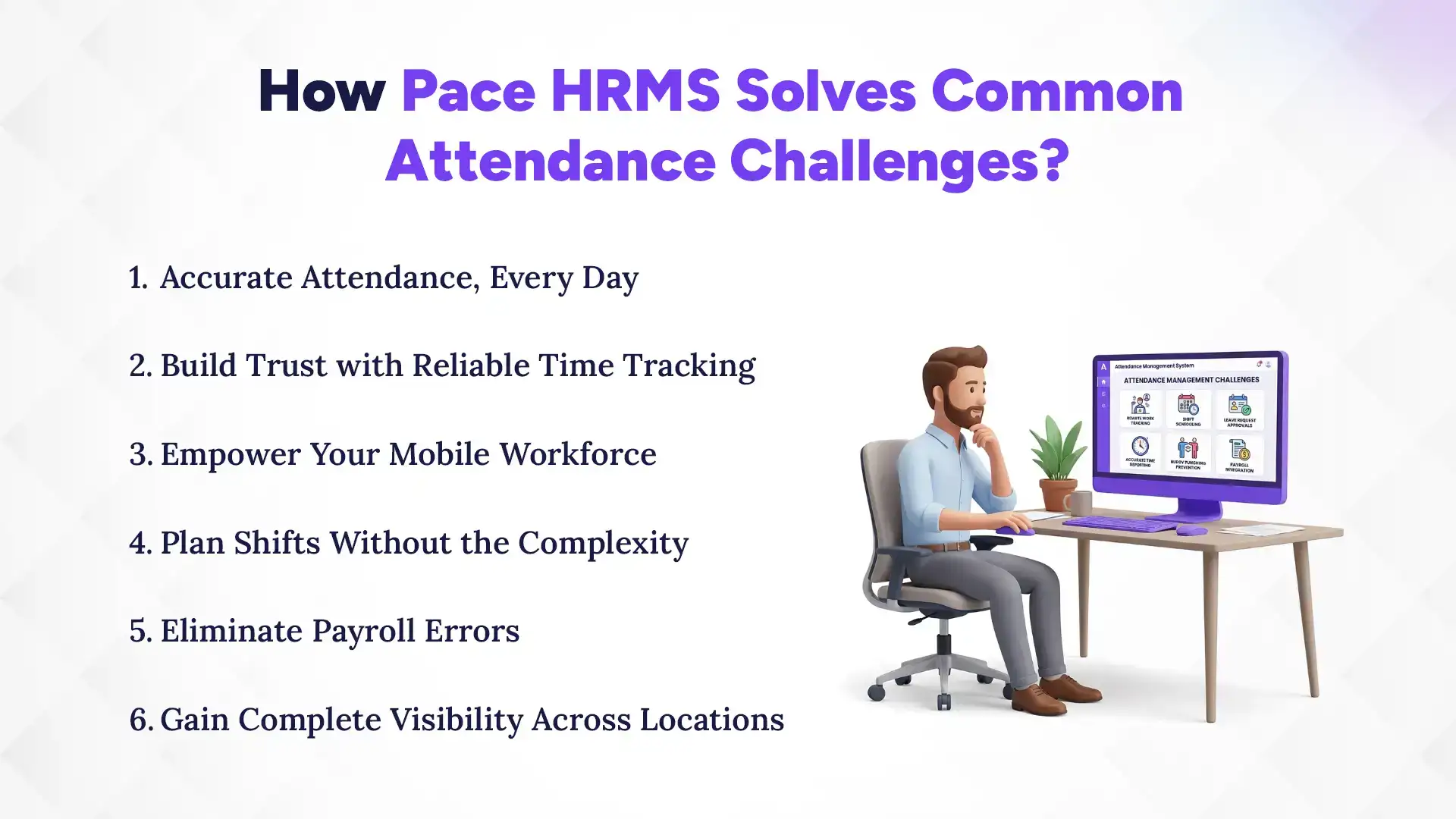
How Pace HRMS Solves Common Attendance Challenges
Pace HRMS goes beyond basic check-ins and check-outs. It serves as a complete HR management platform designed to take the stress out of daily workforce operations for Nepali businesses.
Here is how Pace HRMS solves your daily attendance headaches:
1. Accurate Attendance, Every Day
Pace HRMS connects directly with your existing biometric hardware and mobile devices. Check-ins sync automatically in real time, eliminating manual data entry and human error completely.
2. Build Trust with Reliable Time Tracking
With built-in biometric sync and face recognition features, buddy punching and fake attendance become things of the past. Your employees feel confident knowing their time is tracked fairly and accurately.
3. Empower Your Mobile Workforce
Field staff can easily check in using the mobile app with GPS location tags. Managers receive live location confirmation, giving field teams the flexibility to work efficiently without micromanagement.
4. Plan Shifts Without the Complexity
Whether your business runs on single shifts, rotating schedules, or night shifts, Pace HRMS makes shift planning simple. The system applies shift rules automatically to record punctuality accurately.
5. Eliminate Payroll Errors
Say goodbye to spreadsheet stress at the end of every month. Pace HRMS automatically feeds attendance, leave, and overtime data right into the payroll module for fast, error-free pay slip generation.
6. Gain Complete Visibility Across Locations
Whether you have one office in Kathmandu or multiple branches across Nepal, Pace HRMS provides a single central dashboard. You get full visibility over overall attendance trends in real time.
By replacing manual work with smart automation, Pace HRMS delivers clear business outcomes:
Less manual HR admin work
Accurate, dispute-free payroll
Complete visibility over workforce trends
Faster daily HR operations
Ready to Simplify Attendance Management?
Book a free demo of Pace HRMS and see how automated attendance, payroll integration, and real-time reporting can make HR management faster and easier.
Benefits of Automating Attendance in 2026: Modern HR Management
Upgrading your attendance processes brings long-term value to your whole organization:
Save Valuable HR Time: Automate repetitive tracking so HR teams can focus on hiring and employee engagement.
Reduce Costly Payroll Errors: Pay exact salaries based on verified working hours and automated overtime calculations.
Eliminate Paper Registers: Move away from messy paper registers and manual spreadsheets.
Improve Accountability: Encourage punctuality across teams with transparent attendance tracking.
Achieve Better Compliance: Keep reliable digital records to satisfy company policies and local labor guidelines.
Make Smarter Decisions: Use clear attendance analytics to plan shifts, manage workloads, and improve productivity.
Conclusion
Attendance management is more than recording check-ins and check-outs. It directly affects payroll accuracy, productivity, compliance, and employee trust. Businesses that continue relying on manual processes often spend more time fixing attendance issues than managing their workforce.
Modern HR software helps eliminate these challenges by automating attendance, integrating payroll and leave, and providing real-time workforce visibility.
If your organization is looking to simplify attendance management in Nepal, Pace HRMS offers an all-in-one solution designed to help businesses of every size manage attendance more accurately and efficiently.
FAQs
What is an attendance management system?
+
An attendance management system is software that tracks employee working hours, check-in and check-out times, leaves, and overtime. It helps businesses reduce manual administrative work and ensures accurate payroll processing.
Why should Nepali businesses move away from paper registers?
+
Paper registers are prone to lost data, human entry errors, time theft, and delays. Switching to digital time and attendance software saves time, prevents payroll mistakes, and keeps records secure and accessible.
How does mobile attendance tracking work for field staff?
+
Mobile attendance lets employees check in using a smartphone app. Features like GPS tracking and geo-fencing verify the employee’s exact location when they log their attendance, making it ideal for sales and field teams.
Can Pace HRMS integrate attendance data directly into payroll?
+
Yes! Pace HRMS automatically syncs daily attendance, approved leaves, and overtime hours directly into the payroll module, allowing you to calculate accurate salaries with just a few clicks.
Why is attendance management important?
+
Attendance management helps organizations track employee working hours, absences, late arrivals, and leave accurately. It improves productivity, simplifies payroll processing, reduces errors, and helps managers make better workforce decisions.
What are the different types of attendance systems?
+
The main types of attendance systems include manual registers, biometric systems, card-based systems, PIN-based systems, mobile attendance apps, web-based systems, and automated attendance management software. Each system offers different features depending on the organization’s needs.
Ready to get started?
Book a 30-minute consultation call, and let's talk about your goals.