

.webp&w=3840&q=75)
Conducting a performance review is the structured process of evaluating an employee's work output, behavior, and goal achievement against defined criteria over a specific period and using that evaluation to make documented, defensible decisions about recognition, development, increment, and accountability.
Most companies in Nepal conduct performance reviews in one of two ways: an informal annual conversation where a manager shares general impressions with no structured criteria or no formal review process at all, where increment and promotion decisions are made entirely on instinct and seniority. Both approaches produce the same outcome: high performers feel undervalued because their results are never formally recognized, underperformers continue unchallenged because there is no documented basis to act, and HR teams have no defensible record when employment disputes arise under Nepal's Labour Act 2074.
This guide covers what a performance review is, why it matters for companies in Nepal, the most common mistakes HR managers make, and a complete step-by-step process for conducting reviews that are structured, fair, and legally documented.
What Is a Performance Review?
A performance review is a formal, documented evaluation of an employee's job performance over a defined period, measured against pre-agreed KPIs and behavioral standards, conducted by the direct manager with input from the employee's self-assessment.
It differs from informal feedback because it uses a structured form, produces a written record signed by both parties, and directly informs HR decisions on increments, promotions, and performance improvement plans. Companies in Nepal need this repeatable process to reduce bias, ensure consistency across departments, and meet Labor Act 2074 documentation requirements. Learn what an HRMS is and how it supports this process end to end.
Why Do Performance Reviews Matter for Companies in Nepal?
Performance reviews matter for companies in Nepal because they replace gut-feel, people-based decisions with structured, documented, and legally defensible evaluations, and the benefits of HR software go further by automating the entire review cycle so nothing is missed.
- Identify High Performers: Structured ratings give HR managers objective data to support promotion and increment decisions across the organization.
- Flag Underperformance Early: Regular reviews create documented checkpoints to address declining performance before it affects the wider team.
- Labor Act 2074 Compliance: Signed review records provide the audit trail required when termination, demotion, or increment decisions are disputed.
- Align Goals to Company Objectives: Reviews link individual KPIs to company targets so every employee understands how their role contributes to organizational performance.
- Reduce Bias in People Decisions: Measurable criteria applied consistently across all employees replace personal preference with performance data.
Common Performance Review Mistakes Companies in Nepal Make
Common performance review mistakes companies in Nepal make are conducting reviews only once a year, using vague criteria, letting recency bias dominate, skipping documentation, and running the review as a one-way feedback session.
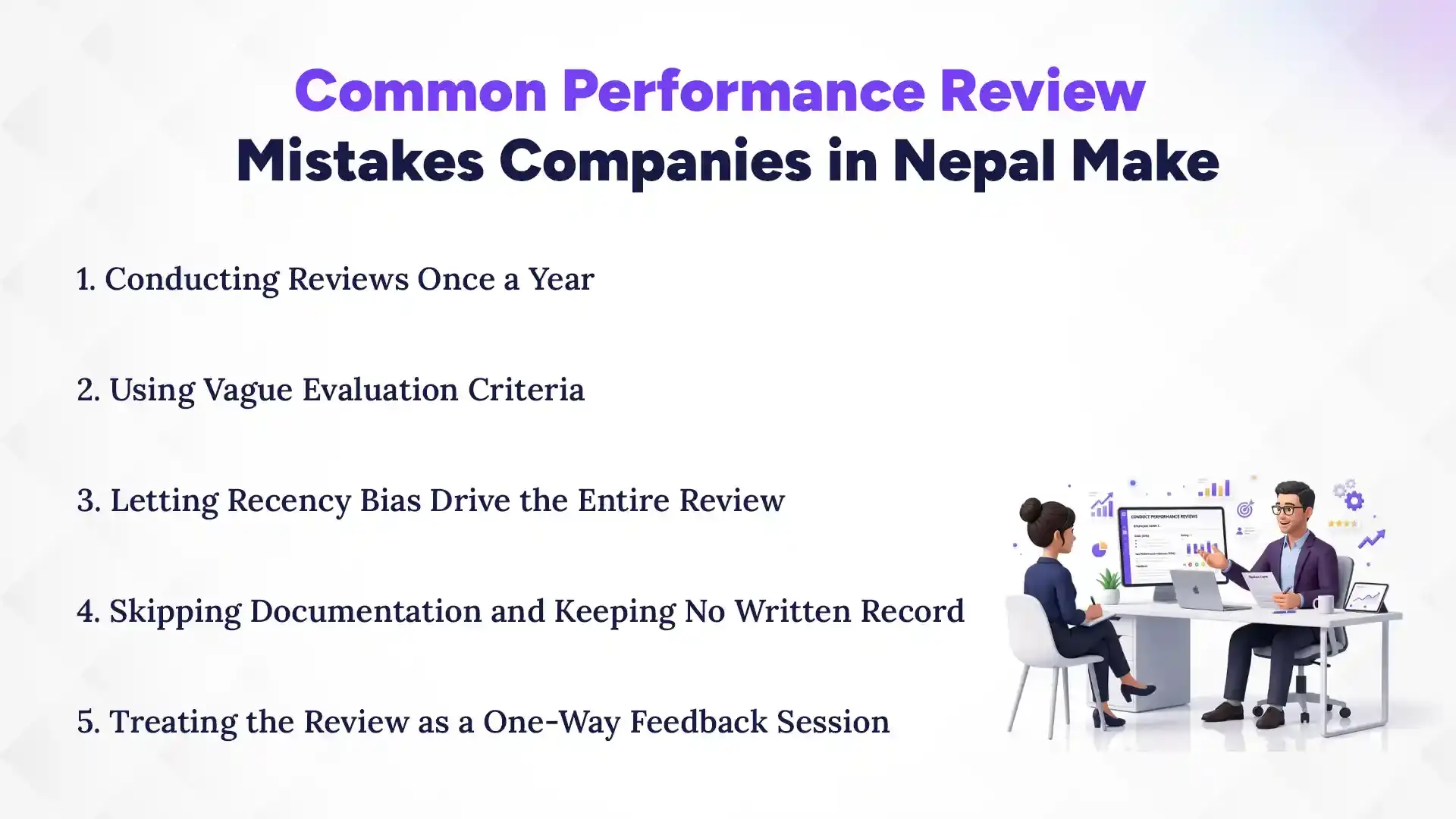
1. Conducting Reviews Once a Year
An annual review based on what the manager remembers from the last few weeks is a recency assessment, not a full-year evaluation. Mid-cycle check-ins at three- or six-month intervals give managers complete data and give employees time to course-correct before the review determines their increment.
2. Using Vague Evaluation Criteria
Rating employees on "attitude" or "dedication" with no measurable standard produces reviews that reflect personal impressions rather than actual performance. In Nepal's workplace context, vague criteria create conditions for bias. Every criterion needs a defined, observable standard.
3. Letting Recency Bias Drive the Entire Review
Recency bias occurs when a manager's evaluation of an employee's full review period is dominated by events from the most recent weeks, because those events are most easily remembered. A strong project delivered in the final month before review season can inflate a rating that should reflect an entire year of mixed performance. A mistake made two weeks before the review can unfairly suppress a rating for an employee who performed consistently well for eleven months. Structured data collection throughout the review period, not just in the final weeks, is the only reliable defense against recency bias.
4. Skipping Documentation and Keeping no Written Record
Verbal reviews with no written record leave the organization unprotected when increment decisions are disputed or labor act complaints are filed. Every review must produce a signed document stored in the employee's HR file.
5. Treating the Review as a One-Way Feedback Session
A performance review that consists entirely of a manager delivering ratings and comments to a silent employee misses the most valuable part of the process. Employees who are not given structured space to share their self-assessment, raise concerns about workload or role clarity, or contribute to their own development goals are less likely to accept the review's findings, less likely to act on improvement feedback, and more likely to disengage from the organization in the months following the review. The review meeting must be a structured dialogue, not a performance verdict delivered from above.
How to Conduct a Performance Review: Step-by-Step
Conducting a performance review effectively requires seven steps: define criteria, collect data, complete the form, share the agenda, conduct the meeting, document the outcome, and follow up between cycles.
Step 1: Define Clear Performance Criteria Before the Review Period
Set measurable KPIs, output targets, and behavioral standards at the start of the review cycle. Both manager and employee must agree on what success looks like before it is evaluated.
Step 2: Collect Performance Data From Multiple Sources
Gather output data (targets hit, projects completed); behavioral data, including records from your attendance management system; and structured input from peers and the employee's self-assessment throughout the period, not just in the week before the review.
Step 3: Complete the Review Form Before the Meeting
The manager completes ratings and written comments in advance using the collected data. Filling out the form during the meeting introduces inconsistency and allows the employee's reactions to influence ratings in real time.
Step 4: Share the Agenda With the Employee in Advance
Send the review criteria, self-assessment form, and meeting agenda three to five working days before the session. Employees who come prepared contribute meaningfully to the review conversation and produce better agreed outcomes.
Step 5: Conduct the Meeting With a Structured Format
Open by confirming the review period and criteria. Let the employee share their self-assessment first. Present the manager's evaluation with specific examples. Discuss gaps openly. Close with agreed development goals and action points for the next cycle.
Step 6: Document the Outcome and Get Sign-Off From Both Parties
The completed review document must capture ratings, written comments, agreed goals, and any performance improvement plan. Both manager and employee sign before filing. The employee's signature confirms they have read and understood the outcome, not that they agree with every rating.
Step 7: Follow Up on Action Points Between Review Cycles
Schedule mid-cycle check-ins to track progress against agreed development goals. A review that produces action points with no follow-up is a conversation, not a management process.
Types of Performance Review Methods Used in Nepal
The most common performance review methods used in Nepal are the annual performance appraisal, quarterly performance review, 360-degree feedback review, self-assessment review, and probationary period review. Each method serves a different review cycle, role type, and organizational need, and the most effective performance management systems in Nepal combine two or more formats depending on the employee's seniority and function.
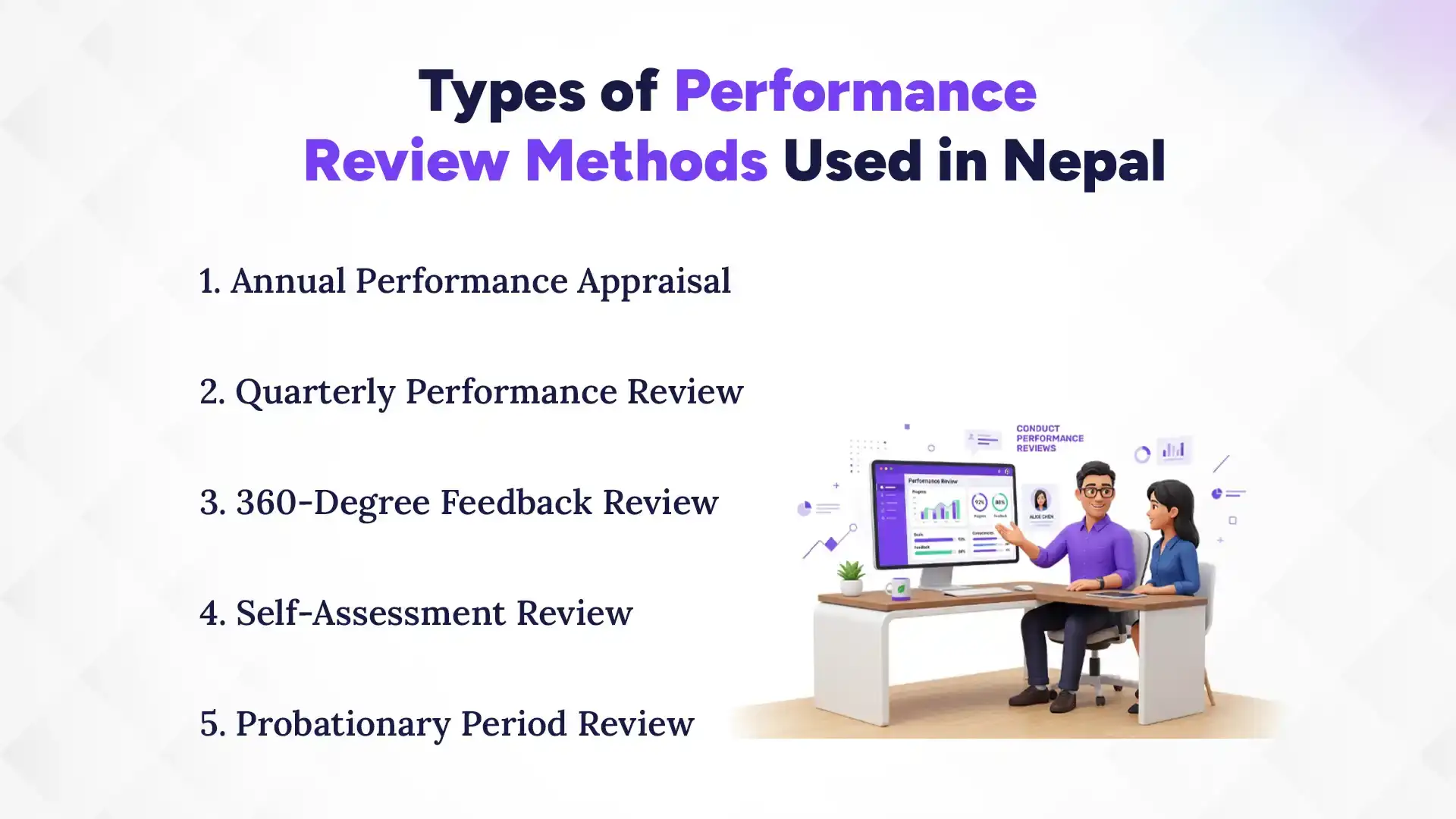
1. Annual Performance Appraisal
The most widely used format in Nepal. Most effective when supported by mid-cycle check-ins to ensure the annual review reflects complete, current data rather than a recency-biased view of the final quarter.
2. Quarterly Performance Review
Evaluates performance over three months. Particularly effective for sales and business development roles where output targets shift each quarter with market conditions.
3. 360-Degree Feedback Review
Collects structured input from managers, peers, direct reports, and key clients. Most effective for senior roles where cross-functional impact and leadership behavior matter as much as individual output.
4. Self-Assessment Review
The self-assessment review asks the employee to evaluate their own performance against the agreed criteria before the manager's evaluation is shared. Self-assessments surface the employee's perspective on their own contribution, highlight areas where the employee and manager see performance differently, and create a more productive review conversation by giving the employee structured ownership of their evaluation.
5. Probationary Period Review
Evaluates new employee performance at the end of probation, typically three to six months after joining. Provides the documented basis for confirming or ending employment under Nepal's Labour Act 2074. HR software for onboarding in Nepal connects the onboarding and probation review process in one structured workflow.
What to Include in a Performance Review Form
A complete performance review form for companies in Nepal must include employee details, the review period, KPI ratings with targets vs. actuals, behavioral competency ratings, manager comments with specific examples, an employee self-assessment section, agreed development goals, and signature fields for both manager and employee with the completion date.
- Employee details and review period covered
- KPI ratings: measurable targets vs. actuals for the review period
- Behavioural competency ratings with defined standards for each level
- Manager written comments with specific examples for every criterion
- Employee self-assessment section completed before the review meeting
- Agreed development goals and action plan for the next review period
- Performance improvement plan section if applicable
- Signature fields for both manager and employee with completion date
How HR Software Makes Performance Reviews Easier in Nepal
HR software makes performance reviews easier in Nepal by replacing paper forms and manual scheduling with a centralized platform. Understand the full features of HR software that make this possible before choosing a platform.
Most Nepali HR managers currently manage reviews through emailed Word templates, Excel completion trackers, and physical files with no searchable structure, a manual process that consistently runs late and creates documentation gaps. HR software eliminates each of these problems with automated workflows that require minimal HR team intervention once configured.
Which Is the Best HR Software for Performance Reviews in Nepal?
Pace HRMS is the best HR software for performance reviews in Nepal because it combines automated review scheduling, structured digital evaluation forms, mid-cycle check-in reminders, digital sign-off, labor act-compliant record storage, and performance trend dashboards in one platform built for the Nepali business context.
For HR managers and business owners in Nepal looking to replace informal appraisals with a structured, automated, and legally compliant performance management process, Pace HRMS is the most practical and locally relevant solution available. Visit the Pace HRMS product page to see how it fits your organization's review cycle.
Conclusion
Performance reviews in Nepal are too legally significant to conduct without documentation and too important for team accountability to conduct informally. A structured process built on pre-agreed criteria, multi-source data, and signed records gives HR managers the performance visibility and labor act compliance that informal annual appraisals cannot provide.
The right time to build that process is before a disputed increment decision or a labor act complaint makes the absence of documentation costly. Contact Pace Infosys today to see how Pace HRMS can automate and structure performance reviews for your organization in Nepal.