

International HR software doesn't fit Nepal's payroll rules because it's built around global or regional tax defaults that don't account for Nepal's provident fund contributions, tax slabs, or fiscal year structure, leaving businesses to patch the gaps manually. What looks like a full-featured platform on paper often turns into a system that gets Nepal's payroll roughly right, which in compliance terms isn't right at all.
This guide covers what actually makes Nepal's payroll rules different, why international platforms struggle to keep up, the specific requirements they typically miss, how businesses currently work around these gaps, the risks of relying on ill-fitting software, what to look for instead, and how Nepal-specific HRMS platforms close the gap closing with which HRMS is best suited for Nepal's payroll rules.
What Makes Nepal's Payroll Rules Different From Global Standards?
Nepal's payroll rules differ from global standards through its specific provident fund and social security contribution structure, its own tax slab system, and statutory leave and holiday requirements that don't match common international defaults.
Provident fund and social security contributions in Nepal follow a specific structure that most international platforms simply don't have built in, which is why dedicated HR software with SSF integration in Nepal is necessary instead of generic global retirement logic. Nepal's tax slab structure is similarly its own system, with brackets and thresholds that don't align with the tax logic global platforms are typically built around by default. On top of that, statutory leave and holiday requirements in Nepal, including festival leave, follow local expectations that generic international defaults rarely account for out of the box.
| Requirement | Nepal Standard | Typical Global Default |
|---|---|---|
| Retirement Contributions | Specific provident fund structure | Generic pension or 401(k)-style logic |
| Tax Calculation | Nepal-specific tax slabs | Global or region-generic tax brackets |
| Statutory Leave | Includes festival and public holiday leave | Standard vacation/PTO models only |
| Fiscal Year | Mid-year start aligned with Nepal's calendar | January–December calendar year default |
Why Do International HR Platforms Struggle With Local Compliance?
International HR platforms struggle with local compliance because they're built around global or regional defaults, offer limited localization beyond major markets, and are slow to adapt when local regulations change.
1. Built Around Global or Regional Defaults
Most international platforms are designed around the tax and labor systems of their largest markets, with everything else treated as a secondary adjustment rather than a core requirement. Being built around global or regional defaults means Nepal's specific rules often get squeezed into a framework that wasn't designed for them.
2. Limited Localization Beyond Major Markets
Vendors typically prioritize localization for large, high-revenue markets, leaving smaller markets like Nepal with partial or generic support at best. This limited localization beyond major markets is a business decision on the vendor's part, not a technical limitation that can't be solved.
3. Slow to Adapt to Local Regulatory Changes
When Nepal's tax rules or statutory requirements change, international vendors are often slow to update their platform, since it's not a priority market for their development roadmap. Being slow to adapt to local regulatory changes leaves businesses exposed during the gap between a rule changing and the software catching up.
What Payroll Requirements Does International Software Typically Miss?
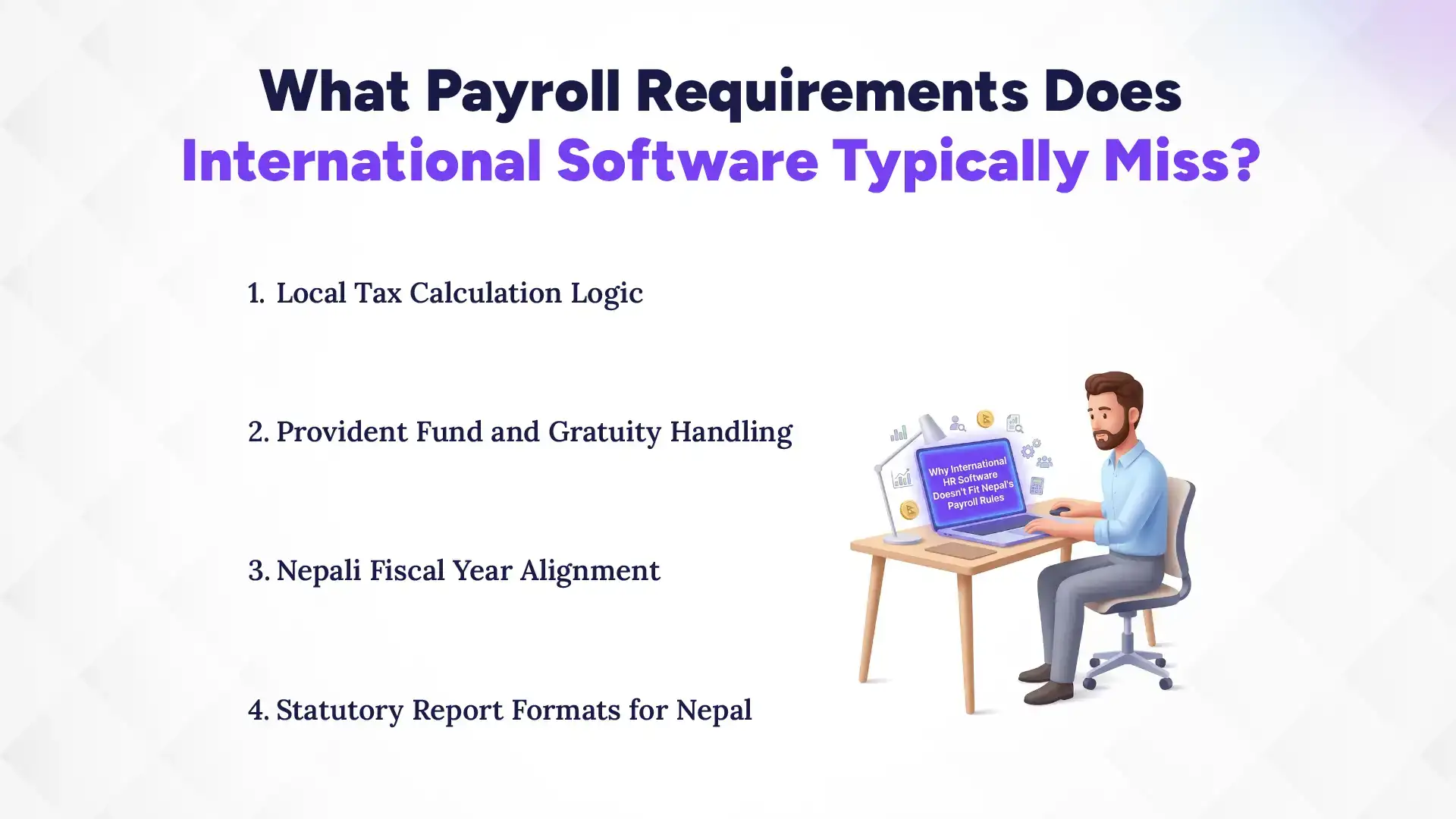
International software typically misses Nepal's local tax calculation logic, provident fund and gratuity handling, alignment with Nepal's fiscal year, and the statutory report formats Nepal requires.
1. Local Tax Calculation Logic
Nepal's tax calculation follows its own brackets and rules that international software often approximates rather than calculates precisely. Missing local tax calculation logic is one of the most consequential gaps, since it directly affects how employee payroll deductions in Nepal are correctly processed and taxed.
2. Provident Fund and Gratuity Handling
Provident fund and gratuity calculations in Nepal follow specific formulas that most global platforms don't natively support. Getting provident fund and gratuity handling wrong creates a compliance and trust problem that surfaces the moment an employee reviews their own contributions.
3. Nepali Fiscal Year Alignment
Nepal's fiscal year doesn't follow the January-to-December calendar most international software defaults to, which throws off reporting periods and annual calculations. Nepali fiscal year alignment issues often go unnoticed until year-end reporting reveals numbers that don't match expectations.
4. Statutory Report Formats for Nepal
Government and statutory filings in Nepal require specific report formats that international software rarely generates natively. Producing statutory report formats for Nepal often becomes a manual, after-the-fact task rather than something the software handles automatically.
How Does Manual Workaround Compensate for These Gaps?
Businesses compensate for these gaps through manual adjustments to payroll calculations, spreadsheet-based compliance tracking on the side, and heavier reliance on external accountants to catch what the software misses.
1. Manual Adjustments to Payroll Calculations
HR or finance staff often recalculate parts of payroll by hand to correct for what the software gets wrong, adding time and risk to every pay cycle. Relying on manual adjustments to payroll calculations defeats much of the purpose of using automated salary processing software in Nepal in the first place.
2. Spreadsheet-Based Compliance Tracking
Businesses frequently maintain a separate spreadsheet just to track the compliance details their HR software doesn't handle correctly. Spreadsheet-based compliance tracking on the side reintroduces exactly the kind of fragmented, error-prone process HRMS is supposed to eliminate.
3. Reliance on External Accountants
Many businesses lean more heavily on external accountants specifically to catch and correct the gaps left by ill-fitting software. Increased reliance on external accountants adds ongoing cost that a properly localized HRMS would remove entirely.
What Risks Come From Using International HR Software in Nepal?
Using international HR software in Nepal risks incorrect tax withholding, non-compliant statutory filings, employee payroll disputes, and penalties during government audits.
1. Incorrect Tax Withholding
When tax logic doesn't match Nepal's actual brackets, employees can be over- or under-withheld without anyone noticing until it becomes a bigger problem. Correcting incorrect tax withholding after the fact is far more disruptive than getting it right from the start.
2. Non-Compliant Statutory Filings
Filings generated in the wrong format or based on incorrect calculations can be rejected or flagged, creating delays and extra work to fix. Avoiding non-compliant statutory filings depends on the software actually producing what Nepal's authorities expect, not an approximation of it.
3. Employee Payroll Disputes
Employees who notice discrepancies in their pay or provident fund contributions understandably raise concerns, and resolving these disputes takes time and damages trust. Reducing employee payroll disputes start with the underlying calculations being correct in the first place, not with better explanations after something goes wrong.
4. Penalties During Government Audits
Inaccurate records or filings discovered during a government audit can result in penalties, regardless of whether the error was intentional. Avoiding penalties during government audits requires payroll software that gets Nepal's specific requirements right by default, not by exception.
What Should You Look for in HR Software Built for Nepal?
HR software built for Nepal should offer native tax and provident fund support, responsiveness to local regulatory updates, and the right HR software features to support teams who are actually familiar with Nepal's rules.
1. Native Nepali Tax and PF Support
Look for software where Nepal's tax slabs and provident fund calculations are built in natively, not approximated through generic settings. Prioritizing native Nepali tax and PF support removes the need for manual correction on every pay cycle.
2. Local Regulatory Update Responsiveness
Ask how quickly a vendor updates their platform when Nepal's tax or labor rules change, since this responsiveness determines how exposed your business is during transition periods. Choosing software with strong local regulatory update responsiveness keeps compliance current, a key factor when evaluating how to choose HR software for long-term stability.
3. Support Teams Familiar With Local Rules
Support staff who actually understand Nepal's payroll requirements can resolve issues far faster than a generic support team working from a global playbook. Working with support teams familiar with local rules turns troubleshooting into a quick conversation instead of a lengthy escalation.
How Do Nepal-Specific HRMS Platforms Handle These Requirements?
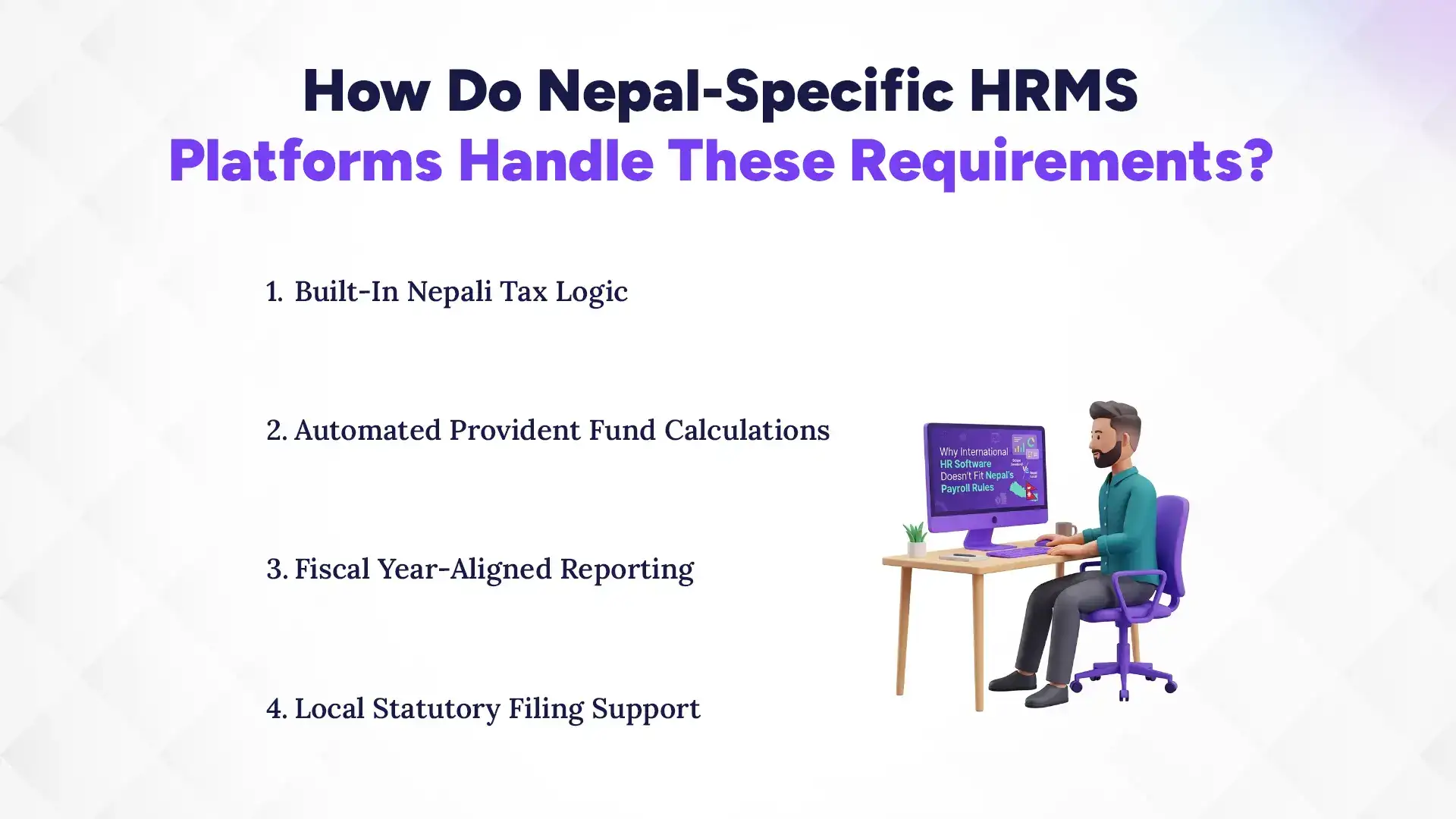
Nepal-specific HRMS platforms handle these requirements through built-in Nepali tax logic, automated provident fund calculations, fiscal year-aligned reporting, and direct support for local statutory filing.
1. Built-In Nepali Tax Logic
Tax calculations follow Nepal's actual brackets and rules by default, removing the need for manual correction or approximation. Relying on built-in Nepali tax logic means every paycheck reflects Nepal's requirements accurately from the first pay cycle.
2. Automated Provident Fund Calculations
Provident fund and gratuity contributions are calculated automatically according to Nepal's specific formulas, without requiring manual intervention. Automated provident fund calculations remove one of the most error-prone parts of payroll under a generic system.
3. Fiscal Year-Aligned Reporting
Reporting periods and annual calculations follow Nepal's actual fiscal year rather than defaulting to a January-to-December cycle. Fiscal year-aligned reporting keeps year-end numbers accurate without requiring manual recalculation to match Nepal's calendar.
4. Local Statutory Filing Support
Nepal-specific platforms generate statutory reports in the formats local authorities actually require, ready to submit rather than needing manual reformatting. Local statutory filing support turns compliance reporting into a routine task instead of a recurring workaround.
Which HRMS Is Best Suited for Nepal's Payroll Rules?
Pace HRMS is best suited for Nepal's payroll rules, with native tax logic, automated provident fund handling, and reporting built around Nepal's fiscal year and statutory requirements. It's designed to reflect how Nepali businesses actually process compliant payroll.
For businesses in Nepal looking to move from global templates to something locally accurate, Pace HRMS is built around Nepal's actual payroll requirements from the ground up, not adapted from a global template after the fact. Tax calculations, provident fund contributions, and statutory filings are handled natively, without requiring manual correction or a spreadsheet running alongside the system. As one of the top 5 HR software in Nepal, it's designed to reflect how Nepali businesses actually process compliant payroll.
What sets Pace HRMS apart is that Nepal's payroll rules were the starting point for the platform's design, not an afterthought bolted onto a system built for other markets. Between native tax logic, automated compliance calculations, and support teams who understand Nepal's requirements directly, it gives businesses payroll software that actually fits instead of one they have to work around.
Conclusion
International HR software's gaps in Nepal aren't a matter of missing features; they're a mismatch between how the platform was designed and what Nepal's payroll rules actually require. A Nepal-built HRMS closes that gap by design rather than through manual workarounds, spreadsheets on the side, or extra reliance on external accountants just to stay compliant.
If your business is dealing with the gaps left by international HR software, explore Pace HRMS's Nepal-specific payroll features with a demo or contact Pace Infosys to see how it fits your team.