
.webp&w=3840&q=75)
HR software with SSF integration is a connected payroll and HR management system that automatically calculates, deducts, and records Social Security Fund contributions for every employee based on their current salary data, eliminating manual contribution calculations, reducing filing errors, and keeping companies compliant with Nepal's SSF regulations without additional administrative effort.
Most companies in Nepal currently manage SSF contributions through a combination of manual spreadsheet calculations, separate accounting entries, and paper-based filing, a process that produces contribution errors, missed deadlines, and compliance gaps that expose organizations to SSF penalties and audits. When payroll and SSF records are managed in separate systems with no direct connection, even a small salary change can create a contribution discrepancy that takes hours to trace and correct.
What Is HR Software with SSF Integration?
HR software with SSF integration is a centralized HR management system that connects directly to Nepal's Social Security Fund framework, automatically calculating employer and employee SSF contributions from current payroll data, generating SSF-compliant contribution reports, and maintaining complete employee SSF records all within the same platform used to process salaries and manage HR functions.
It differs from managing SSF manually or through a standalone accounting tool because manual systems require HR teams to separately calculate contributions for every salary change, new hire, and departure and then cross-reference those calculations against payroll records before filing. HR software with SSF integration removes all manual steps by pulling contribution data directly from the payroll module, so SSF calculations always reflect the current, accurate salary of every employee without additional data entry.
Companies in Nepal need SSF integrated directly into their HR and payroll system because disconnected processes create the calculation errors, filing delays, and record gaps that lead to SSF penalties, compliance audits, and employee disputes over contribution histories.
Why Companies in Nepal Need HR Software with SSF Integration
Companies in Nepal need HR software with SSF integration because manually calculating and filing Social Security Fund contributions for every employee every month is an error-prone, time-consuming process that creates financial penalties and legal risk when contributions are incorrect, late, or undocumented.
- Automating Monthly SSF Contribution Calculations: HR software calculates the correct employer and employee SSF contribution for every staff member automatically from current payroll data, removing the manual calculation step that produces errors when salaries change, allowances are added, or new employees join mid-month.
- Eliminating Manual Filing Errors That Trigger SSF Penalties: Direct integration ensures that the contribution amounts submitted to SSF always match the payroll figures in the HR system, removing the discrepancies between payroll records and SSF filings that trigger audits and financial penalties.
- Connecting Payroll to SSF Deductions Automatically: When a salary is processed, SSF deductions are calculated and recorded simultaneously within the same system, so there is no separate reconciliation step required before filing contributions each month.
- Generating SSF-Compliant Reports and Contribution Records: Integrated systems produce formatted SSF contribution reports and employee contribution histories automatically, giving HR teams the documentation they need for filings, audits, and employee queries without manual report preparation.
- Staying Current With SSF Regulation Changes: HR software platforms update contribution rate configurations when SSF regulations change, so companies are always calculating contributions at the correct rate without manually recalculating every employee's deduction.
Key SSF Compliance Challenges Companies Face in Nepal
Key SSF compliance challenges companies face in Nepal are manual contribution calculation errors, missed filing deadlines, incorrect employee SSF registration, disconnected payroll and SSF records, and difficulty staying updated with SSF regulation changes.
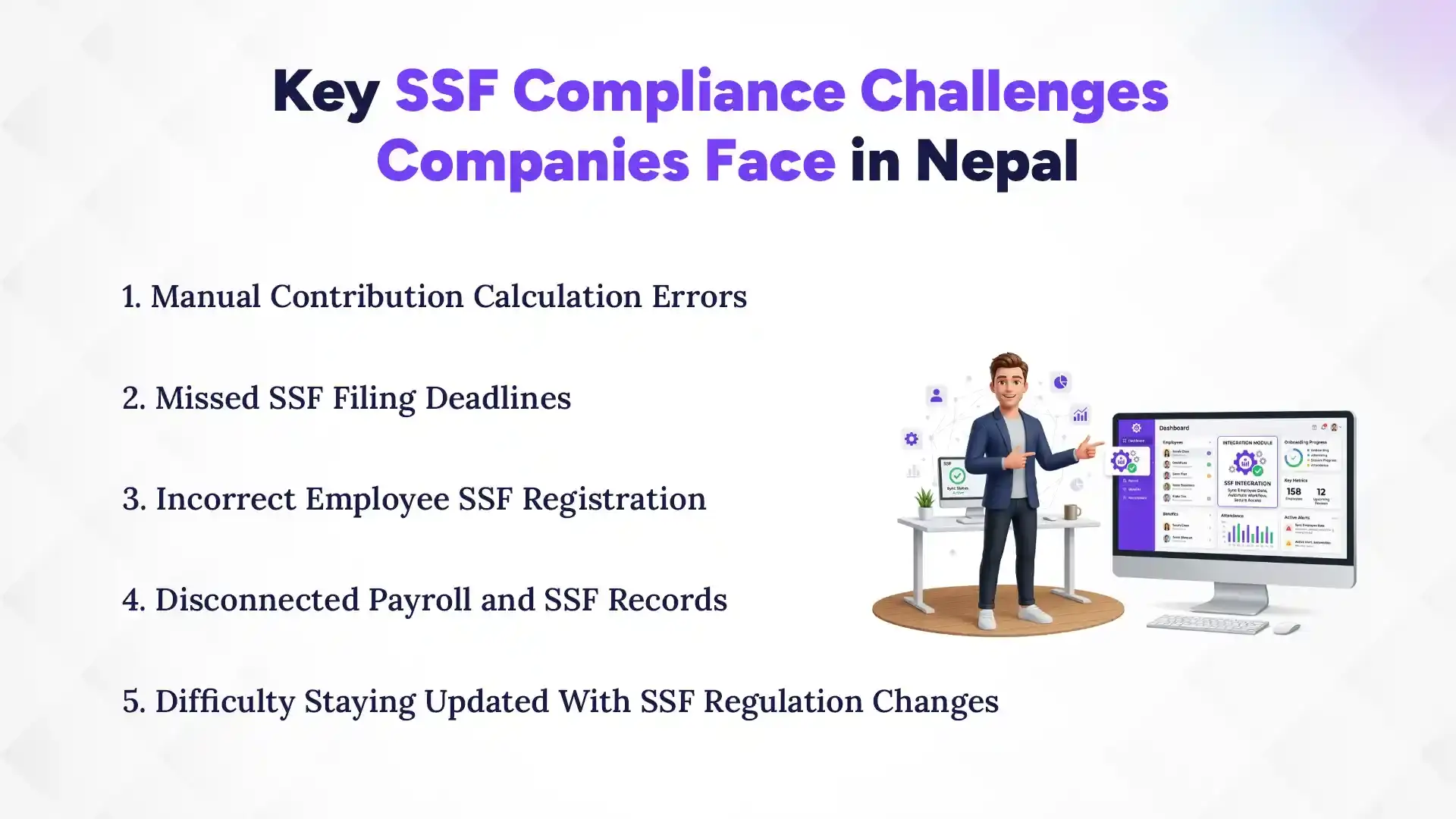
1. Manual Contribution Calculation Errors
Calculating SSF contributions manually for every employee every month creates consistent error risk, particularly when salaries include variable components like overtime, incentives, or mid-month allowance changes that affect the contribution base. A single calculation error applied across multiple employees produces a filing discrepancy that SSF auditors flag, requiring the company to resubmit corrected filings, pay the difference, and in some cases face financial penalties for the underpayment period.
2. Missed SSF Filing Deadlines
SSF contributions in Nepal must be filed and paid within defined monthly deadlines. Companies managing contributions through manual spreadsheets rely on individual HR team members to remember filing dates, prepare contribution summaries, and submit payments on time. When those steps depend on memory rather than automated reminders, deadline misses become a recurring compliance risk, and each late filing attracts penalties that compound over time if the pattern continues.
3. Incorrect Employee SSF Registration
New employees must be registered with SSF before contributions can be filed on their behalf. Companies without an integrated system often delay SSF registration for new hires because the registration process is managed separately from onboarding, payroll, and HR workflows. Late or missed registrations create contribution gaps in the employee's SSF record and expose the company to compliance liability for the unregistered period.
4. Disconnected Payroll and SSF Records
When payroll is processed in one system and SSF contributions are calculated and filed separately, any discrepancy between the two records (a salary figure entered differently, an allowance included in one calculation but not the other) creates a reconciliation problem that HR teams must manually identify and correct before filing. In companies with large or frequently changing workforces, these reconciliation tasks consume significant HR time every month and still produce filing errors that manual checking fails to catch.
5. Difficulty Staying Updated With SSF Regulation Changes
Nepal's SSF framework has evolved since the Social Security Act 2074 came into effect, with contribution rates, eligible salary components, and filing requirements subject to regulatory updates. Companies managing SSF manually must identify each regulatory change, recalculate contribution rates for every employee, and update their filing process accordingly, a task that requires both current regulatory knowledge and the time to implement changes accurately across the entire workforce.
Key Features of HR Software with SSF Integration
The key features of HR software with SSF integration are automated SSF contribution calculation, employee SSF registration and record management, direct payroll and SSF deduction integration, SSF filing and report generation, deadline alerts and compliance reminders, and SSF regulation update management.
1. Automated SSF Contribution Calculation
Automated SSF contribution calculation allows companies to calculate the correct employer and employee SSF contribution for every staff member automatically from current payroll data each month, eliminating the manual calculation step that produces errors when salaries change, new employees join, or allowance structures are updated mid-cycle.
2. Employee SSF Registration and Record Management
Employee SSF registration and record management allows companies to initiate and track SSF registration for new hires directly within the HR platform, maintain a complete SSF contribution history for every employee, and retrieve individual contribution records instantly when employees request SSF statements or when audits require documentation.
3. Direct Payroll and SSF Deduction Integration
Direct payroll and SSF deduction integration allows companies to process salary payments and SSF contribution deductions within the same system simultaneously, so the contribution amount always reflects the exact salary figure used in payroll, removing the reconciliation step between separate payroll and SSF records that creates filing discrepancies.
4. SSF Filing and Report Generation
SSF filing and report generation allow companies to produce formatted monthly contribution reports, employee-level contribution summaries, and SSF payment documentation directly from the HR platform, replacing manually prepared filing reports with automatically generated, audit-ready documents that reflect accurate payroll data.
5. Deadline Alerts and Compliance Reminders
Deadline alerts and compliance reminders allow companies to receive automated notifications before monthly SSF filing deadlines, ensuring that HR teams complete contribution calculations, review reports, and submit payments on time without relying on manual calendar tracking or individual team member memory.
6. SSF Regulation Update Management
SSF regulation update management allows companies to apply updated SSF contribution rates and eligible salary component configurations within the HR platform when regulatory changes take effect, ensuring that all future contribution calculations automatically reflect current SSF requirements without manual recalculation across the entire employee list.
Benefits of HR Software with SSF Integration in Nepal
The core benefits of HR software with SSF integration in Nepal are eliminating contribution errors and penalties, saving HR teams significant monthly processing time, keeping payroll and SSF records aligned automatically, and protecting companies from SSF audit risk.
1. Eliminates SSF Contribution Errors and Penalties
HR software with SSF integration automatically calculates contributions using verified payroll data, reducing manual errors and filing discrepancies. Employer and employee contribution rates are applied consistently for every employee, while payroll and SSF records remain aligned, helping companies avoid compliance issues and penalties.
2. Saves HR Teams Significant Monthly Processing Time
The system generates monthly SSF contribution reports directly from payroll data, eliminating the need for manual spreadsheets and repeated cross-checking. Automated filing reminders also help HR teams meet submission deadlines without spending extra time on tracking and follow-ups.
3. Keeps Payroll and SSF Records Aligned Automatically
Every payroll run automatically updates the corresponding SSF contribution records, ensuring both systems stay synchronized. Salary changes, new hires, and employee departures are reflected automatically, making payroll reconciliation faster and more accurate.
4. Protects Companies From SSF Audit Risk
System-generated contribution records create a complete audit trail for every filing period, making compliance easier to verify. Employee SSF registration is tracked during onboarding, and any regulatory updates are applied consistently across all employees to reduce audit risks.
How to Choose the Right HR Software with SSF Integration in Nepal
Choose the right HR software with SSF integration in Nepal by evaluating four factors: SSF regulation compliance, payroll integration depth, automated filing and deadline reminders, and employee SSF record management.
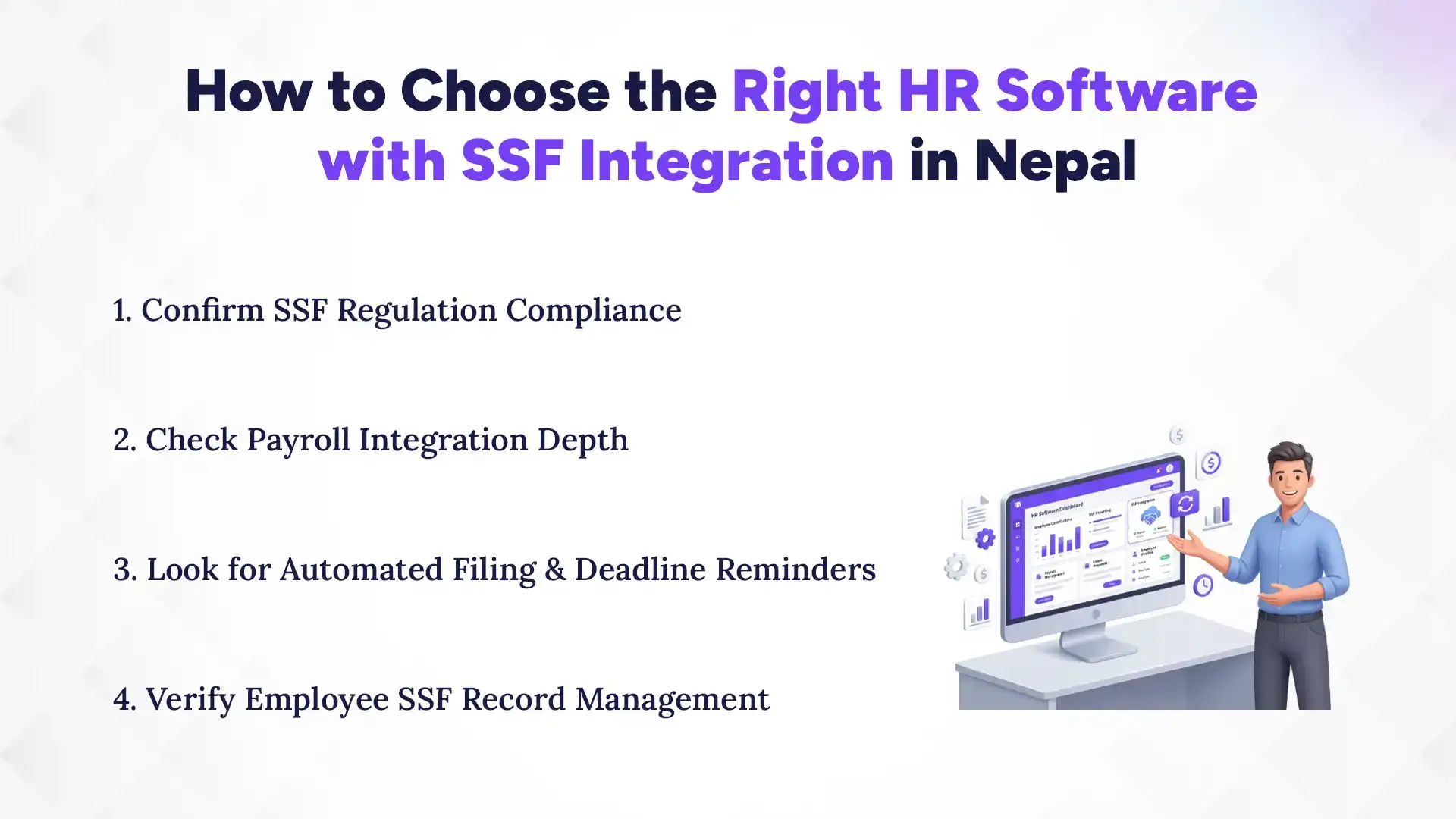
1. Confirm SSF Regulation Compliance
The platform must calculate contributions at current SSF rates and apply the correct eligible salary components as defined under Nepal's Social Security Act 2074. Confirm that the provider has a process for updating contribution rate configurations when SSF regulations change, so your calculations remain compliant without manual reconfiguration.
2. Check Payroll Integration Depth
SSF contributions must be calculated directly from the payroll module's salary data, and confirm this is a native integration, not a manual export and re-entry process between separate systems. Also check that variable salary components, including overtime, allowances, and bonuses, are included in the SSF contribution base as required by current regulations.
3. Look for Automated Filing and Deadline Reminders
The platform must send automated alerts before monthly SSF filing deadlines so HR teams never miss a submission date due to workload or calendar oversight. Confirm that contribution reports are generated automatically in the format required for SSF submission, not as raw data exports that require manual formatting before filing.
4. Verify Employee SSF Record Management
The system must maintain a complete, retrievable SSF contribution history for every employee from registration through the current period. Confirm that new employee SSF registration is triggered within the onboarding workflow so no new hire's contributions are delayed due to a missed registration step.
Which Is the Best HR Software with SSF Integration in Nepal?
Pace HRMS is the best HR software with SSF integration in Nepal because it automatically calculates employer and employee SSF contributions from verified payroll data; generates SSF-compliant contribution reports; maintains complete employee SSF records; sends deadline reminders before monthly filing dates; and updates contribution configurations when SSF regulations change, all within a platform built specifically for Nepal's HR and compliance context.
Pace HRMS removes the manual calculation, reconciliation, and report preparation steps that cost Nepali HR teams hours every month and create the filing errors that lead to SSF penalties. For companies in Nepal looking to replace manual SSF processes or disconnected payroll and SSF systems with a fully integrated, regulation-compliant platform, Pace HRMS is the most practical and locally relevant solution available. Visit the Pace HRMS product page to see how the SSF integration module fits your organization's payroll and compliance workflow.
Conclusion
HR software with SSF integration in Nepal is the most direct solution to the contribution errors, missed deadlines, and compliance gaps that manual SSF management and disconnected payroll systems cannot reliably prevent. When SSF contributions are calculated automatically from accurate payroll data, filed on time through automated reminders, and stored in a complete audit-ready record, HR teams stop managing compliance reactively and start maintaining it systematically.
The longer a company in Nepal manages SSF contributions manually, the greater the accumulated risk of penalties, audit findings, and employee contribution disputes. Contact Pace Infosys today to see how Pace HRMS can automate SSF compliance for your organization in Nepal.