


In today's app-driven world, businesses are under constant pressure to deliver fast, affordable, and high-quality mobile experiences across every device and platform simultaneously. With millions of apps competing for attention on both iOS and Android, the development approach a business chooses directly impacts its speed, budget, and ability to reach its full audience. Building and maintaining two separate native applications is no longer practical for most companies, especially when resources are limited and time to market is critical. This is where hybrid app development has emerged as one of the most practical and cost-efficient solutions available to modern businesses.
In this blog on the benefits of hybrid apps, we will explore how hybrid development helps businesses save costs, launch faster, and deliver consistent experiences across all devices and platforms. You will learn what hybrid apps are, how they differ from native apps, which frameworks lead the industry, and why hybrid development is becoming the preferred approach for businesses of every size. We will also compare hybrid apps with native apps and cover the best frameworks to use in 2026. By the end, you will have a clear understanding of why hybrid app development is the right choice for your business.
What is a Hybrid App?
A hybrid app is a mobile application built using web technologies such as HTML, CSS, and JavaScript that is wrapped in a native container and deployed across multiple platforms from a single codebase. Unlike native apps, which are built separately for iOS using Swift and for Android using Kotlin, hybrid apps use a shared web-based core that runs inside a native shell on each platform.
Hybrid app development has emerged as one of the most practical and cost-efficient solutions for businesses that want to reach users on both iOS and Android without the complexity of building two separate native applications and understanding how to create a hybrid mobile app from the ground up are the first steps toward making that decision confidently.
What Are the Benefits of Hybrid Apps?
The benefits of hybrid apps include lower development costs, faster time to market, consistent user experience across platforms, and easier long-term maintenance from a single shared codebase. Hybrid apps allow businesses to reach users on iOS, Android, and the web simultaneously without building and maintaining separate applications for each platform. With the right framework and development strategy, hybrid apps deliver near-native performance and full access to device features without the overhead of multiple development teams. Overall, hybrid app development is one of the most practical and financially sound approaches to building a mobile presence in 2026.
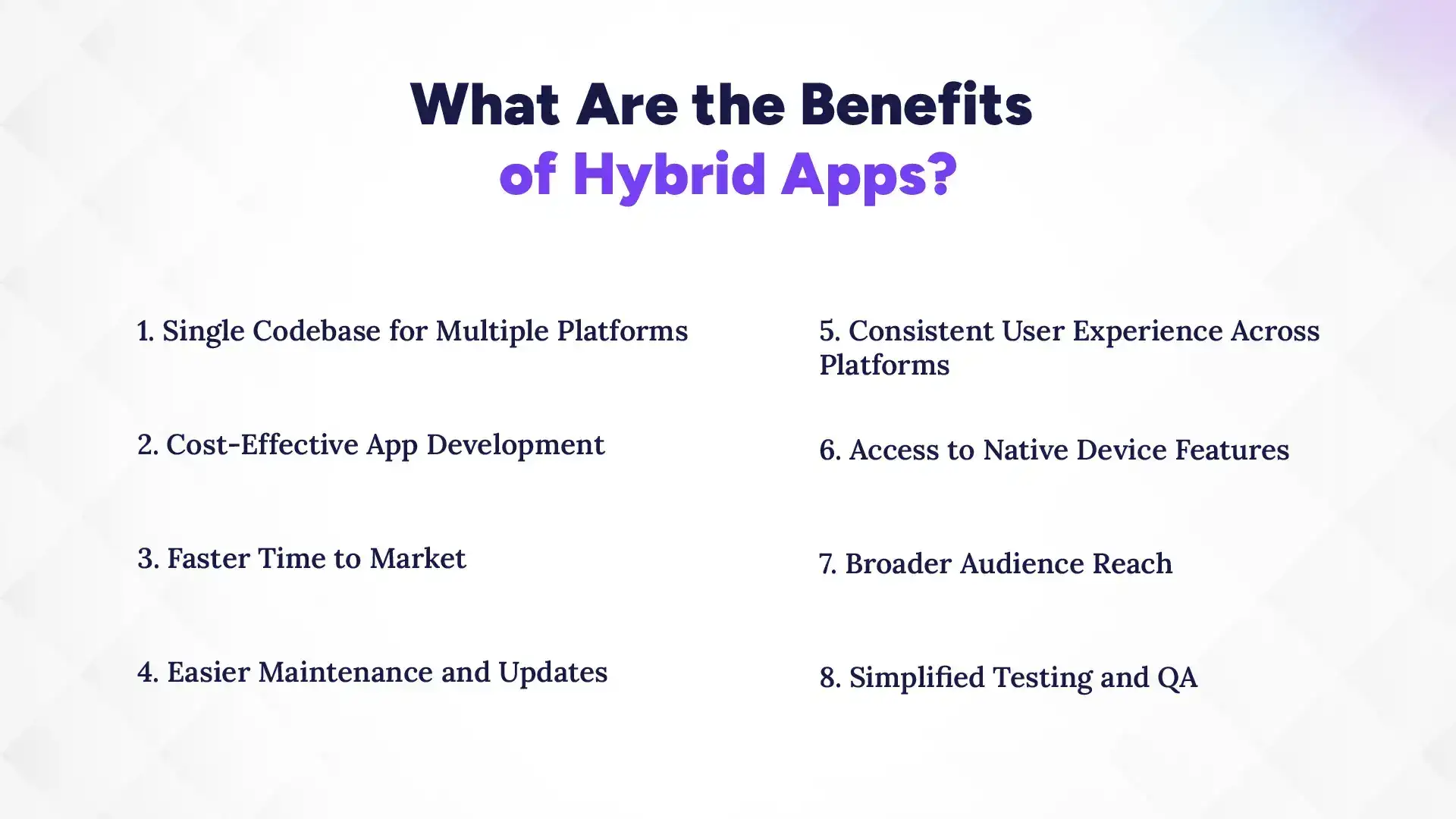
1. Single Codebase for Multiple Platforms
One of the most significant advantages of hybrid app development is the ability to write a single codebase and deploy it across iOS, Android, and the web simultaneously. Developers do not need to build separate versions of the app for each platform, which drastically reduces development time, effort, and complexity. This unified approach ensures that every platform receives the same features, functionality, and updates at the same time, eliminating the delays and inconsistencies that come with maintaining separate native codebases. It simplifies the entire development lifecycle from initial planning and design through to testing, deployment, and ongoing maintenance.
2. Cost-Effective App Development
Hybrid app development significantly reduces the overall cost of building and maintaining a mobile application. Businesses do not need to hire separate iOS app development services or Android app development agencies, which cuts payroll and resource costs considerably. A single team working on one shared codebase can deliver a fully functional application for both major platforms at a fraction of the cost of two parallel native development projects. For startups and small businesses operating with limited technology budgets, this cost advantage is often the deciding factor in choosing hybrid development.
3. Faster Time to Market
Speed is a critical competitive advantage in the mobile app industry, and hybrid development delivers it consistently. Because developers work from a single shared codebase, the overall development cycle is significantly shorter compared to building two separate native applications in parallel. Features are designed, built, and tested once and then deployed across all platforms simultaneously, which reduces the total project timeline and allows businesses to launch their products faster. Getting to market sooner means capturing user attention, generating revenue, and gathering feedback before competitors who are still building separate native versions.
4. Easier Maintenance and Updates
Managing and maintaining a mobile app becomes far simpler when there is only one codebase to work with. Any bug fix, security patch, or feature update needs to be applied only once, and it automatically reflects across iOS, Android, and the web simultaneously. This eliminates the need to track and coordinate separate version histories, release schedules, and testing cycles for each platform, which reduces the operational complexity of running a mobile product significantly. Teams can spend less time on maintenance tasks and more time building new features that deliver value to users.
5. Consistent User Experience Across Platforms
Delivering a consistent user experience across iOS and Android is one of the most important factors in building a trusted and recognizable mobile product. Hybrid app development ensures that the user interface, features, and performance remain uniform across all devices and operating systems, giving users the same design language, navigation patterns, and functionality regardless of what platform they are on. This consistency eliminates confusion, strengthens brand identity, and makes the app feel polished and professional across every device. Users who switch between an iPhone and an Android device will encounter the same experience, which builds familiarity and trust over time.
6. Access to Native Device Features
A common misconception about hybrid apps is that they cannot access the native features of the device they run on. Modern hybrid frameworks have largely eliminated this limitation through sophisticated plugin systems and native bridges that allow developers to integrate device capabilities directly into the hybrid application, which is one of the key reasons businesses exploring cross-platform app development agencies consistently find hybrid solutions to be a compelling and practical choice. Features including the device camera, GPS, push notifications, biometric authentication, Bluetooth, accelerometer, and file system access can all be accessed within a hybrid app. The functional gap between hybrid and native apps has narrowed dramatically in recent years, making hybrid development a viable choice for the vast majority of business use cases.
7. Broader Audience Reach
By targeting iOS, Android, and the web from a single application, businesses can reach a significantly larger audience from the moment they launch. There is no need to choose one platform over another or delay the release on a secondary platform due to budget or resource constraints. Every user, regardless of their device preference or operating system, can access and use the app immediately. This broad reach from day one maximizes the potential user base and increases the opportunity for downloads, engagement, and revenue generation across all platforms simultaneously.
8. Simplified Testing and QA
Testing a mobile app is one of the most time-consuming and resource-intensive parts of the development process, and hybrid development makes it significantly more manageable. With a single shared codebase, QA teams can write tests once and apply them across both iOS and Android simultaneously, which reduces the total testing effort required for each release. Automated testing tools integrate smoothly with popular hybrid frameworks, allowing teams to build robust test suites that catch issues early and consistently across all platforms. This consolidation of the testing process speeds up the release cycle and lowers the overall cost of quality assurance.
Best Hybrid App Development Frameworks
The best hybrid app development frameworks in 2026 are Ionic, Flutter, React Native, Apache Cordova, and Xamarin, each offering distinct strengths depending on your team's skills, project requirements, and long-term product roadmap. Choosing the right framework is one of the most important decisions in any hybrid app development project, and it goes hand in hand with choosing the right mobile app development agency that has the technical expertise to implement it effectively for your specific business goals
1. Ionic: Best for Web-Based Hybrid Apps
Ionic is one of the most widely used hybrid app frameworks and is built on standard web technologies including HTML, CSS, and JavaScript. It is ideally suited for teams with strong web development backgrounds who want to build mobile apps without learning an entirely new language or toolset. Ionic apps run in a WebView container and can also be deployed as progressive web apps, making them highly versatile across both web and mobile environments. Its large library of pre-built UI components and its compatibility with Angular, React, and Vue make it one of the most accessible and flexible hybrid frameworks available.
Ionic is a strong choice for content-driven apps, internal business tools, and informational applications where raw performance is less critical than development speed and accessibility. Its web-based architecture makes it the easiest entry point for web developers transitioning into mobile development.
2. Flutter: Best for High-Performance UI
Flutter, developed and maintained by Google, uses the Dart programming language and its own rendering engine to draw every UI component directly on screen. This approach gives Flutter full control over the visual output and ensures pixel-perfect consistency across iOS, Android, web, and desktop from a single codebase. Flutter's rich library of customizable widgets, its near-native performance, and its fast development cycle supported by hot reload make it one of the most powerful and popular hybrid frameworks in the world today. It is particularly well-suited for apps that require a visually distinctive interface or that prioritize smooth animations and high performance.
Flutter's strong and growing community and Google's continued investment in the framework ensure excellent long-term support and a continuously expanding ecosystem of plugins and tools. For businesses that want the closest possible experience to native performance from a hybrid codebase, Flutter is the strongest option available.
3. React Native: Best for JavaScript Developers
React Native, created by Meta, allows developers to build hybrid mobile apps using JavaScript and React. It maps UI components to native platform elements, which gives apps a native look and feel on both iOS and Android by default. React Native's massive developer community, extensive library ecosystem, and strong corporate backing make it one of the most resource-rich frameworks available. Teams with existing JavaScript or React web development experience can transition to React Native quickly, which reduces onboarding time and allows businesses to leverage their existing talent effectively.
React Native is an excellent choice for projects that require rapid development, a large library of pre-built components, and the ability to share code with existing web projects. Major companies including Facebook, Instagram, and Shopify use React Native in production, which is a strong testament to its capabilities at scale.
4. Apache Cordova: Best for Lightweight Web Apps
Apache Cordova is one of the original hybrid app frameworks and remains a strong choice for lightweight applications that prioritize simplicity and web technology compatibility. Cordova wraps web-based applications in a native shell and provides a plugin ecosystem that gives access to device features including the camera, contacts, and geolocation. It is ideally suited for teams that need to convert existing web applications into mobile apps quickly and affordably. While it does not offer the performance levels of Flutter or React Native, it remains a practical option for less demanding applications.
Cordova's extensive plugin library and broad platform support make it a reliable choice for businesses that need a straightforward, cost-effective mobile solution without heavy performance requirements.
5. Xamarin: Best for Microsoft Ecosystem
Xamarin, backed by Microsoft, allows developers to build hybrid and cross-platform apps using C# and the .NET framework. It is the preferred choice for enterprise development teams already invested in the Microsoft technology stack and wanting seamless integration with Azure cloud services and other Microsoft tools. Xamarin provides full access to native APIs on both iOS and Android, which means developers can implement any platform-specific feature without limitations. Its tight integration with Visual Studio and Azure makes it a natural choice for enterprise teams building scalable, secure, and maintainable mobile applications within a Microsoft-centric infrastructure.
Why Are Hybrid Apps Important for Businesses?
Hybrid apps are important for businesses because they allow them to reach more users, reduce development and operational costs, and maintain a consistent brand presence across all major platforms from a single investment. In a market where users expect seamless mobile experiences on every device, businesses that limit themselves to a single native platform risk losing significant portions of their potential audience. The ability to build once and deploy everywhere gives companies a meaningful strategic edge in speed, budget efficiency, and market coverage. Understanding why hybrid development matters is essential for any business planning a long-term and sustainable mobile strategy.
1. Growing Demand for Multi-Platform Mobile Presence
Today's users do not limit themselves to a single device or operating system. They switch between smartphones, tablets, and computers throughout the day and expect every app they use to work consistently across all of them. This multi-device behavior means that businesses must maintain a presence across platforms to stay relevant, accessible, and competitive. Hybrid app development ensures that no segment of the target audience is excluded due to device preferences or operating system limitations, which is increasingly important as both iOS and Android user bases continue to grow globally.
Multi-platform presence also increases the number of touchpoints a business has with its audience, which creates more opportunities for engagement, conversion, and retention. Users who encounter a brand consistently on both iOS and Android are more likely to develop loyalty and interact repeatedly. Businesses that ignore multi-platform expectations risk losing users permanently to competitors who offer a more universally accessible and consistent mobile experience.
2. Cost Efficiency for Startups and Enterprises
For startups operating with limited funding, hybrid app development offers a way to build a professional, full-featured mobile application without the financial burden of maintaining separate native development teams for iOS and Android. A single development team, one shared codebase, and unified maintenance all contribute to a dramatically lower total cost of ownership compared to native development. This budget efficiency allows startups to allocate more resources to product improvement, customer acquisition, and business growth rather than duplicating development effort across platforms.
Enterprises benefit equally from the budget efficiency of hybrid development. Large organizations managing multiple apps across different business units can reduce their overall mobile development spend significantly by standardizing on a hybrid approach. Faster MVPs enable quicker market validation, which reduces the financial risk of launching new digital products. Whether the business is a two-person startup or a multinational enterprise, hybrid app development delivers measurable and compounding cost efficiency over time.
3. Competitive Advantage Through Faster Launches
In competitive app markets, the ability to launch quickly and reach users on all platforms simultaneously is a decisive advantage. Hybrid development allows businesses to deploy on both iOS and Android at the same time, giving them an immediate edge over competitors who build and release native apps sequentially. The cost savings from a single shared codebase can be reinvested into product features, marketing campaigns, and user acquisition initiatives, which further strengthens the competitive position. Businesses that adopt hybrid development consistently move faster, spend smarter, and capture market share more effectively than those tied to slower native development cycles.
Broader platform availability also improves app store visibility and organic download potential. An app available on both major platforms immediately reaches twice the addressable market, which is a meaningful advantage in industries where user acquisition is competitive and costly. The combination of speed, reach, and cost efficiency makes hybrid development one of the strongest competitive strategies available to mobile-first businesses today.
4. Unified Brand Identity Across All Platforms
A consistent brand experience across all platforms is one of the most valuable business outcomes of hybrid app development. When users see the same design language, interface patterns, and functionality regardless of whether they are on iOS or Android, it reinforces brand identity and builds trust at every touchpoint. Inconsistencies between platform versions can confuse users and weaken brand perception, particularly for businesses where visual identity and user experience are central to their value proposition. Hybrid development eliminates these inconsistencies by design, ensuring that every user interaction reflects the brand accurately and consistently.
Unified brand experiences also simplify internal workflows and reduce operational friction. Marketing teams do not need to manage separate campaigns or assets for different app versions, and design teams maintain a single design system that applies universally. This organizational consistency ensures that every update, campaign, and product decision reinforces rather than fragments the brand. For businesses where brand equity is a strategic long-term asset, hybrid development is an important and practical enabler of consistency.
5. Simplified Long-Term App Lifecycle Management
Managing a mobile app over its full lifetime involves continuous updates, security patches, feature additions, and performance improvements. With a single hybrid codebase, all of this ongoing work happens in one place, which dramatically simplifies long-term app lifecycle management. Development teams do not need to context-switch between separate iOS and Android codebases, which reduces errors, improves development velocity, and lowers the cognitive overhead of maintaining the product. Onboarding new developers is also significantly faster because there is only one codebase to learn and one set of development conventions to follow.
The long-term cost savings of hybrid development compound over time as every update, patch, and new release requires only one round of work instead of two. Businesses that plan for multi-year product roadmaps will consistently find that hybrid development delivers better financial and operational outcomes than maintaining separate native applications. For organizations that want to build sustainable, scalable, and cost-effective mobile products, simplified lifecycle management is one of the most compelling reasons to choose hybrid development from the start.
Which is the Best Hybrid App Development Company?
When it comes to reliable and results-driven hybrid app development, The Pace Infosys stands out as a trusted partner for businesses of all sizes. With deep expertise in Ionic, Flutter, and React Native, The Pace Infosys delivers high-performance hybrid applications that work seamlessly across iOS, Android, and the web. Their team combines strong technical knowledge with a clear understanding of business goals, ensuring that every app they build is precisely aligned with the client's vision, audience expectations, and performance requirements. From initial strategy and UI/UX design to development, testing, and post-launch support, The Pace Infosys provides a complete end-to-end hybrid app development experience.
What sets The Pace Infosys apart is their commitment to transparency, structured project timelines, and consistent communication throughout every stage of the development process. They have a proven track record of delivering hybrid app projects across multiple industries, which means they bring relevant domain experience and tested solutions to every engagement. Whether you are a startup building your first mobile product or an enterprise looking to modernize your digital presence with a cost-effective hybrid solution, The Pace Infosys has the expertise, the tools, and the dedication to deliver. Choosing The Pace Infosys means choosing a partner that is invested in your success from the first conversation to the final release and beyond.
Hybrid Apps vs Native Apps: Which is Better?
When deciding between hybrid and native development, businesses must carefully weigh the trade-offs between cost, speed, performance, and long-term maintainability based on the specific requirements of their project.
Native development delivers the highest possible performance and full access to platform-specific features, but it requires separate codebases, teams, and timelines. Businesses considering this path should first explore what goes into choosing a dedicated IOS app development company to fully understand the investment and commitment involved.
Hybrid development offers a more efficient and affordable path to market with consistent experiences across platforms, making it the right choice for the vast majority of business applications where near-native performance is sufficient.
The right choice ultimately depends on the specific needs of the project. If the app involves highly complex graphics rendering, augmented reality, or deep real-time hardware integration, native development may be the more appropriate option. For the vast majority of business apps, enterprise tools, consumer applications, and content platforms, hybrid development delivers results that are functionally indistinguishable from native at a fraction of the cost, and businesses looking to explore all their options can review the top 10 cross-platform app development companies in Austin to find a team that fits their needs and budget.
Conclusion
Hybrid app development has fundamentally changed the way businesses approach their mobile strategy, making it possible to reach more users, move faster, and spend smarter without sacrificing the quality and functionality that modern audiences expect. From cost savings and faster launches to consistent user experiences and simplified long-term maintenance, the benefits of hybrid apps are clear and compelling for businesses of every size and industry. The frameworks available today, including Flutter, React Native, Ionic, and Cordova, have matured to the point where hybrid apps are a genuinely competitive alternative to native development for the vast majority of real-world use cases.
As mobile usage continues to grow and user expectations rise, businesses that invest in hybrid app development are positioning themselves for sustainable digital success. The ability to build once, deploy everywhere, and maintain a single unified codebase is not just a technical convenience but a genuine and compounding strategic advantage.
If your business is ready to build or scale its mobile presence efficiently and effectively. The Pace Infosys has the expertise and experience to make it happen. Contact The Pace Infosys today, and let us help you build a high-performance hybrid app that delivers real results across every platform your users call home.