Building a mobile app today is no longer just an option, it’s a necessity for businesses looking to stay competitive in the digital world. But developing separate apps for Android and iOS can be costly and time-consuming. That’s where hybrid mobile apps come in, offering a smarter and more efficient solution. With the right approach, you can build a powerful app that works across multiple platforms without doubling your effort.
In this blog on How to Create Hybrid Mobile App, we will walk you through the complete process of building a hybrid app from scratch. You will learn about the technologies, tools, and step-by-step methods required to create a high-performing app. If you are looking for professional guidance, our hybrid mobile app development service can help you understand how experts build scalable solutions. We will also cover key strategies, common mistakes to avoid, and best practices for success. By the end, you’ll have a clear roadmap to confidently launch your own hybrid mobile application.
What is a Hybrid Mobile App?
Hybrid mobile app is an application that is built using a single codebase and can run on multiple platforms, like Android and iOS. If you’re wondering more in detail, here is a simple explanation of what is hybrid mobile app that helps you understand the concept clearly. It combines elements of both native apps and web applications, allowing developers to use technologies like HTML, CSS, and JavaScript. Hybrid apps are wrapped inside a native container, enabling them to access device features such as camera, GPS, and storage. This approach reduces development time and cost while maintaining good performance. It is a popular choice for businesses looking for cross-platform solutions.
How Does a Hybrid Mobile App Work?
Hybrid apps are developed using web technologies like HTML, CSS, and JavaScript
The app runs inside a WebView, which acts like a mini browser within a native app
A native wrapper allows the app to be installed from app stores like regular apps
Plugins and APIs help access device features like camera, GPS, and notifications
The same codebase is used across multiple platforms, reducing development effort
Frameworks like React Native, Flutter, or Ionic help build and manage hybrid apps
Why Choose Hybrid App Development for Your Business?
You should choose hybrid app development for your business because it is cost-effective, faster to launch, uses a single codebase, is easy to maintain, and helps reach a wider audience. This approach allows businesses to build apps for multiple platforms without doubling development effort. It saves time, reduces expenses, and ensures consistent performance across devices. If you are planning to build one, a reliable App development service can help you get better results with the right strategy. Hybrid apps are especially useful for startups and businesses looking for scalable solutions. Overall, they offer a practical balance between performance and efficiency.
1. Cost-Effective Development
Hybrid app development significantly reduces development costs by using a single codebase. Businesses don’t need separate teams for Android and iOS. This lowers overall project expenses. It is ideal for startups with limited budgets. Cost savings can be invested in marketing or scaling. It makes app development more affordable.
2. Faster Time to Market
Hybrid apps can be developed and launched quickly compared to native apps. A single development process speeds up production. Businesses can release their app sooner and gain a competitive advantage. Faster updates are also possible. This helps in responding quickly to market changes. Time efficiency is a major benefit.
3. Single Codebase for Multiple Platforms
One of the biggest advantages is using a single codebase for multiple platforms. Developers write code once and deploy it on Android and iOS. This reduces duplication of work. It ensures consistency in features and design. Maintenance becomes easier with unified code. It improves development efficiency.
4. Easy Maintenance and Updates
Maintaining a hybrid app is simpler because updates are applied to a single codebase. Bug fixes and improvements can be rolled out quickly. This reduces downtime and technical effort. Businesses can keep their app updated with minimal cost. Continuous improvements are easier to manage. It ensures long-term efficiency.
5. Wider Audience Reach
Hybrid apps allow businesses to reach a wider audience across multiple platforms. Users on both Android and iOS can access the app. This increases the potential customer base and engagement. It supports business growth and expansion. More users mean more opportunities for conversions. It helps maximize market reach.
How to Create Hybrid Mobile App? Step-by-Step Guide
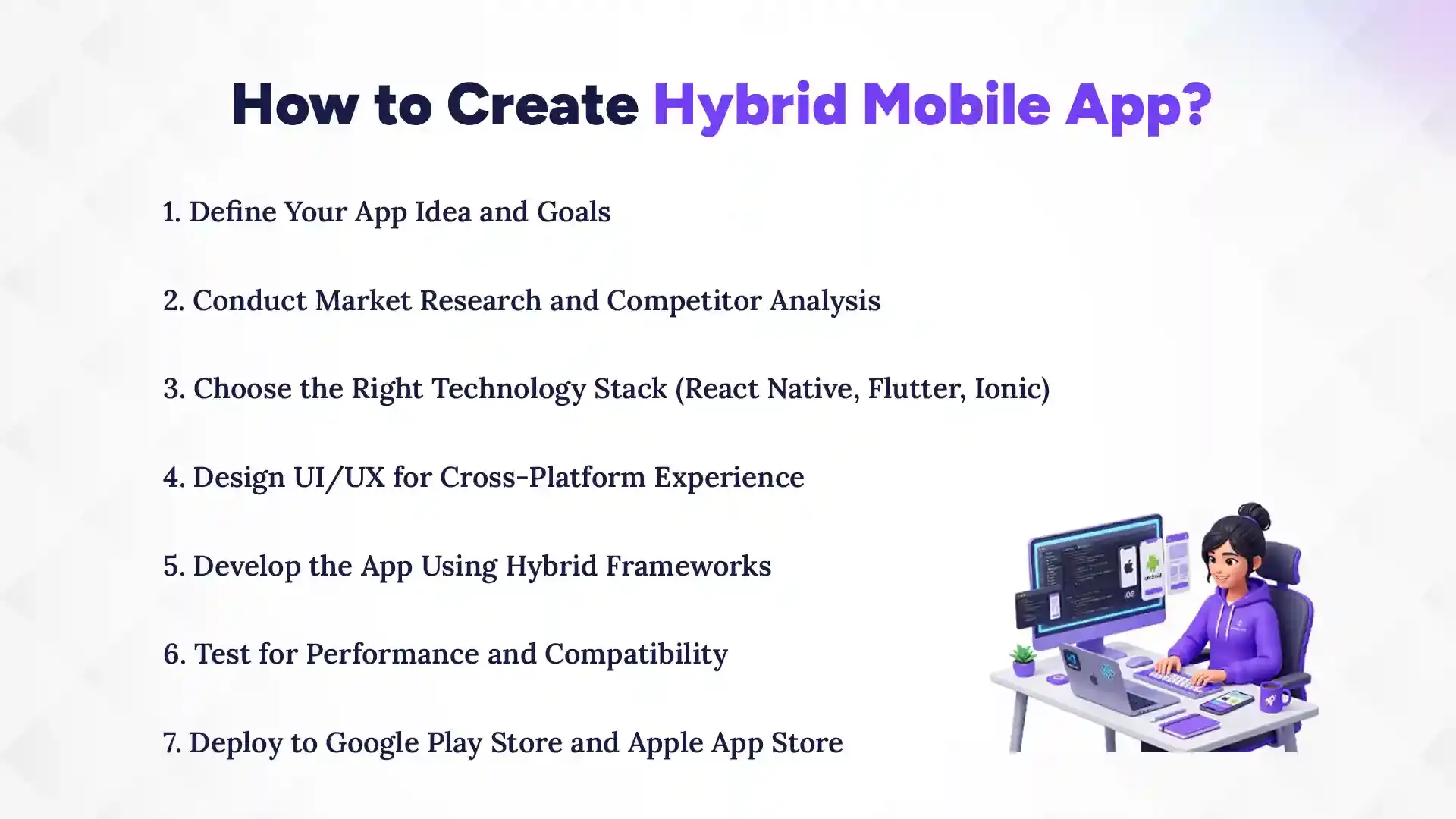
You can create a hybrid mobile app by defining your idea, researching the market, choosing the right technology, designing UI/UX, developing the app, testing it, and finally deploying it to app stores. This structured approach ensures your app is well-planned, functional, and user-friendly. Each step plays a crucial role in building a successful cross-platform application. Proper execution helps avoid common development mistakes. Following this process leads to a high-quality hybrid mobile app.
1. Define Your App Idea and Goals
Start by clearly defining your app idea and business goals. Identify the problem your app will solve and your target audience. A clear vision helps guide the development process. It also ensures better planning and execution. Setting goals helps measure success later. This step builds the foundation of your app. A well-defined idea reduces confusion during development.
2. Conduct Market Research and Competitor Analysis
Research the market to understand user needs and trends. Analyze competitors to identify their strengths and weaknesses. This helps you create a better and unique app. Understanding demand improves your app’s success chances. Market insights guide feature selection. It reduces the risk of failure. Proper research gives you a competitive advantage.
3. Choose the Right Technology Stack (React Native, Flutter, Ionic)
Selecting the right framework is essential for performance and scalability. Popular options include React Native, Flutter, and Ionic. Each has its own advantages depending on project needs. The right choice ensures smooth development and a better user experience. It also affects app speed and functionality. Technology selection is a key decision. Choosing wisely improves long-term app performance.
4. Design UI/UX for Cross-Platform Experience
User-friendly design is crucial for app success. Focus on simple, clean, and intuitive interfaces. Ensure consistency across Android and iOS platforms. Good UI/UX improves user engagement and satisfaction. It also reduces user confusion. Strong design enhances overall app quality. A great design keeps users engaged and returning.
5. Develop the App Using Hybrid Frameworks
Start coding the app using your chosen hybrid framework. Developers build features and integrate APIs during this stage. The app is created using a single codebase for multiple platforms. Proper coding ensures smooth functionality. Regular testing during development is important. This step brings your app to life. Clean coding practices improve scalability and performance.
6. Test for Performance and Compatibility
Testing ensures your app works properly on different devices and platforms. Check for bugs, performance issues, and usability problems. Compatibility testing improves user experience. Fixing issues early prevents major problems later. Quality testing is essential before launch. It ensures a stable app. Thorough testing guarantees a better user experience.
7. Deploy to Google Play Store and Apple App Store
After testing, the app is ready for deployment. Submit your app to the Google Play Store and Apple App Store. Follow their guidelines and approval processes. Once approved, your app becomes available to users. Post-launch updates and maintenance are important. Deployment marks the final step of development. Continuous updates help keep your app competitive.
What Technologies Are Used to Create Hybrid Mobile Apps?
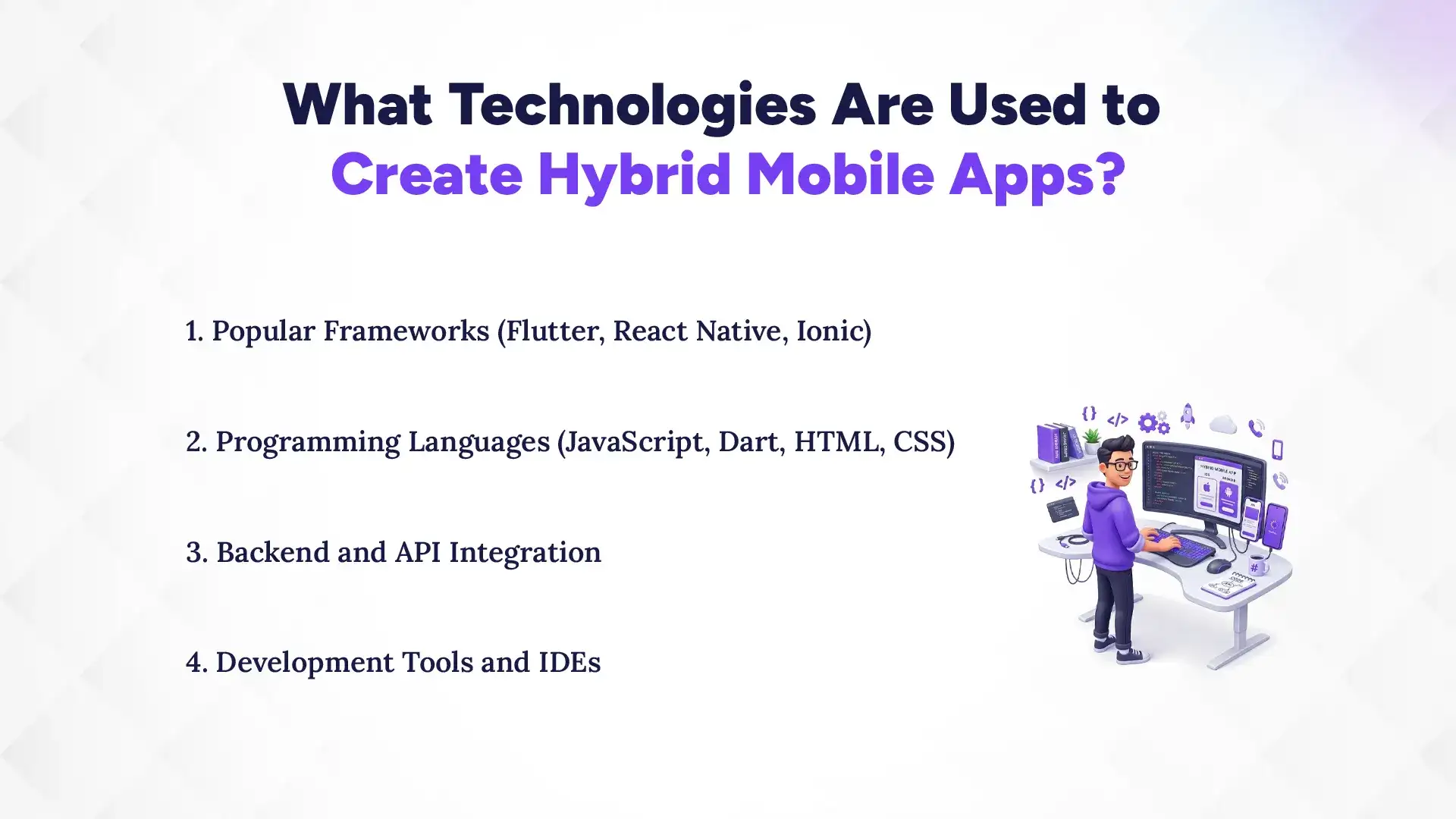
Hybrid mobile apps are created using a combination of frameworks, programming languages, backend systems, and development tools that enable cross-platform functionality. These technologies allow developers to build apps using a single codebase while still accessing native device features. Popular frameworks and modern tools make the development process faster, scalable, and efficient. Choosing the right technology stack is crucial for performance and user experience. It also determines how easily the app can be maintained and updated.
1. Popular Frameworks (Flutter, React Native, Ionic)
Frameworks are the foundation of hybrid app development. Flutter uses Dart and offers fast performance with a rich UI. React Native uses JavaScript and provides a near-native experience. Ionic is based on web technologies like HTML, CSS, and JavaScript. These frameworks allow developers to build cross-platform apps easily. Each framework has its own strengths and use cases. Choosing the right one depends on project needs and goals.
2. Programming Languages (JavaScript, Dart, HTML, CSS)
Programming languages are used to build the app’s functionality and interface. JavaScript is widely used in frameworks like React Native and Ionic. Dart is mainly used with Flutter for high-performance apps. HTML and CSS are used for designing layouts and styling. These languages help create responsive and interactive user interfaces. A strong understanding of these languages improves development quality. They form the core of hybrid app development.
3. Backend and API Integration
Backend systems manage data, user authentication, and server-side operations. APIs connect the app with backend services and third-party tools. Integration allows features like login, payments, and notifications. A strong backend ensures smooth app performance. It also supports scalability as the app grows. Proper API integration improves functionality and user experience. Backend development is essential for app success.
4. Development Tools and IDEs
Development tools and IDEs help developers write, test, and manage code efficiently. Tools like Android Studio, Visual Studio Code, and Xcode are commonly used. They provide features like debugging, code editing, and performance testing. These tools improve productivity and reduce errors. Proper tools make development faster and smoother. They also help in maintaining code quality. Choosing the right tools enhances overall development efficiency.
How Much Does It Cost to Create a Hybrid Mobile App?
Cost to create a hybrid mobile app typically ranges from $3,000 to $50,000+ (or higher depending on complexity) based on features, design, and development approach. Simple apps cost less, while advanced apps with integrations and custom features require a higher budget. Factors like developer location, technology stack, and timeline also impact the total cost. Hybrid apps are generally more affordable than native apps due to the single codebase approach. Overall, the cost varies based on project requirements and scalability needs.
1. Cost Based on Features and Complexity
The more features your app has, the higher the development cost will be. Simple apps with basic functionality are cheaper to build. Advanced apps with payment systems, APIs, and animations cost more. Complex UI/UX designs also increase pricing. Custom features require additional development time. Complexity is the biggest cost factor.
2. Development Team vs Freelancers Cost
Hiring a development company usually costs more but offers better quality and support. Freelancers may be cheaper but can lack consistency and long-term reliability. Agencies provide a full team, including designers and testers. Freelancers are suitable for small projects with limited budgets. Choice depends on project scale and budget. Quality and expertise affect pricing differences.
3. Maintenance and Update Costs
After launching the app, regular maintenance is required to fix bugs and improve performance. Updates may include new features or security patches. This adds ongoing monthly or yearly costs. Maintenance ensures smooth functionality across devices. Neglecting updates can affect user experience. Long-term support is essential for app success. It should be included in the overall budget.
Hybrid vs Native Apps: What is the Difference?
Hybrid and native apps differ mainly in performance, development approach, cost, and user experience. Hybrid apps use a single codebase for multiple platforms, while native apps are built separately for each platform. This makes hybrid apps more cost-effective, but native apps generally deliver higher performance. Understanding these differences helps businesses choose the right approach based on their goals and budget.
Feature
Hybrid Apps
Native Apps
Performance and Speed
Moderate performance due to WebView layer, suitable for most business apps
High performance with direct access to device hardware
Development Cost and Time
Lower cost and faster development using a single codebase
Higher cost and longer development for separate platforms
User Experience and Design
Consistent UI, but may feel less smooth than native apps
Superior UI/UX with platform-specific design elements
Maintenance and Scalability
Easy to maintain with a single codebase update
More complex maintenance due to multiple codebases
Platform Support
Works on Android and iOS using same code
Separate development required for each platform
Development Flexibility
High flexibility with frameworks like Flutter and React Native
Limited flexibility but optimized performance
Common Mistakes to Avoid While Creating Hybrid Mobile Apps
While building a hybrid mobile app, many developers make avoidable mistakes that can negatively impact performance, user experience, and long-term success. These errors often happen due to poor planning, wrong technology choices, or lack of testing. Avoiding such mistakes is essential to ensure your app runs smoothly across all platforms. A well-structured development approach helps improve quality and user satisfaction. Paying attention to these areas leads to a more stable and scalable application.
1. Ignoring User Experience
Ignoring user experience is one of the biggest mistakes in hybrid app development. A poorly designed interface can make the app difficult to use and reduce user engagement. Developers should focus on simple, clean, and intuitive design. Consistency across Android and iOS is also important. Slow navigation and confusing layouts should be avoided. A good UX directly improves user retention and satisfaction.
2. Choosing the Wrong Framework
Selecting the wrong framework can severely affect app performance and scalability. Each framework, like Flutter, React Native, or Ionic, has different strengths. Using an unsuitable framework may lead to technical limitations later. It can also increase development time and cost. Proper research is essential before choosing. The right framework ensures smooth development and better results.
3. Poor Testing and Optimization
Skipping proper testing can lead to bugs, crashes, and poor performance. Hybrid apps must be tested across multiple devices and operating systems. Optimization ensures the app runs smoothly under different conditions. Ignoring this step reduces user trust. Performance issues can affect ratings and downloads. Thorough testing is essential before launch.
4. Not Planning for Scalability
Failing to plan for scalability can limit the future growth of the app. As users increase, the app must handle higher traffic efficiently. Poor architecture may cause slow performance or crashes. Developers should design apps with future expansion in mind. Scalability ensures long-term success. Proper planning helps the app grow with business needs.
How to Choose the Right Hybrid App Development Company?
You can choose the right hybrid app development company by evaluating their experience, technical skills, pricing, and post-launch support. A reliable company should have a strong portfolio, proven expertise in hybrid frameworks, and transparent communication throughout the project. Selecting the right partner ensures better app quality, timely delivery, and long-term success. It also reduces development risks and improves overall project efficiency. Careful evaluation is essential before making a final decision.
1. Check Experience and Portfolio
Reviewing a company’s experience helps you understand their expertise in hybrid app development. A strong portfolio shows their previous work and project quality. It also helps you assess their design and technical capabilities. Experienced companies are more likely to deliver stable apps. Case studies and client projects provide valuable insights. This ensures you choose a reliable development partner.
2. Evaluate Technical Expertise
Technical expertise is crucial for building a high-quality hybrid app. The company should be skilled in frameworks like Flutter, React Native, or Ionic. Strong knowledge of APIs, UI/UX, and backend systems is also important. Skilled developers ensure better performance and scalability. Poor expertise can lead to technical issues later. Always choose a team with strong technical knowledge.
3. Consider Budget and Timeline
Budget and timeline play a major role in selecting the right company. You should compare pricing with services offered. A good company provides clear cost estimates without hidden charges. Timely delivery ensures faster market entry for your app. Unrealistic promises should be avoided. Balance between cost and quality is essential for success.
4. Look for Post-Launch Support
Post-launch support is important for maintaining and updating your app. A good company provides bug fixes, updates, and performance improvements after launch. This ensures your app runs smoothly over time. Without support, apps can face technical issues. Long-term maintenance is necessary for scalability. Always choose a company that offers reliable after-sales support.
Which is the Best Hybrid App Development Company?
The Pace Infosys is the best hybrid app development company because it delivers high-quality, scalable, and cost-effective mobile solutions using modern frameworks like Flutter and React Native. It focuses on building user-friendly hybrid apps with strong performance across both Android and iOS platforms. The company follows a structured development process that ensures timely delivery and reliable support. With expertise in UI/UX, backend integration, and post-launch maintenance, it provides complete end-to-end hybrid app development services tailored to business needs.
Conclusion
Creating a hybrid mobile app is one of the smartest choices for businesses that want to build a strong digital presence across both Android and iOS platforms. With the right planning, technology stack, and development approach, hybrid apps offer cost-effective development, faster deployment, and wider audience reach. From idea validation to design, development, testing, and deployment, every step plays an important role in ensuring app success. Choosing the right framework and development strategy can significantly improve performance and user experience.
Overall, hybrid app development provides a perfect balance between efficiency and functionality for modern businesses. It allows companies to scale faster while keeping development costs under control. By following best practices and avoiding common mistakes, businesses can build powerful and future-ready mobile applications. With continuous updates and proper maintenance, a hybrid app can deliver long-term value and strong market competitiveness. Also, explore the top 10 hybrid mobile app development companies in Austin, Texas.
FAQs
What is a hybrid mobile app?
+
A hybrid mobile app is built using one codebase that works on both Android and iOS platforms. It combines web technologies with native app features for better flexibility.
Which frameworks are used to create hybrid apps?
+
Popular frameworks include Flutter, React Native, and Ionic for building efficient hybrid mobile applications. These frameworks support cross-platform development with a single codebase.
How long does it take to build a hybrid app?
+
Development time depends on complexity, but usually ranges from a few weeks to several months. Simple apps take less time, while complex apps require longer development cycles.
Is hybrid app development cost-effective?
+
Yes, hybrid app development is more affordable because it uses a single codebase for multiple platforms. This reduces development time, resources, and overall project cost significantly.
What are the benefits of hybrid mobile apps?
+
Hybrid apps offer faster development, lower cost, and wider audience reach across platforms. They are easy to maintain and support quick updates.
Are hybrid apps good for business growth?
+
Yes, hybrid apps help businesses reach more users and improve digital presence effectively. They support scalability and faster market expansion opportunities.
What is the difference between hybrid and native apps?
+
Hybrid apps use one codebase, while native apps are built separately for each platform. Native apps offer better performance but cost more time and money.
Which company is best for hybrid app development?
+
The Pace Infosys is considered a top hybrid app development company for quality and reliable solutions. It offers end-to-end development with modern technologies and support.
Ready to get started?
Book a 30-minute consultation call, and let's talk about your goals.