

.webp&w=3840&q=75)
Your app idea is only as good as the team that builds it. You might have the perfect concept, a clear target audience, and a solid business plan, but if you hand that vision to the wrong development company, you could end up with a buggy product, a missed deadline, a drained budget, and a reputation problem with your users on day one.
Choosing the right iOS app development company is one of the most important business decisions you will make. The right partner does not just write code. They understand your goals, guide you through Apple's strict requirements, design an experience your users will love, and support you long after your app goes live on the App Store.
This guide covers everything you need to know: what iOS development companies actually do, why the right choice matters, the step-by-step process for evaluating agencies, the questions you must ask before signing anything, and the red flags that should send you running in the other direction.
What Does an iOS App Development Company Do?
An iOS app development company handles everything from turning your app idea into a live product on the Apple App Store. A full-service company brings together strategists, designers, developers, QA testers, and project managers to build an app that meets your business goals and Apple's technical standards.
Here is what a professional iOS development company typically handles for your business:
1. End-to-end App Design, Development & Deployment
From the first discovery call to the moment your app goes live, a good company manages the entire product lifecycle. This includes scoping your requirements, designing your user interface, writing and testing the code, and submitting the final build to Apple.
2. App Store Submission and Compliance
Getting an app approved on the Apple App Store is not a simple upload. Apple reviews every submission against a strict set of guidelines covering performance, security, privacy, and content. An experienced iOS development team knows exactly how to prepare your app to pass review on the first attempt and how to handle a rejection if one occurs.
3. Maintenance and Post-launch Support
iOS apps do not run themselves. Every time Apple releases a new version of iOS, your app needs to be tested and updated to remain compatible. A reliable development partner offers ongoing maintenance to keep your app stable, secure, and performing well as the platform evolves.
4. UX/UI design for the Apple Ecosystem
iOS users expect a specific kind of experience. Apple's Human Interface Guidelines define how apps should look, feel, and behave on iPhone and iPad. A skilled iOS design team builds interfaces that feel native, intuitive, and consistent with the platform your users already know well.
Why Hiring the Right iOS App Development Company Is Important
Hiring the right iOS app development company is important because it ensures a smooth build, faster App Store approval, and a product your users love. The right partner saves you time, protects your budget, and sets your app up for long-term success. Below is the other detailed breakdown of other points.
1. Apple's Strict App Store Guidelines Require Expertise
Apple reviews every app submitted to its platform and rejects anything that does not meet its standards for performance, privacy, security, design, and content. These guidelines are detailed, frequently updated, and non-negotiable. A development team without deep iOS experience may build an app that works technically but still gets rejected for issues they never anticipated, such as improper use of device permissions, missing privacy disclosures, or non-compliance with Apple's in-app purchase policies. Every rejection costs you time, money, and momentum. An experienced iOS company eliminates these risks because they have navigated the review process many times before.
2. Poor Development Leads to Crashes, Rejections, and Bad Reviews
A poorly built iOS app does not just frustrate your users. It damages your brand. When users encounter crashes, slow load times, broken features, or confusing navigation, they leave one-star reviews on the App Store, and those reviews stay visible to every potential user who finds your app from that point forward. Recovering from a wave of negative reviews is far harder and more expensive than building the app correctly in the first place. The right development company invests in rigorous testing before launch so your users experience the app the way it was intended to work.
3. Long-Term ROI of a Well-Built App
A well-designed, well-built iOS app is not just a product. It is a business asset that pays dividends over time through customer retention, increased sales, reduced service costs, and brand loyalty. When you invest in quality development upfront, you are investing in an asset that continues generating value long after launch. A cheaply built app, on the other hand, typically requires costly rebuilding within a year or two as technical debt accumulates and user complaints pile up. The right partner builds for the long term, not just the deadline.
Signs Your Business Needs an iOS App Development Company
If your app idea has no technical team behind it, your current app is underperforming, or your business is growing faster than your technology, it is time to hire a professional iOS app development company.
1. You Have an App Idea but No Technical Team
If your team has a strong business concept and a clear picture of who your users are but nobody can write Swift code or navigate Xcode, you need an external development partner. An iOS app development company becomes your technical team for the duration of the project and beyond.
2. Your Current App Is Outdated or Performing Poorly
If you already have an iOS app but it has not been updated for a new iOS version, crashes frequently, loads slowly, or looks like it was designed five years ago, users are noticing. An outdated app signals to customers that you do not prioritize their experience. A professional development company can audit your existing app, identify the core issues, and rebuild or refactor it into something that performs the way users expect.
3. Your Competitors Have Better Apps
If your competitors have clean, fast, feature-rich apps and yours does not, they have a meaningful advantage in your market. Users increasingly judge the quality of a business by the quality of its digital products. A professionally built app can close that gap and, with the right strategy, open a lead.
4. You Are Scaling and Need Custom Features
Off-the-shelf solutions and basic apps hit a ceiling when your business grows. If you are adding new services, entering new markets, or integrating with complex backend systems, you need custom iOS development that is built to scale with you. A capable development company can design an architecture that accommodates your growth without requiring a full rebuild every time your needs evolve.
5. Your In-House Team Lacks iOS Expertise
General software developers and web developers do not automatically understand iOS development. Swift, Apple's frameworks, and App Store compliance require specialized knowledge that takes years to develop. If your internal team does not have dedicated iOS expertise, a professional development company fills that gap far faster and more reliably than a self-taught generalist.
How to Choose an iOS App Development Company?
To choose the right iOS app development company, start by defining your app goals, features, and budget. Then evaluate companies based on their iOS portfolio, technical expertise, development process, client reviews, and post-launch support.
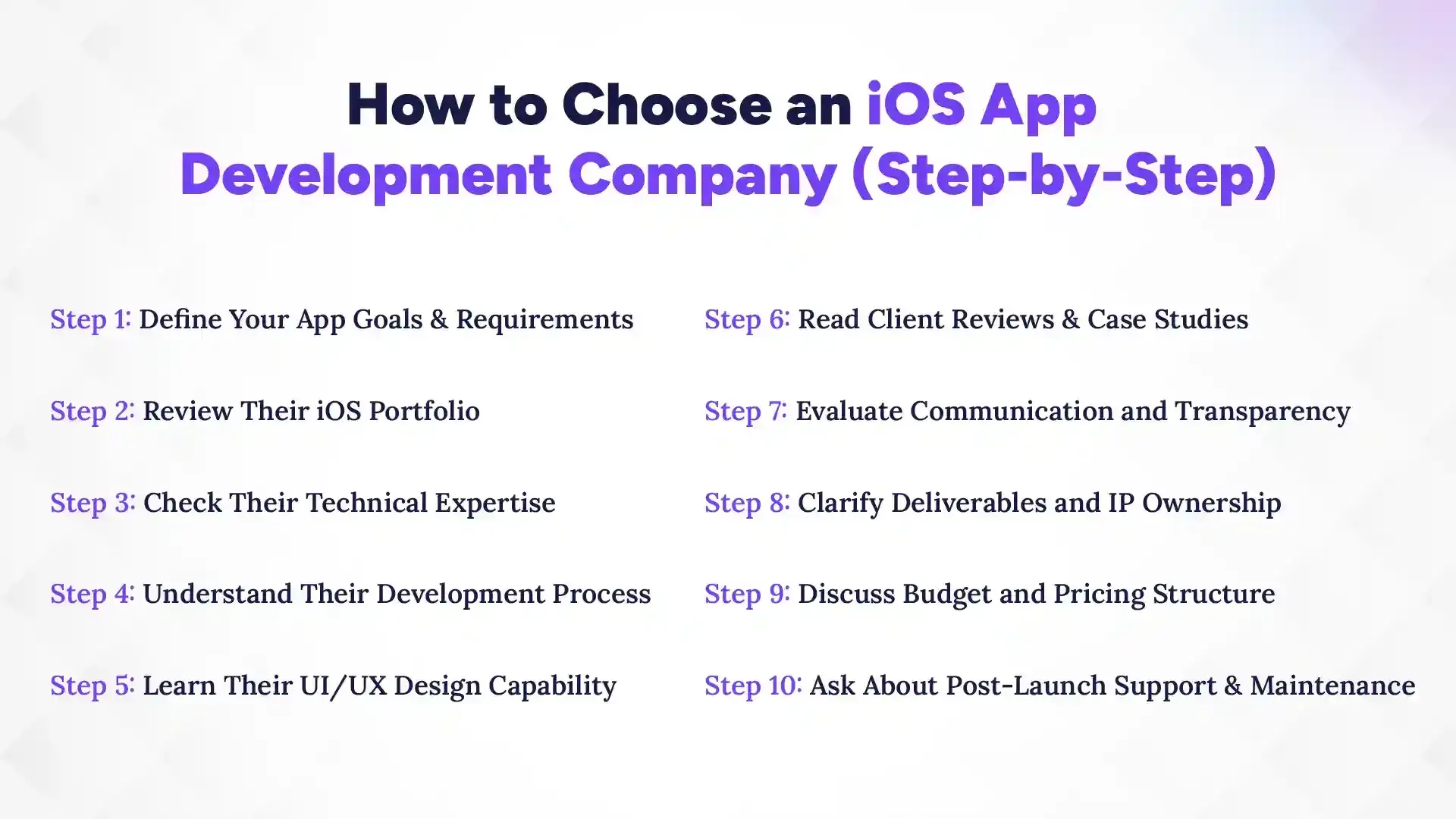
1. Define Your App Goals and Requirements First
Before you contact a single agency, get clear on what you are actually building and why. What problem does your app solve? Who are your target users? What are the core features you need at launch versus features that can wait for a later version? Do you need backend infrastructure, third-party integrations, or specific device capabilities like the camera, location services, or biometric authentication?
The clearer your requirements, the better your conversations with agencies will be. You will be able to evaluate their responses more accurately, get more meaningful cost estimates, and avoid scope creep once the project begins.
2. Review Their iOS Portfolio
A company's portfolio is the most honest indicator of what they are capable of. Look beyond the visuals. Open the apps they have built in the App Store and use them yourself. Pay attention to how they feel on your device. Are they fast? Do they follow iOS design conventions? Are they regularly updated? Do they have strong user ratings?
Look for variety in the types of apps they have built and evidence that they understand different industries and user types. Be cautious of portfolios that show only design mockups or screenshots without live App Store links. If the work is real and they are proud of it, they will point you directly to the download page.
3. Check Their Technical Expertise
Not all development companies have the same technical depth. For iOS development, you want a team that is proficient in Swift (Apple's primary programming language), experienced with Xcode and Apple's development tools, familiar with frameworks like UIKit and SwiftUI, and knowledgeable about Apple's privacy requirements, background processing rules, and performance optimization techniques.
Ask specifically about the technologies your app will require. If you need push notifications, in-app purchases, HealthKit integration, or ARKit features, confirm that the team has hands-on experience with those APIs. A company that gives you vague or evasive answers to technical questions is telling you something important about their actual capabilities.
4. Understand Their Development Process
A well-run development project follows a documented process. Ask any agency you are evaluating to walk you through how they manage a project from start to finish. You want to hear about how they gather requirements, how they handle design iterations, how they structure their development sprints, how they conduct testing, and how they manage the App Store submission process.
Agencies that use structured methodologies like Agile or iterative sprint-based development give you regular visibility into progress and opportunities to give feedback throughout the project rather than waiting until the very end. Avoid companies that are vague about their process or that promise a finished product with no structured checkpoints along the way.
5. Learn Their UI/UX Design Capability
Design is not decoration in an iOS app. It is the primary way your users experience your product. Apple's Human Interface Guidelines set clear expectations for how iOS apps should behave, and users notice immediately when an app violates those conventions. Good iOS design feels effortless because it anticipates what users expect and delivers exactly that.
Ask to see the agency's design work specifically for iOS, not just general web or product design. Ask how they approach user research and whether they conduct usability testing. The best companies treat design as a strategic function, not just an aesthetic one, and they can explain the reasoning behind their design decisions in terms of user behavior and business outcomes.
6. Read Client Reviews and Case Studies
What past clients say about an agency is more valuable than anything the agency says about itself. Look for reviews on independent platforms like Clutch, Google, or G2 where clients describe their actual experience working with the company. Pay attention to comments about communication, meeting deadlines, staying within budget, handling problems, and the quality of the finished product.
Case studies go a step further by showing you how the agency approached a specific challenge and what the measurable results were. A well-written case study tells you the client's problem, the agency's solution, and the outcome in concrete terms. If an agency can only show you design screenshots and has no client testimonials or case study examples, treat that as a warning sign.
7. Evaluate Communication and Transparency
You will be working closely with this team for months, and strong communication is what separates a smooth project from a stressful one. Pay attention from your very first interaction. Do they respond promptly? Do they ask thoughtful questions about your project? Do they explain technical concepts clearly without drowning you in jargon?
Ask how they will communicate with you during the project, how often you will receive progress updates, and who your primary point of contact will be. You want a company that keeps you informed, flags issues early rather than hiding them, and treats you as an active partner in the process rather than a client to be managed.
8. Clarify Deliverables and IP Ownership
Before you sign any agreement, make absolutely sure you understand what you will own when the project is complete. This means your source code, your design assets, your App Store account, your backend infrastructure, and any documentation the agency creates during the project. Some agencies retain ownership of the codebase or use proprietary frameworks that lock you into a long-term dependency on them for updates and maintenance. That is a risk you want to eliminate before the project starts.
Get a clear, written list of every deliverable included in the project scope. This protects both parties and prevents misunderstandings about what was and was not included in the original agreement.
9. Discuss Budget and Pricing Structure
Be direct about your budget early in the conversation. A professional agency will not be offended by budget discussions, and having that number on the table from the beginning helps both sides quickly determine whether there is a fit worth pursuing.
Understand how the agency structures its pricing. Fixed-price contracts give you cost certainty but can lead to scope disputes if requirements change. Time-and-materials models give you flexibility but require careful budget management. Ask what is included in the quoted price, how change requests are handled, and what would trigger additional costs. A transparent agency will answer these questions directly and without hesitation.
10. Ask About Post-Launch Support and Maintenance
An app launch is not the end of the project. It is the beginning of the product lifecycle. iOS updates from Apple come several times a year and often require compatibility updates in your app. User feedback after launch will surface bugs and feature requests. Your business will evolve, and the app will need to evolve with it.
Ask every agency you evaluate what happens after launch. Do they offer a maintenance retainer? How quickly do they respond to critical bugs? Do they provide monitoring and analytics support? A company that treats the launch as the finish line is not thinking about your long-term success. A true partner plans for what comes after.
Which Is the Best iOS App Development Company in the USA?
The Pace Infosys is one of the best iOS app development companies, located in Austin, Texas. They deliver user-focused design, modern interfaces, seamless user experiences, and conversion-driven digital solutions for businesses of all sizes. Their team combines creative design strategy with practical usability to build apps that look impressive and perform smoothly, making them a trusted choice for professional iOS development services.
Questions to Ask Before Hiring an iOS App Development Company
Before hiring an iOS app development company, always ask whether they have built apps in your industry before, what their development process looks like, how they handle App Store rejections, who owns the source code after delivery, and what post-launch support they offer.
1. Have you built apps in my industry before?
Industry experience is not mandatory, but it is a genuine advantage. An agency that has built healthcare apps, for example, will already understand HIPAA considerations, user sensitivity around health data, and the specific UX expectations of clinical or patient-facing products.
2. Can you show published App Store examples?
Portfolio screenshots are easy to produce. A live, downloadable app with real user reviews is much harder to fake. Ask for direct links to their published work and take the time to actually use the apps yourself.
3. What is your iOS development process?
A structured, documented process is a sign of a mature team that has delivered real projects under pressure. Listen for clear phases, defined milestones, testing procedures, and a transparent handover process.
4. How do you handle App Store rejections?
Every team that has submitted enough apps has encountered a rejection at some point. What matters is how they respond. A good team has a clear process for diagnosing the issue, addressing Apple's feedback, and resubmitting quickly.
5. Who owns the source code after delivery?
You should own everything. If the answer is anything other than a clear and unconditional confirmation that you receive full ownership of all code and assets, ask for clarification before proceeding.
6. How do you manage revisions and scope changes?
Scope changes happen on nearly every project. Ask how the agency handles them, how they are priced, and how they prevent scope creep from derailing the timeline and budget.
7. What does post-launch support look like?
Ask specifically about response times for critical bugs, iOS update compatibility, and what a typical maintenance engagement looks like in terms of cost and structure.
Red Flags to Avoid When Choosing an iOS App Development Company
Knowing what to look for is important. Knowing what to walk away from is equally important. These warning signs are worth taking seriously.
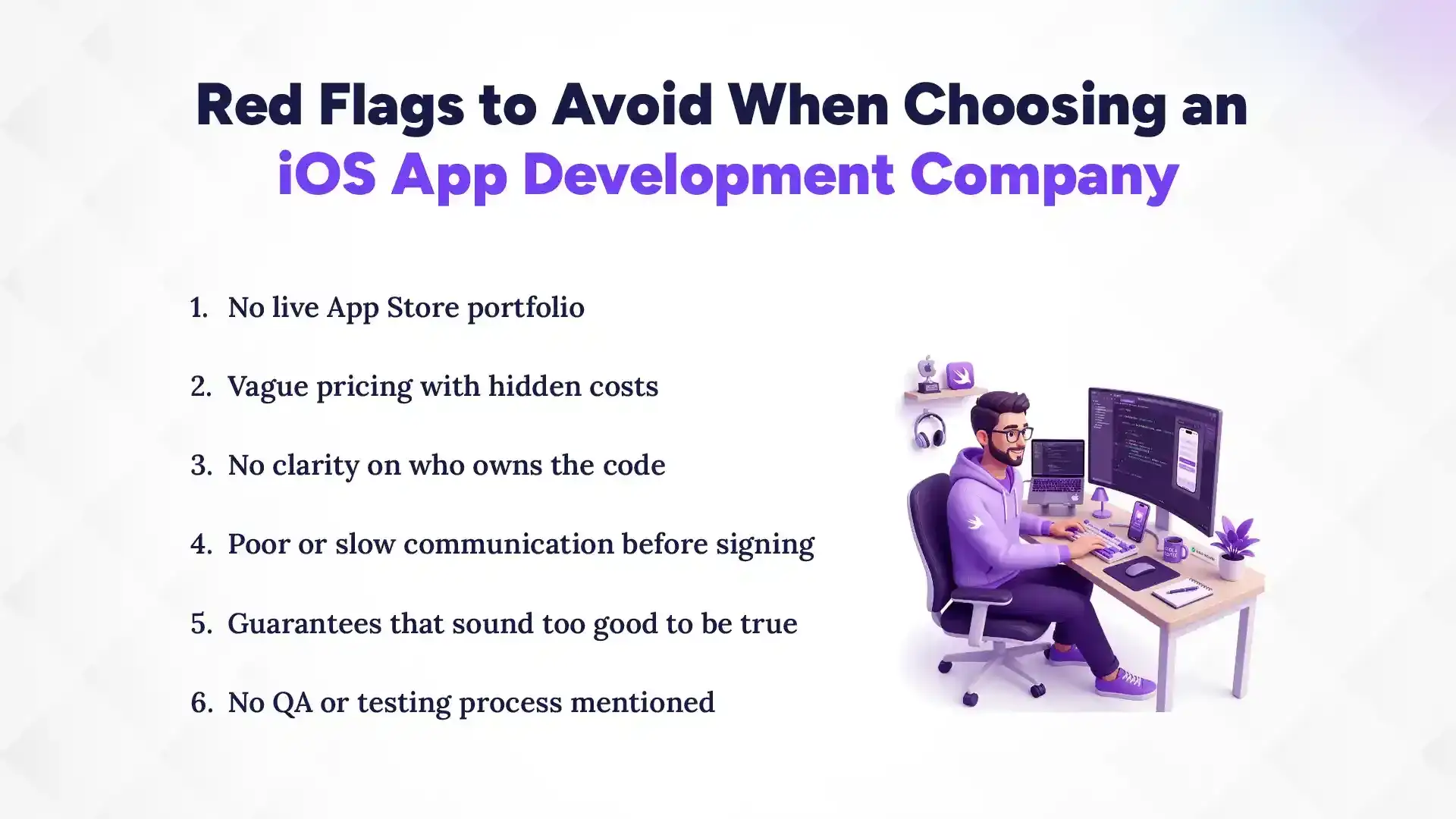
1. No live App Store portfolio.
If an agency cannot point you to live, downloadable apps they have shipped, they either lack real experience or are unwilling to stand behind their past work. Either way, that is not a company you want building your product.
2. Vague pricing with hidden costs.
A professional agency can give you a clear, itemized breakdown of what is included in their quote and what would trigger additional charges. If a company is evasive about costs or uses language like "it depends" without ever giving you a concrete range, expect budget surprises down the road.
3. No clarity on who owns the code.
Any agency that hesitates on this question, uses proprietary frameworks without disclosing it, or includes ambiguous language about intellectual property in their contracts is a serious risk. Walk away and find a company that gives you clean, unconditional ownership.
4. Poor or slow communication before signing.
If an agency takes days to respond to basic inquiries before you are even a client, that behavior will only get worse once you have paid them and they have less incentive to prioritize your project. Communication quality before the contract is a reliable preview of communication quality during it.
5. Guarantees that sound too good to be true.
No experienced iOS developer can guarantee App Store approval, a specific launch date without knowing the full scope, or dramatic ROI outcomes from the app alone. These claims are the marks of an agency that tells prospects what they want to hear rather than what they need to hear.
6. No QA or testing process mentioned.
Testing is not optional in iOS development. An app that has not been tested on multiple devices, across different iOS versions, and under real-world usage conditions will have bugs in production. Any company that does not have a clear, dedicated testing phase in their process is cutting corners that your users will ultimately pay for.
How Much Does iOS App Development Cost?
iOS app development in the US typically costs between $10,000 and $30,000 for a basic MVP, $30,000 to $100,000 for a mid-level app, and $100,000 or more for an enterprise-level solution, depending on features, team seniority, and project complexity.
| Package Level | Estimated Price Range | Typical Scope |
|---|---|---|
| Basic / MVP | $10,000 – $30,000 | Simple app, core features, minimal integrations |
| Mid-Level | $30,000 – $100,000 | Custom features, backend integration, multiple user roles |
| Enterprise | $100,000+ | Complex systems, advanced integrations, ongoing development |
An MVP (Minimum Viable Product) app at the lower end of the range typically covers one primary use case with a clean UI and basic functionality. It is enough to test your concept with real users before committing to a full build.
A mid-level project adds more sophisticated features, custom backend infrastructure, third-party API integrations, and more polished design. Enterprise-level development covers the full spectrum of complex product needs, from multi-platform architecture to advanced security and compliance requirements, and often includes ongoing development beyond the initial launch.
Keep in mind that the lowest price is rarely the lowest risk. Agencies that quote significantly below market rate are almost always cutting costs somewhere, whether in the quality of their developers, the depth of their testing, or the amount of time they spend understanding your actual requirements. View app development as a long-term business investment, not a one-time transaction, and budget accordingly.
Tips for Getting the Best Results From Your iOS App Development Company
Choosing the right company is only half of the equation. How you work with that company during the project has a major impact on the quality of the final product. Here is how to be the kind of client that gets exceptional results.
1. Prepare a Clear Brief and Wireframe Ideas
The more clearly you can communicate your vision before development begins, the less time and money get spent on misunderstandings and rework. Even rough hand-drawn sketches of your key screens are more useful than a verbal description alone. A clear brief reduces ambiguity and gives the team something concrete to react to from day one.
2. Stay Involved During Development Sprints
Agile development works best when the client is an active participant, not a passive observer waiting for the finished product. Review work at the end of each sprint, give timely feedback, and flag concerns early rather than waiting until the final weeks of the project.
3. Give Specific and Timely Feedback
Vague feedback like "this does not feel right" or "make it more modern" costs everyone time. Specific feedback like "the button color does not match our brand guidelines" or "this navigation pattern feels unfamiliar for iOS users" gives the team something concrete to act on. The faster you respond to design and development questions, the faster the project moves.
4. Test on Real Devices Before Launch
Simulators catch some problems but not all of them. Before your app goes to the App Store, test it on actual iPhones and iPads across different iOS versions. Recruit a small group of real users who match your target audience and watch how they interact with the app. Real-world testing reveals the issues that controlled testing misses.
5. Plan for App Store Optimization from Day One
Your app's discoverability in the App Store depends on your title, subtitle, keywords, screenshots, and ratings. These are not afterthoughts to address after launch. Work with your development company to plan your App Store presence as part of the overall project so you launch with the strongest possible visibility from the first day.
Conclusion
Choosing the right iOS app development company is a decision that will shape the trajectory of your digital product for years to come. The right partner brings technical depth, a structured process, honest communication, and a genuine commitment to your success beyond the launch date. The wrong partner costs you time, money, and user trust that can take a long time to rebuild.
Take the time to review portfolios critically, ask the hard questions, check client reviews, and evaluate communication quality before you sign anything. Understand what you are paying for, confirm that you will own everything when the project is complete, and find a company whose process gives you confidence that they have delivered real projects under real pressure.
Your iOS app is an investment in your business. Build it right the first time with a team that understands what that means.
Ready to find the right iOS app development partner? Start your conversations today with a clear brief, a defined budget, and the confidence that comes from knowing exactly what to look for.