Search is no longer just about ranking on Google; it is evolving into AI-driven answers and generative results. Businesses now compete not only for clicks but also for visibility in answer engines and AI platforms. This shift has made optimization strategies more advanced and important than ever. Understanding these changes is essential for staying competitive in the digital space.
In this blog on AEO vs. GEO, we will explore the key differences between Answer Engine Optimization and Generative Engine Optimization. You will learn what AEO and GEO mean, how they work, and why they are important for modern SEO, including a clear understanding of what is seo in the broader digital marketing landscape. We will also cover optimization strategies, benefits, and their role in AI-powered search. By the end, you will clearly understand how both approaches shape the future of digital marketing.
What is AEO (Answer Engine Optimization)?
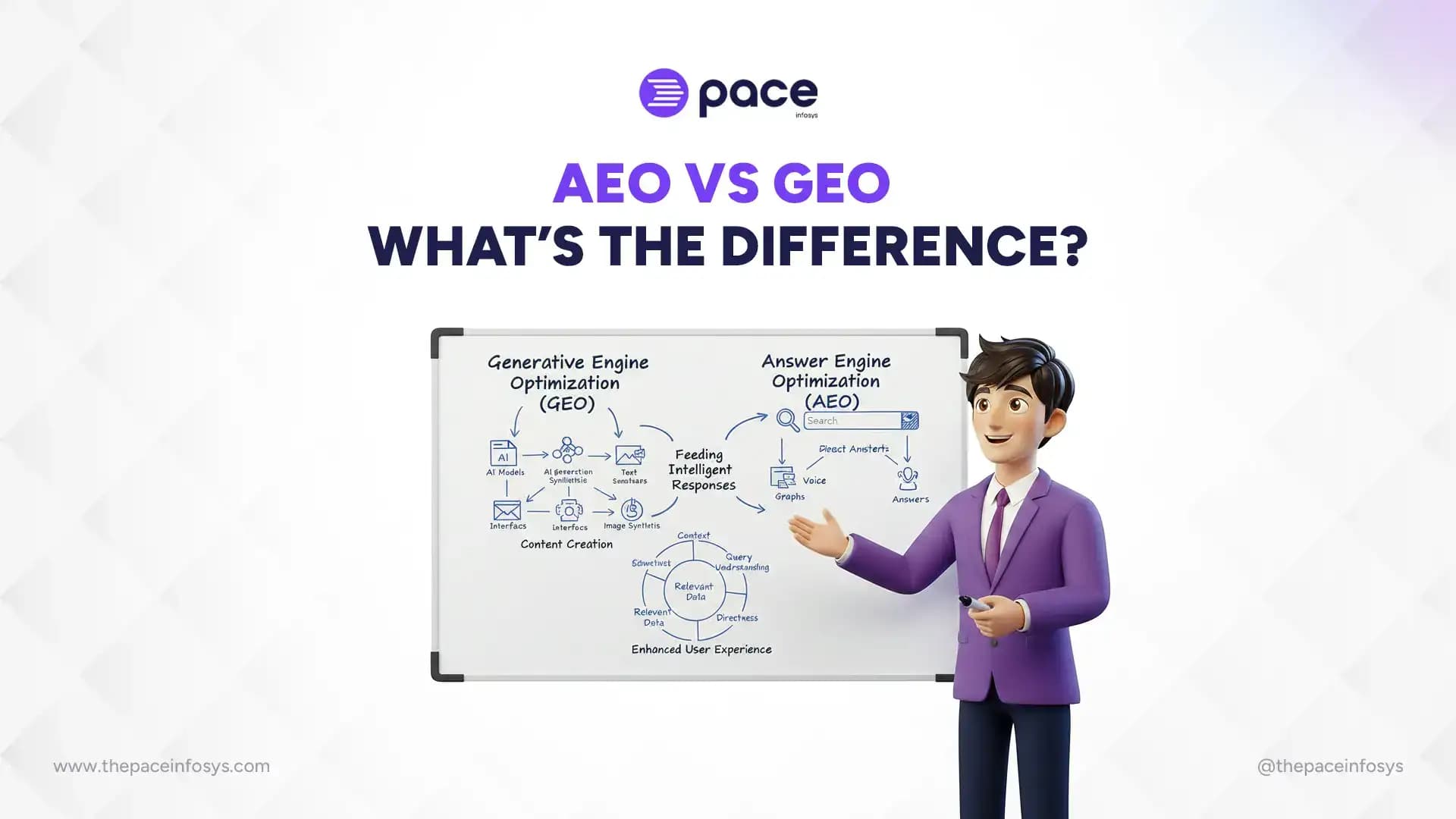
AEO (Answer Engine Optimization) is the process of optimizing content to directly answer user questions on search engines and voice assistants. It focuses on providing clear, concise, and structured answers that can appear in featured snippets and “People Also Ask” sections. AEO helps content get selected by Google and voice search tools for instant responses. It is mainly used to improve visibility in question-based searches and enhance user experience. Overall, it ensures users get quick and accurate information without needing to click multiple results.
What is GEO (Generative Engine Optimization)?
GEO (Generative Engine Optimization) is the process of optimizing content so it can be used and referenced by AI-powered tools like ChatGPT and other generative search engines. It focuses on creating high-quality, context-rich, and well-structured content that AI systems can easily understand and summarize. GEO ensures that content is included in AI-generated answers instead of just traditional search results. It emphasizes topical depth, clarity, and relevance for better AI interpretation. Overall, GEO helps brands gain visibility in modern AI-driven search experiences.
AEO vs GEO: What's the Difference?
AEO and GEO are both modern search optimization strategies, but they target different types of search experiences. AEO is focused on traditional search engines and voice assistants, while GEO is designed for AI-powered and generative platforms. Together, they help improve visibility across both search and AI ecosystems.
Feature
AEO (Answer Engine Optimization)
GEO (Generative Engine Optimization)
Definition
Focused on providing direct answers to specific queries
Focused on making content usable in AI summaries
Main Focus
Quick, direct, and concise answers
Context-rich, detailed, and informative content
Primary Platforms
Google Snippets, PAA, Voice Assistants
ChatGPT, Gemini, Perplexity AI
Content Style
Short-form, structured FAQs, bullet points
Long-form, semantically rich, topic-dense
Goal
Rank in featured snippets (Zero-click)
Be included in AI-generated responses
User Intent
Question-based ("what is," "how to")
Conversational and contextual prompts
Optimization Strategy
Schema markup, FAQs, headings
Topical authority, semantic depth
Ranking Outcome
Appears in zero-click results
Appears in AI summaries & conversational responses
Requirement
Precise, concise, extractable answers
Comprehensive, well-structured content
Role in SEO
Enhances traditional search visibility
Enhances presence in AI ecosystems
How to Optimize for AEO (Answer Engine Optimization)?
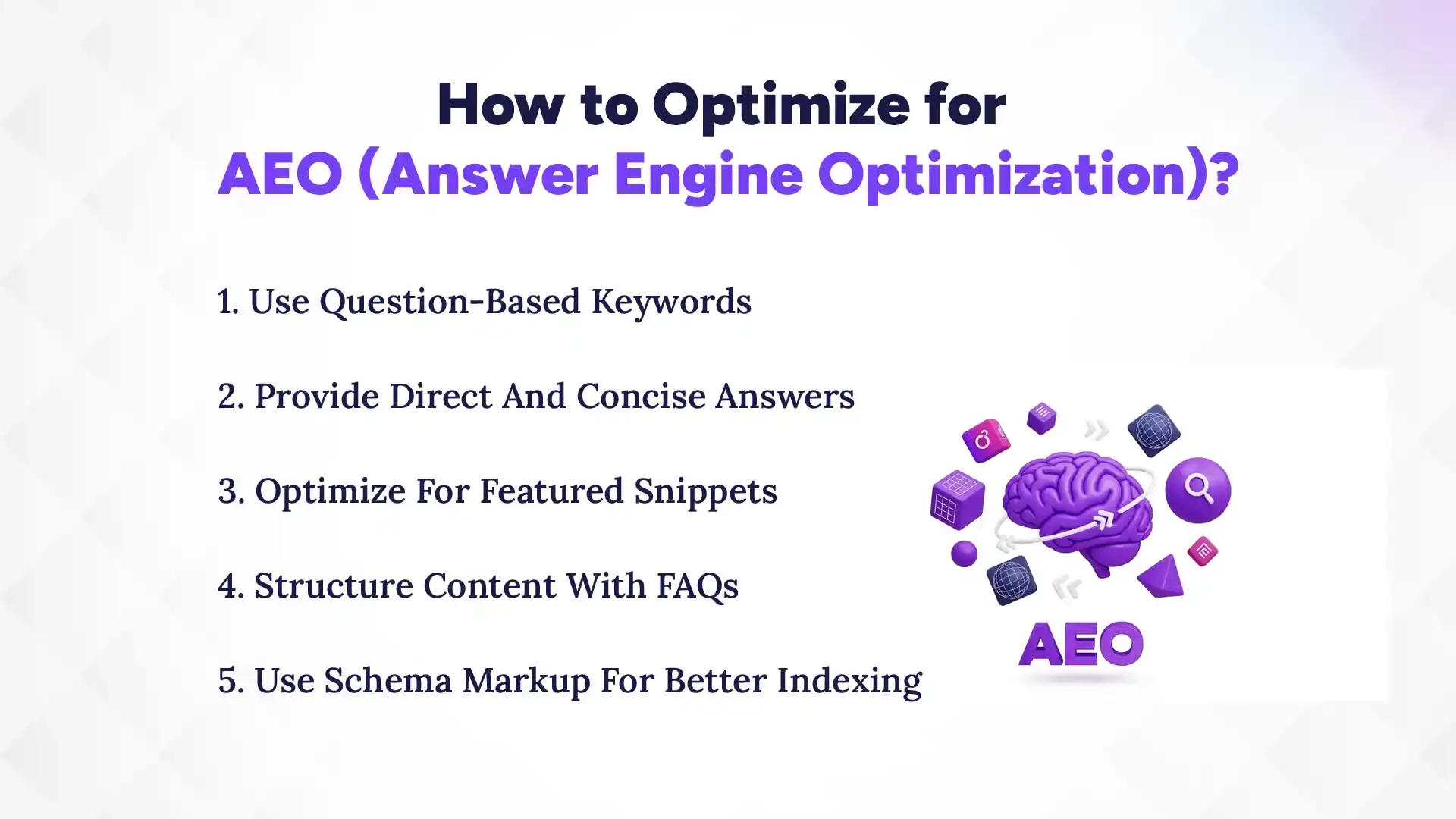
To optimize for AEO, you need to structure your content in a way that directly answers user questions in a clear and concise format. The goal is to help search engines quickly extract and display your content in featured snippets, voice search, and answer boxes. AEO focuses on improving visibility for question-based searches. It requires a mix of content structuring, keyword targeting, and technical SEO elements. Overall, it enhances your chances of appearing in instant search results.
1. Use Question-Based Keywords
Using question-based keywords helps target users who are actively searching for answers. These include queries like “what is,” “how to,” and “why does.” Such keywords align with search intent and improve visibility in answer-based results. They make content more relevant to user queries. Question keywords increase snippet chances. They improve targeting accuracy. They also boost organic reach. They help match real user intent.
2. Provide Direct And Concise Answers
Search engines prefer clear and short answers for AEO optimization. Content should directly address the question in the first few lines. Avoid unnecessary fluff and focus on clarity. This helps in getting featured in instant answer boxes. Concise answers improve readability. They increase snippet selection chances. They also enhance user satisfaction. They make content easier to extract.
3. Optimize For Featured Snippets
Featured snippets are highlighted answers shown at the top of Google results. To optimize for them, use structured formatting like bullet points, tables, and short paragraphs. Clearly answer the main question within 40-60 words when possible. This increases the chance of ranking in position zero. Snippet optimization is a key part of on-page seo and boosts visibility. It drives more organic traffic. It also improves brand exposure. It increases click-through rates.
4. Structure Content With FAQs
FAQ sections help organize content into question-answer format. This makes it easier for search engines to understand and extract information. FAQs also match natural user search behavior. They improve chances of appearing in “People Also Ask” sections. FAQs enhance AEO performance. They improve content structure. They also increase engagement. They support better indexing.
5. Use Schema Markup For Better Indexing
Schema markup helps search engines understand content context better. It improves indexing and increases chances of rich results. FAQ schema and How-To schema are especially useful for AEO. It makes content more structured and machine-readable. Schema is an important part of technical seo and boosts search visibility. It improves ranking potential. It also supports voice search optimization. It enhances SERP appearance.
How to Optimize for GEO (Generative Engine Optimization)?
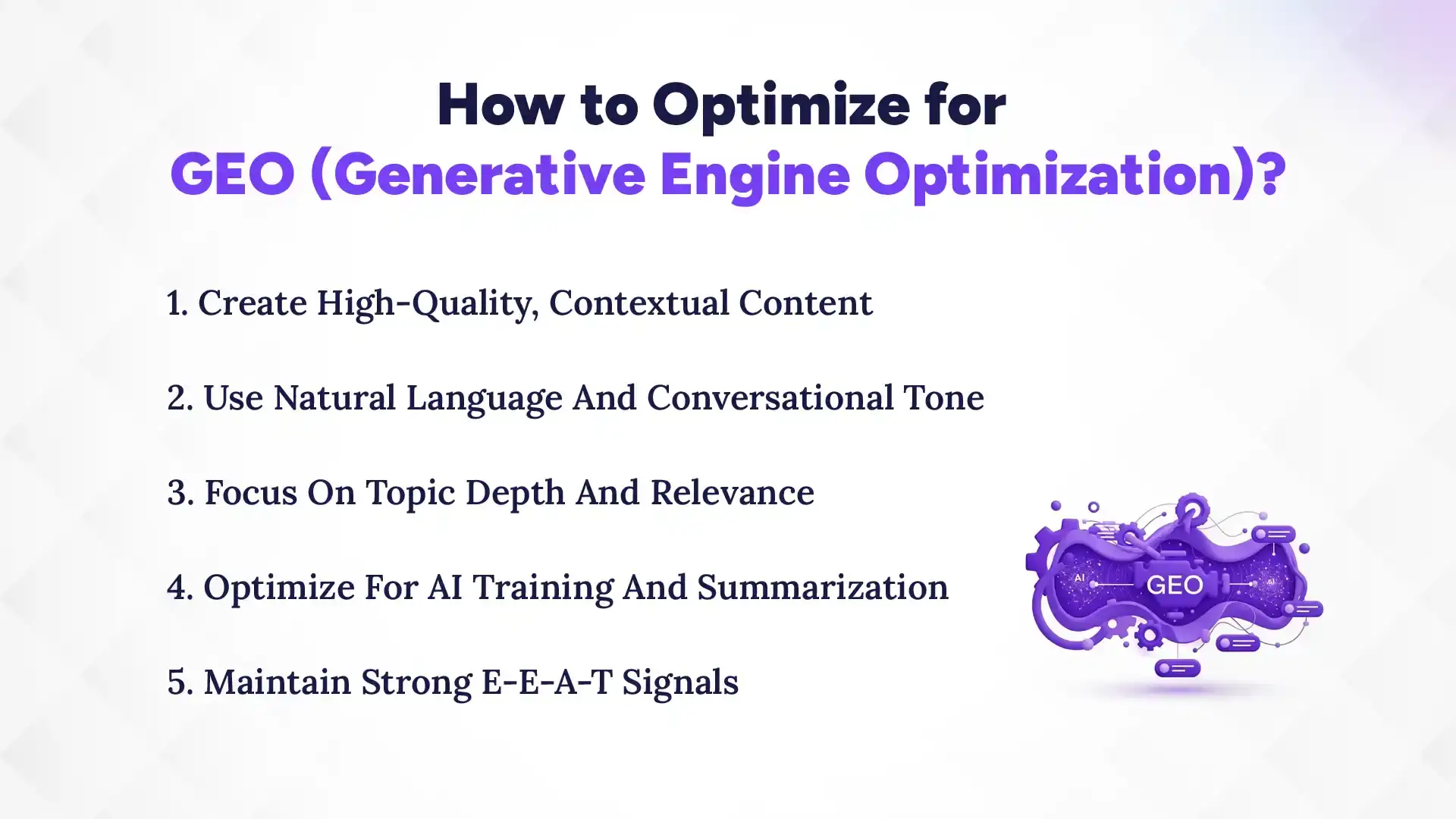
To optimize for GEO, you need to create high-quality, context-rich content that AI systems can easily understand, interpret, and use in generated responses. The focus is on writing in a natural, conversational style while maintaining depth, relevance, and authority. GEO ensures your content is included in AI-generated answers across tools like ChatGPT and Gemini. It also requires strong credibility signals and well-structured information. Overall, it improves visibility in AI-driven search ecosystems.
1. Create High-Quality, Contextual Content
High-quality content is the foundation of GEO optimization. It should provide complete and meaningful information that fully answers user intent. Context helps AI understand the topic more accurately. Content should be well-researched and structured logically. Better quality increases AI inclusion chances. It improves content reliability. It also strengthens topical authority. It ensures long-term visibility.
2. Use Natural Language And Conversational Tone
GEO content should sound natural and human-like. Avoid overly robotic or keyword-heavy writing. A conversational tone helps AI models better interpret meaning. It also improves readability for users. Natural language improves AI understanding. It increases content usability. It also enhances engagement. It makes content more relatable.
3. Focus On Topic Depth And Relevance
Deep and relevant content performs better in GEO. Cover the topic comprehensively with supporting details and examples. Avoid shallow or incomplete explanations. AI prefers content that fully explains concepts. Depth improves content authority. It increases chances of AI citation. It also boosts trustworthiness. It enhances topic coverage.
4. Optimize For AI Training And Summarization
Content should be structured in a way that AI can easily summarize. Use clear headings, logical flow, and simple explanations. This helps generative engines extract accurate information. Well-structured content improves AI usability. Clear structure improves summarization quality. It enhances AI response accuracy. It also increases visibility. It supports better content extraction.
5. Maintain Strong E-E-A-T Signals
E-E-A-T stands for Experience, Expertise, Authoritativeness, and Trustworthiness. Strong E-E-A-T signals improve content credibility. Include accurate data, expert insights, and reliable sources. This helps AI and search engines trust your content. E-E-A-T builds authority. It improves ranking potential. It also strengthens long-term visibility. It enhances content trust value.
Benefits of AEO and GEO in Digital Marketing
AEO and GEO play a major role in improving how brands appear in both traditional search engines and AI-powered platforms. These strategies help businesses increase visibility, attract more targeted users, and stay relevant in the evolving digital landscape. By optimizing for both answer engines and generative engines, companies can maximize their online presence. Overall, AEO and GEO together create a stronger, more future-ready SEO strategy.
1. Increased Visibility In Search And AI Results
AEO and GEO help content appear in Google search results as well as AI-generated responses. This increases the chances of being discovered by users across multiple platforms. AEO focuses on featured snippets, while GEO ensures inclusion in AI tools. Together, they expand digital reach significantly. Higher visibility improves brand exposure. It helps attract more potential customers. It also strengthens online presence. It ensures wider content distribution. It increases discoverability across channels.
2. Improved Organic Traffic And Engagement
Both AEO and GEO strategies drive more organic traffic by targeting user intent effectively. When content ranks in snippets or AI answers, it naturally attracts more clicks and views. This leads to better engagement rates and longer user interaction. Content becomes more discoverable and useful. Organic traffic increases without paid ads. It improves audience quality. It also boosts engagement metrics. It supports long-term growth. It increases user interaction time.
3. Higher Chances Of Featured Snippets And AI Mentions
AEO increases the likelihood of appearing in Google featured snippets, while GEO improves chances of being cited in AI-generated answers. These positions are highly valuable for visibility and credibility. Being featured builds instant authority in your niche. It also increases trust among users. Top placements improve click-through rates. They enhance brand recognition. They also drive consistent traffic. They strengthen SEO performance. They boost authority signals.
4. Stronger Brand Authority And Trust Building
When your content consistently appears in search results and AI responses, it builds strong brand authority. Users start recognizing your website as a reliable source of information. This improves trust and credibility over time. Both AEO and GEO support long-term brand positioning. Authority increases customer confidence. It improves brand reputation. It also enhances loyalty. It strengthens market presence. It supports brand recall.
5. Better User Experience And Content Reach
AEO and GEO focus on delivering clear, relevant, and helpful content to users. This improves overall user experience by providing quick and accurate answers. Well-structured content reaches a wider audience across platforms. It also reduces bounce rates and increases satisfaction. Better UX leads to higher retention. It improves content accessibility. It also increases sharing potential. It enhances overall digital performance. It improves user satisfaction levels.
Future of Search: AEO and GEO
Future of search is rapidly shifting from traditional keyword-based SEO to AI-driven and answer-focused optimization. Is generative engine optimization future of digital marketing, becoming essential as users increasingly rely on voice assistants and generative AI tools for information? Search engines are evolving to deliver direct answers instead of just listing links. This transformation is reshaping how content is created, optimized, and delivered online.
1. Rise Of AI-Powered Search Engines
AI-powered search engines are changing how users find information online. Platforms like ChatGPT and Gemini provide direct, conversational answers. This reduces dependency on traditional search result pages. Content must now be optimized for AI understanding. AI search increases answer-based visibility. It improves user experience. It also changes SEO strategies. It makes optimization more intelligent.
2. Growth Of Voice Search Optimization
Voice search is becoming more popular with smart devices and assistants. Users prefer speaking queries instead of typing. This increases the importance of natural, question-based content. AEO plays a key role in voice search results. Voice search improves accessibility. It enhances real-time responses. It also boosts mobile search usage. It changes keyword strategies.
3. Expansion Of Generative AI Platforms
Generative AI platforms are expanding across industries and search experiences. These tools generate summarized answers from multiple sources. GEO ensures content is included in these AI responses. High-quality and contextual content becomes more important. Generative AI improves content discovery. It enhances information delivery. It also reshapes SEO priorities. It increases AI-driven visibility.
4. Shift From Keywords To User Intent
Search is moving away from exact keywords toward understanding user intent. AI systems focus more on meaning and context. This makes content depth and clarity more important. AEO and GEO both support intent-based optimization. Intent improves search accuracy. It enhances content relevance. It also boosts engagement. It strengthens search performance.
5. Importance Of Structured And Contextual Content
Structured content helps AI systems understand and process information easily. Clear headings, FAQs, and schema markup are becoming essential. GEO especially relies on well-organized contextual data. This improves chances of being selected in AI responses. Structure improves AI readability. It increases indexing efficiency. It also boosts content usability. It supports better ranking outcomes.
Conclusion
AEO and GEO are transforming the way search engines and AI platforms understand and deliver content. While AEO focuses on providing direct answers in traditional search results, GEO ensures visibility in AI-generated responses across modern tools. Together, they represent the future of search optimization, where user intent, context, and clarity matter more than just keywords.
In today’s digital landscape, businesses must adapt to both AEO and GEO strategies to stay competitive. These approaches not only improve visibility but also enhance trust, engagement, and brand authority. As search continues to evolve with AI and generative technologies, optimizing for both will be essential for long-term success. Brands like The Pace Infosys that start implementing these strategies early will gain a strong advantage in the future of SEO and digital marketing.
FAQs
What is the difference between AEO and GEO?
+
AEO focuses on direct answers in search engines, GEO targets AI responses. Both improve visibility but work on different search platforms.
Why is AEO important in SEO?
+
AEO helps websites appear in featured snippets and voice search results. It improves visibility for question-based user queries.
Why is GEO important for digital marketing?
+
GEO ensures content appears in AI-generated answers and summaries. It increases visibility in tools like ChatGPT and Gemini.
Can AEO and GEO work together?
+
Yes, both strategies complement each other in modern SEO. Together they improve search and AI visibility significantly.
Which is better AEO or GEO?
+
Neither is better alone; both serve different optimization purposes. Using both provides maximum digital visibility and reach.
How does AEO improve website traffic?
+
AEO improves click-through rates through featured snippets and quick answers. It attracts users searching for direct solutions.
How does GEO affect SEO strategy?
+
GEO shifts SEO focus toward AI-readable and contextual content. It enhances chances of being used in AI responses.
Is GEO the future of SEO?
+
Yes, GEO is becoming essential with growing AI-driven search platforms. It will play a major role in future SEO evolution.
Ready to get started?
Book a 30-minute consultation call, and let's talk about your goals.